
TEST ITEM FILE
FOR
ENVIRONMENT: SCIENCE BEHIND THE STORIES
SECOND CANADIAN EDITION
Textbook Authors
Jay H. Withgott, Cornell University
Scott R. Brennan, Western Washington University
Barbara Murck, University of Toronto Mississauga
Test Item File
Piotr Trela, Memorial University
Toronto
Chapter 1 An Introduction to Environmental Science
1.1 Graph and Figure Interpretation Questions
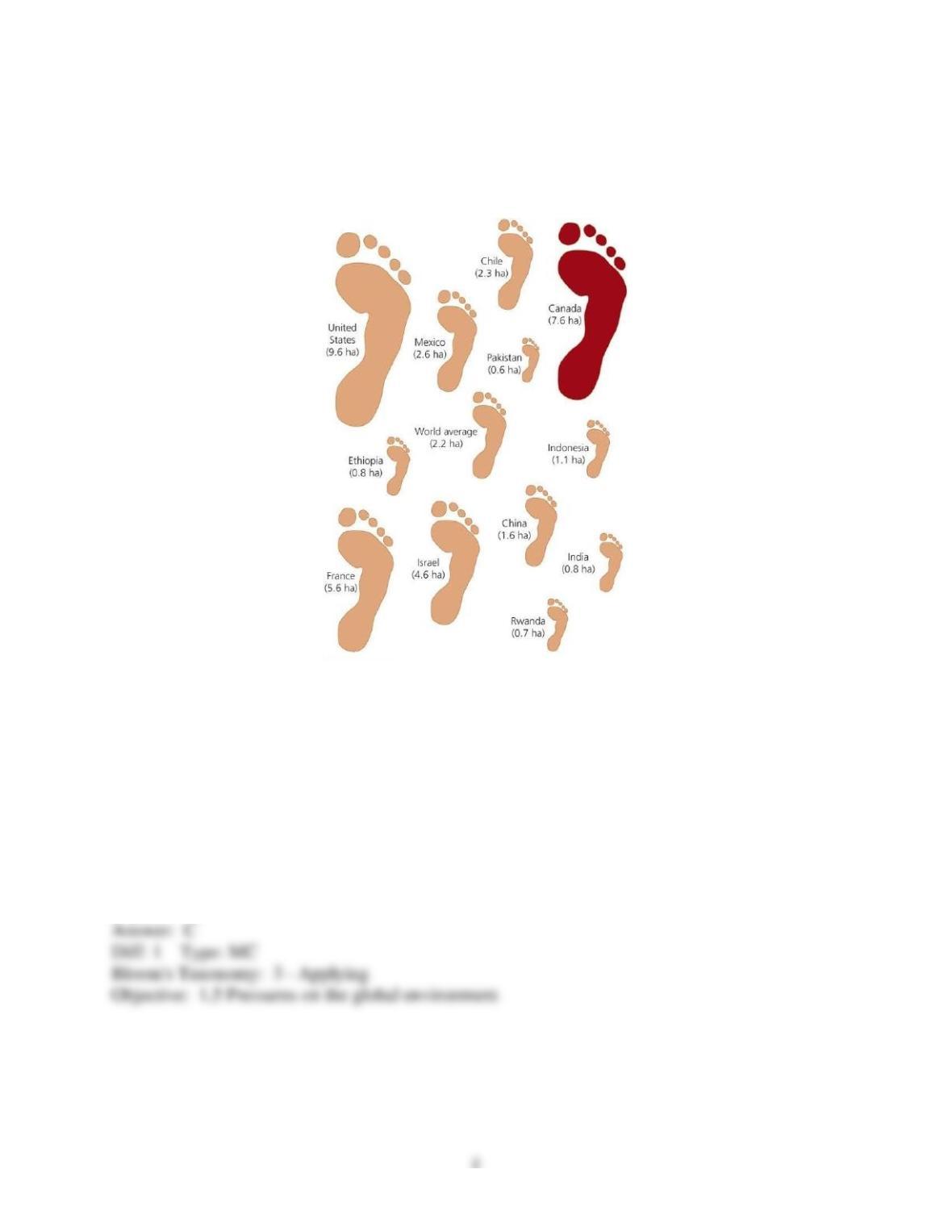
Figure 1.1
Use Figure 1.1 to answer the following questions.
1) Refer to Figure 1.1. One citizen of Canada uses as many resources as ________ citizens of
China.
A) about 3
B) about 7
C) about 5
D) about 9
E) to answer one needs to know how many times the population of China is larger than the
population of Canada

2) Refer to Figure 1.1. Currently, humanity is depleting renewable resources 30% faster than
they can replenish. If everyone on the planet had an ecological footprint of the average citizen of
Canada, then humans would ________.
A) be depleting resources 60% faster than they are replaced
B) be able to provide for everyone without difficulty, using the other 70% of the resources
C) need 4.5 Earths to support everyone
D) need 2.5 additional Earths to support everyone
E) need 30% more resources to support everyone
3) Refer to Figure 1.1. At the current rate, the world on average uses up our resources 30%
faster than they can replenish. The Canadian average ecological footprint is approximately
________ times larger than the average world footprint.
A) 3
B) 2.5
C) 3.5
D) 4
E) 2
1.2 Matching Questions
Match the following.
A) ecology
B) natural sciences
C) hypothesis
D) qualitative data
E) dependent variable
F) environmental studies
G) quantitative data
H) prediction
I) independent variable
J) correlation
K) experimental data
L) probability
1) A scientific field of study
2) Information expressed with numbers
3) The variable that is manipulated
4) Expectations of experimental outcome
5) Numerical expression of the likelihood that a conclusion is true
6) Social studies dealing with environment are part of
1.3 Short Answer Questions
1) Differentiate between renewable and nonrenewable natural resources. Give examples of each.
2) How does the lesson of Easter Island apply to the modern world?
3) A town has uncovered an environmental problem that involves the local landfill leaching
chemicals into the groundwater that is used by a neighbouring housing development. How will
the interdisciplinary nature of environmental science help solve this problem?
4) What is the difference between correlation and causation in scientific experimentation?
5) Give one example of a scientific “paradigm shift.”
6) If in a test of the impact of added fertilizers on the biological productivity of lakes, we add
fertilizer to one lake and not to the other, then the second lake serves in this experiment as a
________.
7) Data not expressible in numbers are called ________.
8) The process of science, called the ________, is used to develop new information in scientific
fields.
9) The sum total of our surroundings, affected by living and nonliving things, is called
________.

10) In response to agricultural problems, scientists devised and promoted ________. (Name one
solution.)
11) A(n) ________ is an activity designed to test the validity of a hypothesis; it involves
manipulating ________, which are conditions that can change.
12) Before 1939 malaria was still a disease that people in southern Ontario could get and die
from. In 1939, DDT became available; by 1950, it had completely eliminated the mosquito that
carries malaria. People then learned about DDT‘s health hazards and, by the 1970s, DDT was
banned. The mosquito that carries malaria is now back. If malaria comes back, people may want
to spray again with DDT because they know it is less dangerous than malaria. This is an example
of how human perception can ________.
13) Garrett Hardin’s concept of ________ argues that resources open to unregulated exploitation
inevitably become overused.
1.4 Multiple-Choice Questions
1) A paradigm ________.
A) is a group of several hypotheses that can be tested together
B) is a dominant view in science
C) can only come from qualitative data
D) is synonymous with the scientific method
E) can only come from quantitative data

2) Advances in agriculture ________.
A) did not increase the amount of food per person from a global perspective
B) do not include chemical fertilizers
C) are viewed as one of humanity’s greatest failures
D) have resulted in increased death rates
E) have resulted in alteration and destruction of natural systems
3) The scientific process and knowledge is based on ________.
A) observation
B) testing hypotheses that are built on observations
C) the fact that hypotheses can be proven
D) just quantitative data
E) educated guesses
4) Scientific inquiry is based on ________.
A) an incremental approach to knowledge
B) facts that can be positively proven by testing hypotheses
C) the production of technological advances
D) designing experiments that have never been done before
E) changing paradigms
5) A hypothesis is ________.
A) a prediction about something that is uncertain
B) a testable proposition that explains a phenomenon or answers a question
C) a technique that is used to examine environmental conditions
D) the design of an experiment that can be used for the process of science
E) a proven scientific fact

6) Sachiko and Fred are having a discussion about the scientific method. Sachiko makes the
comment that every time she sees people carrying open umbrellas, she also sees several small car
accidents. This is a(n) ________.
A) hypothesis
B) theory about umbrellas
C) theory about car accidents
D) scientific study
E) observation
7) An experiment ________.
A) is an activity designed to test the validity of a hypothesis
B) often involves manipulating as many variables as possible
C) does not need to be repeated
D) involves only the collection of qualitative data
E) is designed to prove a scientific hypothesis
8) Ecology is ________.
A) concerned only with solving environmental problems
B) the study of organisms and their interactions with each other and with the environment
C) a subfield of environmentalism
D) not a crucial discipline to environmental science
E) the study of animal behaviour
9) According to Edward O. Wilson, biodiversity ________.
A) cannot be conserved
B) is a nonrenewable resource
C) can recover quickly
D) can recover quickly with human intervention
E) is a resource that can be used endlessly for human benefit

10) In general, natural resources ________.
A) should not be used
B) should be conserved
C) belong only to those on whose property they exist
D) are evenly divided among all countries
E) should be used by everyone equally
11) Solutions to environmental problems ________.
A) can be implemented only by scientists
B) must be sustainable
C) must be on a local scale
D) must be left to industry
E) are best discussed in the political arena
12) Ruben has a new puppy and wants to feed it the best possible food. He decides on an
experiment where he will feed it the very best canned food plus a dietary supplement of vitamins
recommended by a veterinarian. Which of the following best describes Ruben’s project?
A) This is an example of a good controlled experiment.
B) Ruben needs to take measurements of the puppy’s weight and height at least once a week for
it to be a good experiment.
C) Ruben needs to control for the amount of exercise, water, and care that the puppy gets each
week, so that they are equal from week to week.
D) Ruben needs to feed his mother’s 6-year-old chocolate Shar-Pei a standard diet so he can
compare his puppy with a control dog.
E) This is not an experiment—there are no controls or replicates.

13) The process by which several researchers review another researcher’s manuscript prior to
publication to ensure research quality is referred to as ________.
A) hypothesis testing
B) investigative inquiry
C) peer review
D) quality control
E) critical analysis
14) Rocks, wind, water, temperature and solar radiation are all examples of ________.
A) non-renewable resources
B) abiotic environmental factors
C) biotic environmental factors
D) renewable resources
E) biodegradable materials
15) “T” in the IPAT formula stands for ________.
A) technology
B) time
C) transition
D) transpiration
E) telecommuting
16) “A” in the IPAT formula stands for ________.
A) affluence
B) anthropogenic
C) abiotic
D) agriculture
E) anticipatory