General Chemistry: Atoms First, 2e (McMurry and Fay)
Chapter 0 Chemical Tools: Experimentation and Measurement
0.1 Multiple Choice Questions
1) A consistent explanation of known observations is called
A) an experiment.
B) a hypothesis.
C) a prediction.
D) a theory.
2) An interpretation of the results of many tests is called
A) an experiment.
B) a hypothesis.
C) a prediction.
D) a theory.
3) The fundamental SI unit of mass is the
A) centigram.
B) gram.
C) kilogram.
D) milligram.
4) Which of the following is a fundamental SI Unit?
A) centimeter
B) kilogram
C) microsecond
D) milliliter
5) All of the following are fundamental SI units except the
A) gram.
B) Kelvin.
C) meter.
D) second.
6) What symbol is used to express the factor, 10-6?
A) M
B) m
C) μ
D) n
7) What symbol is used to represent the factor 10-3?
A) M
B) m
C) μ
D) n
8) What symbol is used to represent the factor 10-9?
A) M
B) m
C) μ
D) n
9) The factor 0.01 corresponds to which prefix?
A) deka
B) deci
C) centi
D) milli
10) The factor 10-2 corresponds to which prefix?
A) deka
B) deci
C) centi
D) milli
11) Convert 5.100 × 10⁻³ to ordinary notation.
A) 0.0005100
B) 0.005100
C) 510.0
D) 5100
12) Convert 0.003002 to standard scientific notation.
A) 3.002 × 10⁻³
B) 3002 × 10-6
C) 3.002 × 10³
D) 3002 × 106
13) A sailor circumnavigated the earth and covered 4,264,000 meters. Express this number in
standard scientific notation.
A) 4.264 × 10⁻⁷ m
B) 4.264 × 10⁻⁶ m
C) 4.264 × 10⁶ m
D) 4.264 × 10⁷ m
4
14) Without using a calculator, solve the following problem:
)10 × (1
)]10 × (1 × )10 × [(1
10–
225
A) 1 × 10⁻⁶
B) 1 × 10⁴
C) 1 × 1024
D) 1 × 1034
15) Without using a calculator, solve the following problem:
)10 × (1
)]10 × (1 × )10 × [(1
3
225–
A) 1 × 100
B) 1 × 10⁻³
C) 1 × 10⁻⁹
D) 1 × 10-12
16) An astronaut uses a laboratory balance and weighs an object on earth and again on the moon.
Which statement below about the weight and mass of the object is true?
A) The mass and weight will be identical on the earth and the moon.
B) The mass will be the same on earth and moon but the weight will be less on the moon.
C) The weight will be the same on earth and moon but the mass will be less on the moon.
D) Both the mass and weight will be different on earth and moon.
17) When measuring a solid metal block at constant temperature, which measurement will
change in numerical value depending on the location where it is taken?
A) length
B) mass
C) volume
D) weight
18) One kilogram is slightly more than ________ U.S. pounds?
A) 0.5
B) 1
C) 2
D) 5
19) One gram is approximately the same as half the mass of a new U.S.
A) penny.
B) dime.
C) quarter.
D) dollar.
20) Which of the following is the greatest mass?
A) 1000 μg
B) 1.000 × 10⁻⁴ kg
C) 1.000 × 10⁻² cg
D) 1.000 × 10⁻⁸ Mg
21) The mass of a proton is 1.67 × 10⁻²⁷ kg. What is the mass of a proton in Gigagrams?
A) 1.67 × 10-39 Gg
B) 1.67 × 10-36 Gg
C) 1.67 × 10⁻³³ Gg
D) 1.67 × 10⁻³⁰ Gg
22) The mass of a single copper atom is 1.055 × 10⁻²² g. This is the same mass as
A) 1.055 × 10⁻¹⁶ mg.
B) 1.055 × 10⁻²⁵ kg.
C) 1.055 × 10⁻²⁸ μg.
D) 1.055 × 10⁻³¹ ng.
23) A student weighed 3000. μg of sulfur in the lab. This is the same mass as
A) 3.000 × 10⁻⁶ g.
B) 3.000 × 10⁻³ kg.
C) 3.000 × 10³ mg.
D) 3.000 × 10⁶ ng.
24) The number of cm in 1.0 in is closest to ________.
A) 1.0
B) 1.5
C) 2.0
D) 2.5
25) The thickness of a U.S. dime is approximately one
A) m.
B) cm.
C) mm.
D) μm.
26) Convert 1 μm to meters.
A) 1 × 10⁻⁹ m
B) 1 × 10⁻⁶ m
C) 1 × 10⁻³ m
D) 1 × 10⁶ m
27) The average distance between nitrogen and oxygen atoms is 115 pm in a compound called
nitric oxide. What is this distance in centimeters?
A) 1.15 × 10⁻⁹ cm
B) 1.15 × 10⁻⁸ cm
C) 1.15 × 1012 cm
D) 1.15 × 1016 cm
28) The diameter of an atom is approximately 1 × 10⁻¹⁰ m. What is the diameter in millimeters?
A) 1 × 10-16 mm
B) 1 × 10-13 mm
C) 1 × 10⁻⁷ mm
D) 1 × 10⁻⁴ mm
29) The diameter of the nucleus of an atom is approximately 1 × 10-15 meters. If 1 nm is equal
to 10 what is the diameter of the nucleus in
A) 1 × 10-23 Å
B) 1 × 10⁻⁸ Å
C) 1 × 10⁻⁷ Å
D) 1 × 10⁻⁵ Å
30) What is the coldest temperature possible?
A) 0°C
B) 0°F
C) 0 K
D) none of these
31) If the melting point of titanium metal is 1672°C, what is its melting point in Kelvins?
A) 897 K
B) 1399 K
C) 1945 K
D) 3042 K
32) Which of the following is the lowest temperature?
A) 37°C
B) 54°F
C) 313 K
D) All of these temperatures are all equal.
33) Which one of the following statements about temperature scales is false?
A) The boiling point of water on the Fahrenheit scale is 212 degrees.
B) The Celsius degree is smaller than the Fahrenheit degree.
C) The freezing point of water on the Celsius scale is 0 degrees.
D) All temperatures on the Kelvin scale are positive numbers.
34) The freezing point of methane is -295°F and the boiling point is -263°F. The temperature of
the surface of Titan, a moon of Saturn, is 93 K. If methane exists on Titan, it is
A) a gas.
B) a liquid.
C) a solid.
D) a plasma.
35) The nighttime and daytime temperatures on Mercury are 13 K and 683 K respectively. The
melting point and boiling point of sulfur is 246°F and 832°F. Which of the following statements
is true? On Mercury sulfur exists
A) only in the liquid state.
B) only in the solid state.
C) as both a liquid and a gas.
D) as both a liquid and a solid.
36) One liter is approximately the same as one U.S.
A) ounce.
B) pint.
C) quart.
D) gallon.
37) Which of the following volumes is equal to 10 mL?
A) 10 cm3
B) 10 dm3
C) 0.10 L
D) 0.00010 kL
38) Convert 100 cm3 to m3.
A) 1 × 10⁻⁴ m3
B) 1 × 100 m3
C) 1 × 10⁴ m3
D) 1 × 10⁸ m3
39) Convert 15 m3 to liters.
A) 1.5 × 10⁻² L
B) 1.5 L
C) 1.5 × 10² L
D) 1.5 × 10⁴ L
40) Which of the following is the smallest volume?
A) 44 cm3
B) 1.0 dL
C) 5.5 × 10³ mL
D) 1 × 10⁸ nL
41) A piece of metal ore weighs 8.25 g. When a student places it into a graduated cylinder
containing water, the liquid level rises from 21.25 mL to 26.47 mL. What is the density of the
ore?
A) 0.312 g/mL
B) 0.633 g/mL
C) 1.58 g/mL
D) 3.21 g/mL
42) The density of aluminum is 2.702 g/cm3. What is the final liquid level of water if 1.130
ounces of aluminum is dropped into a graduated cylinder containing 15.90 mL of water?
A) 17.08 mL
B) 21.66 mL
C) 27.76 mL
D) 47.95 mL
43) A gold ingot weighs 5.50 lbs. If the density of gold is 19.31 g/cm3, and the length and width
of the ingot are 12.0 cm and 3.00 cm respectively, what is the height of the ingot?
A) 6.50 × 10⁻³ cm
B) 3.59 cm
C) 10.2 cm
D) 1.34 × 103 cm
44) The estimated mass of the planet Jupiter is 1.90 × 1027 kg and the density is believed to be
1.34 g/cm3. If Jupiter were a perfect sphere, what would be its diameter? For a sphere, V = 4/3
π.
A) 6.96 × 10⁶ m
B) 6.96 × 10⁷ m
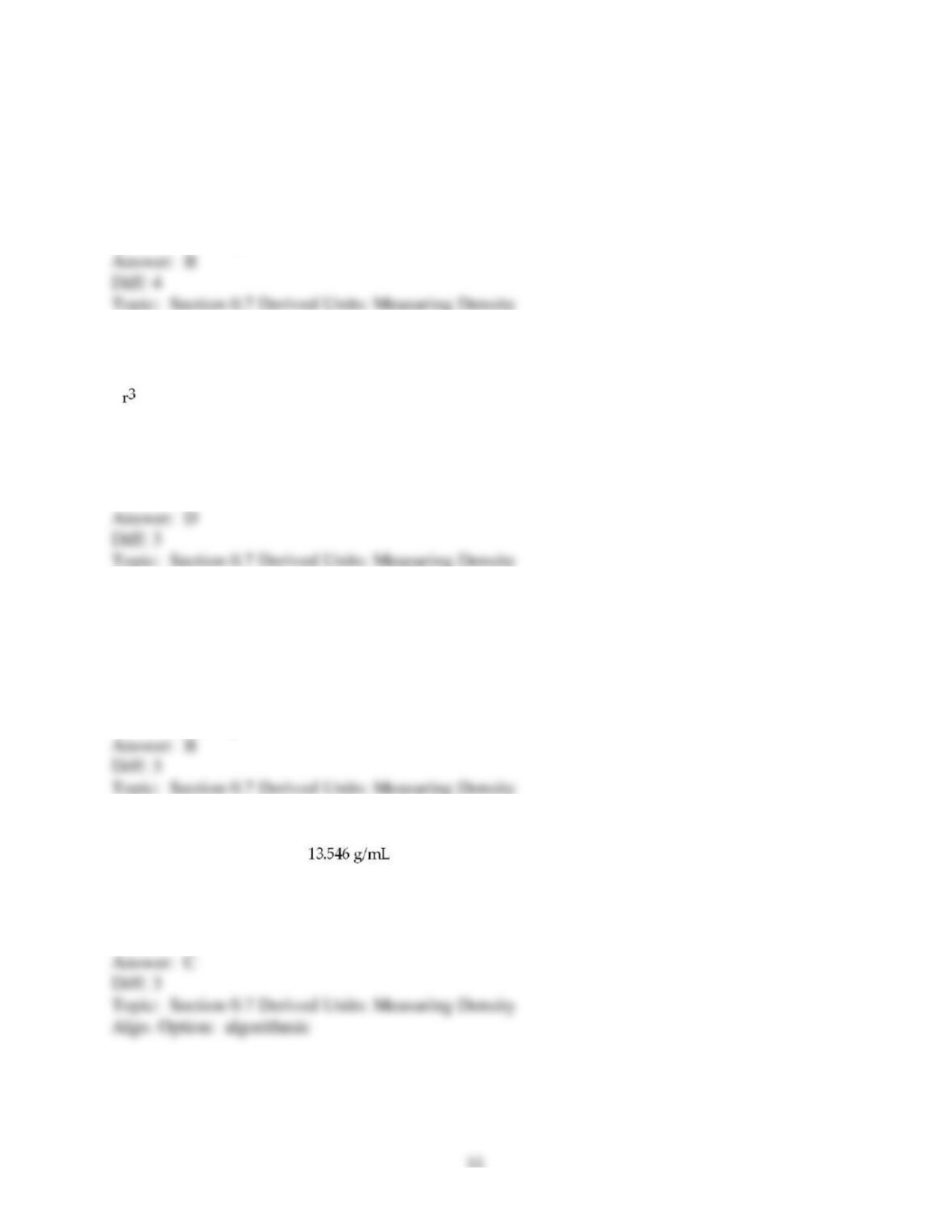
C) 1.39 × 10⁷ m
D) 1.39 × 10⁸ m
45) The volume of a well is 40.0 ft3. How many kilograms of concrete will it take to fill the well
if the density of concrete is 2.85 g/cm3?
A) 3.47 kg
B) 3.23 × 10³ kg
C) 3.47 × 10³ kg
D) 3.23 × 10⁶ kg
46) A mass of mercury occupies 0.750 L. What volume would an equal mass of ethanol occupy?
The density of mercury is and the density of ethanol is 0.789 g/mL.
A) 0.0437 L
B) 0.0777 L
C) 12.9 L
D) 22.9 L
12
47) Because of the high heat and low humidity in the summer in Death Valley, California, a
visitor requires about one quart of water for every two miles traveled on foot. If the density of
water is 0.990 g/mL at 45°C, how many kilograms of water are required for a person to walk 30
kilometers in Death Valley?
A) 8.7 kg
B) 70 kg
C) 3.5 × 10² kg
D) 7.0 × 10² kg
48) Specific gravity of a liquid is often defined as the ratio of the density of a substance to the
density of water. If the specific gravity of X relative to water is 0.800 and the specific gravity of
Y relative to water is 1.50, which of the following statements is false?
A) If X is a liquid, Y will float on X.
B) If X is a solid, X will float in water.
C) If Y is a liquid, water will float on Y.
D) If Y is a liquid, X will float in Y.
49) A piece of plastic weighing 1.157 g has a volume of 1.48 cm3. A piece of wood has the same
volume but weighs 3.85 g. The density of liquid X is 0.765 g/mL and the density of liquid Z is
1.13 g/mL. The two liquids are immiscible. If the plastic and wood are added to the two liquids,
what is the order of layers from top to bottom in the container?
A) liquid X, liquid Z, plastic, wood
B) liquid X, plastic, liquid Z, wood
C) plastic, wood, liquid Z, liquid X
D) wood, liquid Z, plastic, liquid X
50) Calculate the kinetic energy of a 150-g baseball moving at a speed of 40. m/s (89 mph).
K. E. = .
A) 6.0 J
B) 1.2 × 10² J
C) 6.0 × 10³ J
D) 1.2 × 10⁵ J
51) The average mass of an oxygen atom is 5.3 × 10⁻²⁶ kg. Calculate the kinetic energy of a
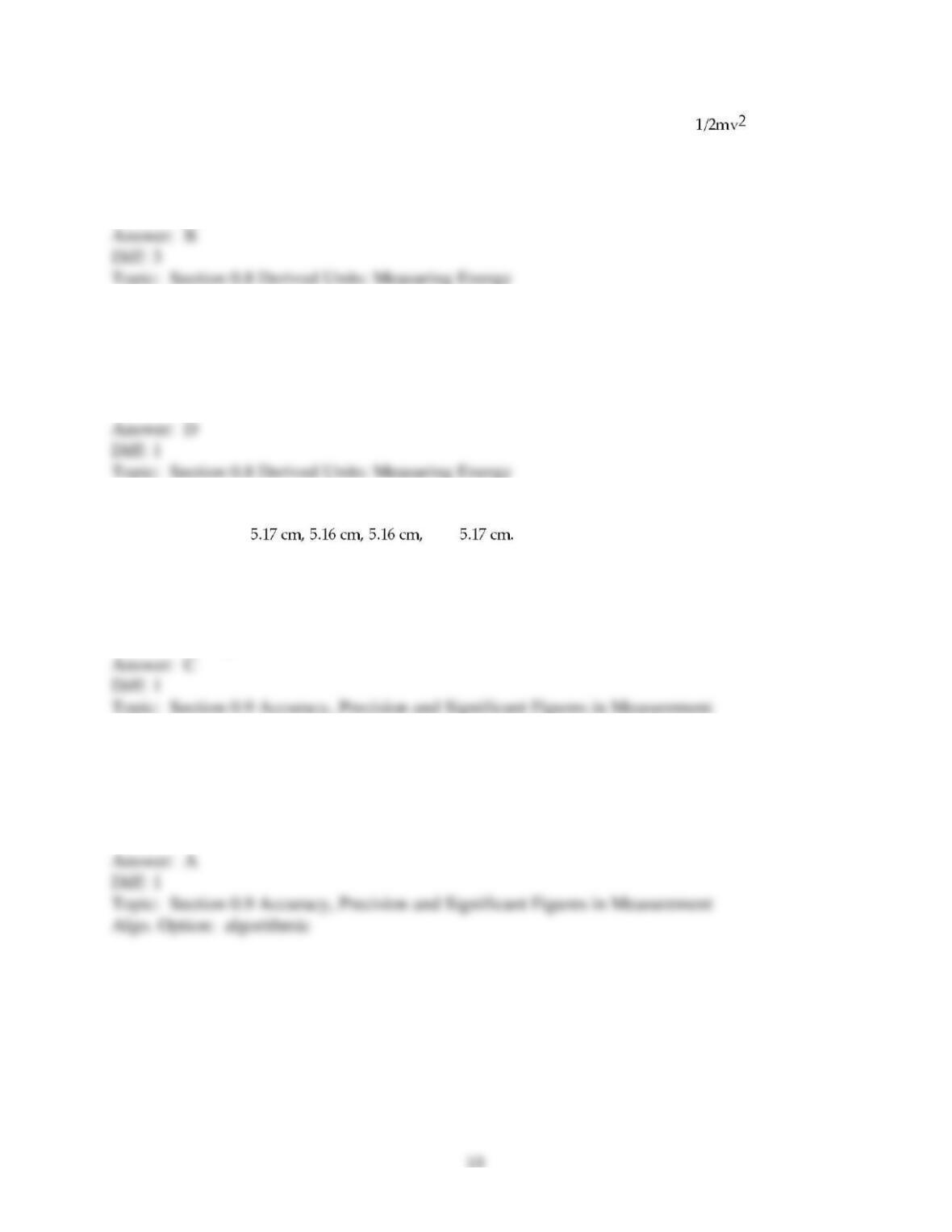
mole of oxygen atoms, all moving at a speed of 400 m/s (1000 mph). K. E. = .
A) 8.2 × 10⁻²¹ J
B) 2600 J
C) 5200 J
D) 13,000 J
52) The nutritional calorie (abbreviated Cal) is equal to
A) 1 mcal.
B) 4.184 J.
C) 4.184 cal.
D) 1 kcal.
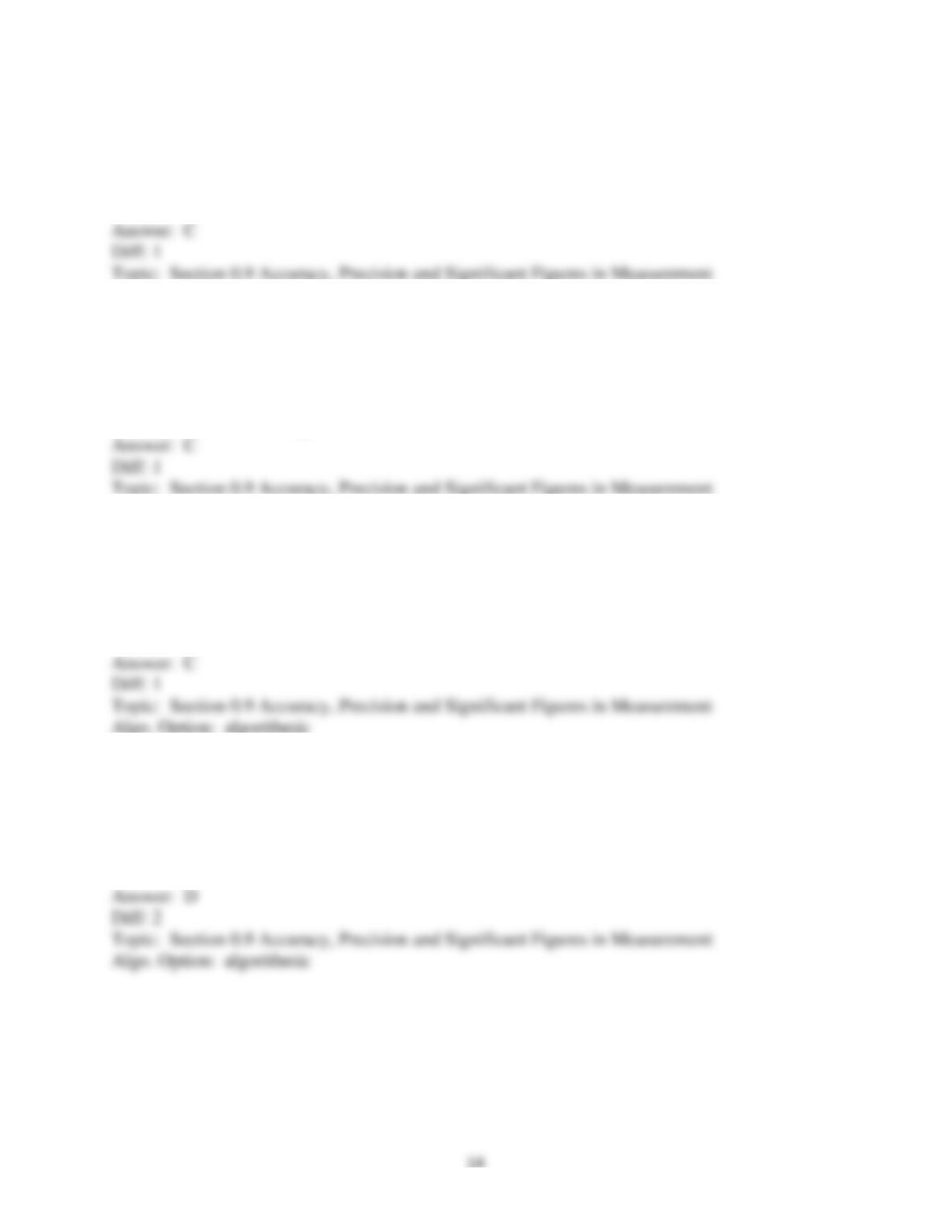
53) A student measured the diameter of a sphere and determined the average value. His
measurements are and If the true diameter is 6.18 cm, what can
be said about the student’s results?
A) It is accurate and precise.
B) It is accurate but not precise.
C) It is precise but not accurate.
D) It is neither precise nor accurate.
54) Which of the following numbers has the greatest number of significant figures?
A) 0.5070
B) 0.201
C) 418000
D) 6.02 × 1024
55) Which of the following is an exact number?
A) 0.507 grams
B) 1.13 liters
C) 2 people
D) 5.37°C
56) The measured mass of a sample of iron was 1.23 g. Which digit in the measurement has the
least certainty?
A) the first digit, 1
B) the middle digit, 2
C) the last digit, 3
D) They are all certain digits.
57) How many of the following numbers contain 3 significant figures?
0.105 6.010 0.0100 8.00 × 10²
A) one
B) two
C) three
D) four
58) How many significant figures are there in the answer to the following problem?
(8.881 × 2.100) + 0.590 = ?
A) one
B) two
C) three
D) four
59) What is the answer for the following multiplication when the correct number of significant
figures are used?
23.8216 × 81.66 = ?
A) 1945
B) 1945.271856
C) 1.95 × 1
D) 1945.27
60) How many significant figures are there in the answer for the following problem?
23.1 + 0.5588 + 17 = ?
A) one
B) two
C) three
D) four
61) How many significant figures are there in the answer for the following problem?
0.500
1.05] × 119) – [(131.7
= ?
A) one
B) two
C) three
D) four
62) A propane molecule contains 3 atoms of carbon. The number 3 represents how many
significant figures?
A) one
B) two
C) three
D) infinite
63) Round off 507,506 to four significant figures.
A) 5075
B) 5076
C) 5.075 × 10⁵
D) 5.076 × 10⁵
64) Round off 507,506 to three significant figures.
A) 507
B) 508
C) 5.07 × 10⁵
D) 5.08 × 10⁵
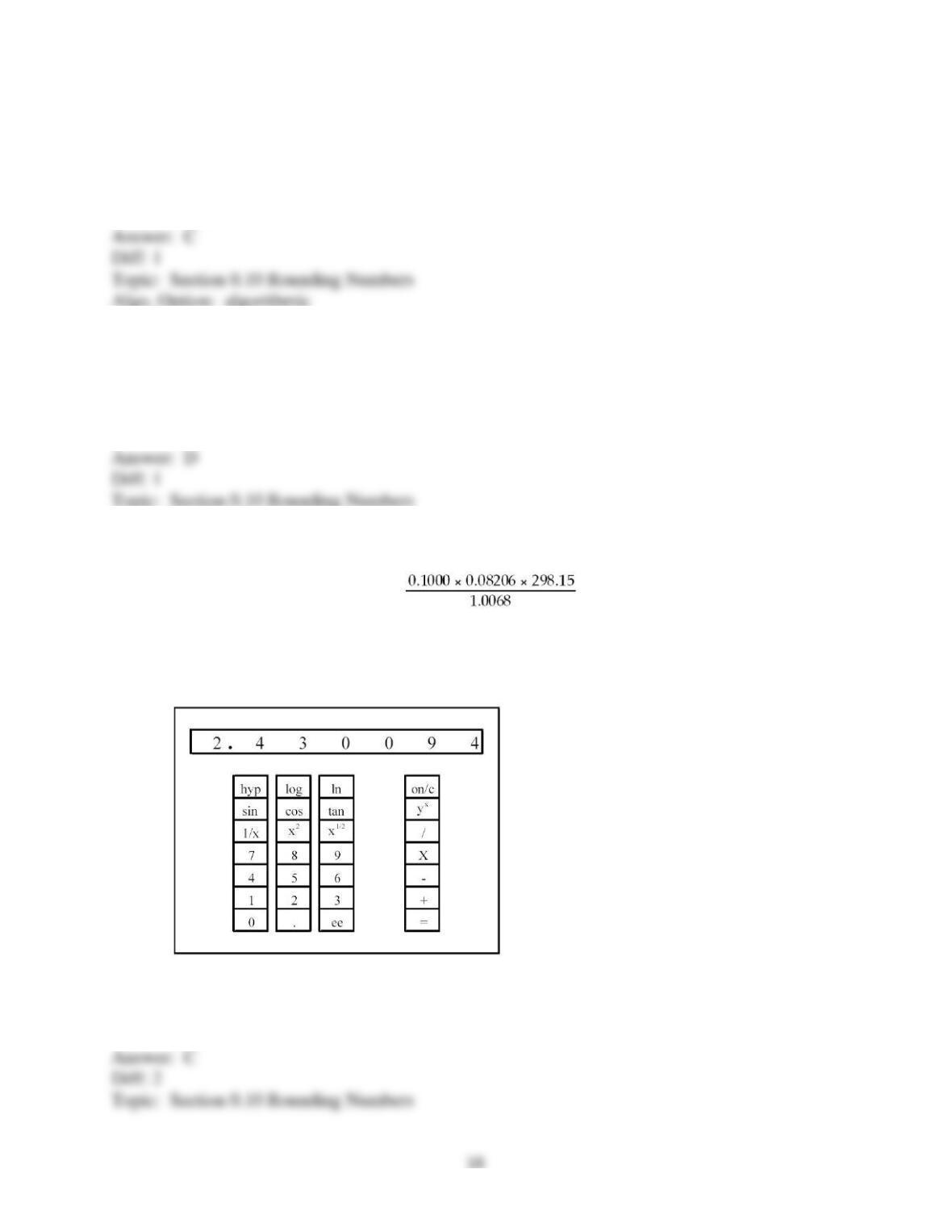
65) Each of the numbers in the following calculation represents a quantity measured by a student
in the laboratory.
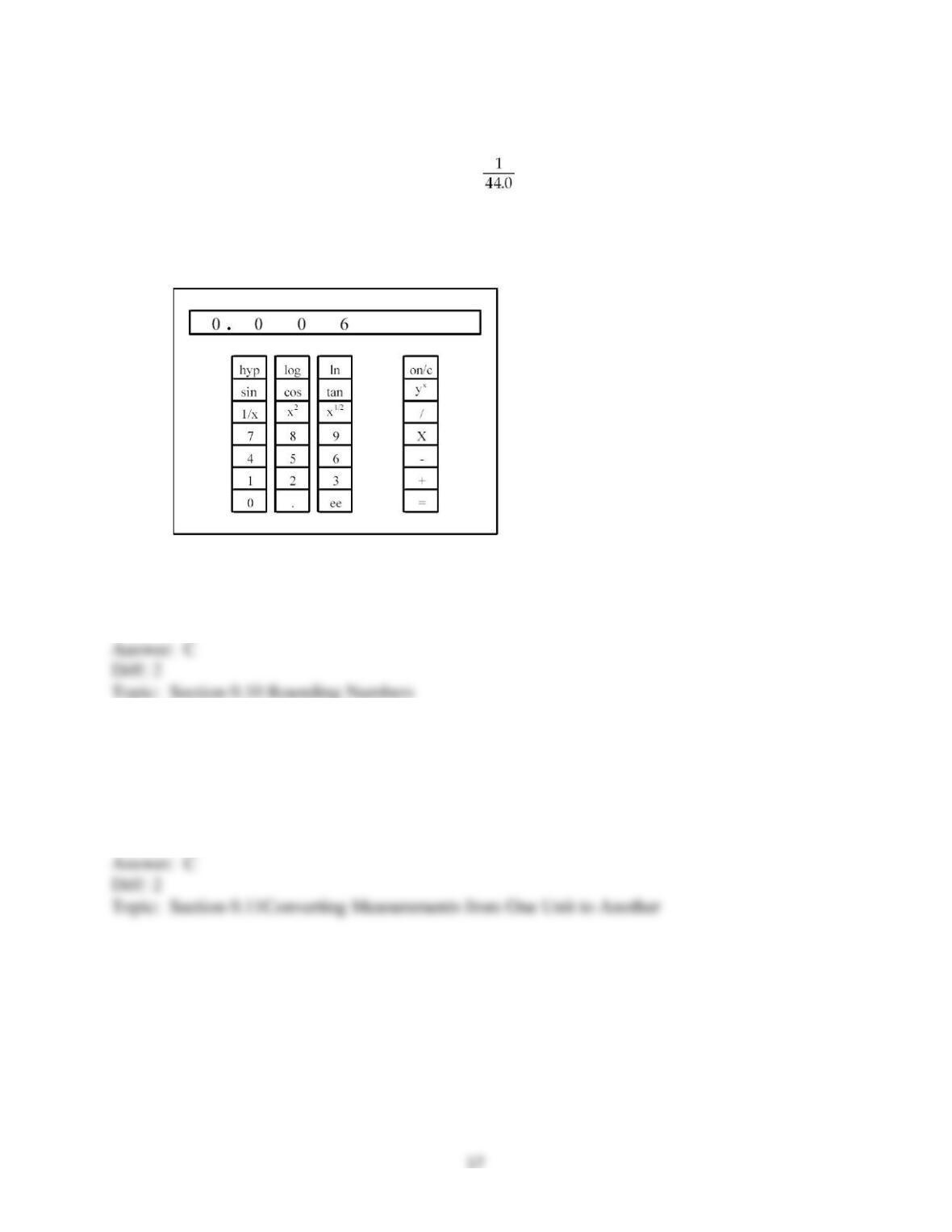
P =
After performing the calculation, the student’s calculator appeared as shown below:
To the correct number of significant figures what is the value of P?
A) 2
B) 2.43
C) 2.430
D) 2.430094
66) Each of the numbers in the following calculation represents a quantity measured by a student
in the laboratory.
g = 0.0220 × × 12.0
After performing the calculation, the student’s calculator appeared as shown below:
To the correct number of significant figures what is the value of g?
A) 6 × 10⁻³
B) 6.0 × 10⁻³
C) 6.00 × 10⁻³
D) 6.000 × 10⁻³
67) To the correct number of significant figures, an automobile traveling at 28 mi/h is traveling
at ________ km/h (1 km = 0.6214 mi).
A) 17
B) 17.40
C) 45
D) 45.06
68) An automobile uses gasoline at a rate of 35 mi/gal, which is the same as ________ km/L
(1 km = 0.6214 mi, 1 gal = 3.78 L).
A) 5.8
B) 15
C) 82
D) 210
69) If 1.4% of the mass of a human body is calcium, how many kilograms of calcium are there in
a 173-pound man?
A) 1.1 kg Ca
B) 5.3 kg Ca
C) 1.1 × 10² kg Ca
D) 5.3 × 10² kg
70) A fishing boat accidentally spills 15 barrels of diesel oil into the ocean. Each barrel contains
42 gallons. If the oil film on the ocean is 2.5 × 10² nm thick, how many square meters will the
oil slick cover?
A) 9.5 × 10⁻³ m2
B) 9.5 × 10⁶ m2
C) 9.5 × 10⁷ m2
D) none of these