1) The correct name for HClO2 is ________.
A) perchloric acid
B) chloric acid
C) hypochlorous acid
D) hypychloric acid
E) chlorous acid
2) Which one of the following could be a straight-chain alkane?
A) C9H20
B) C3H3
C) C4H6
D) C5H4
E) C3H6
3) Which one of the following gases would deviate the least from ideal gas behavior?
A) Ne
B) CH3Cl
C) Kr
D) CO2
E) F2
4) How many chiral centers are there in CH3CHCHCH2CHBr2?
A) 0
B) 1
C) 2
D) 3
E) 4
5) The correct name for Na2O2 is ________.
A) sodium oxide
B) sodium dioxide
C) disodium dioxide
D) sodium peroxide
E) disodium oxide
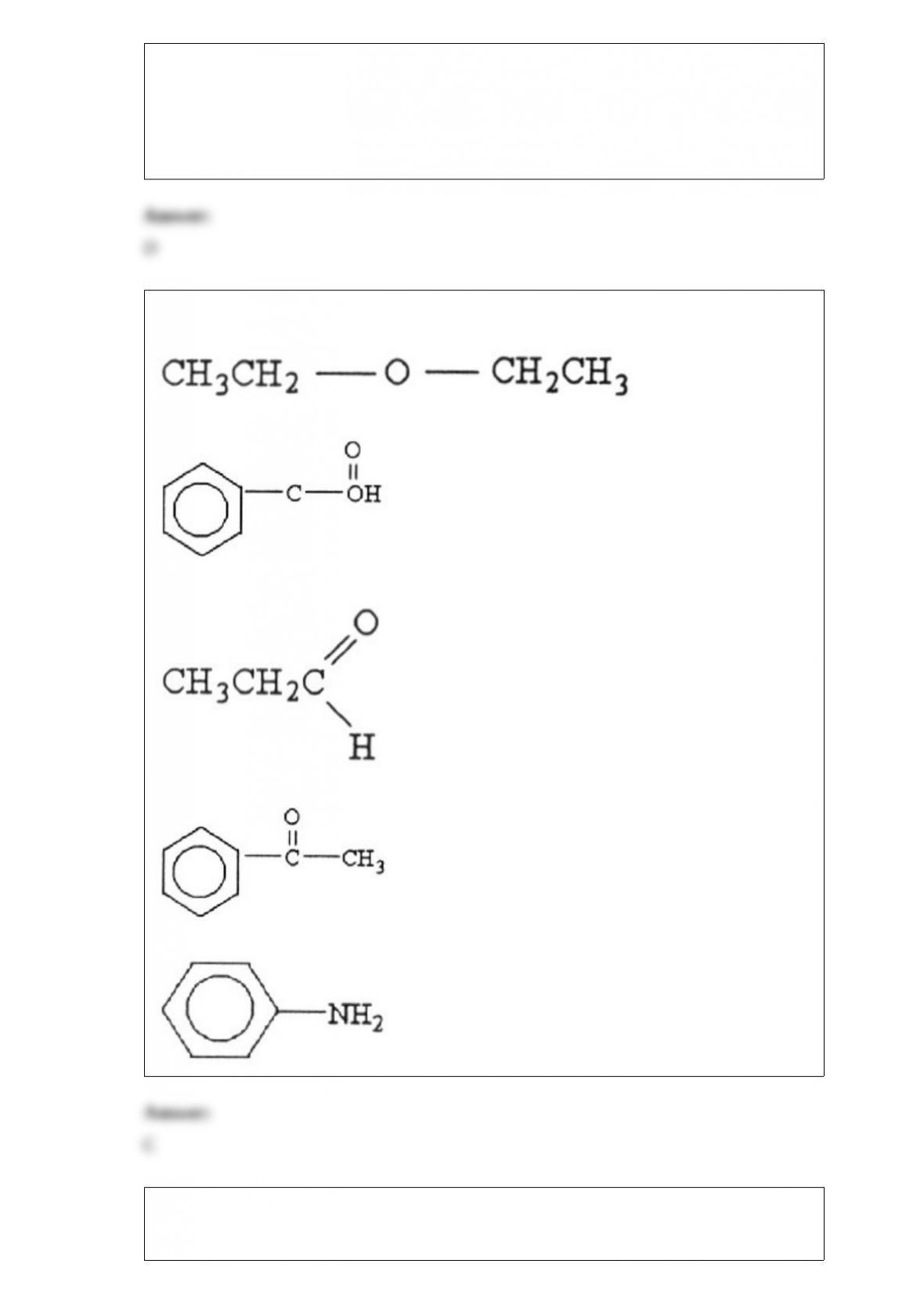
6) Which structure below represents an aldehyde?
A)
B)
C)
D)
E)
7) The correct result (indicating the proper number of significant figures) of the
following calculation of the molecular mass for H2SO4 is ________.

4 X 15.9994 + 32.066 + 2 X 1.0079
A) 98.08
B) 98.079
C) 98.074
D) 98.838
E) 98.84
8) The conjugate base of H2PO4
– is ________.
A) H3PO4
B) HPO4
2-
C) PO4
3-
D) H3O+
E) OH–
9) Of the following, the smallest and lightest subatomic particle is the ________.
A) neutron
B) proton
C) electron
D) nucleus
E) alpha particle
10) In the symbol below, X = ________.
X
A) N
B) C
C) Al
D) K
E) not enough information to determine

11) Which ion below has the largest radius?
A) Cl–
B) K+
C) Br–
D) F–
E) Na+
12) Of the following, ________ will lower the activation energy for a reaction.
A) increasing the concentrations of reactants
B) raising the temperature of the reaction
C) adding a catalyst for the reaction
D) removing products as the reaction proceeds
E) increasing the pressure
13) The balanced reaction between aqueous nitric acid and aqueous strontium
hydroxide is ________.
A) HNO3 (aq) + Sr(OH)2 (aq) → Sr(NO3)2 (aq) + H2 (g)
B) HNO3 (aq) + Sr(OH)2 (aq) → H2O (l) + Sr(NO3)2 (aq)
C) HNO3 (aq) + SrOH (aq) → H2O (l) + SrNO3 (aq)
D) 2HNO3 (aq) + Sr(OH)2 (aq) → 2H2O (l) + Sr(NO3)2 (aq)
E) 2HNO3 (aq) + Sr(OH)2 (aq) → Sr(NO3)2(aq) + 2H2 (g)
14) Given the following reactions
N2 (g) + O2 (g) → 2NO (g) ΔH = +180.7 kJ
2N2O (g) → O2 (g) + 2N2 (g) ΔH = -163.2 kJ
the enthalpy of reaction for
2N2O (g) → 2NO (g) + N2 (g)
is ________ kJ.
A) 145.7
B) 343.9
C) -343.9
D) 17.5
E) -145.7

15) Electromagnetic radiation travels through vacuum at a speed of ________ m/s.
A) 186,000
B) 125
C) 3.00 X 10⁸
D) 10,000
E) It depends on wavelength.
16) The pH of a 0.30 M solution of a weak acid is 2.67. What is the Ka for this acid?
A) 2.1 x 10⁻⁴
B) 4.4 x 10⁻⁴
C) 1.5 x 10⁻⁴
D) 6.6 x 10⁻⁴
E) none of the above
17) The symbol for the element neon is ________.
A) Rb
B) Si
C) Mg
D) Mn
E) Ne
18) A 25.5 mL aliquot of HCl (aq) of unknown concentration was titrated with 0.113 M
NaOH (aq). It took 51.2 mL of the base to reach the endpoint of the titration. The
concentration (M) of the acid was ________.
A) 1.02
B) 0.114
C) 0.454
D) 0.113
E) 0.227
19) The correct name for Na3[CoF6] is ________.
A) trisodium hexakisfluorocobalt (III)
B) trisodium hexakisfluorocobalt (II)
C) trisodium hexakisfluorocobalt (IV)
D) sodium hexafluorocobaltate (III)
E) sodium hexafluorocobaltate (IV)
20) Suppose you have just added 200.0 ml of a solution containing 0.5000 moles of
acetic acid per liter to 100.0 ml of 0.5000 M NaOH. What is the final pH? The Ka of
acetic acid is 1.77 x 10⁻⁵.
21) Non-superimposable mirror-image isomers of a substance are called ________.
22) Compounds containing only boron and hydrogen are called ________.
23) In general, the solubility of a slightly soluble salt is ________ by the presence of a
second solute that furnishes a common ion.
24) What is the name of an alcohol derived from hexane?

25) A catalyst that is present in the same phase as the reacting molecules is called a(n)
________ catalyst.