
1) The principal quantum number for the outermost electrons in a Te atom in the ground
state is ________.
A) 3
B) 4
C) 5
D) 6
E) 7
2) Gaseous argon has a density of 1.40 g/L at standard conditions. How many argon
atoms are in 1.00 L of argon gas at standard conditions?
A) 4.76 x 10²²
B) 3.43 x 1025
C) 2.11 x 10²²
D) 1.59 x 1025
E) 6.02 x 10²³
3) To produce acceptable quality drinking water from seawater by desalination, the
level of salt must be reduced ________ fold.
A) 10
B) 50
C) 70
D) 100
E) 120
4) The F-N-F bond angle in the NF3 molecule is slightly less than ________.
A) 90°
B) 109.5°
C) 120°
D) 180°
E) 60°
5) A double bond consists of ________ pairs of electrons shared between two atoms.
A) 1
B) 2
C) 3
D) 4
E) 6
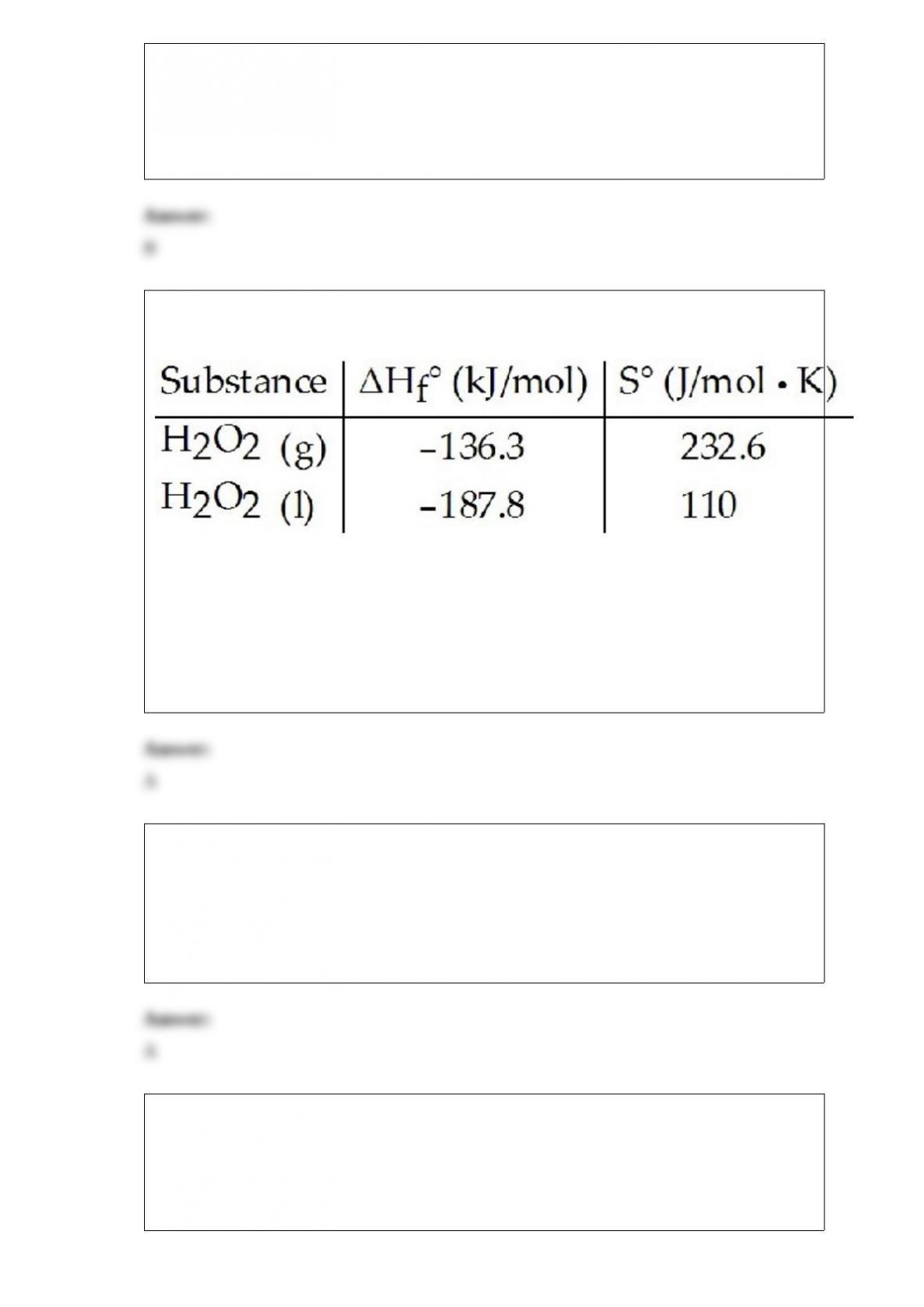
6) Given the following table of thermodynamic data,
complete the following sentence. The vaporization of PCl3 (l) is ________.
A) nonspontaneous at low temperature and spontaneous at high temperature
B) spontaneous at low temperature and nonspontaneous at high temperature
C) spontaneous at all temperatures
D) nonspontaneous at all temperatures
E) not enough information given to draw a conclusion
7) ________ is a monosaccharide.
A) Fructose
B) Lactose
C) Guanine
D) Glycogen
E) none of the above
8) A complex of correctly written formula [Pt(NH3)3Br]Br H2O has which set of
ligands in its inner coordination sphere?
A) 3 NH3
B) 3 NH3 and 2 Br–

C) 3 NH3 and 1 Br–
D) 3 NH3, 1 Br–, and 1 H2O
E) 3 NH3, 2 Br–, and 1 H2O
9) In the presence of excess oxygen, methane gas burns in a constant-pressure system to
yield carbon dioxide and water:
CH4 (g) + 2O2 (g) → CO2 (g) + 2H2O (l)³ ΔH = -890.0 kJ
Calculate the value of q (kJ) in this exothermic reaction when 1.80 g of methane is
combusted at constant pressure.
A) -100.1 kJ
B) 0.0324 kJ
C) -0.0100 kJ
D) 30.9 kJ
E) -1.00 x 10⁵ kJ
10) A result of the common-ion effect is ________.
A) that some ions, such as Na+ (aq), frequently appear in solutions but do not
participate in solubility equilibria
B) that common ions, such as Na+ (aq), don’t affect equilibrium constants
C) that the selective precipitation of a metal ion, such as Ag+, is promoted by the
addition of an appropriate counterion (X–) that produces a compound (AgX) with a very
low solubility
D) that ions such as K+ and Na+ are common ions, so that their values in equilibrium
constant expressions are always 1.00
E) that common ions precipitate all counter-ions
11) An atom of 14C contains ________ electrons.
A) 14
B) 20
C) 8
D) 10
E) 6

12) The element X has three naturally occurring isotopes. The masses (amu) and %
abundances of the isotopes are given in the table below. The average atomic mass of the
element is ________ amu.
A) 52.62
B) 56.14
C) 55.70
D) 55.40
E) 55.74
13) The concentration of CO2 in a soft drink bottled with a partial pressure of CO2 of
6.5 atm over the liquid at 29 oC is 2.2 x 10⁻¹ M. The Henry’s law constant for CO2 at
this temperature is ________.
A) 2.2 x 10⁻¹ mol/L-atm
B) 7.6 x 10⁻³ mol/L-atm
C) 5.6 x 10⁻³ mol/L-atm
D) 3.4 x 10⁻² mol/L-atm
E) More information is needed to solve the problem.
14) 87 pm is the same as ________ Angstroms.
A) 870
B) 8.7
C) 87
D) .87
E) .087