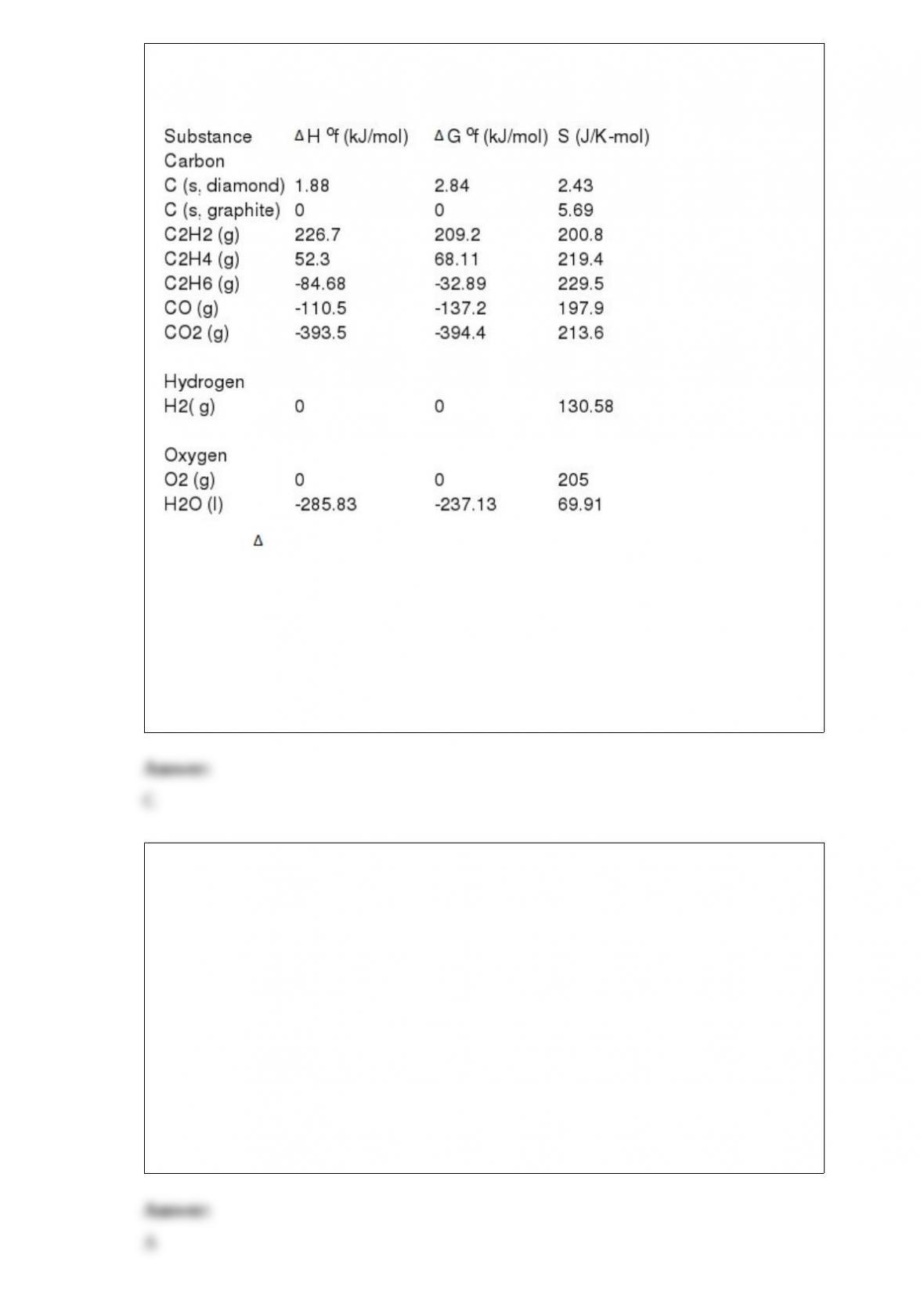
1) Thermodynamic Quantities for Selected Substances at 298.15 K (25 oC)
The value of S o for the catalytic hydrogenation of acetylene to ethane,
C2H2 (g) + 2H2 (g) –> C2H6 (g)
is ________ J/K mol.
A) -76.0
B) +440.9
C) -232.5
D) +232.5
E) +28.7
2) At elevated temperatures, dinitrogen pentoxide decomposes to nitrogen dioxide and
oxygen:
2N2O5(g) –> 4NO2 (g) + O2 (g)
When the rate of formation of O2 is 2.2 x 10⁻⁴ M/s, the rate of decomposition of N2O5
is ________ M/s.
A) 7.2 x 10⁻³
B) 3.6 x 10⁻³
C) 1.8 x 10⁻³
D) 1.4 x 10⁻²
E) 0.00090

3) For a given reaction, H = +22.2 kJ/mol and S = +81.1 J/K-mol. The reaction is
spontaneous ________. Assume that H and S do not vary with temperature.
A) at T < 274 K
B) at T > 274 K
C) at T > 298 K
D) at T < 298 K
E) at all temperatures
4) The oxidation state of nitrogen in the NO2 molecule is ________.
A) +4
B) +3
C) +5
D) +2
E) -3
5) Based on electron configuration, which is most likely colorless?
A) [Cu(NH3)4]2+
B) [Cd(NH3)4]2+
C) [Ni(NH3)6]2+
D) [Cr(NH3)5Cl]2+
E) [Co(NH3)6]2+
6) You are given two clear solutions of the same unknown monoprotic acid, but with
different concentrations. Which statement is true?
A) There is no chemical method designed to tell the two solutions apart.
B) It would take more base solution (per milliliter of the unknown solution) to
neutralize the more concentrated solution.
C) A smaller volume of the less concentrated solution contains the same number of
moles of the acid compared to the more concentrated solution.
D) If the same volume of each sample was taken, then more base solution would be
required to neutralize the one with lower concentration.
E) The product of concentration and volume of the less concentrated solution equals the
product of concentration and volume of the more concentrated solution.

7) The correct name for HBrO2 is ________.
A) hydrobromic acid
B) perbromic acid
C) bromic acid
D) bromous acid
E) hydrobromous acid
8) Which calculation clearly shows a conversion between temperatures in degrees
Celsius, °C, and temperature in Kelvins, K?
A) K = °C + 273.15
B) K = 273.15 – °C
C) K = [°C – 32] / 1.8
D) K = [°C + 32] X 1.8
E) K = °C
9) Silver nitrate and aluminum chloride react with each other by exchanging anions:
3AgNO3 (aq) + AlCl3 (aq) → Al(NO3)3 (aq) + 3AgCl (s)
What mass in grams of AgCl is produced when 4.22 g of AgNO3 react with 7.73 g of
AlCl3?
A) 17.6
B) 4.22
C) 24.9
D) 3.56
E) 11.9
10) The temperature of a sample of CH4 gas (10.34 g) in a 50.0 L vessel at 1.33 atm is
________ °C.
A) 984
B) -195
C) 195

D) 1260
E) -1260
11) The half-life of 223Ra is 11.4 days. How much of a 200.0 mg sample remains after
600 hours?
A) 0.219 mg
B) 21.9 mg
C) .0302 mg
D) 43.8 mg
E) 6.04 mg
12) Potassium forms an ion with a charge of ________.
A) 2+
B) 1-
C) 1+
D) 2-
E) 0
13) The reaction between strontium hydroxide and chloric acid produces ________.
A) a molecular compound and a weak electrolyte
B) two weak electrolytes
C) two strong electrolytes
D) a molecular compound and a strong electrolyte
E) two molecular compounds
14) When H2SO4 is neutralized by NaOH in aqueous solution, the net ionic equation is
________.
A) SO4
2- (aq) + 2Na+ (aq) → Na2SO4 (aq)
B) SO4
2- (aq) + 2Na+ (aq) → Na2SO4 (s)
C) H+ (aq) + OH– (aq) → H2O (l)

D) H2SO4 (aq) + 2OH– (aq) → 2H2O (l) + SO4
2- (aq)
E) 2H+ (aq) + 2NaOH (aq) → 2H2O (l) + 2Na+ (aq)
15) Which of the following characteristics would prevent liquid crystal behavior?
A) long axial structure
B) ionic configuration
C) carbon-carbon single bonds
D) double bonding
E) polar groups