
1) The specific heat capacity of lead is 0.13 J/g-K. How much heat (in J) is required to
raise the temperature of 15 g of lead from 22 °C to 37 °C?
A) 2.0 J
B) -0.13 J
C) 5.8 x 10⁻⁴ J
D) 29 J
E) 0.13 J
2) Carbon dioxide is produced ________.
A) in blast furnaces when metal oxides are reduced with CO
B) by combustion of carbon-containing substances in an excess of oxygen
C) when carbonates are heated
D) by fermentation of sugar during the production of ethanol
E) by all of the above processes
3) A solution is prepared by mixing 15.0 mL of 0.100 M HCl and 5.00 mL of 0.200 M
NaCl. What is the molarity of chloride ion in this solution?
A) 0.175
B) 8.00
C) 1.25
D) 0.0250
E) 0.125
4) What happens to the mass number and the atomic number of an element when it
undergoes alpha decay?
A) The mass number decreases by 4 and the atomic number decreases by 2
B) The mass number does not change and the atomic number increases by 1
C) The mass number increases by 4 and the atomic number does not change.
D) The mass number increases by 2 and the atomic number decreases by 1
E) The mass number does not change and the atomic number increases by 2
5) Which noble gas is expected to show the largest deviations from the ideal gas

behavior?
A) helium
B) neon
C) argon
D) krypton
E) xenon
6) The freezing point of water at 1 atm pressure is ________.
A) 0 °F
B) 0 K
C) 0 °C
D) -273 °C
E) -32 °F
7) The Keq for the equilibrium below is 5.4 x 10¹³ at 480.0 oC.
2NO (g) + O2 (g) 2NO2 (g)
What is the value of Keq at this temperature for the following reaction?
NO2 (g) NO (g) + O2 (g)
A) 5.4 x 10⁻¹³
B) 5.4 x 10¹³
C) 1.4 x 10⁻⁷
D) 5.66 x 10⁻³
E) none of the above
8) What sulfur compound is used to sterilize wine?
A) H2SO4
B) H2S
C) Na2SO3
D) SO2
E) Na2S

9) An aqueous solution contains 0.100 M NaOH at 25.0 oC. The pH of the solution is
________.
A) 0.100
B) 1.00
C) 13.00
D) 7.00
E) -1.00
10) An aqueous solution contains 0.050 M of methylamine. The concentration of H+ in
this solution is ________ M. Kb for methylamine is 4.4 x 10⁻⁴.
A) 0.050
B) 2.2 x 10⁻¹³
C) 2.9 x 10⁻¹³
D) 4.5 x 10⁻¹³
E) 2.2 x 10⁻¹²
11) Thermodynamic Quantities for Selected Substances at 298.15 K (25 oC)
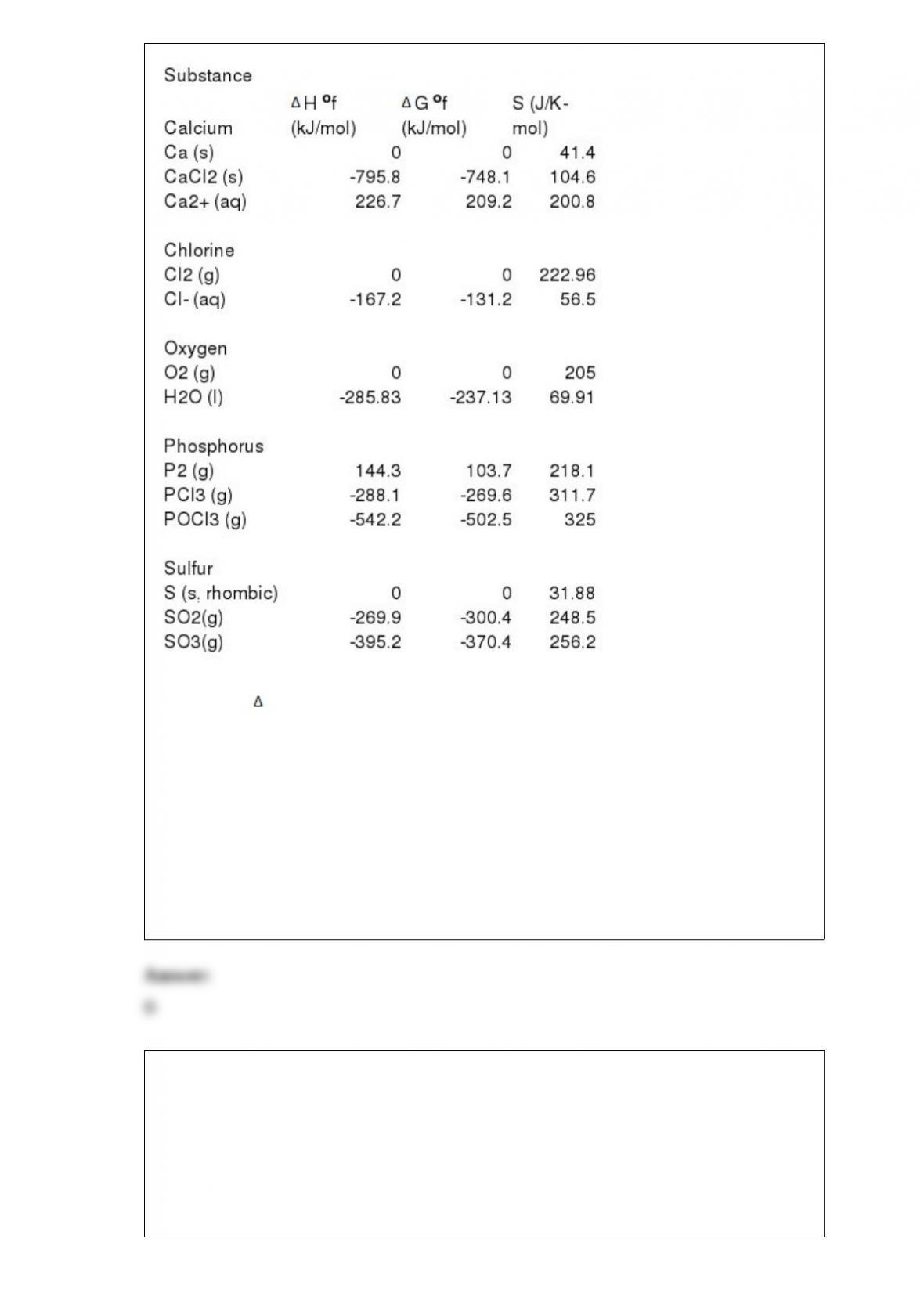
The value of H o for the oxidation of solid elemental sulfur to gaseous sulfur trioxide,
2S (s, rhombic) + 3O2( g) –> 2SO3 (g)
is ________ kJ/mol.
A) +790.4
B) -790.4
C) +395.2
D) -395.2
E) +105.1
12) Which of the following is not released by the combustion of fossil fuels?
A) CO2
B) SO2
C) CH4
D) NO
E) O3

13) The oxidation state of oxygen in O2F2 is ________.
A) +1
B) -1
C) +2
D) 0
E) -2
14) Based on the octet rule, boron will most likely form a ________ ion.
A) B3-
B) B+
C) B3+
D) B2+
E) B2-
15) Which one of the following is a correct representation of beta particle?
A) e
B)
C) e
D) He
16) Which one of the quantum numbers does not result from the solution of the
Schrodinger equation?
A) principal
B) azimuthal
C) magnetic
D) spin
E) angular momentum
17) The noble gases were, until relatively recently, thought to be entirely unreactive.
Experiments in the early 1960s showed that Xe could, in fact, form compounds with
fluorine. The formation of compounds consisting of Xe is made possible by ________.
A) the availability of xenon atoms
B) xenon’s noble gas electron configuration
C) the stability of xenon atoms
D) xenon’s relatively low ionization energy
E) xenon’s relatively low electron affinity
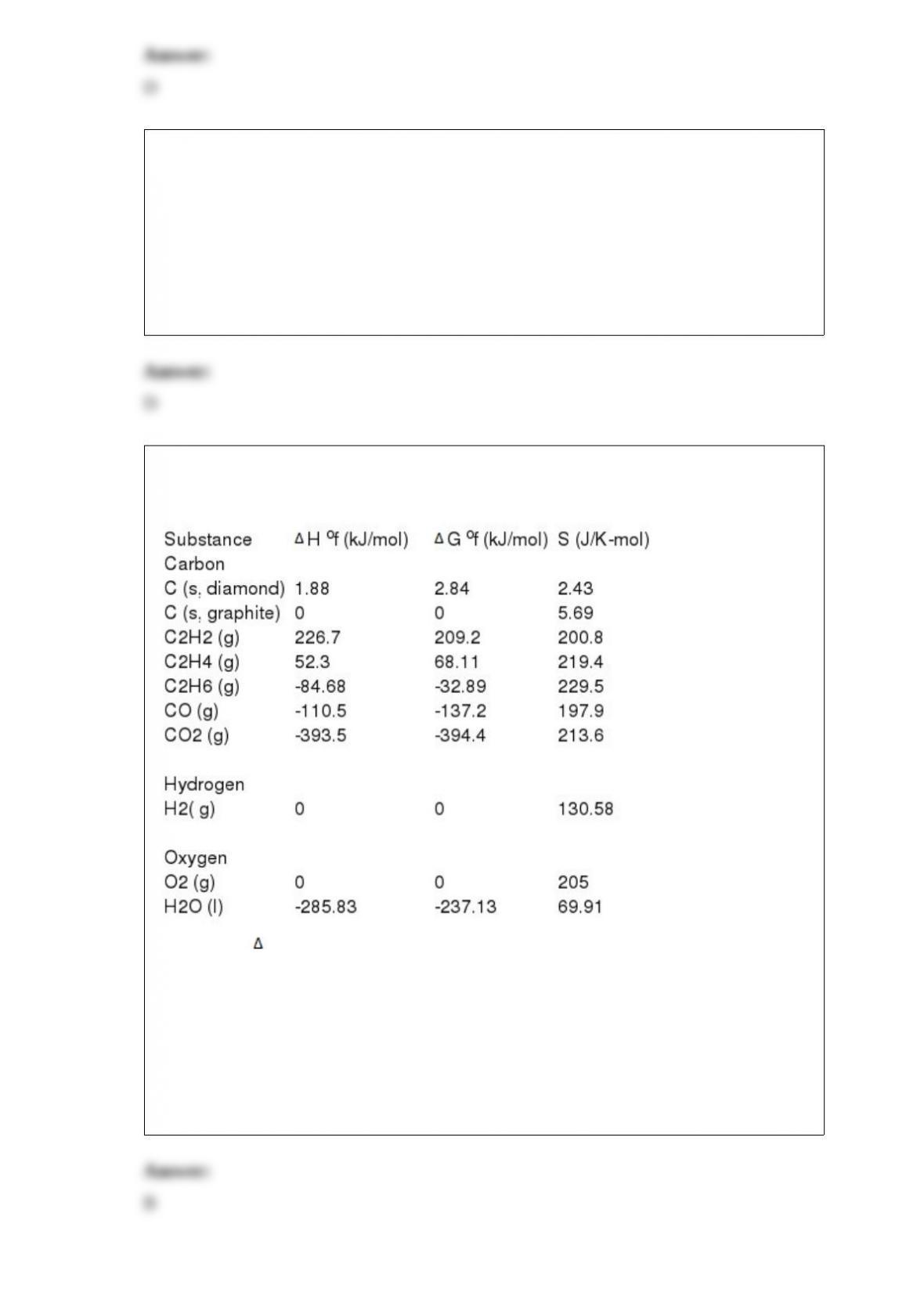
18) Thermodynamic Quantities for Selected Substances at 298.15 K (25 oC)
The value of S o for the catalytic hydrogenation of ethene to ethane,
C2H4 (g) + H2(g) –> C2H6 (g)
is ________ J/K mol.
A) -101.9
B) -120.5
C) -232.5
D) +112.0
E) +101.9

19) The brown color of photochemical smog over a city is mainly due to ________.
A) NO2
B) N2O4
C) CO
D) SO2
E) CO2
20) The electron configuration [Kr]4d10 represents ________.
A) Ag+
B) Cd
C) Cd+
D) Ag2+
E) Sr2+