
What is the overall reaction for the production of hydrogen from methane and water?
A) CH4(g) + H2O(g) –> CO(g) + 3 H2(g)
B) CO(g) + H2O(g) –> CO2(g) + H2(g)
C) CH4(g) + 2 H2O(g) –> CO2(g) + 4 H2(g)
D) 2 CH4(g) + 3 H2O(g) –> CO(g) + CO2(g) + 5 H2(g)
E) 2 H2O(g) –> O2(g) + 2 H2(g)
Given the following information:
Li(s) –> Li(g)enthalpy of sublimation of Li(s) = 166 kJ/mol
HBr(g) –> H(g) + Br(g)bond energy of HBr = 363 kJ/mol
Li(g) –> Li+(g) + e− ionization energy of Li(g) = 520. kJ/mol
Br(g) + e− –> Br− (g)electron affinity of Br(g) = −325 kJ/mol
Li+(g) + Br− (g) –> LiBr(s)lattice energy of LiBr(s) = −809 kJ/mol
H2(g) –> 2H(g)bond energy of H2= 432 kJ/mol
Calculate the change in enthalpy for:
2Li(s) + 2HBr(g) –> H2(g) + 2LiBr(s)
A)262 kJ
B)−602 kJ
C)−517 kJ
D)−992 kJ
E)none of these
Which of the following equations correctly represents the process involved in the
electron affinity of X?
A)X+(g) + e–=> X(g)
B)X+(g) + Y–(g) => XY(g)
C)X(g) + e–=> X–(g)
D)X(g) => X+(g) + e–
E)X+(g) => X+(aq)
Consider the endothermic reaction 2 BrCl(g) Br2(g) + Cl2(g). What will be the
effect on the equilibrium of

a)changing the volume at constant temperature?
b)increasing the temperature at constant volume
A) a) equilibrium shifts towards products, b) equilibrium shifts towards products.
B) a) equilibrium shifts towards reactants, b) equilibrium shifts towards products.
C) a) equilibrium shifts towards products, b) equilibrium shifts towards reactants.
D) a) no change in the equilibrium, b) equilibrium shifts towards products.
E) a) no change in the equilibrium, b) equilibrium shifts towards reactants.
Which of the following ions forms the fewest insoluble salts?
A)Al3+
B)Cl–
C)NO3
–
D)OH–
E)Mg2+
When the volume is decreased at constant temperature, the ratio of the partial pressure
of PCl5to the partial pressure of PCl3will
A) increase
B) decrease
C) stay the same
D) impossible to tell without more information
E) none of these
Which one of the following statements is false?
A)The change in internal energy, DE, for a process is equal to the amount of heat
absorbed at constant volume, qv.
B)The change in enthalpy, DH, for a process is equal to the amount of heat absorbed at
constant pressure, qp.
C)A bomb calorimeter measures DH directly.
D)If qpfor a process is negative, the process is exothermic.
E)The freezing of water is an example of an exothermic reaction.
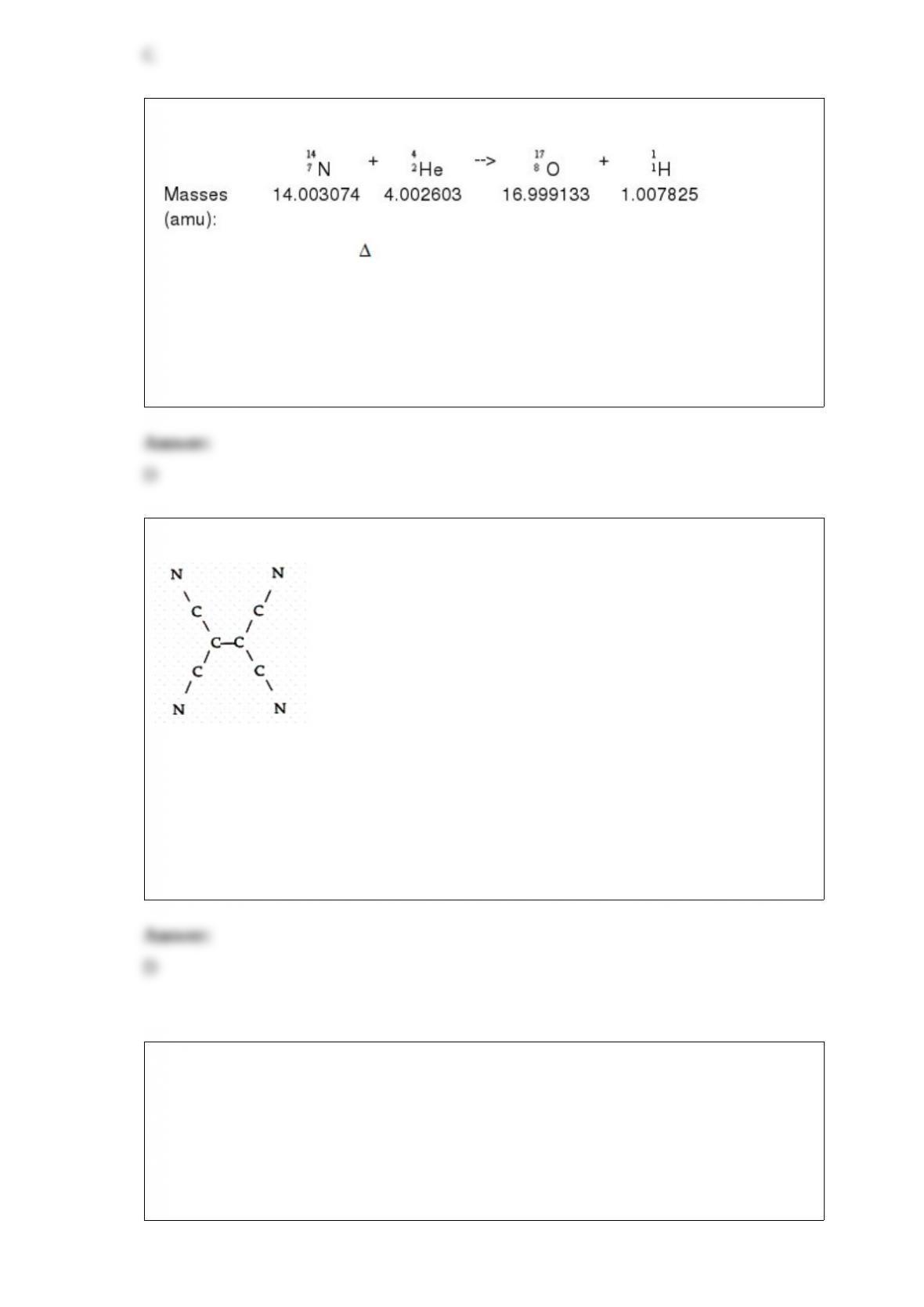
Consider the following process:
Which statement describes E for the process?
A) 1.15 x 10¹¹J/mol are released.
B) 1.15 x 10¹⁴J/mol are released.
C) 1.15 x 10¹⁸J/mol are absorbed.
D) 1.15 x 10¹¹J/mol are absorbed.
E) None of these.
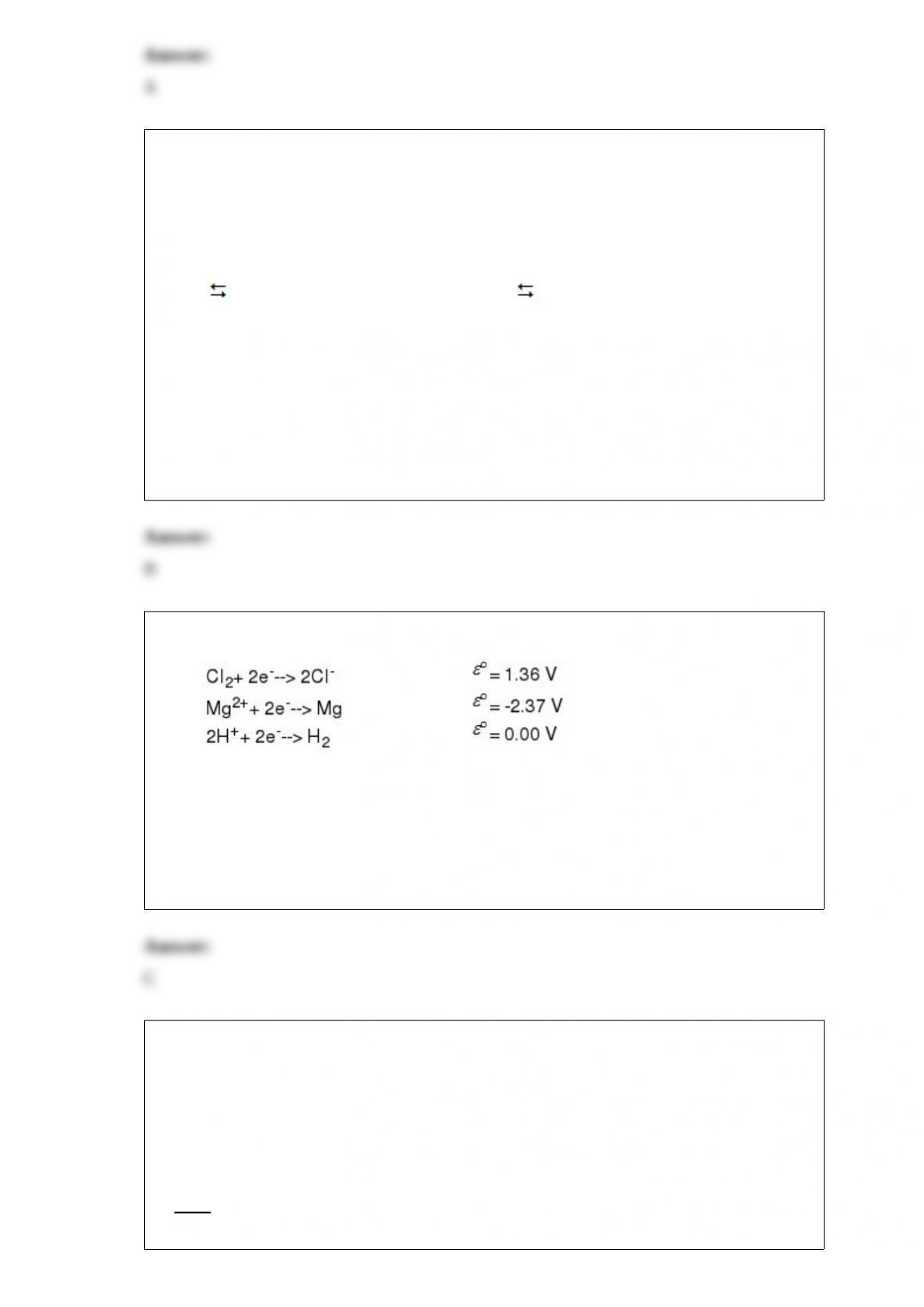
Tetracyanoethylene has the skeleton shown below:
From its Lewis structure determine the following:
How many sigma and pi bonds are in the molecule?
A)4 sigma and 5 pi
B)6 sigma and 8 pi
C)9 sigma and 8 pi
D)9 sigma and 9 pi
E)5 sigma and 8 pi
Which of the following nuclides would be most expected to undergo b-decay?
A) 200Ta
B) 209Bi
C) 257Fm
D) 18Na
E) 121Xe
Which of the following statements is true?
I.The concentration of a pure liquid does not appear in the mass-action expression
II.If Q > K, the reaction will produce more products and less reactants to reach
equilibrium
III.The equilibrium constant of an overall reaction is the product of the equilibrium
constants of the individual reactions that add up to the overall reaction
IV.If A B has a reaction quotient, Q, then n A n B has a reaction quotient, Qn
V.An equilibrium constant expressed in terms of concentrations can be greater than the
corresponding equilibrium constant expressed in terms of pressure, depending on the
reaction
A) II, III, IV and V
B) I, III, IV and V
C) III and IV
D) III, IV and V
E) All are true
Which of the following is the best reducing agent?
A) Cl2
B) H2
C) Mg
D) Mg2+
E) Cl–
As part of the calibration of a new laboratory balance, a 1.000-g mass is weighed with
the following results:
TrialMass
11.201 ± 0.001
21.202 ± 0.001
31.200 ± 0.001
The balance is:
A)Both accurate and precise.
B)Accurate but imprecise.
C)Precise but inaccurate.
D)Both inaccurate and imprecise.
E)Accuracy and precision are impossible to determine with the available information.
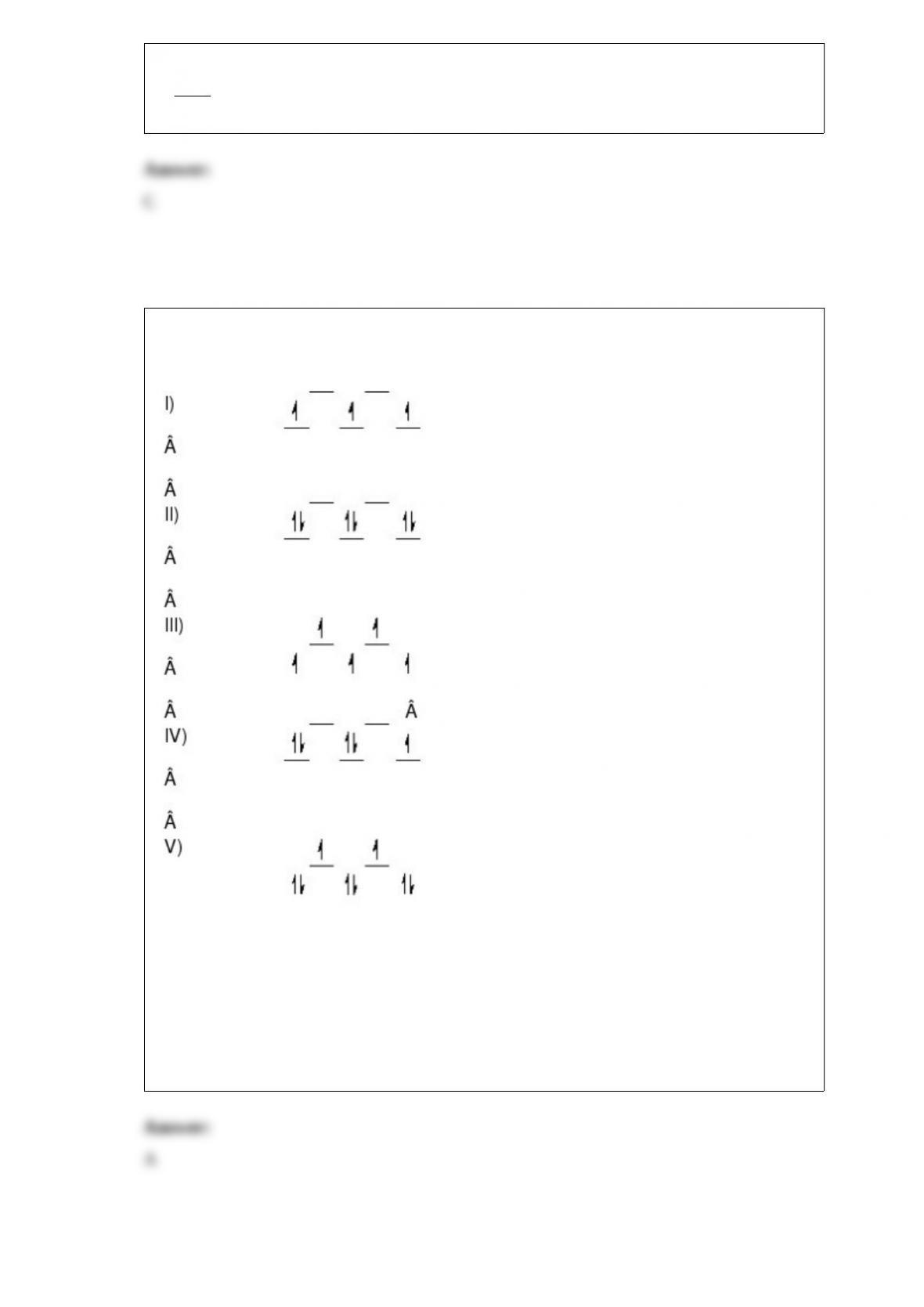
Here are some crystal field representations of d electrons in an octahedral complex:
Choose the representation that fits the transition metal atom in the following species:
[Cr(NH3)5Cl]SO4
A) representation I
B) representation II
C) representation III
D) representation IV
E) representation V

Balance the following redox equation in basic solution. What is the coefficient of the
water? MnO4
–(aq) + HCOOH(aq) –> Mn2+(aq) + CO2(g)
A) 2
B) 4
C) 6
D) 8
E) 16
The first-order decomposition of H2O2at -30 °C occurs with a half-life of 42.0 seconds.
What will be the residual concentration of 10.2 mol/L H2O2after 3 minutes?
A)0.326 mol/L
B)0.523 mol/L
C)8.73 mol/L
D)9.71 mol/L
E)11.9 mol/L