
1) The square of Schrodinger’s wave equation is called an orbital.
2) Aldehydes are less reactive than ketones.
3) Radioactive decay is a first order kinetic process.
4) A gas is considered “ideal” if one mole of it in a one-liter container exerts a pressure
of exactly 1 atm at room temperature.
5) Rates of reaction can be positive or negative.
6) Humans digest starch but not cellulose because of differences in the type of linkage
between the glucose monomers of these substances.
7) Which of the following would require the largest volume of 0.100 M sodium
hydroxide solution for neutralization?
A) 10.0 mL of 0.0500 M phosphoric acid
B) 20.0 mL of 0.0500 M nitric acid
C) 5.0 mL of 0.0100 M sulfuric acid
D) 15.0 mL of 0.0500 M hydrobromic acid
E) 10.0 mL of 0.0500 M perchloric acid

8) What is the concentration (M) of KCl in a solution made by mixing 25.0 mL of 0.100
M KCl with 50.0 mL of 0.100 M KCl?
A) 0.100
B) 0.0500
C) 0.0333
D) 0.0250
E) 125
9) There are ________ sulfur atoms in 25 molecules of C4H4S2.
A) 1.5 x 1025
B) 4.8 x 1025
C) 3.0 x 1025
D) 50
E) 6.02 x 10²³
10) Consider a pure crystalline solid that is heated from absolute zero to a temperature
above the boiling point of the liquid. Which of the following processes produces the
greatest increase in the entropy of the substance?
A) melting the solid
B) heating the liquid
C) heating the gas
D) heating the solid
E) vaporizing the liquid
11) A sample of He gas (2.0 mmol) effused through a pinhole in 53 s. The same amount
of an unknown gas, under the same conditions, effused through the pinhole in 248 s.
The molecular mass of the unknown gas is ________ g/mol.
A) 0.19
B) 5.5
C) 88
D) 19
E) 350

12) Alkynes always contain a ________.
A) C C bond
B) CC bond
C) C-C bond
D) C H bond
E) CH bond
13) Most of the elements on the periodic table are ________.
A) gases
B) nonmetals
C) metalloids
D) liquids
E) metals
14) The complete electron configuration of vanadium, element 23, is ________.
A) 1s22s22p103s23p7
B) 1s22s22p63s23p63d34s2
C) 1s42s42p63s43p5
D) 1s42s42p103s43p1
E) 1s42s42p83s43p3
15) ________ is isoelectronic with scandium.
A) Cr3+
B) Mn5+
C) Mn
D) Mn4-
E) K+
16) At 1000.0 K, the equilibrium constant for the reaction
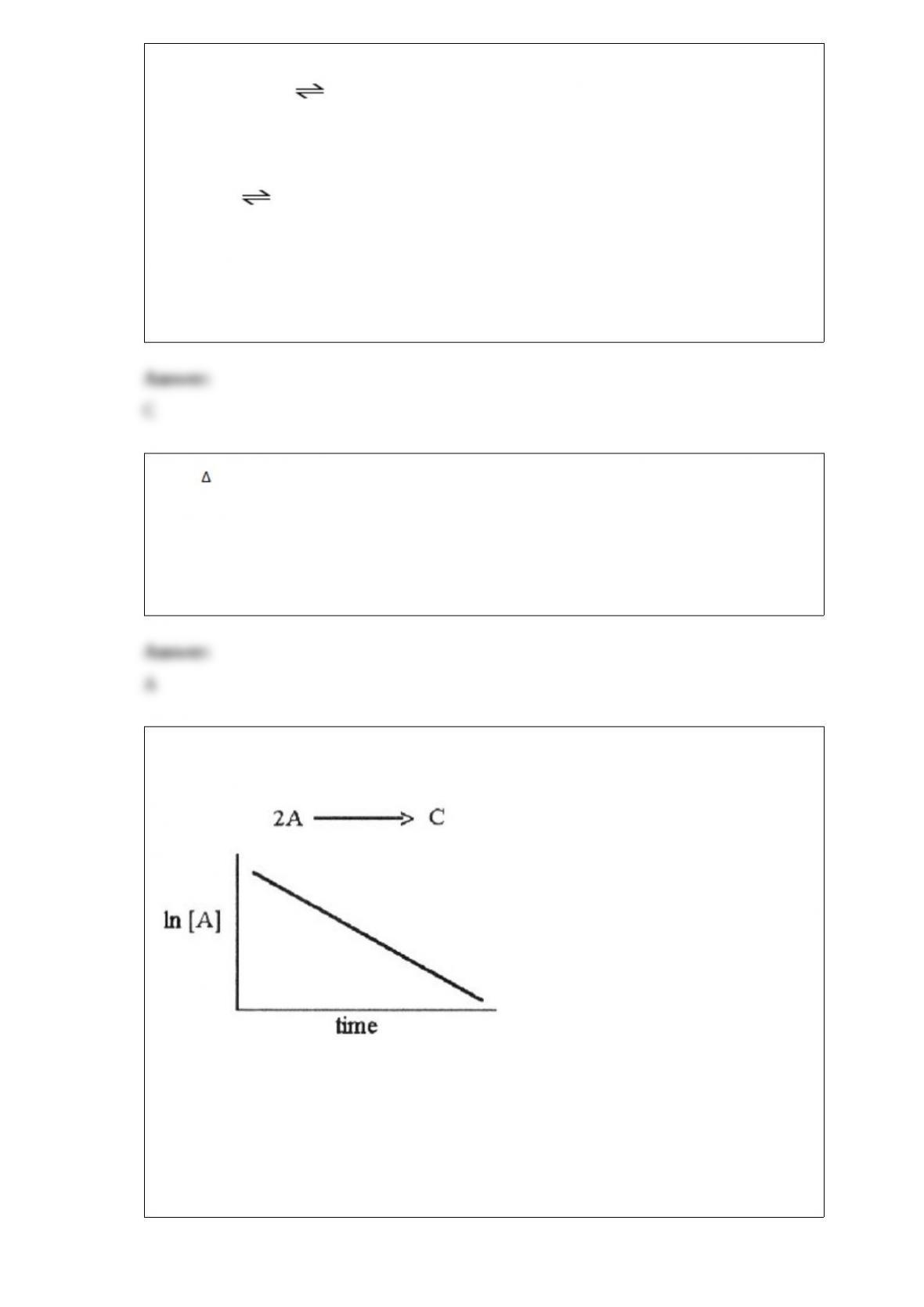
2NO (g) + Br2 (g) 2NOBr (g)
is Kp = 0.016. Calculate Kp for the reverse reaction,
2NOBr (g) 2NO (g) + Br2(g).
A) 0.016
B) 1.6 x 10⁻⁴
C) 63
D) 0.99
E) 1.1
17) If G o for a reaction is less than zero, then ________.
A) K > 1
B) K = 1
C) K < 1
D) K = 0
E) more information is needed.
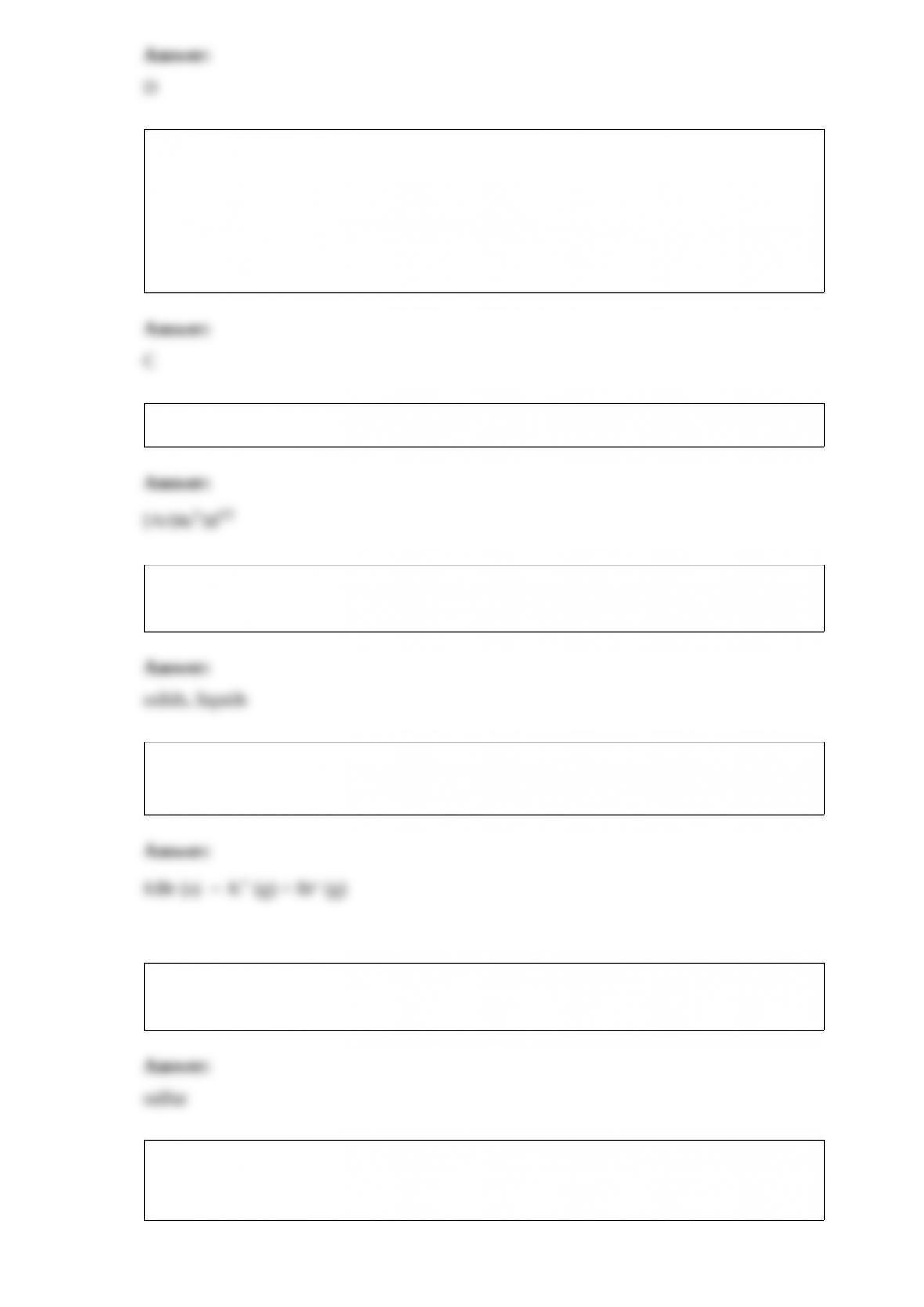
18) The graph shown below depicts the relationship between concentration and time for
the following chemical reaction.
The slope of this line is equal to ________.
A) k
B) -1/k
C) ln [A]o
D) -k
E) 1/k
19) What is the magnitude of the rate constant for the reaction?
A) 1.15 x 10⁴
B) 4.6
C) 230
D) 115
E) 713
20) The ground state electron configuration of copper is ________.
21) Pure ________ and pure ________ are excluded from equilibrium-constant
expressions.
22) Write the balanced chemical equation for the reaction for which ΔH°rxn is the lattice
energy for potassium bromide.
23) Coal contains hydrocarbons of high molecular weight as well as compounds
containing ________, oxygen, or nitrogen.
24) How many grams of CH3OH must be added to water to prepare 175 mL of a
solution that is 1.0 M CH3OH?

25) What colors of light does chlorophyll-a absorb?