Which of the following is a form of flexible pricing?
a. odd-even pricing
b. yield management pricing
c. above-, at-, or below-market pricing
d. target pricing
e. cost-plus pricing
Answer:
When Theresa Martinez relocated from the East to the Midwest, she needed to find a
bank with offices in her new state. Several banks offered banking products (checking
and savings accounts, loans, certificates of deposit) and other financial products (mutual
funds, insurance) that were available from her former bank. After selecting U.S. Bank,
Theresa later needed some help with her accounts and went to visit her personal banker.
She was very impressed with the banker’s attitude and willingness to explain certain
items to her in terms she could understand. The service Theresa received from the U.S.
Bank banker exhibited __________ properties.
a. credence
b. expertise
c. experience
d. search
e. customer relationship
Answer:
Dependability is the consistency of replenishment. This is important to all firms in a
supply chain and to consumers. It can be broken into three elements: safe delivery,
complete delivery, and __________.
a. honest and accurate pricing
b. quality products
c. consistent lead time
d. a well-informed delivery staff
e. product warranties
Answer:
Tuition, charges, fares, and rates are all
a. euphemisms for the name “price” to the price factor in services.
b. names given to the price of services.
c. names given to the intangible portion of the price of a service.
d. names that are interchangeable when identifying the price of a service.
e. terms used in services to imply a higher quality product than the terms “cost” or
“price.”
Answer:
Which of the following statements regarding the preapproach stage for international
selling is most accurate?
a. Customs rarely influence a preapproach protocol.
b. The preapproach stage is shorter and less intensive than with domestic consumers.
c. Customs are very important in dictating appropriate protocol.
d. In most cases, the buyer rather than the seller initiates the contact between seller and
buyer.
e. Pricing or price ranges are presented to the customer in order to determine if the
customer is a qualified lead.
Answer:
The term “bricks and clicks” refers to __________ and __________ respectively.
a. catalogs; websites
b. search engines; websites
c. traditional retailers; online retailers
d. buildings; mice
e. computer savvy buyers; computer novice buyers
Answer:
The online consumer lifestyle segment called “hooked, online, and single”
a. are married couples with children at home who use the Internet like a consumer
magazine.
b. rarely spend money online and use the Internet only as an information source.
c. regularly visit their favorite bookmarked websites and spend the most money online.
d. regard the Internet as a convenient tool for buying music, books, and computer
software.
e. consist of young, affluent single consumers who spend more time online than any
other segment.
Answer:
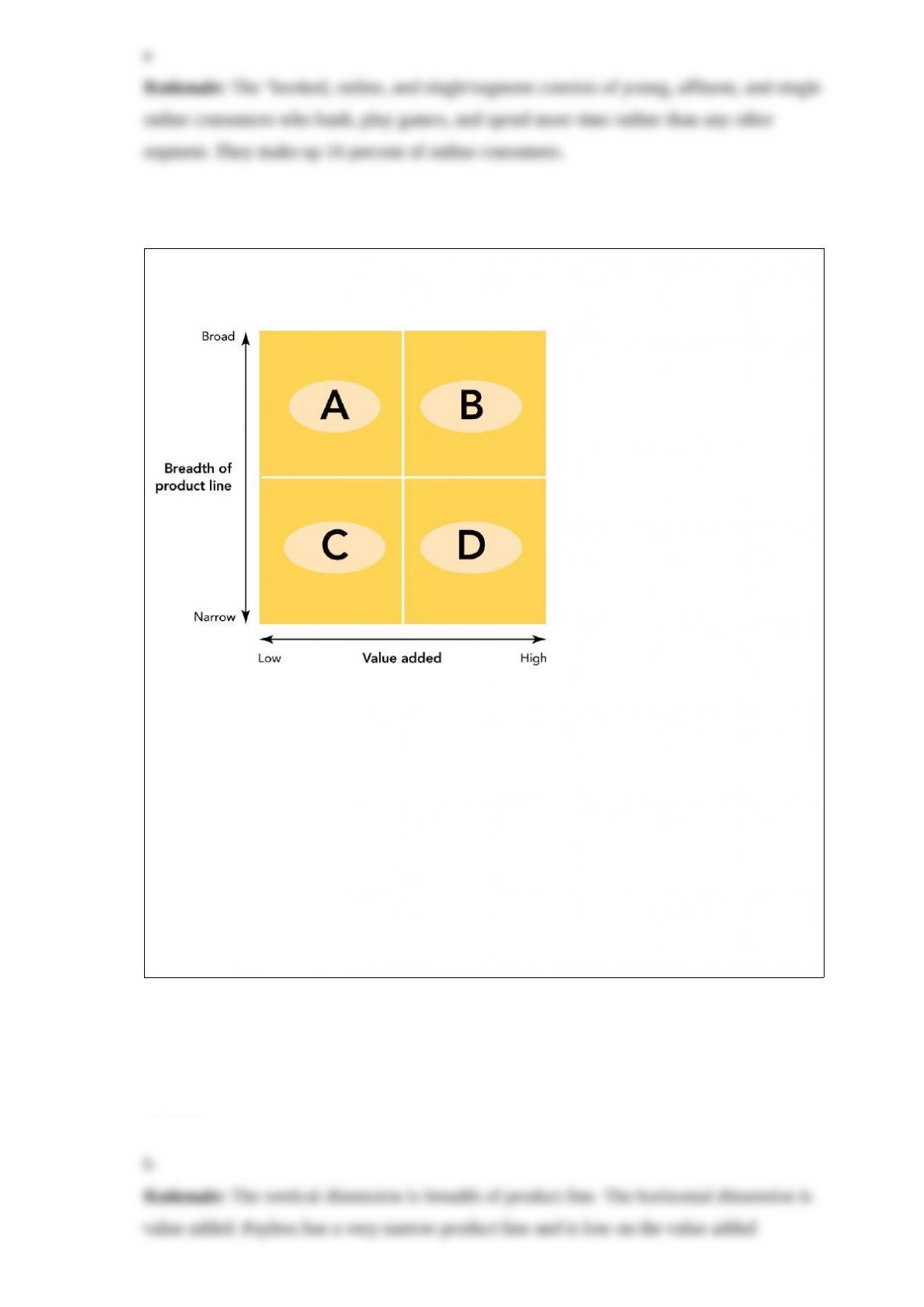
Figure 1.
Which of the following stores would best fit in “C” shown in Figure 1. above?
a. Kmart
b. Payless ShoeSource
c. Dillard’s department store
d. 7-Eleven
e. Lamborghini automobile dealer
Answer:
Which of the following statements regarding labels is most accurate?
a. Although labels are can carry useful information, the less information communicated,
the better.
b. The brand logo or brand name should always be the largest image on a label.
c. Labels can be very expensive, but they are important because they often are the first
contact the consumer has with the product.
d. The best labels to use on food products are those that can be easily removed from the
can in case product changes need to be made.
e. One penny for every dollar consumers spend on products goes towards packaging
and labeling costs.
Answer:
One of Porter’s generic business strategies that focuses on reducing expenses and, in
turn, lowers product prices while targeting a broad array of market segments, is referred
to as a
a. differentiation focus strategy.
b. cost focus strategy.
c. differentiation strategy.
d. cost leadership strategy.
e. supply focus strategy.
Answer:
The ability to buy a soda from a vending machine demonstrates which element of the
marketing mix?
a. product
b. price
c. promotion
d. place
e. process
Answer:
Sterile Feral, Inc. is a nonprofit organization that catches wild or stray cats, and then
neuters, vaccinates, and releases them back into the wild. Veterinarians are particularly
impressed with how dependably the organization is able to perform its promised
service. With which service quality dimension are veterinarians most impressed?
a. assurance
b. tangibility
c. reliability
d. credibility
e. empathy
Answer:
Advertising and promotion costs tend to be higher with a __________ strategy because
the company must generate awareness among consumers and retailers for each new
brand name without the benefit of any previous impressions.
a. co-branding
b. private branding
c. multibranding
d. multiproduct branding
e. mixed branding
Answer:
Michael Porter has identified four key elements in a nation’s competitive advantage:
factor conditions; demand conditions; __________; and company strategy, structure,
and rivalry.
a. consumer behavior
b. workforce education and skill levels
c. related and supporting industries
d. governmental regulation
e. ethnocentrism
Answer:
Which type of sales presentation would be best suited for an inexperienced, less
knowledgeable salesperson?
a. need-satisfaction presentation
b. stimulus-response presentation
c. cold canvassing
d. canned sales presentation
e. directed selling presentation
Answer:
Directions on how and when to use a product and information about the source and
composition of a product that appear on packaging labels provide what kind of
benefits?
a. communication benefits
b. storage benefits
c. perceptual benefits
d. protection benefits
e. self-realization benefits
Answer:
Eppie’s Used Cars wanted to determine whether straight price discounting worked
better than a free gift. It ran two different television commercials on alternate
Wednesdays. Commercial A offered 20 percent off Blue Book price for any
4-wheel-drive vehicle on the lot while Commercial B offered a free tent with the
purchase of any 4-wheel-drive vehicle at Blue Book price. The offer was the
__________ variable. How many people responded to each type of offer was the
__________, and would suggest whether straight discounting or a gift incentive was the
better strategy for increasing traffic.
a. marketing; dependent variable
b. dependent ; independent variable
c. control data; independent variable
d. independent; dependent variable
e. dependent; control data
Answer:
Chip-N-Dough Cookie Company will let you select cookies and put a photo of yourself
on the tin. This is an example of
a. mass customization.
b. multiple marketing.
c. target marketing.
d. product clustering.
e. repositioning.
Answer:
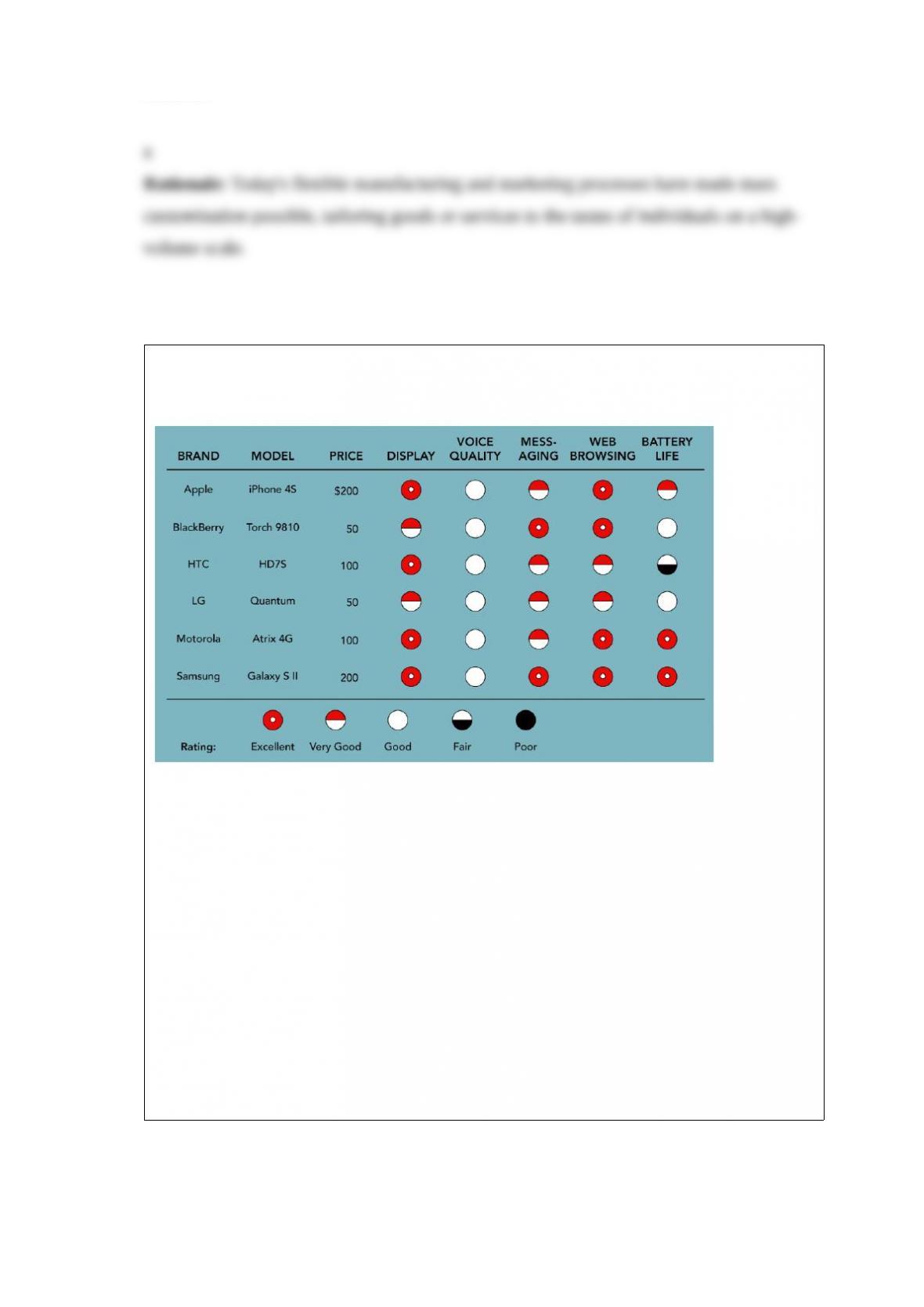
Figure 1.
In Figure 1. above, the first column “Brand” includes Apple, Blackberry, HTC, LG,
Motorola, and Samsung. These brands are referred to as the __________ when
consumers use Consumer Reports to evaluate smartphones.
a. consideration set
b. evaluative criteria
c. points of difference
d. value propositions
e. core benefits
Answer:
The fundamental, passionate, and enduring principles of an organization that guide its
conduct over time are referred to as its __________.
a. core values
b. strategic goals
c. vision
d. corporate culture
e. corporate ethos
Answer:
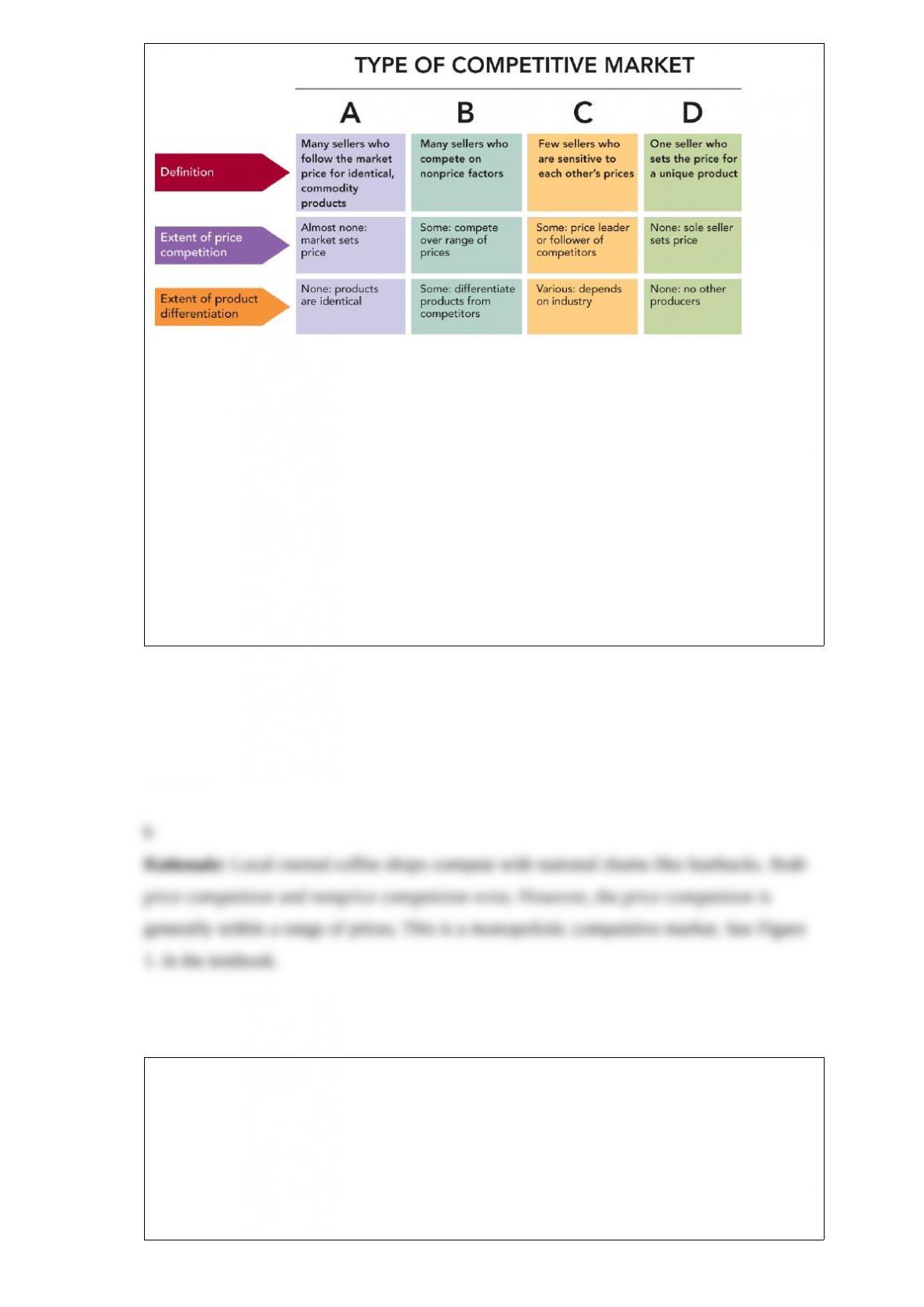
Figure 1.
Using Figure 1. above, how much price competition is likely for small coffee shops?
a. There is almost none; the market sets the price.
b. There are many sellers competing within a range of prices.
c. There is generally a price leader that sets the price.
d. Starbucks sets the price and all other coffee shops follow its lead.
e. Price is set by the seller but regulated by the government.
Answer:
One marketing action that can be taken to sell a single product or service to multiple
market segments is to
a. develop and produce another version of the product.
b. manufacture products that appeal to different markets.
c. develop separate promotional campaigns.
d. purchase another firm that has additional products that would appeal to multiple
markets.
e. issue stock to fund additional research and development for new products.
Answer:
Which salesforce organizational structure is best when there are many different
consumers with many different or specialized needs?
a. NAICS
b. customer
c. product
d. geographical
e. market segmentation
Answer:
Mall intercept interviews refer to
a. impersonal data collection methods in strip shopping malls.
b. telephone interviews with consumers about their shopping center habits.
c. scientifically-selected individuals from the local community who agree to participate
in a research study and are directed to go to a specific shopping center where the
interviews will be conducted.
d. focus groups located in major shopping centers.
e. personal interviews of consumers visiting shopping centers.
Answer:
Barriers to entry refer to
a. business practices or conditions that make it difficult for new firms to enter the
market.
b. governmental prohibitions regarding the establishment of businesses that are
considered immoral.
c. governmental prohibitions regarding the establishment of businesses that are
considered legal but unethical.
d. restrictive fees that are set intentionally high in order to prevent additional
competition in an already highly competitive industry.
e. strong-armed tactics that are illegal but commonly used in certain industries to hinder
competition.
Answer:
With a __________ compensation plan, a salesperson is paid a specified salary plus a
commission on sales or profits generated.
a. sales response
b. combination
c. straight sales
d. straight commission
e. market share
Answer:
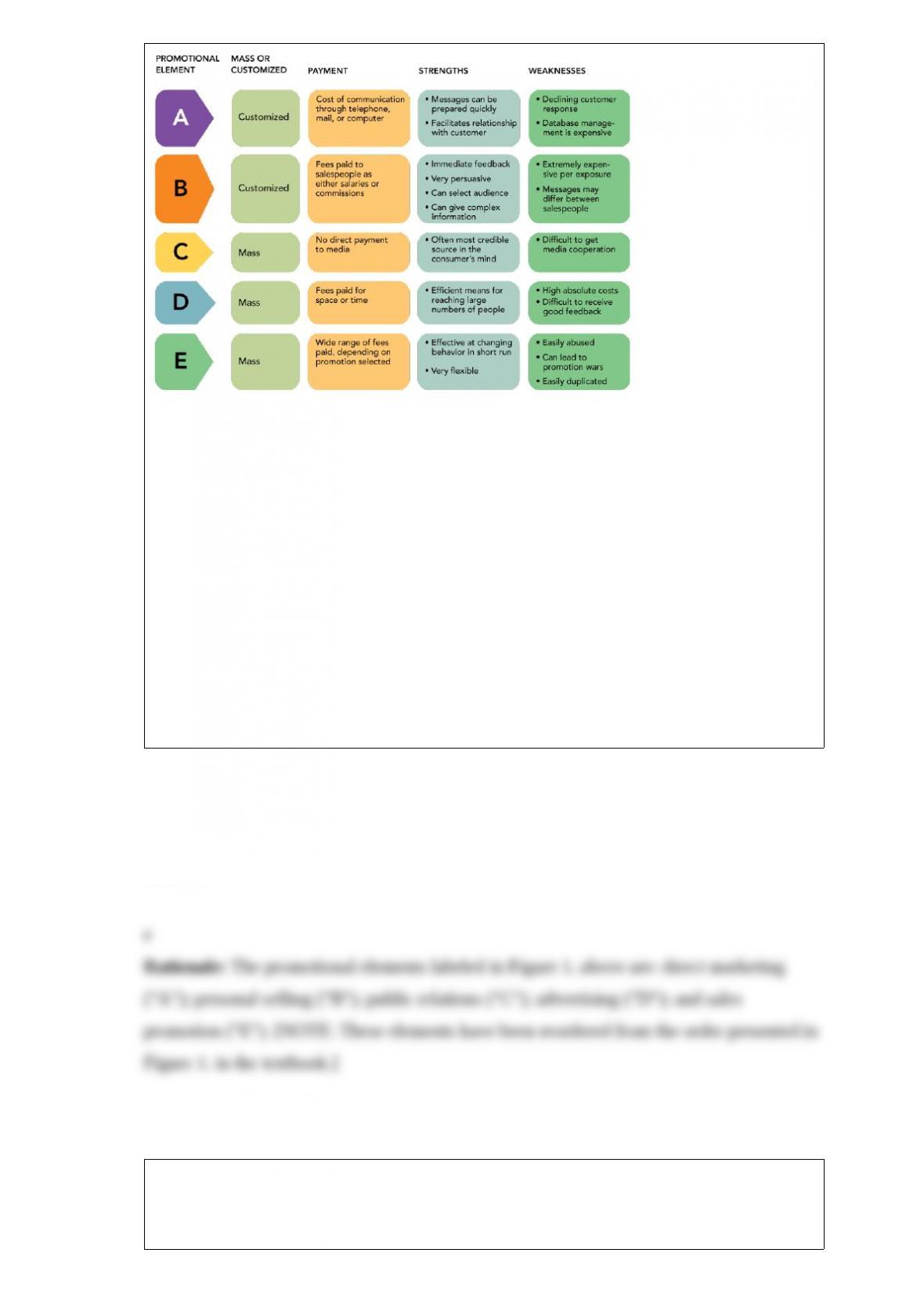
Figure 1.
To communicate with consumers, a company can use one or more of five promotion
alternatives. In Figure 1. above, the promotional element labeled “A” represents
_________.
a. advertising
b. personal selling
c. public relations
d. sales promotion
e. direct marketing
Answer:
The Department of Labor monitors consumer expenditures through its annual
__________.
a. Consumer Price Index
b. Consumer Confidence Index
c. Consumer Expenditure Survey
d. Index of Consumer Sentiment
e. National Consumer Spending Survey
Answer:
Promotional expenses at the maturity stage of the product life cycle are often designed
to __________.
a. convince those who have abandoned the brand to try it again
b. maintain market share
c. create a sense of nostalgia
d. attract more price conscious consumers
e. thwart the growing number of competitors that have entered the market
Answer:
One problem that can occur from the use of a transactional website is __________,
even though marketers claim the number of new customers they attract to stores offsets
this problem.
a. customer attrition
b. stickiness
c. cannibalization
d. unauthorized buzz
e. excessive product returns
Answer:
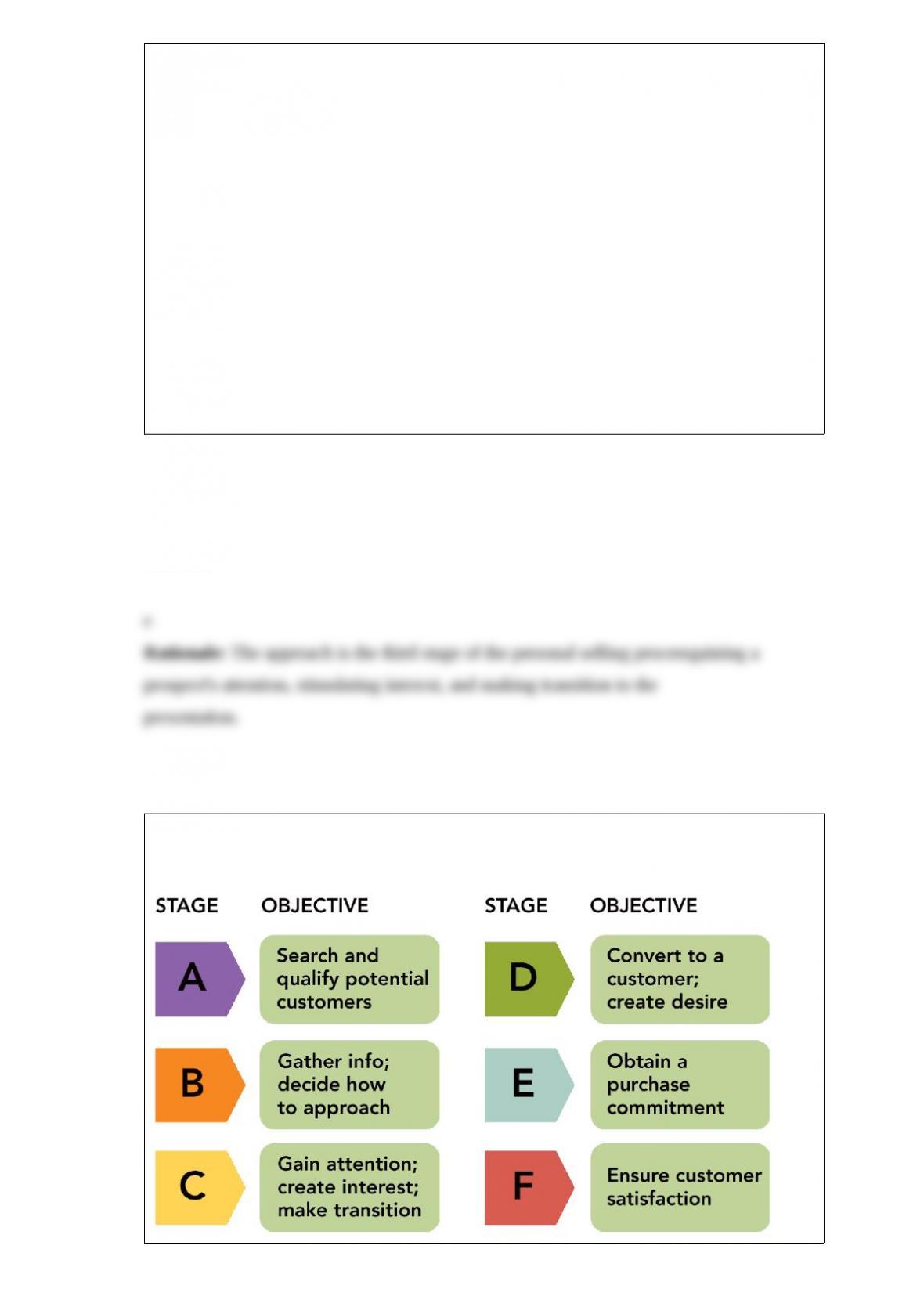
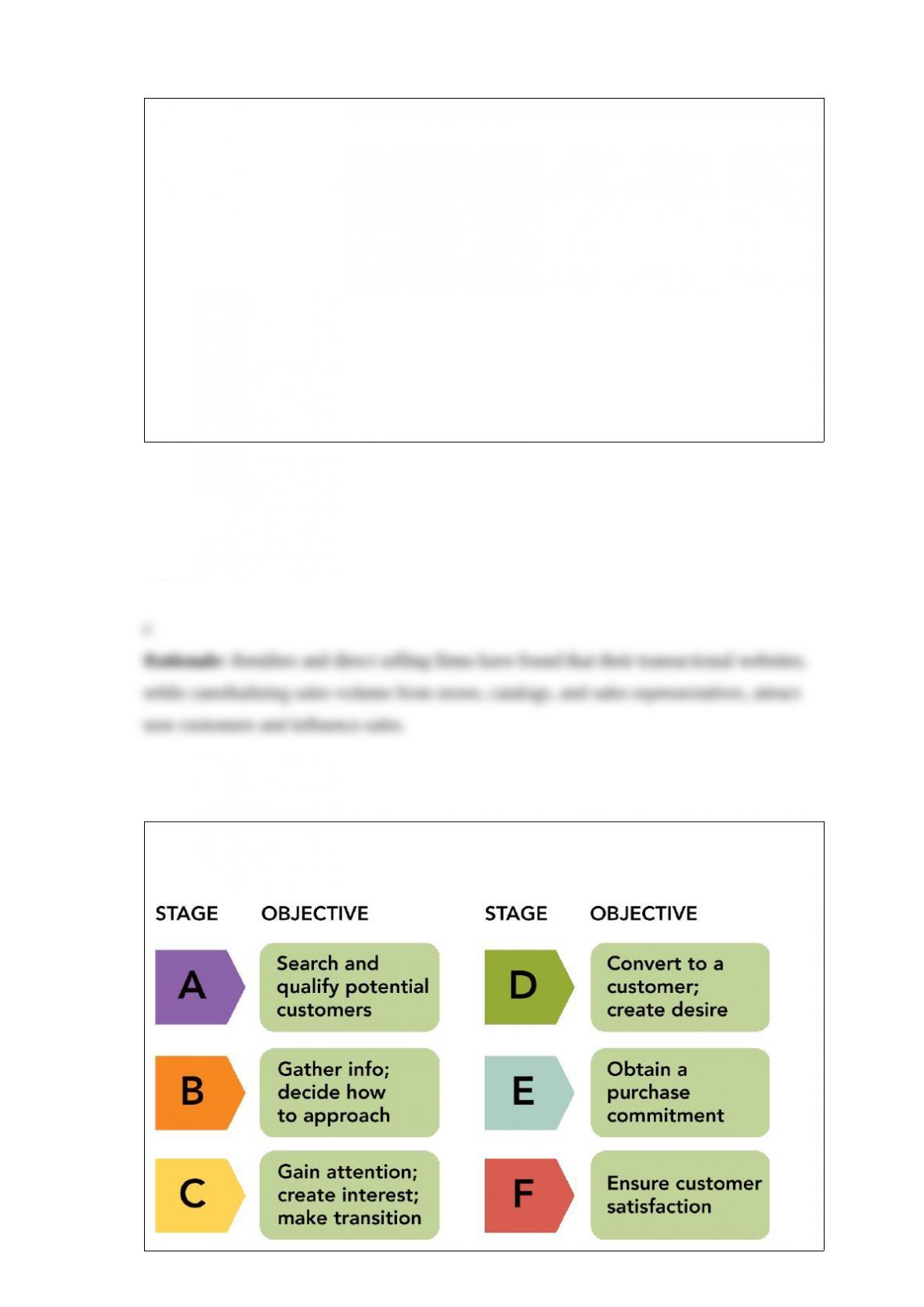
Figure 1.
Figure 1. above shows there are six stages in the personal selling process (“A” through
“F”) along with the objective(s) of each stage. If the salesperson’s objective is to “gain a
prospect’s attention, stimulate interest, and make transition to the presentation,” what
stage of the personal selling process is the salesperson engaged in?
a. presentation
b. follow-up
c. prospecting
d. preapproach
e. approach
Answer:
Figure 1.
As shown in Figure 1. above, “F” is the__________ stage in the personal selling
process.
a. presentation
b. follow-up
c. preapproach
d. close
e. approach
Answer:
When a U.S. airplane manufacturer sells its airplanes to business executives in
Germany without using intermediaries, it is referred to as
a. direct exporting.
b. indirect exporting.
c. licensing.
d. foreign manufacturing.
e. foreign assembly.
Answer:
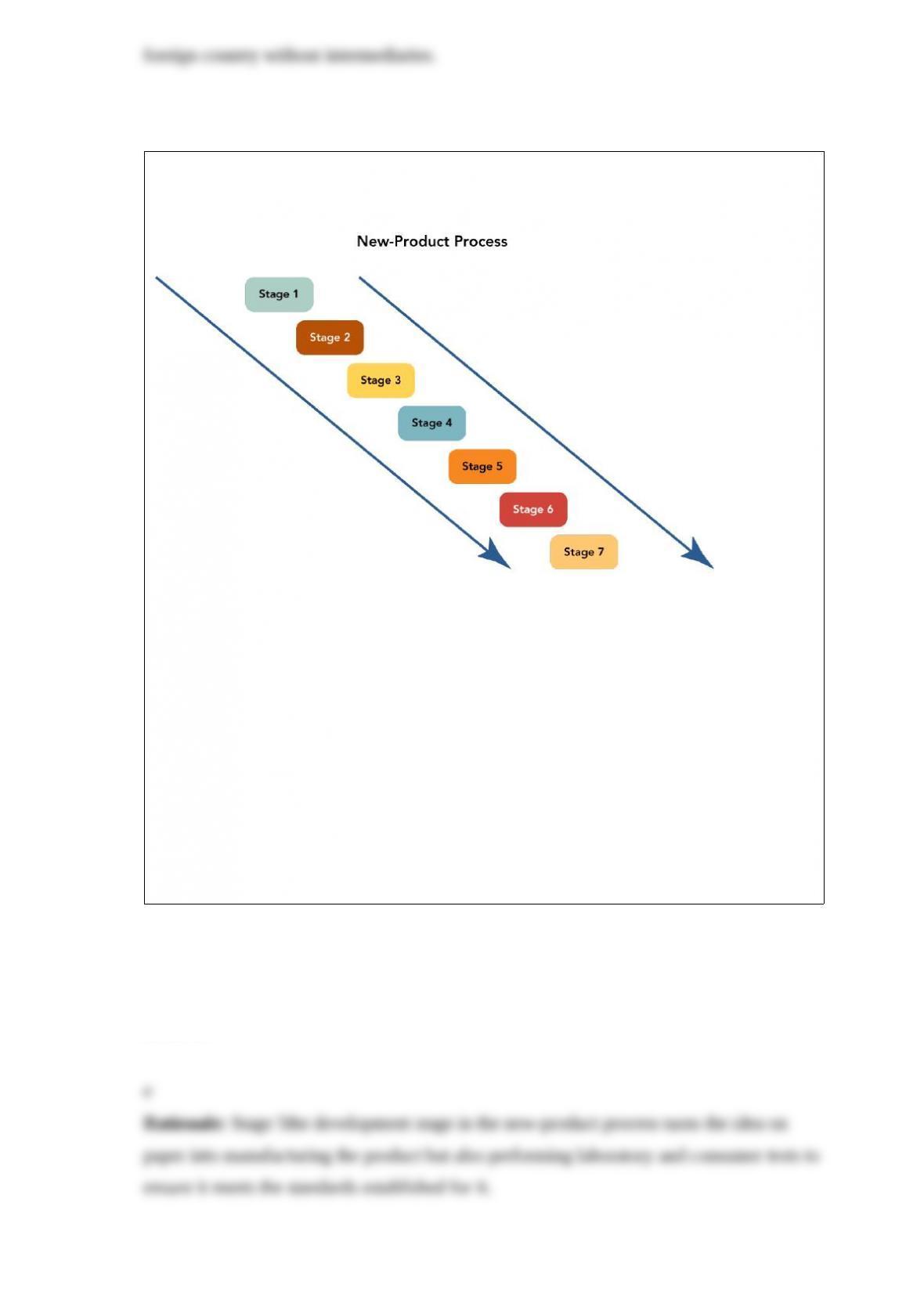
Figure 1.
Figure 1. above represents the seven stages of the new-product development process.
Stage 5 is the __________ stage.
a. business analysis
b. screening and evaluation
c. market testing
d. commercialization
e. development
Answer:
The European Union consists of 27 member countries. This single market houses more
than __________ million consumers with a combined GDP that is larger than that of the
United States.
a. 100
b. 200
c. 300
d. 400
e. 500
Answer:
List the four sequential steps used to develop brand equity. Which step is the most
difficult?
Answer:
How long is a product life cycle? What determines its length?
Answer:
Explain the four ways to classify marketing decisions according to ethical and legal
relationships.
Answer:
What is the difference between a movement along a demand curve and a shift of a
demand curve?
Answer:
What is the value of retailing for consumers and the economy?
Answer:
Explain the price equation in the context of a new car purchase.
Answer:
Define and describe at least one similarity and one difference between dual distribution
and a strategic channel alliance.
Answer:
A new sandwich shop has opened just off-campus and would like the university
students to frequent the shop whenever they are hungry. What is the best type of sales
promotion to use to reach them and why?
Answer:
Why would an organization produce a single product or service and then attempt to sell
it to two or more market segments?
Answer:
What are the three steps used in choosing a supply chain?
Answer:
What is the difference between a semantic differential scale and a Likert scale?
Answer:
Define the customer experience from an interactive marketing perspective. List the
seven website design elements that companies use to produce a customer experience.
Which two of these design elements provide a platform for the other five?
Answer:
Explain why odd-even pricing may be successful.
Answer:
Define consumer socialization.
Answer:
Explain the market research that David Windorski, 3M inventor, did to develop the
Post-itFlag Highlighter.
Answer:
At the BMW website, BMW.com, you can design your own personal BMW. If you
choose to use this method to purchase a car, what type of utility(ies) has(have) been
created?
Answer: