Best Foods Company is considering expanding beyond the regional market segments
now served by its Hellmann’s mayonnaise. One criterion management wants to use to
evaluate potential new geographic market segments is whether new equipment must be
bought to serve each new segment. This is an example of which criterion used to select
target market segments?
a. Best Foods’ competitive position in the segment
b. Best Foods’ created product groupings
c. expected growth of the market segment
d. size of the market segment
e. cost of reaching the segment
Answer:
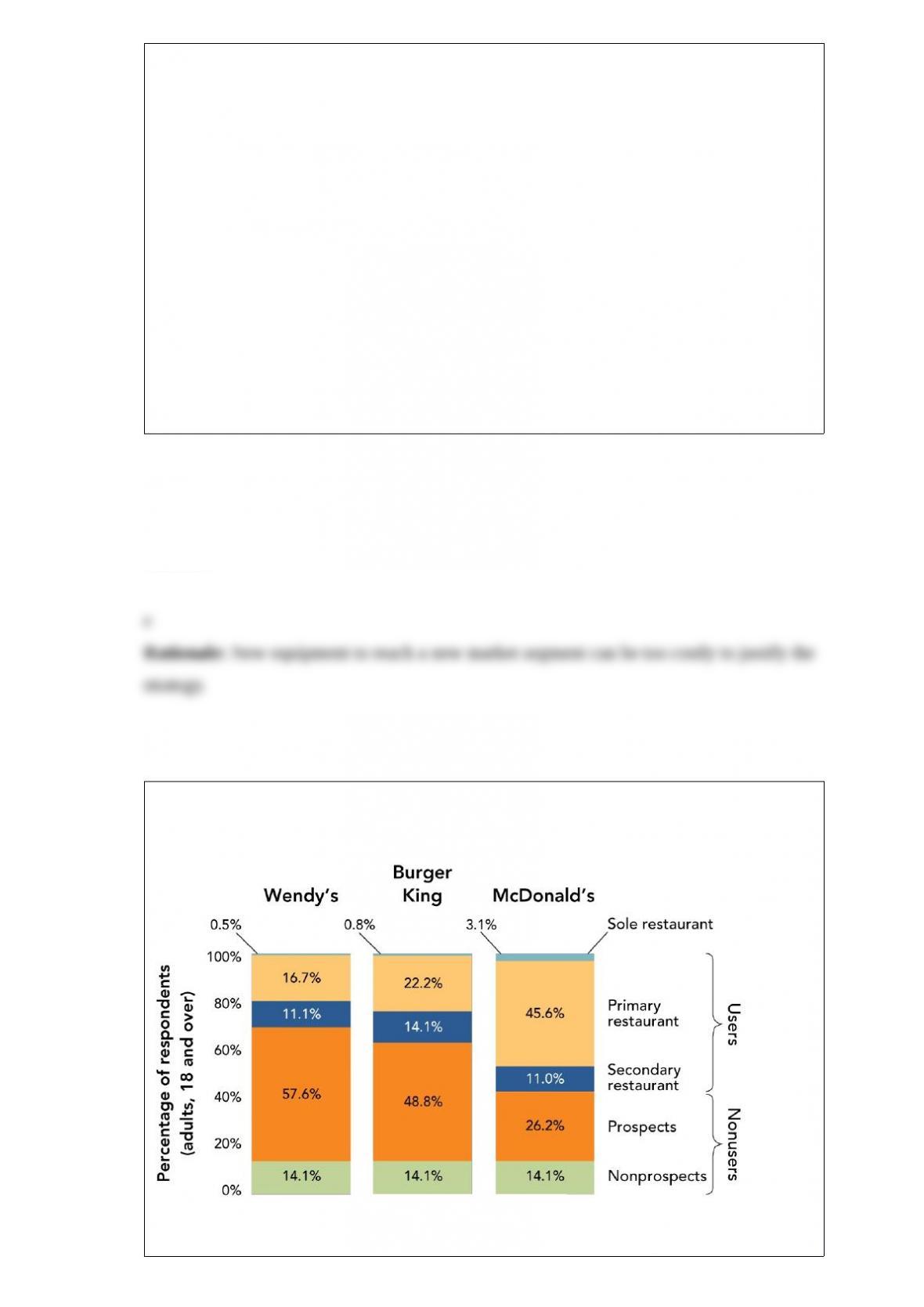
Figure 1.

As an owner of a Wendy’s fast food restaurant, the information in Figure 1. above
suggests that Wendy’s prospects are __________ of the total compared to __________
for McDonald’s.
a. 48.8 percent, 57.6 percent
b. 16.7 percent, 45.6 percent
c. 57.6 percent, 48.8 percent
d. 16.7 percent, 22.2 percent
e. 57.6 percent, 26.2 percent
Answer:
Bots contribute to the convenience of online shopping because they
a. reduce time spent online.
b. allow customers to make online comparisons of prices and product features.
c. permit customers to design one-of-a-kind items that fit their specific needs.
d. allow customers to engage in an electronic dialogue with marketers.
e. offer customers almost any product or service they want.
Answer:
From an organization’s perspective regarding its new products and innovations, which
of the following new-product strategies has the lowest level of risk?
a. a radical invention
b. a brand extension
c. a product line extension
d. a jump in innovation
e. a product deletion
Answer:
Which of following statements is NOT true about attitudes?
a. Marketers are primarily concerned with American core values when developing
advertising messages.
b. Attitudes are learned.
c. Attitudes are shaped by one’s values and beliefs.
d. An attitude is a learned predisposition to respond to an object or class of objects in a
consistently favorable or unfavorable way.
e. Personal values affect attitudes by influencing the importance assigned to specific
product attributes.
Answer:
Economists have identified four types of competitive markets: pure monopoly,
monopolistic competition, oligopoly, and __________.
a. pure competition
b. government-dominated
c. capitalist
d. socialist
e. communist
Answer:

Which of the following statements about cost and its impact on online shopping is most
accurate?
a. Fixed pricing is commonly used online because there is no need to respond quickly to
changes in supply and demand conditions.
b. The margins for online goods are usually higher than those purchased in traditional
marketplaces.
c. Any price advantage for online purchases is lost in shipping and handling fees.
d. Many popular items bought online can be purchased at the same price or cheaper
than in retail stores.
e. Dynamic pricing is the most commonly used pricing strategy for Internet purchases.
Answer:
The two general methods for quoting prices related to transportation costs are FOB
origin pricing and __________.
a. uniform delivered pricing
b. mode of transportation pricing
c. regional pricing
d. flexible pricing
e. FOB destination pricing
Answer:
Promotional expenditures at the introduction stage of the product life cycle are best
spent on __________.
a. contests and sweepstakes to stimulate selective demand
b. product samples to create secondary demand
c. advertising to cultivate primary demand
d. personal endorsements to generate word of mouth demand
e. coupons to maintain brand loyalty or static demand
Answer:
Business firms pursue several different types of goals. A(n) __________ goal is when a
firm seeks to balance the conflicting goals of stakeholders to promote their overall
welfare, even at the expense of profits.
a. customer satisfaction
b. shareholder
c. profit minimization
d. social responsibility
e. employee welfare
Answer:
The sales process at Xerox typically follows the six stages of the personal selling
process. During the sixth stage, the salesperson continues to meet and communicate
with the client to __________.
a. remove all competitors’ products from the clients’ offices
b. sell ancillary and complementary products
c. provide assistance and monitor the effectiveness of the installed solution
d. request leads for other potential sales
e. offer special price incentives for future pre-buys
Answer:

Making special adjustments to the list or quoted price would occur during __________
of the price-setting process.
a. Step 2
b. Step 3
c. Step 4
d. Step 5
e. Step 6
Answer:
In addition to seeking ideas from more well-known sources, organizations also get ideas
from universities, inventors, and small nontraditional firms. For example, inventor Gary
Schwartzberg sold his idea for __________ to Kraft Foods, Inc.
a. scones with coffee-flavored cream filling
b. an Omega-3 enriched SKU for the Philadelphia cream cheese line
c. tube-shaped bagels filled with Philadelphia cream cheese
d. deep fried chicken skins for people who cannot eat pork
e. a crispy baked macaroni and cheese snack that can be eaten out of a bag like Cheetos

Answer:
DirectProtect is an insurance provider that uses telemarketers rather than insurance
agents to sell its insurance and deal with claims. It wants to introduce its product into
new markets, but before it does so, it wants to have a prediction of how successful its
sales efforts will be. The first thing researchers did was invite in a group of eight
insured people to talk about home and auto insurance. Their conversation was recorded
and later analyzed to determine if there were any differences between customers from
different markets. This was an example of a(n)
a. experiment.
b. focus group.
c. panel.
d. evaluative interview.
e. depth interview.
Answer:
The Starch test uses aided recall to determine the percentage of those who: (1)
remember seeing a specific magazine ad, (2) _________, (3) read any part of the ad,
and (4) read at least half of the ad.
a. felt the ad was vague or ambiguous
b. felt elements of the ad were inappropriate
c. could summarize the key ad points in their own words
d. saw or read any part of the ad identifying the product or brand
e. remembered having seen the ad before and had already tried the product
Answer:
Coca-Cola hired “brand police” to make sure that the Coca-Cola brand name and logo
are not used without written permission. Why is Coca-Cola so rigorous in protecting its
trademark?
a. Coca-Cola risks losing its generic status.
b. In order to maintain the use of its widely recognizable trademark, Coca-Cola must

prevent the name from becoming generic.
c. The Robinson-Patman Act conferred ownership of the Coke name and other
trademarked property to the Coca-Cola Company.
d. The government will file charges for trademark infringement only if the owner of the
trademark has documented proof of wrongdoing.
e. By protecting its trademark, Coca-Cola is protecting the entire soft drink industry
from indirect competition.
Answer:
Synergy analysis seeks opportunities by finding the optimum balance between
a. the needs of the manufacturer versus the needs of the consumer.
b. the desire for profit versus responsibility to society as a whole.
c. the expense of marketing effort versus the marketing results obtained.
d. a firm’s market segments and its product groupings.
e. marketing efficiencies versus R&D-manufacturing efficiencies.
Answer:

Forever Quilting is a company that designs and distributes quilting kits. The kits are
priced at $120 each. The costs of the materials that go into each kit are $45. It costs $5
in labor to assemble a kit. The company has monthly expenses of $1,000 for rent and
insurance, $200 for heat and electricity, $500 for advertising in quilting magazines, and
$3,500 for the monthly salary of its owner. Forever Quilting’s marginal revenue is
a. $50.
b. $70.
c. $120.
d. $3,500.
e. $5,200.
Answer:
Motorola invented the Six Sigma program that sets as a goal no more than one defect in
one million parts manufactured. This is an example of a(n) __________ goal.
a. profit
b. sales revenue
c. quality
d. market share
e. employee welfare
Answer:
Mountain Dew’s Dewmocracy 2 campaign featured a seven-stage process. Stage One
involved
a. designing a label for the can.
b. a truck stop tour with samples of new flavors.
c. fans organizing into “flavor nations.”
d. color selection.
e. naming the product.
Answer:
The __________ for Lucent Technologies is “To use our unique capabilities to ensure
that our customers thrive, our business grows, and we enrich the personal
communications experience for people around the world.”
a. sustainability doctrine
b. core benefit proposition
c. corporate philosophy
d. mission statement
e. code of ethics
Answer:
A custom tailor wishes to use target profit pricing to establish a price for a
custom-designed business suit. Assume variable cost is $200 per suit, fixed cost is
$44,000, and the target profit is $50,000 based on a volume of 50 suits. What price
should be charged for a typical custom suit?
a. $520
b. $1,040
c. $1,880
d. $2,080
e. $10,000
Answer:

A good has tangible attributes that a consumer’s __________ can perceive.
a. cognitive intelligence
b. knowledge of past experiences
c. five senses
d. sixth sense
e. emotional intelligence
Answer:
Which of the following statements about market segmentation for organizational
markets is most accurate?
a. Criteria for segmenting markets are the same whether the market is composed of
consumers or organizations.
b. Both consumer markets and organizational markets use demographic, geographic,
and behavioral bases to segment markets.
c. Psychographic criteria are just as important in segmenting organizational markets as
they are in segmenting consumer markets.
d. Organizational markets use exactly the same selection criteria as consumer markets.
e. The greatest difference in market segmentation strategies between consumer and
organizational markets is the number of employees employed in the segmentation
process.
Answer:
A common financial indicator of how effectively retail space is used to generate
revenue can be calculated by determining __________.
a. net sales
b. shareholders’ equity
c. market share
d. sales per square foot
e. return on investment
Answer:
When Betty Crocker repeatedly advertises that baking a cake from one of its mixes
tastes just like homemade, it is influencing which type of learning?
a. stimulus discrimination
b. cognitive learning
c. brand loyalty
d. stimulus generalization
e. behavioral learning
Answer:
A trade promotion where the manufacturer gives a retailer a case allowance price for
products in their warehouse, which prevents shelf stock from running down during the
promotional period is referred to as a __________.
a. level stock protection program
b. floor stock protection program
c. ceiling stock protection program
d. ground stock protection program
e. hedge stock protection program
Answer:
The Boston Consulting Group (BCG) uses business portfolio analysis to quantify
performance measures and growth targets to analyze its clients’ strategic business units
(SBUs)
a. as if each were a separate investment.
b. to establish their worth to society at large.
c. to determine which would be suited for a SWOT analysis.
d. to determine which units are candidates for diversification analysis.
e. to determine which units can be divided into smaller, tactical business units (TBUs).
Answer:
The purpose of the __________ is to forbid certain actions that are likely to lessen
competition, although no actual harm has yet occurred.
a. Federal Trade Commission Act
b. Lanham Act
c. Clayton Act
d. Sherman Antitrust Act
e. Robinson-Patman Act
Answer:
An advantage of the straight salary compensation plan is that __________.
a. it provides an incentive to expand sales volume
b. it can be easily adapted to changes in the economy
c. it doesn”t include nonselling activities that take time away from selling
d. salaries can be lower
e. it is easy to administer
Answer:
After the release of the movie E.T., sales of Hershey’s Reese’s Pieces soared while
Mars, the makers of M&M’s, regretted not permitting its product to be used in the film.
This is an example of _________.
a. product continuity
b. subsidized advertising
c. subliminal direction
d. reverse product placement
e. product placement
Answer:
The purpose of pioneering institutional advertisements is to
a. promote a specific brand’s features and benefits.
b. inform people what a company is, what it can do, and where it is located.
c. state the position of a company on an issue.
d. reinforce previous knowledge of a product.
e. promote the advantages of one product class over another.
Answer: