The reformulation of the original less sweet, more bitter Coca-Cola (now Coca-Cola
Classic) into a new sweeter one (eventually called New Coke) was one of the biggest
decisions in the firm’s history. Coke was responding to Pepsi’s gain in market share with
its sweeter formulation and its Pepsi Challenge taste tests and commercials. New Coke
replaced “old Coke” on supermarket shelves. Loyal Coke customers were incensed that
“old Coke” was discontinued. They loved the taste and brand identity of “old Coke” and
rebelled against New Coke. TV and print ads designed to persuade Coke and Pepsi
drinkers to switch to New Coke were ineffective. After a short period of time,
Coca-Cola reintroduced old Coke as Coca-Cola Classic. Eventually, Coca-Cola
withdrew New Coke from the market. The launch of New Coke is an example of
__________.
a. good planning and good implementation
b. good planning and poor implementation
c. poor planning and good implementation
d. poor planning and poor implementation
e. poor evaluation
Answer:
Figure 1.: Question 1
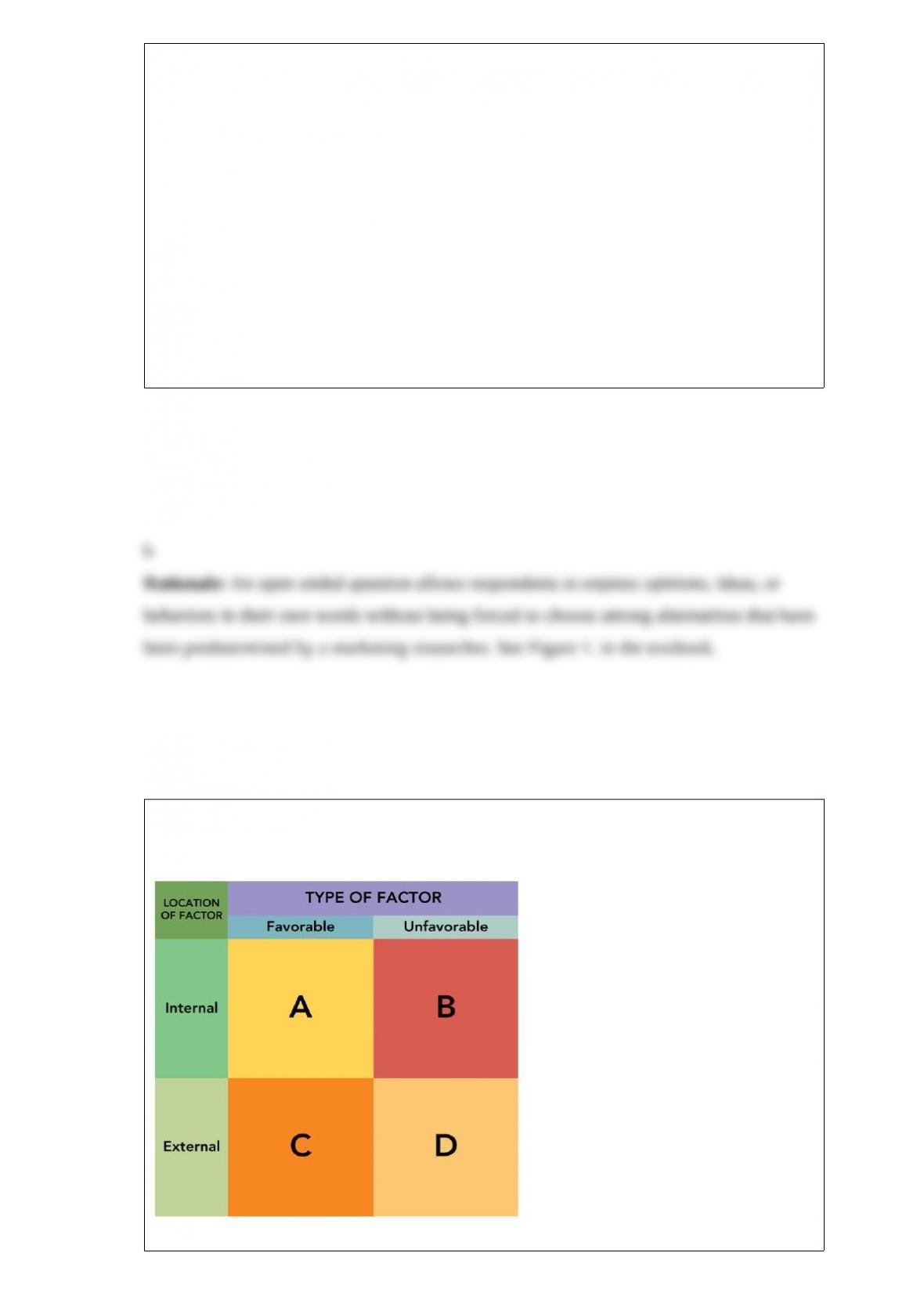
Consider Figure 1.: Question 1 above, which is part of a Wendy’s survey that assessed
fast-food restaurant preferences among present and prospective consumers. Question 1
illustrates which type of question format?
a. dichotomous
b. open-ended
c. close-ended
d. attitudinal
e. semantic differential
Answer:
Figure 1.
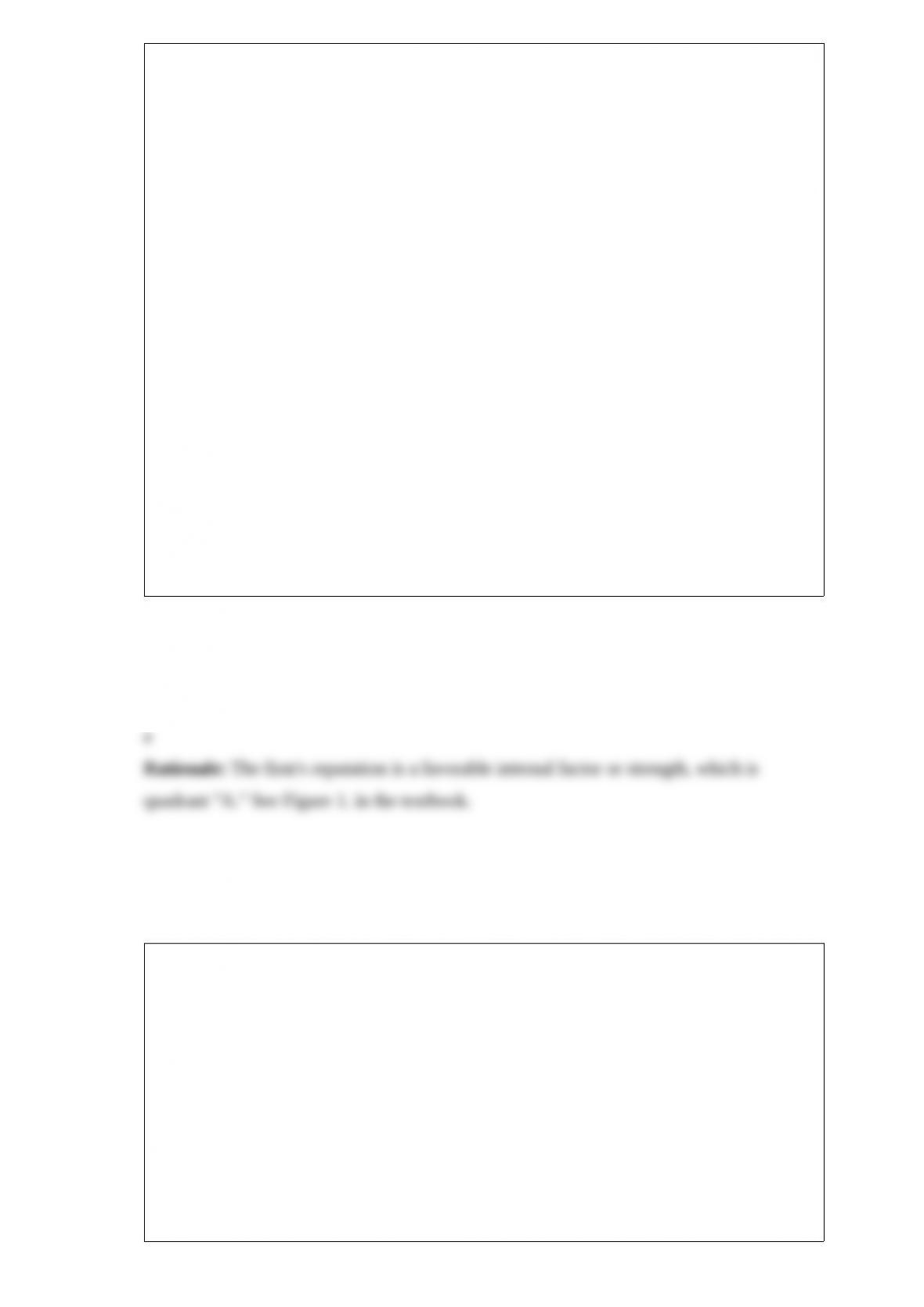
Consider Figure 1. above. A Florida-based flashlight company has been extremely
successful due in part to the number of hurricanes in Florida that result in power
outages. The firm is thinking of expanding its product offerings to include other
emergency supplies such as generators and survival kits (consisting of food bars, a
water filtration system, first aid supplies, etc.). Before going ahead with this decision,
there were several factors that had to be taken into consideration: (1) The firm has a
great reputation with its flashlights and does not want to ruin it. (2) Its physical plant
could be refitted relatively easily to make small generators, but it would be rather
costly. (3) It would have to rely on another firm to manufacture and package the
survival kits. (4) Although there are nine named hurricanes scheduled for the upcoming
year, no one really can predict what will happen. The company’s reputation would fall
in which quadrant(s) of the SWOT analysis grid?
a. “A”
b. “B”
c. “C”
d. “D”
e. “A” and “D”
Answer:
Communication is the process of conveying a message to others and it requires six
elements. These elements include: a source, a message, __________, a receiver, and the
processes of encoding and decoding.
a. a concept
b. an offer
c. a brand
d. a slogan
e. a channel of communication
Answer:
Figure 1.
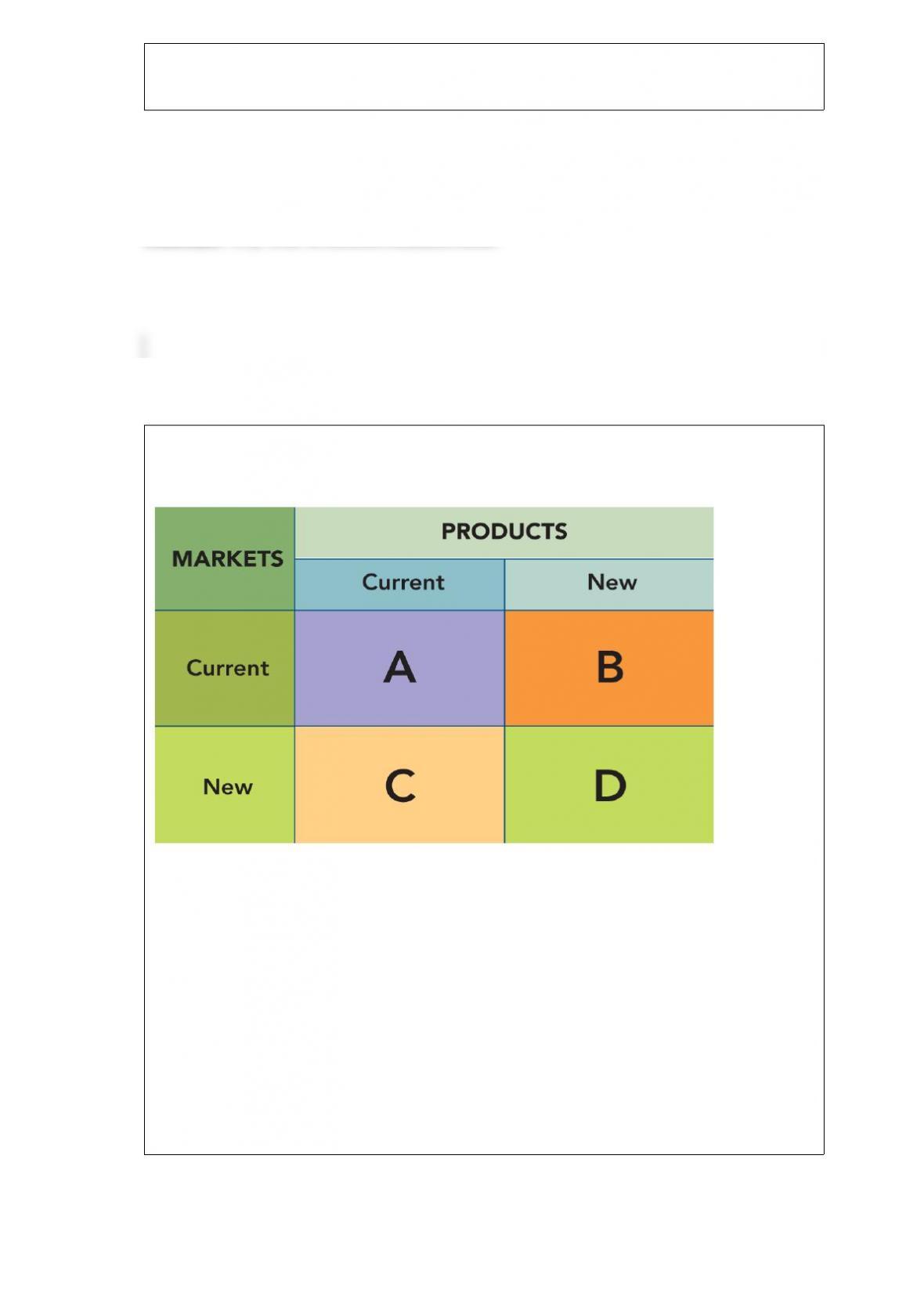
Quadrant “A” in Figure 1. above represents the marketing strategy of __________.
a. market penetration
b. product development
c. market development
d. product penetration
e. diversification

Answer:
If you wanted to set up a business importing amber from Latvia to the United States,
you would have to plan on paying the U.S. Customs Service roughly 20 percent of the
value of the product as a(n) __________.
a. bribe
b. tariff
c. subsidy
d. excise tax
e. quota
Answer:
As product adopters, members of the early majority __________.
a. have a fear of debt and use neighbors and friends as information sources
b. are skeptical and have below average social status
c. are deliberate and use many informal social contacts
d. are leaders in social settings and have a slightly above average education
e. are venturesome, highly educated, and use multiple information sources
Answer:
The communication aspect of packaging on a can of Campbell’s soup would most likely
be of the greatest benefit to __________.
a. people in a hurry to get to work
b. people on a tight budget
c. people with dietary restrictions
d. people who are brand loyal
e. people who love to try new things
Answer:
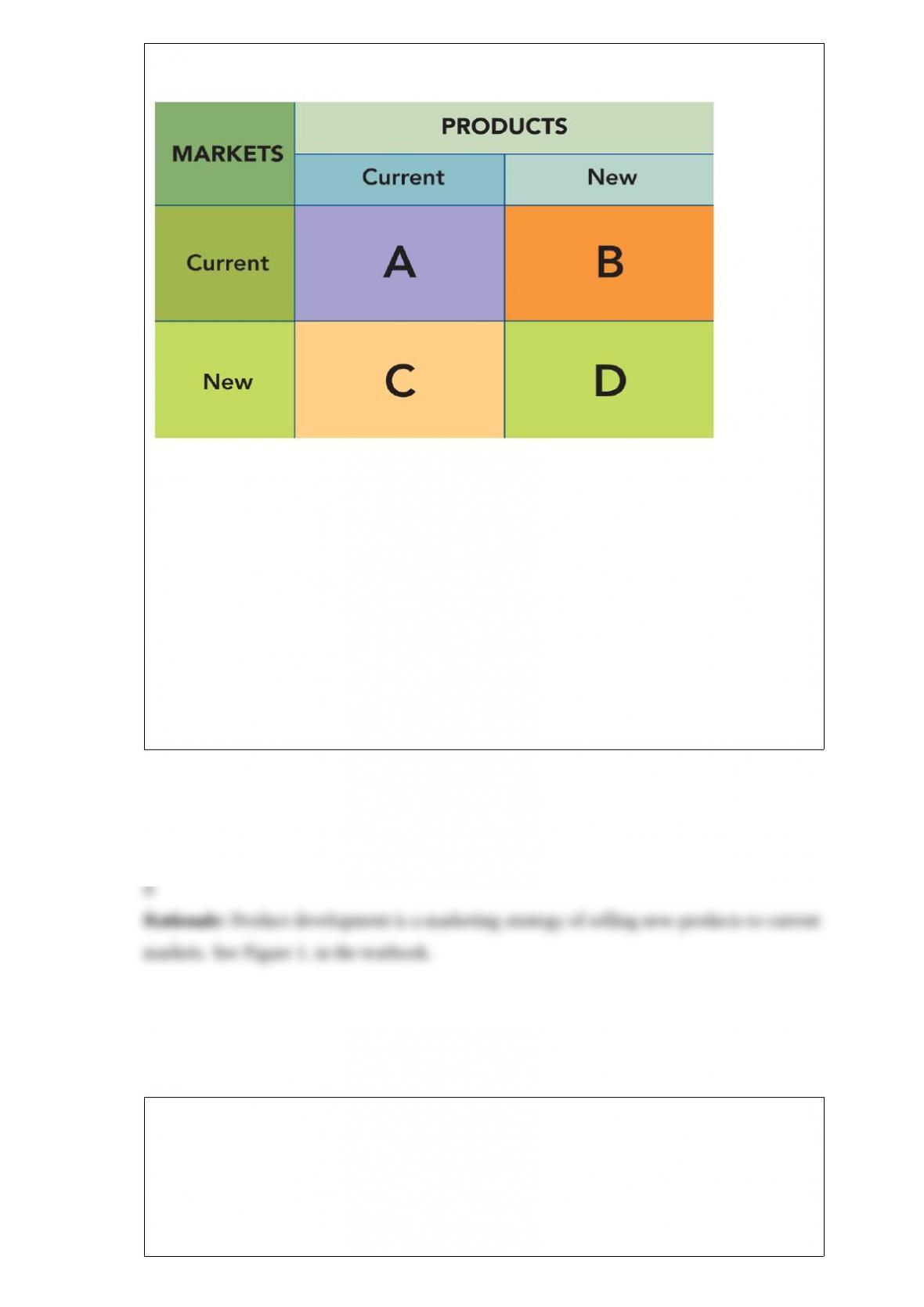
Figure 1.
Quadrant “B” in Figure 1. above represents the marketing strategy of __________.
a. market penetration
b. product penetration
c. market development
d. product development
e. diversification
Answer:
A disadvantage of a straight commission compensation plan is that __________.
a. it provides incentive to expand sales volume
b. it can discourage salespeople from providing customer service
c. it includes nonselling activities that take time away from selling
d. the overall compensation is usually lower than a straight salary compensation plan
e. it is difficult to administer
Answer:
One of the advantages associated with radio as an advertising medium is that it
a. has a long exposure time.
b. can target general audiences.
c. has an unlimited amount of advertising time available.
d. is relatively simple to convey complex messages.
e. uses humor, sound, and intimacy effectively.
Answer:
Social media deliberately seek to ensure that the message does not end with an
individual receiver. Social media seek to reach __________.
a. “two-way receivers”
b. “end receivers”
c. “active receivers”
d. “followers”
e. “connections”
Answer:
In the new-product process, product ideas that survive the business analysis stage
proceed to the __________ stage.
a. market testing
b. screening and evaluation
c. business analysis
d. development
e. commercialization
Answer:
The owners of a small toy store with a limited advertising budget were very concerned
about spending their advertising dollars wisely. One of their primary advertising goals
was to expose customers in a limited market area to their advertising messages as often
as possible. The owners of the toy store were concerned with
a. reach.
b. frequency.
c. gross rating points.
d. cost per thousand.
e. ratings.
Answer:
While reading the newspaper, Belinda noticed an advertisement containing a coupon
from Bayer that is redeemable only at Target stores. This ad is an example of
a. cooperative advertising.
b. co-branding.
c. a finance allowance.
d. a merchandise allowance.
e. specialty advertising.
Answer:
Netflix used to charge $14.99 per month for its movie rental service. However, when
Blockbuster introduced the same service at $13.99, Netflix then dropped its price to
$13.99. Netflix most likely made this price reduction in an attempt to
a. decrease revenue but increase profit.
b. increase profit by decreasing revenue.
c. maintain market share.
d. decrease market share.
e. increase efficiency.
Answer:
What type of contractual system describes a situation where assistance in selecting the
location, setting up the store or facility, advertising, and training personnel is provided?
a. administered system
b. conglomerate system
c. franchise system
d. vertical integrated system
e. retail-sponsored cooperative
Answer:
A set of human characteristics associated with a brand name is referred to as
__________.
a. a symbolic brand
b. a brand personality
c. a brand mannerism
d. brand personification
e. product personification
Answer:
Brand managers find out what people are saying about their brand on Twitter by
a. having employees perform spot-checks on posts.
b. creating their own Twitter account and seeing what “followers” say on Facebook.
c. using keyword search monitoring from services such as CoTweet or HootSuite.
d. recognizing that posts are too brief to allow for a substantive mention of their brand.
e. employing outside search services such as Google and Bing.
Answer:
Which of the following in NOT a criterion to use in forming market segments?
a. The ability to assign buyers to a segment is cost-effective and simple.
b. The result of segmenting will cause an increase in market share or profit.
c. There are significant similarities among buyers in the market segment.
d. There is a potential marketing action to reach the segment.
e. Buyers throughout the entire market have very similar wants and needs.
Answer:
Screening and evaluation refers to the stage of the new-product process
a. where prospective customers are exposed to new product prototypes for the first time.
b. where new product concepts that have been found viable are converted into actual
prototypes.
c. that internally and externally evaluates new-product ideas to eliminate those that
warrant no further effort.
d. that specifies the features of the product and the marketing strategy needed to bring it
to market and make financial projections.
e. where consumers evaluate a new product’s performance in an actual-use situation.
Answer:
A waitress at a Cracker Barrel restaurant uses __________ when she asks a family if
“they have left any room left for dessert.”
a. inquiry selling
b. formula selling
c. suggestive selling
d. method selling
e. a canned sales presentation
Answer:
Travel websites like Priceline.com are designed to be __________ oriented, with
emphasis on destinations, scheduling, and prices.
a. content
b. functionally
c. aesthetically
d. text
e. picture
Answer:
Which of the following is a cost-oriented pricing method?
a. loss leader pricing
b. standard markup pricing
c. at-, above-, or below-market pricing
d. price lining
e. penetration pricing
Answer:
Figure 1.
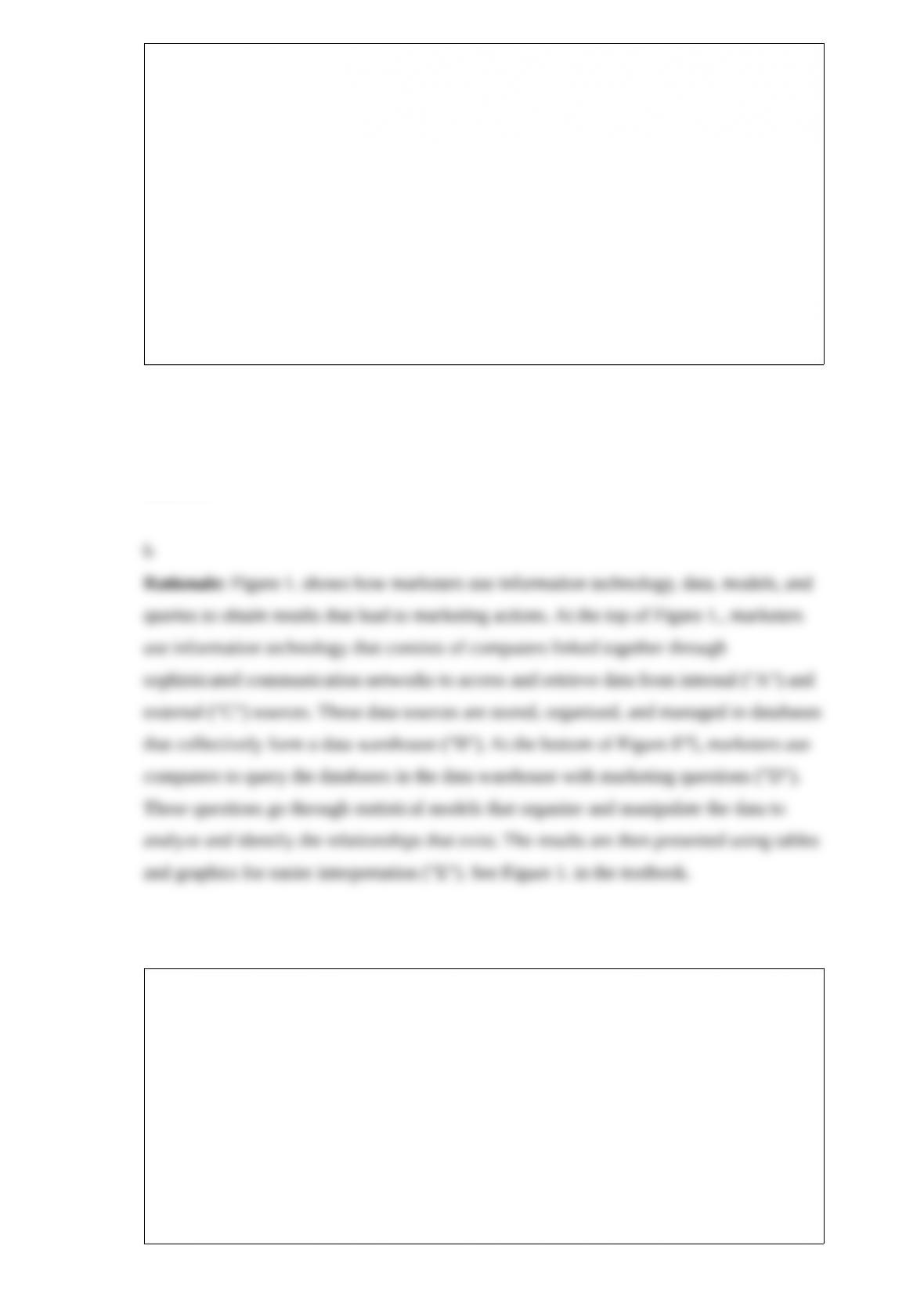
Figure 1. above shows how marketing researchers and managers use information
technology to turn information into marketing actions. What does “E” represent?
a. external data sources
b. results
c. data warehouse
d. internal data sources
e. buying queries
Answer:
Market share is the ratio of sales revenue of the firm to the total sales revenue of all
__________, including the firm itself.
a. firms in the industry
b. firms in the competitive set
c. firms in the WTO.
d. product groupings
e. domestic firms in a country
Answer:
Some __________ of online consumers say they visit websites from their place of
work, which partially accounts for the sales level during the workweek.
a. 15 percent
b. 20 percent
c. 30 percent
d. 40 percent
e. 50 percent
Answer:
There are seven commonly used organizational buying criteria. One of them is
__________.
a. flexibility and adaptability
b. ability to meet the quality specifications required for the item
c. adherence to governmental policies
d. senior management directives
e. consumer demand
Answer:
Porter’s four generic business strategies involve combinations of (1) __________ and
(2) a stress on costs versus product differentiation.
a. organizational structure
b. degree of geographical distribution
c. investment in research and development
d. relative number of products in a product line
e. competitive scope or the breadth of the target markets
Answer:
Creative marketers engage in value-pricing, which is the practice of simultaneously
__________and maintaining or decreasing price.
a. decreasing product and service benefits
b. increasing product and service benefits
c. decreasing profit
d. analyzing benefits
e. decreasing cost
Answer:
A risk with __________ is that too many uses for one brand name can dilute the
meaning of a brand for consumers.
a. brand extensions
b. family branding
c. co-branding
d. private branding
e. mixed branding
Answer:
There are four unique elements to servicesintangibility, inconsistency, inseparability,
and inventorywhich are referred to as the __________.
a. service mix
b. four I’s of services
c. service matrix
d. span of services
e. service continuum
Answer:
To increase demand for complementary products, the price of a product often is
a. marked up.
b. off-priced.
c. marked down.
d. value-added.
e. maintained.
Answer:
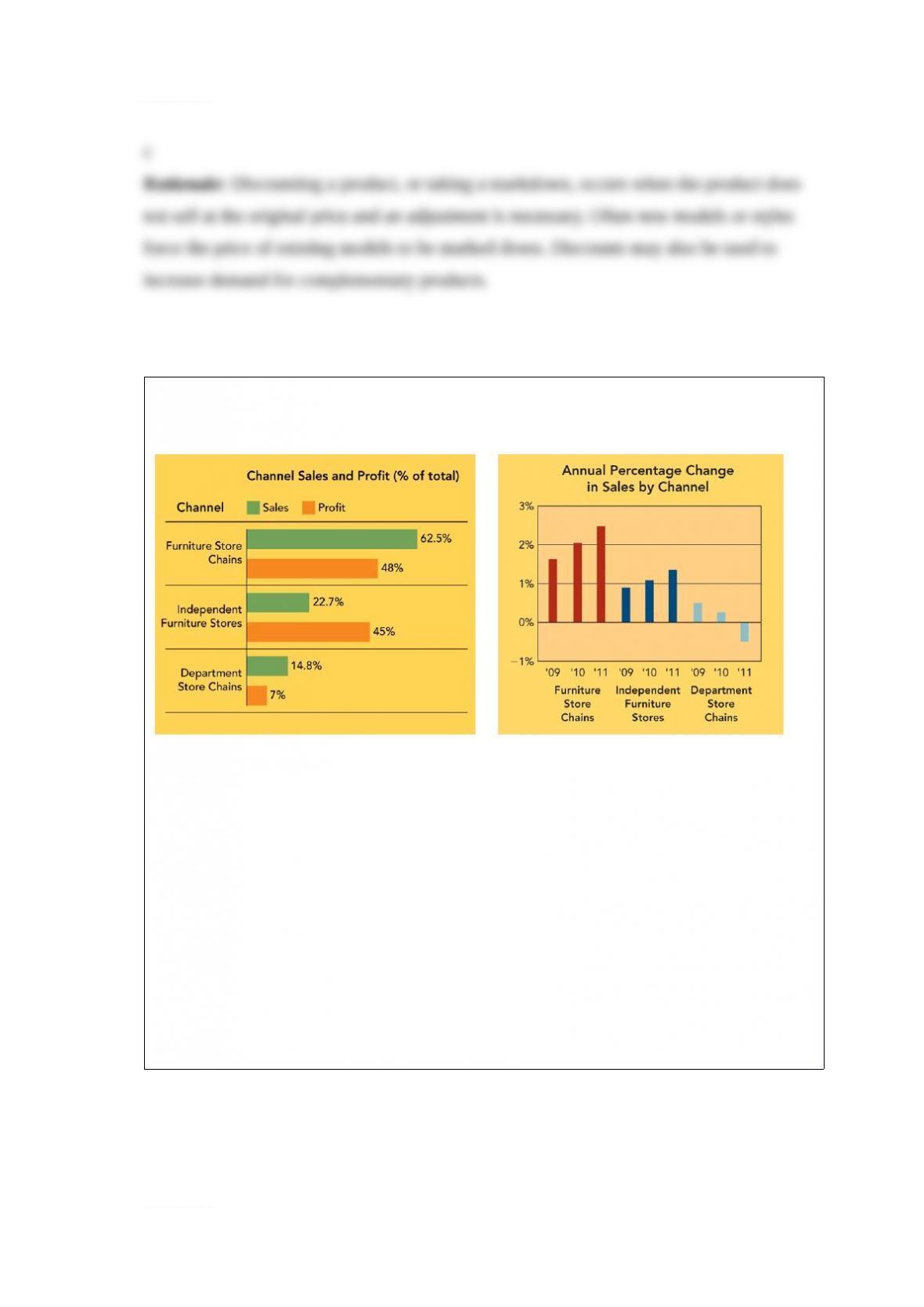
Channel Sales and Profit Marketing Dashboard
Which of the channels shown in the Channel Sales and Profit Marketing Dashboard
above represents the most sales for a particular furniture manufacturer?
a. independent furniture stores
b. furniture store chains
c. department store chains
d. mass merchandisers
e. none of the above
Answer:
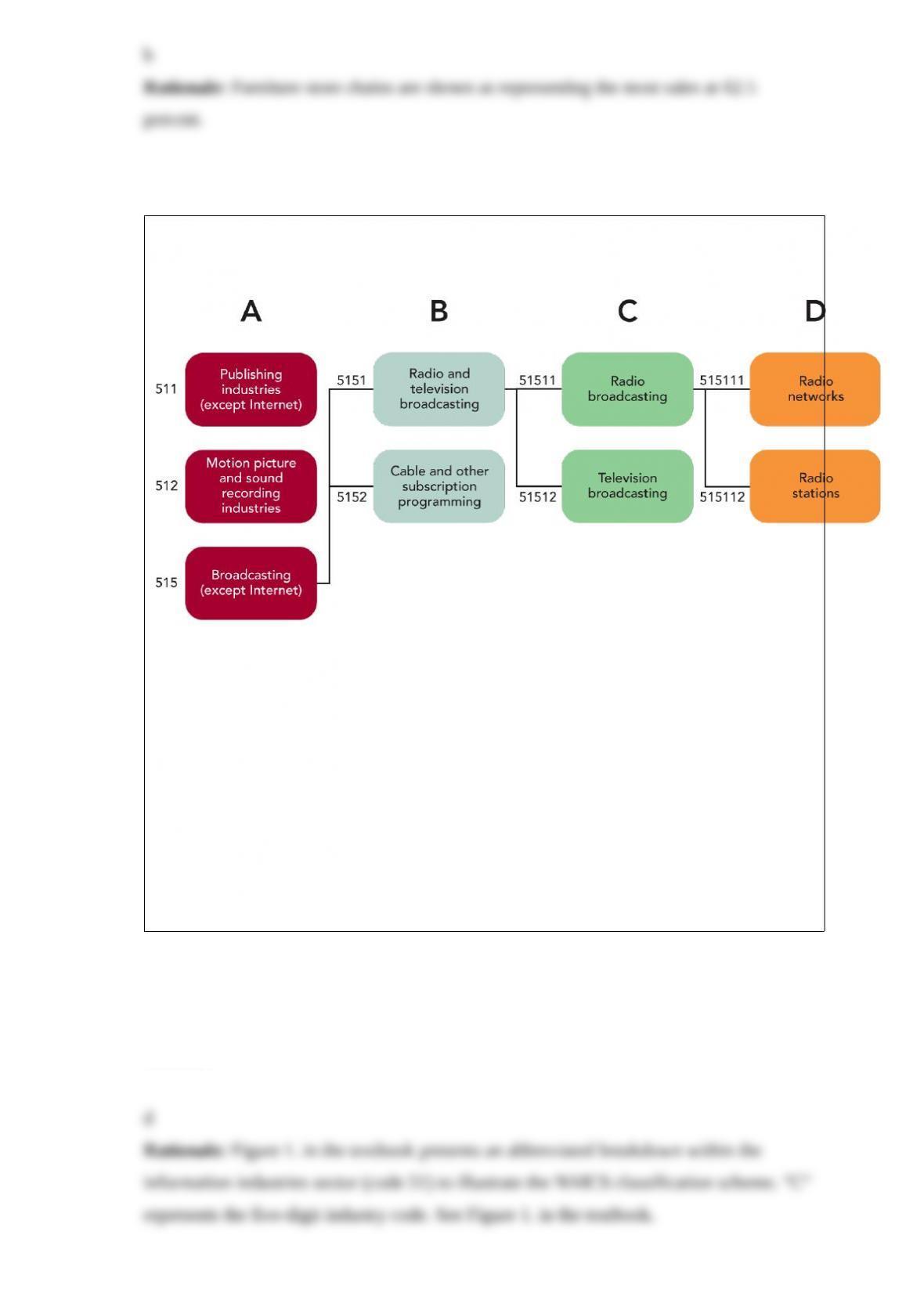
Figure 1.
In the breakdown for the NAICS code based on Figure 1. above, “C” represents the
a. two-digit industry sector code
b. three-digit industry subsector code
c. four-digit industry group code
d. five-digit industry code
e. six-digit U.S. national industry code
Answer: