
The phenomenon in which consumers often choose membership in microcultures in an
effort to stand out or define themselves from the crowd is called _____.
a. resurgence
b. acculturation
c. divergence
d. enculturation
e. stratification
In the balance theory, the object-person relation is referred to as a(n) _____ relation.
a. sentiment
b. unit
c. primary
d. secondary
e. central
Which of the following statements is true of the mere exposure effect?

a. The mere exposure effect is created in the presence of attention.
b. The increased liking associated with the mere exposure effect is difficult to elicit.
c. The size of the effect is not very strong relative to an effect created by a strong
cohesive argument.
d. The mere exposure effect works best when the consumer has a high involvement in
processing the object.
e. The mere exposure effect has the greatest effect on old and familiar objects.
Which of the following types of switching costs involves lost time and effort?
a. Rational switching cost
b. Financial switching cost
c. Relational switching cost
d. Temporal switching cost
e. Procedural switching cost
_____ is the separation of a market into groups based on the different demand curves
associated with each group.

a. Market zoning
b. Market augmentation
c. Market positioning
d. Market segmentation
e. Market selection
The American Heart Association (AHA) is an organization that promotes cardiac care.
It organizes various awareness programs for the public on ways to prevent cardiac
ailments. Which of the following types of social power does AHA have in the domain
of cardiac care?
a. Referent power
b. Legitimate power
c. Expert power
d. Reward power
e. Coercive power
When Dane was invited for dinner by his friend who is a self-confessed cheese lover,
Dane felt obligated to buy cheese for him. However, Dane has very little knowledge of

cheese and seldom buys it. On the day of the dinner, he was stalled at work with some
business meetings and did not have the time to decide on which cheese to buy. He
grabbed the first block of cheese he saw at the store for his friend. Which of the
following decision-making approaches best reflects Dane’s final choice of cheese?
a. Limited decision making
b. Extended decision making
c. Habitual decision making
d. Routine decision making
e. Involved decision making
Which of the following is true about consumer behavior traits?
a. Low self-monitors care deeply about what others think and say about their behaviors.
b. Consumers with low need for cognition tend to think carefully about products,
problems, and even marketing messages.
c. Consumers with high need for cognition tend to be influenced by things like an
endorser’s attractiveness and cues that are not central to a message.
d. Low self-monitors tend to care more about the functionality of products.
e. High self-monitors are not sensitive to the opinions of others.

_____ memory represents stored information concerning stimuli one is exposed to but
does not pay attention to.
a. Autobiographical
b. Implicit
c. Episodic
d. Semantic
e. Declarative
_____ refers to the interpretation or understanding that a consumer develops about
some attended stimulus based on the way meaning is assigned.
a. Attention
b. Exposure
c. Comprehension
d. Elaboration
e. Sensation
Rocco’s Seafood restaurant claims to have the “best shrimp po-boy in town!” Which of

the following is this an example of?
a. Scam ad
b. Puffery
c. Astroturfing
d. Ambushing
e. Hoarding
The business practice wherein companies operate with the understanding that products
provide value in multiple ways is called the _____ concept.
a. net worth
b. total value
c. value marketing
d. product value
e. multifaceted product
Refer to Superfocus Scenario. The advertising, distribution through the website and eye
care providers, the price, and the free trial offer are examples of Superfocus’s _____.

a. marketing tactics
b. corporate strategy
c. company mission
d. value proposition
e. product differentiation
_____ is a personality trait that represents how sensitive a consumer is to immediate
rewards.
a. Compulsivity
b. Impulsivity
c. Susceptibility
d. Sensitivity
e. Accountability
A belief among consumers that their ethnic group is superior to others and that the
products that come from their native land are superior to other products is called
consumer _____.

a. imperialism
b. polycentrism
c. pseudoskepticism
d. ethnocentrism
e. xenocentrism
Which of the following is true about complaining behavior?
a. All customers reporting dissatisfaction complain.
b. Negative approach emotions like anger are most likely to precede complaining
behavior.
c. Dissatisfied consumers are more likely to complain than angry consumers.
d. Disgusted consumers are more likely to complain than angry consumers.
e. Price-sensitive consumers are less likely to complain than those who are not price
sensitive.
Which of the following concepts represents how much stronger one stimulus has to be
relative to another so that someone can notice that the two are not the same?

a. Absolute difference
b. Just noticeable difference (JND)
c. Subliminal difference
d. Distortive difference
e. Incremental difference
Expectations of what a consumer thinks should happen given past experiences with a
product or service are called _____ expectations.
a. relative
b. predictive
c. ideal
d. normative
e. equitable
CHRISTMAS SHOPPING SCENARIO

Many consumers wait until the weekend before Christmas to do their gift shopping, and
Lanny is one of those consumers. She did not want to go to a crowded mall as she only
had a Saturday to do all of her shopping. She saw an advertisement that morning in the
newspaper for a new store that claims to be the “right destination for all kinds of
Christmas shopping.” She decided to go there instead of the mall in order to avoid the
crowd in the mall. While she was in the new store, she was trying to keep a track of her
purchases in her head in an attempt to avoid going overboard and winding up with a
huge credit card bill next month. In just two hours, Lanny was able to purchase all the
gifts she needed and even found a cute bracelet for herself though the bracelet was not a
part of the shopping list that she had made earlier. Refer to Christmas Shopping
Scenario. Lanny’s shopping was focused on one thinggetting done with Christmas
shopping on a single day. This is an example of _____ shopping.
a. impulsive
b. hedonic
c. epistemic
d. acquisitional
e. experiential
A brand community is an example of a(n) _____.
a. primary group
b. secondary group
c. task group
d. action group
e. outgroup
Marcie works as a salesperson for a major cosmetics manufacturer. She normally begins
by approaching potential customers with very expensive products, even though she
knows that they will refuse. This refusal makes it easier for Marcie to sell other
products which are relatively cheaper by showing consumers that she has been
“apparently hurt” by their rejection. This is an example of the _____ sales technique.
a. foot-in-the-door
b. door-in-the-face
c. even-a-penny-will-help
d. “I”m working for you!”
e. two-steps-forward
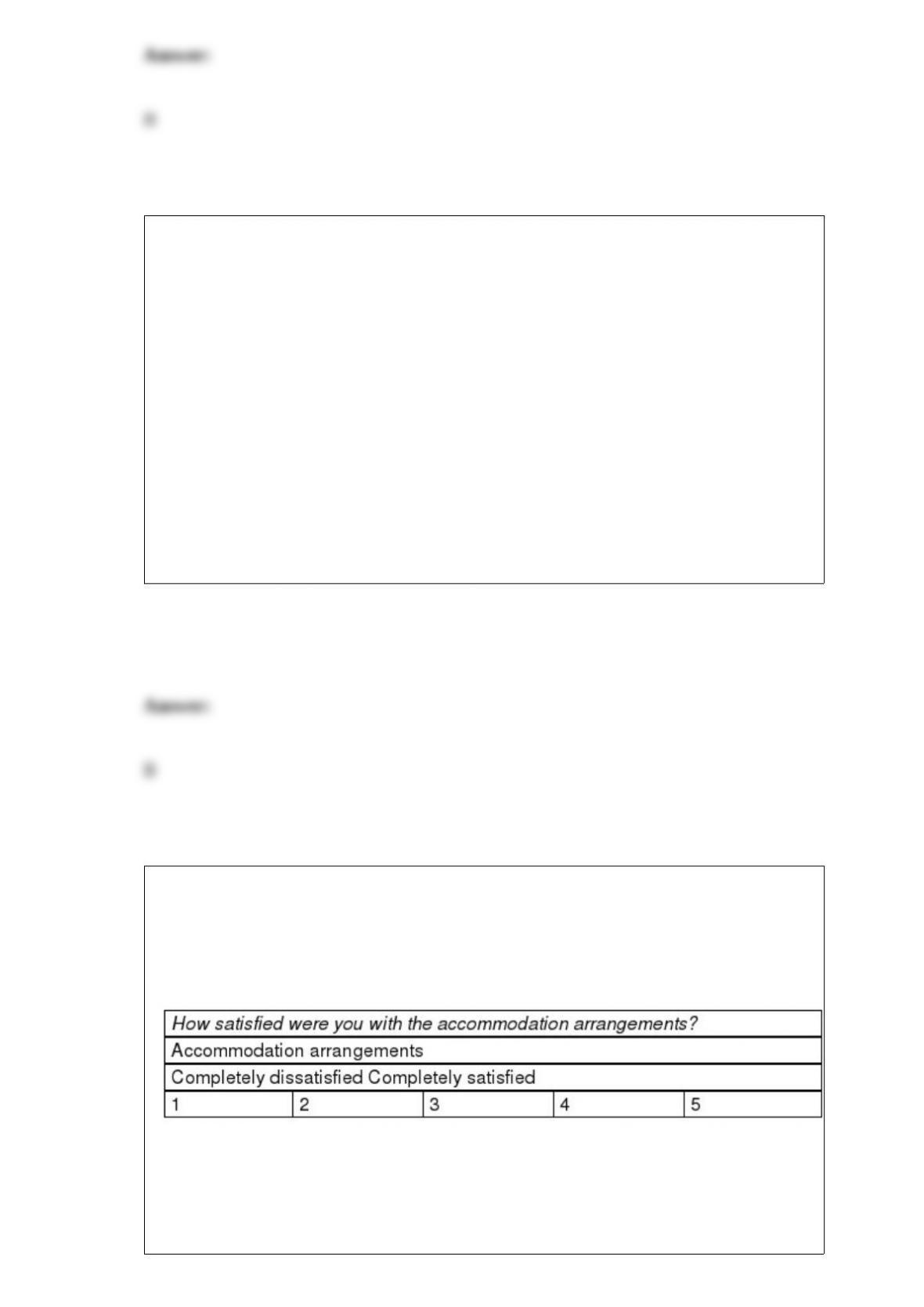
A market researcher was contacted by a travel firm to assess consumer satisfaction on
the travel services provided by the firm. The researcher collected feedback from
customers by distributing questionnaires. The questionnaire consisted of ten questions
and each question had five options ranging from completely dissatisfied to completely
satisfied. One such question from the questionnaire is as follows:
This is an example of a(n) _____ measure.
a. direct, global

b. disconfirmation
c. open-ended
d. unstructured
e. attribute-specific
Beth had been searching for the right foundation for her skin type. She had tried a few
brands before, however, none of them suited her sensitive skin. When Beth finally
found what she was looking for, she made it a point to tell all her close friends about
how good the product was for her skin. This is an example of _____ word-of-mouth.
a. primary
b. natural
c. organic
d. unscripted
e. amplified
Sam needed a new pair of bicycle pedals. After visiting several stores to find the right
ones, he purchased a pair from a local store called All Things Sports and was satisfied
that his needs were met. Which of the following best describes the type of value Sam
received?

a. End-state value
b. Premium value
c. Terminal value
d. Utilitarian value
e. Purchase value
Which of the following decision-making perspectives assumes that consumers
diligently gather information about purchases, carefully compare various brands of
products on salient attributes, and make informed decisions regarding what brand to
buy?
a. Rational decision-making perspective
b. Experiential decision-making perspective
c. Behavioral influence decision-making perspective
d. Functional decision-making perspective
e. Implemental decision-making perspective
Elaine had a problem with the computer printer she purchased. When she called the

toll-free service support number, she was told that she had to pay to speak to a service
representative. It made her so unhappy that she told all of her friends and family about
the problem with the printer and the poor service she received, and advised them never
to buy that brand. According to the information given in this case, which of the
following postconsumption behaviors best describes Elaine’s behavior?
a. Loyalty
b. Switching
c. Avoidance
d. Disconfirmation
e. Negative word-of-mouth
Penalties associated with performing a nongratifying or culturally inconsistent behavior
are known as cultural ______.
a. sanctions
b. roles
c. limitations
d. biases
e. equities

Choco Fond, a dessert place, introduced a new square-shaped ice-cream cone with a
soft gooey texture instead of the usual crunchy cone. Choco Fond’s customers never
warmed up to the new product as they felt it was too different from the traditional cone
and never gave them the feeling of having an ice-cream. Which of the following
reactions is most likely to account for the customers’ cognitive categorization of the
new product?
a. Contrast
b. Anticipation
c. Accommodation
d. Distortion
e. Assimilation
In Jack’s home country, business negotiations focus primarily on immediate profits and
quick temporary solutions. According to the CSV dimension, this is an example of a
culture low in _____.
a. masculinity
b. individualism
c. power distance
d. long-term orientation
e. uncertainty avoidance

Using online technologies to facilitate word-of-mouth by having consumers spread
marketing messages through their online connections is known as _____ marketing.
a. affinity
b. stealth
c. viral
d. multi-level
e. ambush
Juan Chavez is majoring in a discipline that examines the production and consumption
of goods and services. Which of the following best describes Juan’s major?
a. Economics
b. Accounting
c. Anthropology
d. Psychology
e. Production management

The physical parts of a product are known as _____.
a. benefits
b. elements
c. attributes
d. resources
e. components
A basic _____ premise is that customers form relationships with companies as opposed
to companies conducting individual transactions with customers.
a. Consumer Behavior Framework
b. Customer Relationship Management
c. Marketing Consumer Framework
d. Relationship Quality Management
e. Consumption Process Framework
Vince harbors a passion for cars. He constantly seeks out information on new
automobile models without any intention of buying them. Which type of consumer

search behavior does this represent?
a. Postpurchase search
b. Passive search
c. Binary search
d. Prepurchase search
e. Ongoing search
When shoppers process ambient citrus odors, they tend to feel higher levels of pleasant
emotions while shopping and tend to be more receptive to product information.
Consumers with very high involvement in some product category are called market
mavens.
While tradition can be thought of as influencing culture, it can also be stated that, in the
long run, culture also defines tradition.
A 3rd Party Endorsement represents one form of publicity in which an ostensibly
objective outsider (neither the customer nor business) provides publicly available
purchase recommendations.
According to the balance theory, consistency in the triad (composed of observer, person,
and object) is maintained when the multiplication of the signs in the sentiment and unit
relations results in a negative value.
As a consumer’s level of knowledge increases, he or she is able to focus on criteria that
are most important in making a selection and to discount irrelevant information.
Income is a recognizable determinant of social class.
Satisfaction is the only postconsumption reaction that exists.
Social couponing refers to a type of buying where consumers receive a coupon by
joining a special social networking website.
Drinking soft drinks because one really likes the taste is driven by hedonic motivations.
According to the changing schema-based affect theory, if the affect found in a schema
can be changed, then the attitude toward a brand will change as well.
The term augmented product means the original product plus the extra things needed to
increase the value from consumption.
The prediction of individual behavior tends to be weaker with the multiple-trait
approach.
When noncompensatory rules are used, strict guidelines are set prior to selection, and
any option that does not meet the specifications is eliminated from consideration.
A feature is a performance characteristic of an object.
Hemispheric lateralization influences metaphor comprehension.
Competitive intensity refers to the resources allocated to one brand from among the set
of competing brands.
Retailers specializing in things like a wide selection of goods, low prices, guarantees,
and knowledgeable employees facilitate the task of shopping. This type of positioning
emphasizes the functional quality of a retail store.
According to the elaboration likelihood model of persuasion, nonproduct related
information such as music or the imagery presented along with the message, are
examples of central cues.