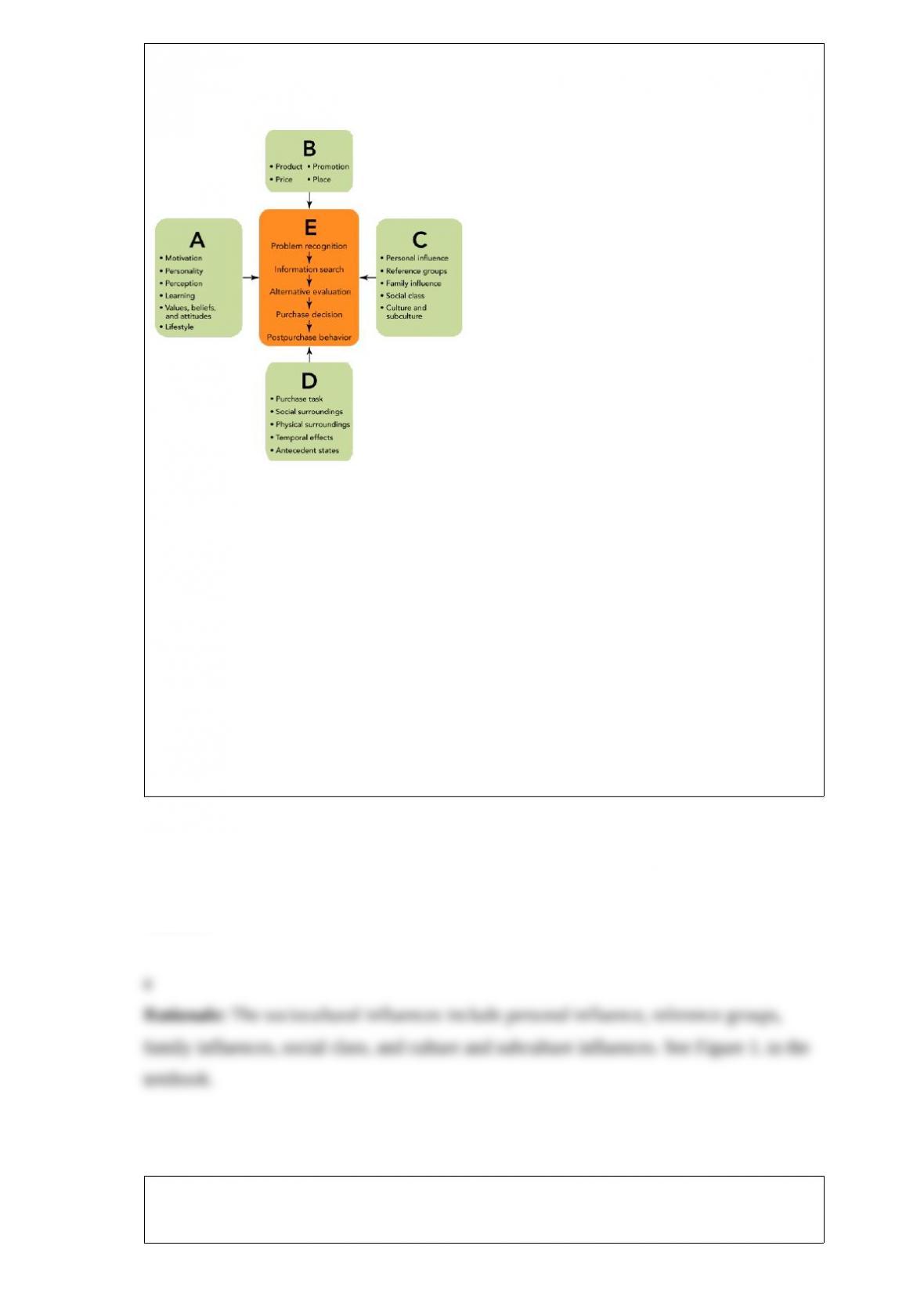
Figure 1.
In Figure 1. above, “C” represents the __________ influences that can affect the
consumer purchase decision process.
a. sociocultural
b. economic
c. environmental
d. situational
e. market dominated
Answer:
How a person establishes expectations for a service not yet experienced is influenced by
word of mouth communications, __________, past experiences, and promotional
activities.
a. personal needs
b. the economy
c. consumer income
d. competitive trends
e. how the organization delivers its service
Answer:
Stores like Dillard’s, Macy’s, and Neiman Marcus carry a wide range of different types
of products but not unusual sizes. They are known as __________.
a. limited-line stores
b. scrambled merchandise stores
c. hypermarkets
d. intertype outlets
e. general merchandise stores
Answer:
Partnership selling refers to __________.
a. the creation of cross-functional selling teams designed to provide the ultimate
consumer with the best possible product and service
b. the practice of using an entire team of professionals in selling to and servicing major
customers
c. an illegal practice whereby buyers and sellers combine their expertise and resources
to share customer, competitive, and company information for their personal benefit
d. a legal but unethical practice whereby buyers and sellers combine their expertise and
resources to share customer, competitive, and company information for their personal
benefit
e. the practice whereby buyers and sellers combine their expertise and resources to
create customized solutions, commit to joint planning, and share customer, competitive,
and company information for their mutual benefit, and ultimately the benefit of the
customer
Answer:
Research that provides ideas about a relatively vague problem is referred to as
a. virtual research
b. interactive research
c. causal research
d. descriptive research
e. exploratory research
Answer:
The first step in segmenting and targeting markets that link customer needs to
marketing actions is to
a. group potential buyers into segments.
b. group products to be sold into categories.
c. develop a market-product grid and estimate size of the overall market.
d. select target markets.
e. take marketing actions to reach target markets.
Answer:
Growth in the direct-selling industry is the result of two trends: (1) there is a growing
number of companies that are using direct selling to reach consumers who prefer
one-on-one customer service and a social shopping experience rather than online
shipping or big discount stores and (2)
a. many direct selling retailers are expanding into markets outside of the United States.
b. increased gas prices and traffic congestion are causing people to want stores to
deliver products to them.
c. the pendulum is beginning to swing back to more mothers (and fathers) staying home
during the day with children, making direct selling more convenient.
d. the purchase or lease of real estate to build an actual “brick” retail store is becoming
prohibitive.
e. graduating business students are finding it more difficult to find a traditional sales
position and like the idea of being their own bosses.
Answer:
Brand extensions require__________.
a. manufacturing a product under a new name that consumers will view as an entirely
new product line
b. manufacturing a new product with the same brand name for a new market segment in
the same product class so consumers will view it as a logical addition to the original
product line
c. manufacturing accessory products for the base offering, such as Barbie clothes for
Barbie Dolls
d. licensing another firm to manufacture modified versions of the original products
e. applying the current brand name to enter a completely different product class
Answer:
Manufacturing a product only when there is an order from a customer is referred to as
a. order customization.
b. a one product one market segment strategy.
c. synergistic marketing.
d. build-to-order.
e. specialty customization.
Answer:
When the Floral Council, a trade association of flower shop retailers, advertises that
giving flowers is a thoughtful and appreciated gift for any occasion, it is trying to
stimulate __________ demand.
a. selective
b. primary
c. derived
d. generic
e. secondary
Answer:
A code of ethics refers to
a. a formal statement of moral and ethical business attitudes.
b. a formal statement of ethical principles and rules of conduct.
c. an informal guide of ethical principles and moral conduct.
d. the written document stating the beliefs and values of each employee in a firm.
e. a firm’s itemized list of business activities that are and are not consistent with the
company’s mission statement.
Answer:

The outcome of a direct marketing offer designed to motivate people to visit a business
is referred to as _________.
a. direct order consignment
b. lead generation
c. traffic generation
d. indirect order fulfillment
e. first-mover advantage
Answer:
A retail location that typically has one primary store (usually a department store branch)
with 20 to 40 smaller outlets serving a population of consumers who are within a 10- to
20-minute drive is referred to as a(n) __________.
a. power center
b. regional shopping center
c. community shopping center
d. central business district
e. urban megacenter
Answer:
The American business period that strives to satisfy consumer needs while achieving an
organization’s goals is called the __________ era.
a. marketing concept
b. sales
c. production
d. societal marketing concept
e. customer relationship
Answer:
Most stores today are near several others in one of five settings: the central business
district, the community shopping center, the regional shopping center, the power center,
or the __________.
a. suburban downtown
b. strip mall
c. exurb value center
d. rural micromall
e. urban megacenter
Answer:
Dell established its company primarily with direct telephone-and Internet-based sales.
In terms of Dell’s global expansion strategy, which of the following statements is most
accurate?
a. Dell will sell its computers in “traveling” stores, consisting of custom-made trailers
with solar energy panels that will allow them to reach remote marketplaces.
b. Dell will partner with each country’s largest department stores and sell its computers
in the small appliance department.
c. Dell will issue its own credit card through multinational banks, making it possible for
customers who would not normally qualify for credit to do so.
d. Dell will distribute its products through electronics retailers to reach more buyers
quickly.
e. Dell will maintain the exact same strategies that brought it this far because it sees no
reason to “mess with success.”
Answer:
Effective marketing benefits society because it
a. reduces competition, making the playing field more even.
b. improves the quality of products and services regardless of the cost.
c. allows companies to charge whatever price they want, regardless of product quality.
d. makes countries more competitive in world markets while simultaneously reducing
competition in their home markets.
e. enhances competition, which improves the quality of products and services and
lowers their prices.
Answer:
June Golden is part of the buying center for a large manufacturer. Her field of expertise
is logistics and she is responsible for choosing transportation providers for the
company. A sales representative for Yellow Roadway (a very large trucking firm) calls
on June; however, her secretary thinks he is quite rude and announces that June is not
available. The secretary is acting in the role of __________ for the buying center.
a. gatekeeper
b. decider
c. buyer
d. influencer
e. user
Answer:
Which of the following is a basis used to segment U.S. organizational markets?
a. geographic
b. psychographic
c. income
d. needs
e. education
Answer:
All of the following are profit-oriented approaches to selecting an approximate price
level EXCEPT:
a. target ROI pricing.
b. target return-on-investment pricing.
c. target return-on-sales pricing.
d. target profit pricing.
e. cost-plus percentage-of-cost pricing.
Answer:
An arrangement whereby a firm reaches different buyers by employing two or more
different types of channels for the same basic product is referred to as __________.
a. a strategic channel alliance
b. multiple level selling
c. parallel distribution
d. dual distribution
e. multilayered distribution
Answer:
A(n) __________ is an Internet-based network used within the boundaries of an
organization.

a. web exchange
b. commercial online service
c. extranet
d. Internet service provider
e. intranet
Answer:
Which of the following is high in experience properties?
a. clothing
b. a vacation
c. legal services
d. auto repair
e. a medical diagnosis
Answer:
The major difference between an off-price retailer and a discount store is that off-price
retailers purchase merchandise from manufacturers __________ and discount stores
buy from wholesalers __________.
a. who are trying to offload returned or slightly irregular inventory; selling new but
inexpensive merchandise
b. at below wholesale prices; and charge a high initial price with the full intent of taking
markdowns later
c. at below wholesale prices; at full price but take a less of a markup
d. at various price points; at the lowest price points possible
e. who are part of a retailing cooperative; who are part of a wholesaling cooperative
Answer:
In the seven Ps of services, the term “process” refers to
a. the patented steps of service encounters that distinguish one service provider from
another.
b. licensed procedures that have met ISO 9000 guidelines for safety.
c. the procedures, mechanisms, and flow of activities by which the service is created
and delivered.
d. a protocol for behaviors and activities for people-based rather than technology-based
services.
e. the decisions consumers’ make during the purchase of services.
Answer:
The planning gap refers to
a. the difference between projected total costs and realized total revenues.
b. the difference between projected total costs and net profits.
c. the difference between marginal revenue and marginal cost.
d. the percentage point difference between a firm and its next largest competitor in
terms of market share.
e. the difference between the projection of the path to reach a new goal and the
projection of the path of the results of a plan already in place.
Answer:
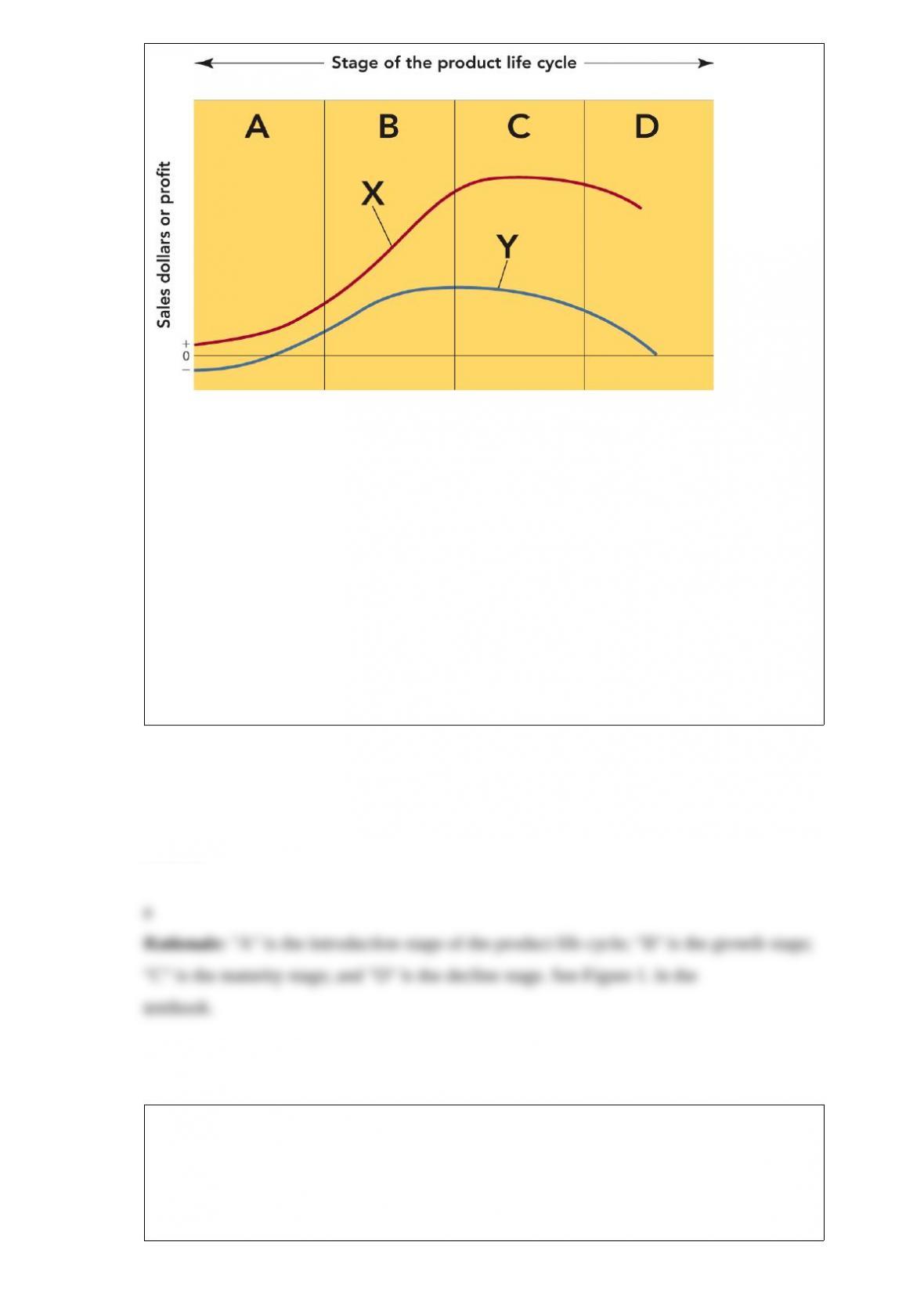
Figure 1.
Figure 1. above represents the stages of the product life cycle. What does the portion of
the curve labeled “A” represent?
a. introduction
b. maturity
c. growth
d. accelerated development
e. decline
Answer:
When a small retail chain hires an accountant to do its income taxes, the retail chain
would have purchased a(n) __________ kind of business product.
a. ancillary service
b. industrial service
c. specialty service
d. accessory service
e. contractual service
Answer:
iVillage.com is a website for women that encourages its users to discuss health and
beauty, parenting, personal finances, career management and relationships. This website
is an example of __________.
a. a web community
b. spam
c. a shopping bot
d. a blog
e. a web caf
Answer:
What is the primary disadvantage of employing a market specialization strategy?
a. Gaining market distribution will be costly.
b. The organization may be spread too thin.
c. The organization achieves neither marketing nor manufacturing synergies.
d. R&D-manufacturing has the difficulty of producing multiple products.
e. There are too many product substitutes over which a firm would not have control.
Answer: