
The reward to a business firm for the risk it undertakes in marketing its offerings is
referred to as
a. shareholders’ equity.
b. profit.
c. assets.
d. contribution margin.
e. goodwill.
Answer:
With a __________ pricing strategy, a price setter stresses the __________ side of the
pricing problem.
a. demand-oriented; cost
b. supply-oriented; target ROI
c. competition-oriented; marketing channel
d. cost-oriented; cost
e. profit-oriented; revenue
Answer:

Standard markup pricing is considered to be a __________ approach to pricing.
a. demand-oriented
b. profit-oriented
c. cost-oriented
d. competition-oriented
e. service-oriented
Answer:
A New York carwash owner wanted to open a carwash in Quebec, Canada. He hired a
U.S. translator to create signage for the new venture and to design some simple
advertising. It was not until the business was opened that he learned that he should have
used __________. His French signs actually said “car bath” instead of “car wash.”
a. Unispeak
b. back translation
c. semiotics
d. semantic symbolism
e. linguistic exchange

Answer:
The Lemon Tree is a high-fashion boutique selling top-of-the-line women’s clothing and
accessories. The keys to its success include knowing customers’ changing tastes and
providing something different from other retailers. In addition, because of the high
value of the merchandise, The Lemon Tree’s management is exploring the use of
computerized inventory controls and sales order processing. From this description, one
can infer that the LEAST IMPORTANT environmental force to The Lemon Tree at
this particular time would be
a. economic.
b. competitive.
c. technological.
d. social.
e. regulatory.
Answer:
Another name for order cycle time is
a. physical distribution sequence.
b. total logistics cycle.

c. replenishment time.
d. logistical support time.
e. billing cycle.
Answer:
There are five stages in the consumer purchase decision process. The third stage is
__________.
a. information search
b. purchase decision
c. alternative evaluation
d. postpurchase behavior
e. problem recognition
Answer:

North America’s fastest-growing HDTV and consumer electronics company is
a. Samsung.
b. Philips.
c. LG.
d. Sony.
e. Vizio.
Answer:
Personal selling serves three major roles in a firm’s overall marketing effort.
Salespeople: (1) are the critical link between a firm and its customers; (2) __________;
and (3) may play a dominant role in a firm’s marketing program.
a. play a key role in research and development
b. are the company in consumers’ eyes
c. play a dominant role in implementing an organization’s pull strategy
d. provide the most valuable resource for segmenting and selecting target markets
e. are one of many people in a firm that contacts potential customers
Answer:
Large organizations are extremely complex. They usually consist of __________
organizational levels whose strategies are linked to marketing.
a. three
b. five
c. ten
d. fifteen
e. twenty to thirty
Answer:
There are five common approaches to posttests: aided recall, unaided recall, attitude
tests, __________, and sales tests.
a. exposure tests
b. inquiry tests
c. performance tests
d. jury tests

e. comparison tests
Answer:
Customer relationship management refers to
a. the view that organizations should satisfy the needs of consumers in a way that
provides for society’s well-being.
b. the process of identifying prospective buyers, understanding them intimately, and
developing favorable long-term perceptions of the organization and its offerings so that
buyers will choose them in the marketplace.
c. the idea that an organization should (1) strive to satisfy the needs of consumers (2)
while also trying to achieve the organization’s goals.
d. the links an organization has to its individual customers, employees, suppliers, and
other partners for their mutual long-term benefit.
e. the cluster of benefits that an organization promises customers to satisfy their needs.
Answer:
Which of the following is considered one of the major factors that influences ethical
behavior?

a. organizational structures
b. legislation
c. federal regulatory agencies
d. a nation’s moral philosophy
e. business culture and industry practices
Answer:
One test of whether marketing research should be done is
a. if different outcomes will lead to different marketing actions.
b. if different outcomes will lead to the same marketing actions.
c. using a jury of executive opinion to interpret the data.
d. agreeing to take action only if the decision is unanimous.
e. if the action is agreed on, regardless of the outcome of the research.
Answer:

BMW StreetCarver is a skateboard that features BMW’s technology in its wheel
suspension, which stabilizes the board’s sleek design and allows for greater control
around sharp curves. BMW wants its skateboard to be within the consideration set of
potential skateboard buyers. In this case, it most likely should focus on
a. reducing the postpurchase dissatisfaction that may result from purchasing its product.
b. making sure its advertisements get on the air during sporting events such as ESPN’s
X-Games.
c. making appeals directed towards motivational ego needs.
d. explaining the sleek design of the StreetCarver in advertising so that the brand
becomes part of a skateboarder’s consideration set.
e. creating personality profiles for skateboarders.
Answer:
A flexible-price policy refers to
a. setting the price of a line of products at a number of different specific pricing points.
b. setting the prices for all items in a product line to cover the total cost and produce a
profit for the complete line, not necessarily for each item.

c. deliberately selling a product below its customary price, not to increase sales, but to
attract customers’ attention in hopes that they will buy other products as well.
d. setting different prices for products and services depending on individual buyers and
purchase situations.
e. Adding a fixed percentage to the cost of all items in a specific product class.
Answer:
Much of Google’s success is based on the ten guidelines of its corporate philosophy.
Guideline 8 states, “The need for information _________.”
a. is the next frontier
b. is the power behind change
c. is insatiable
d. separates the winners from the losers
e. crosses all borders
Answer:

A failure fee is a penalty payment
a. a retailer assesses a manufacturer to handle defective new products that customers
returned.
b. a wholesaler makes to a retailer as compensation for sales not made while the
product was on the shelf.
c. a retailer makes to a manufacturer for stockoutsnot keeping point-of-purchase
displays continuously stocked with the new product.
d. a manufacturer makes to a wholesaler as compensation for case-lot sales not made to
retailers.
e. a manufacturer makes to compensate a retailer for devoting valuable shelf space to a
product that fails to sell.
Answer:
Ann’s young son suffers from allergies and complains about his watery eyes and
drowsiness. Ann felt bad because she thought there was nothing she could do to help
him. When Ann saw the ad for a new drug that counters these symptoms in Martha
Stewart Living magazine, she vowed to ask his doctor about this product on her son’s
next visit. Ann is at which stage in the hierarchy of effects?
a. She is the trial stage and will move to the interest stage soon.
b. She has moved quickly from the awareness stage to the interest stage.
c. She was in the consumer development stage and will more than likely move to the
transition stage.
d. She is in the evaluation stage and will move to the interest stage soon.
e. She was in the interest stage and then moved quickly to the diffusion stage.

Answer:
A budgeting method that allocates funds to a promotion as a percentage of past or
anticipated sales, in terms of either dollars or units sold, is referred to as __________
budgeting.
a. percentage of sales
b. competitive parity
c. all-you-can-afford
d. objective and task
e. linear forecast
Answer:
Consumers who read, hear, or see the message sent by a source during the
communication process are referred to as __________.
a. purchasers

b. the target market
c. receivers
d. sources
e. encoders
Answer:
All activities involved in selling, renting, and providing products and services to
ultimate consumers for personal, family, or household use are referred to as
__________.
a. manufacturing
b. retailing
c. wholesaling
d. facilitating
e. logistics
Answer:
One tool available for services when trying to balance demand is __________.
a. off-peak pricing
b. product lay-away
c. credit incentives
d. container sales
e. product rationing
Answer:
Figure 1.
According to Figure 1. above, how much is the jobber trade discount?
a. $3.15
b. $7.00
c. $30.00
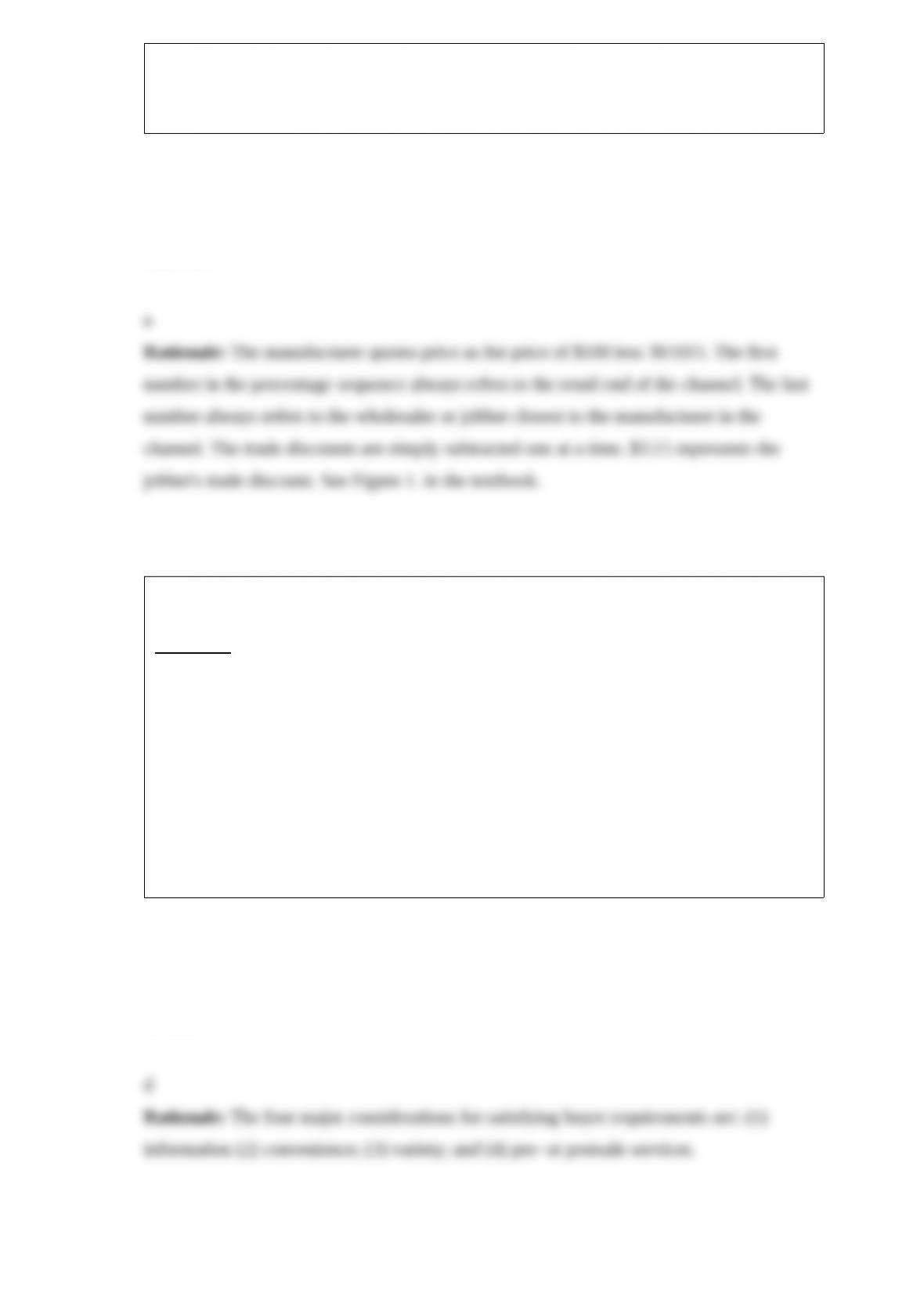
d. $63.00
e. $70.00
Answer:
All of the following are buyer requirements for choosing a marketing channel
EXCEPT:
a. pre- or postsale services.
b. convenience.
c. variety.
d. profitability.
e. information.
Answer:
Which of the following statements should the salesperson use to acknowledge and
convert the prospect’s objection into a reason for buying?
a. “I think I might be able to explain that better to you after showing you this diagram.”
b. “Yes, you”re right, it is lighter but that is done intentionally to make your work
easier.”
c. “That’s true. It does have a shorter shelf life, but that really hasn”t been a problem. It
is so popular it never stays on the shelf that long anyway.”
d. “Where did you hear that? Your source must have erroneous information.”
e. “As I was saying, .”
Answer:
The amount of time per month that visitors spend on a company’s website is referred to
as
a. visiting time.
b. stickiness.
c. staying power.
d. browsing time.
e. connectiveness.
Answer:
Which of the following statements about Facebook is MOST accurate?
a. Facebook is the third most-used social network.
b. Facebook has a global presence and is accessible in over 70 languages.
c. Facebook has almost 80 million active users.
d. Facebook lets people keep in touch through long text-entries similar to e-mail.
e. Facebook is just as successful as Twitter.
Answer:
The key steps of planning, implementation, and evaluation are part of (the)
a. gap analysis.
b. strategic marketing process.
c. situational analysis.
d. synergy analysis.
e. diversification analysis.
Answer:
Companies often pursue a market share objective when __________.
a. industry sales are flat or declining
b. profits are increasing
c. industry sales are beginning to rise
d. there is a sudden increase in production costs
e. stockholders are seeking higher dividends
Answer:
The actions taken during market product focus and goal setting, Step 2 of the planning
phase, include: (1) __________, (2) select target markets, (3) find points of difference,
and (4) position the product.
a. identify industry trends
b. research customers
c. set market and product goals
d. develop the program’s marketing mix
e. develop the budget by estimating revenues, expenses, and profits
Answer:
Figure 1.
In Figure 1. above, “B” represents which stage of the market segmentation process?
a. link needs to actions
b. identify market needs
c. establish a marketing protocol
d. execute marketing program actions
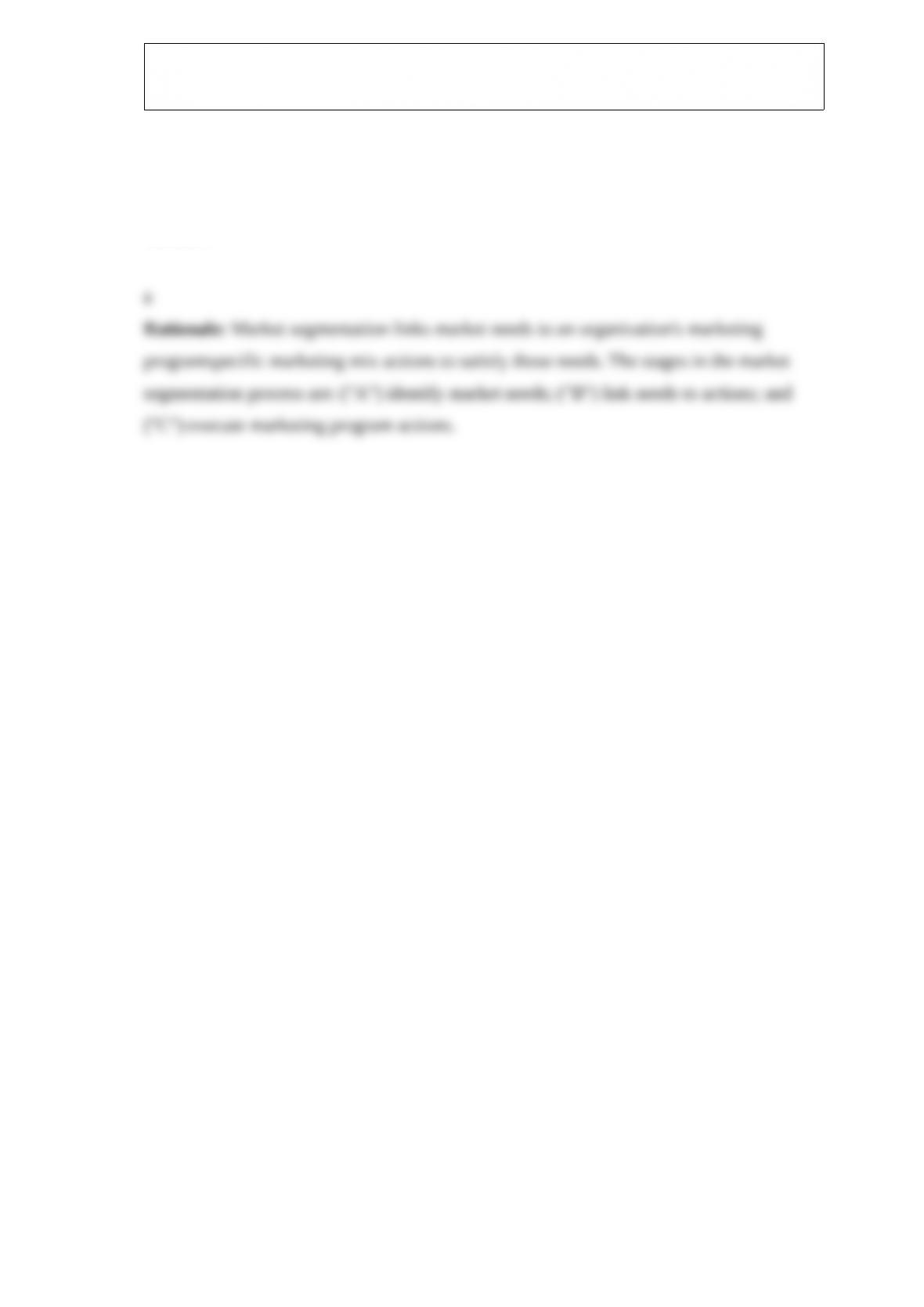
e. segment and select the target markets
Answer: