
The range of offerings from the tangible to the intangible or product-dominant to
service-dominant is referred to as the
a. service continuum.
b. product continuum.
c. tangibility line.
d. inseparability span.
e. customer contact audit.
Answer:
3M Company executives were perplexed when the company’s Scotch-Brite
floor-cleaning product initially produced lukewarm sales in the Philippines. A Filipino
employee explained that consumers generally clean floors by pushing coconut shells
around with their feet. 3M changed the shape of the pad to a foot and sales soared. 3M
changed its product in response to a Filipino __________.
a. value
b. belief
c. custom
d. idiosyncrasy
e. demographic pattern
Answer:
Which promotional mix alternative has the advantage of allowing the seller to see
and/or hear the potential buyer’s reaction to the message?
a. advertising
b. personal selling
c. public relations
d. sales promotion
e. publicity
Answer:
Frequency refers to
a. the number of different advertisements, sales promotions, or publicity events in an
IMC campaign for a product or service.
b. the total number of times an advertisement is aired on television or radio.
c. the average number of times a firm airs an advertisement.
d. the number of times an advertisement can be shown before it begins to lose its
effectiveness.
e. the average number of times a person in the target audience is exposed to an
advertisement.
Answer:
Driving time, proximity, hours of operation, and the usability of a website are all
examples of which buyer requirement?
a. information
b. variety
c. pre- or postsale services
d. adaptability
e. convenience
Answer:
In classifying social media, the degree of acoustic, visual, and personal contact between
two communication partners is referred to as __________, whereas the degree to which
a person’s thoughts, feelings, likes, and dislikes are made public is referred to as
__________.
a. self-disclosure; media richness.
b. emotional value; social degree.
c. media richness; self-disclosure.
d. social degree; emotional value.
e. media richness; user-generated content.
Answer:
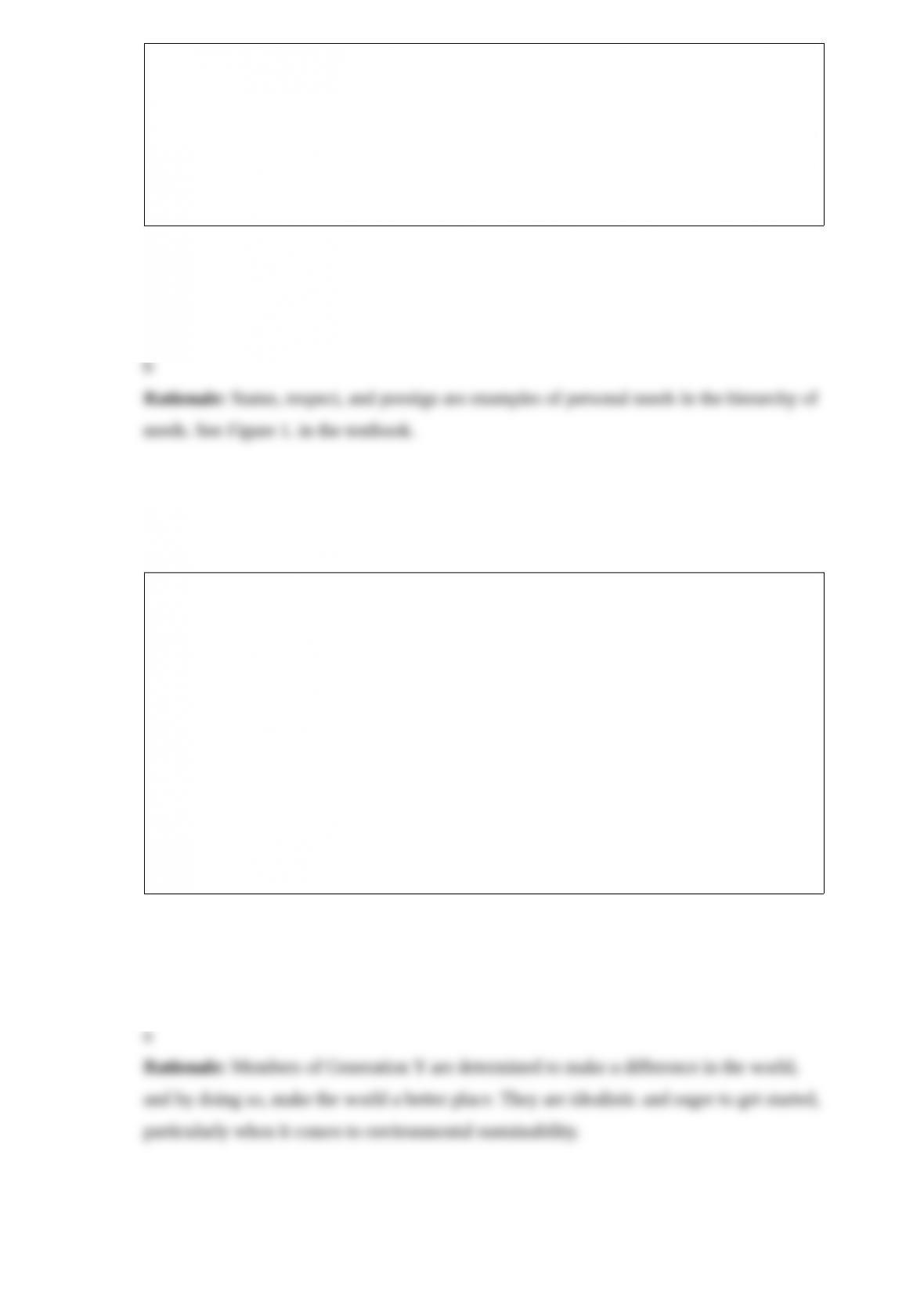
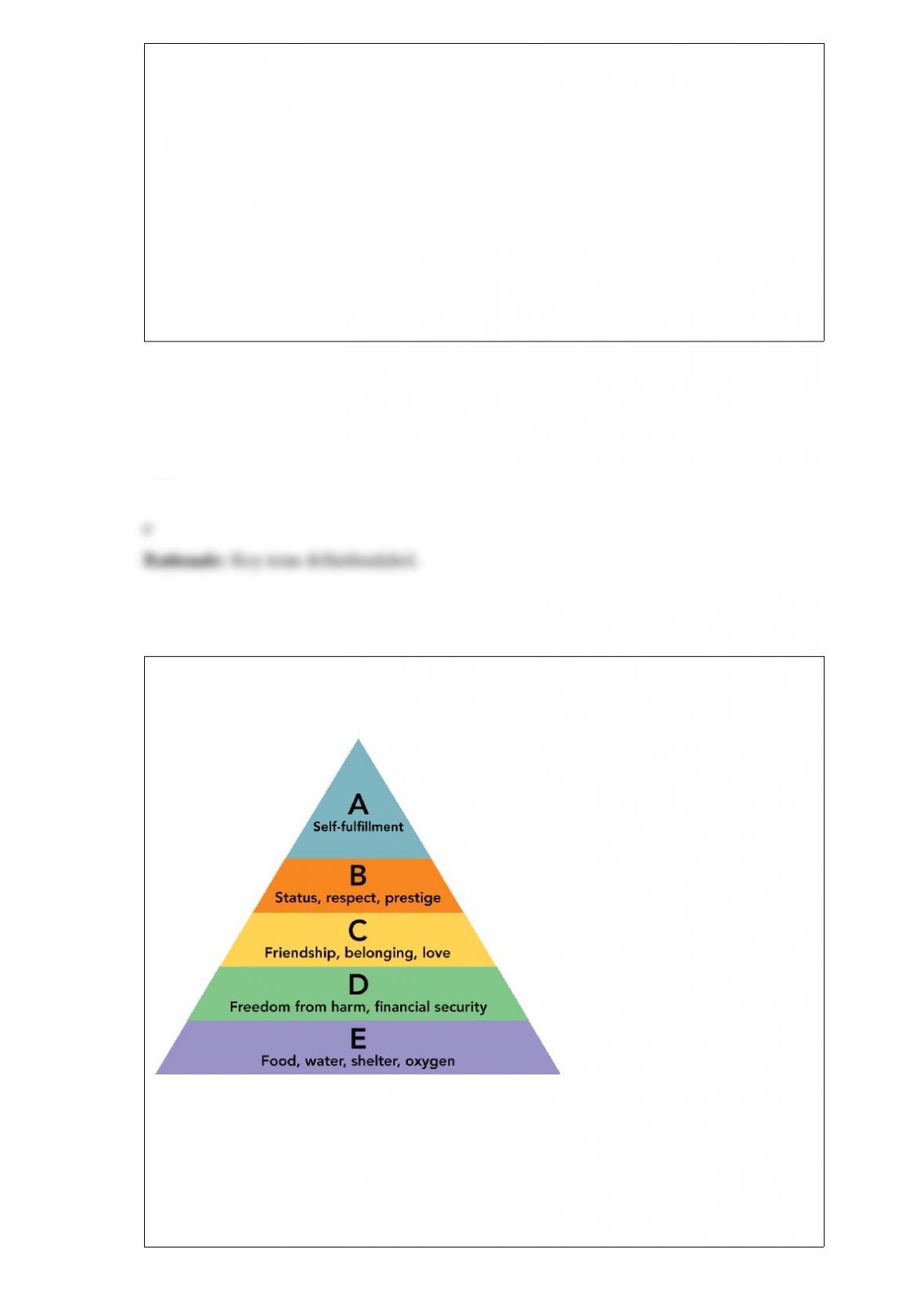
Figure 1.
According to Figure 1. above, status is an example of a __________ need.
a. self-actualization
b. personal
c. social
d. safety
e. physiological
Answer:
Members of Generation Y are idealistic and eager to get started making the world a
better place. One way they hope to achieve their goal is through __________.
a. environmental sustainability
b. political activism
c. intergenerational dialogue
d. fiscal conservatism
e. educational reform
Answer:
The prices for all furniture sold at American Furniture Warehouse end in $9, such as
$599.99, $899.99, etc. American Furniture Warehouse uses
a. odd-even pricing.
b. dynamic pricing.
c. price lining.
d. bundle pricing.
e. product line pricing.
Answer:
Price elasticity of demand is determined by a number of factors such as whether the
item is a luxury product or service, the availability of substitutes, the necessity of the
product or service, and
a. the stage of the product or service in its product life cycle.
b. the degree of carrying costs for the manufacturer or distributor.
c. the financial resources of the organization itself.
d. the cash outlay of purchase relative to a person’s disposable income.
e. the ability of the organization to meet sudden increases in demand.
Answer:
The Better Business Bureau (BBB) tries to use __________ to get its members to
comply with its standards of business conduct.
a. the FTC
b. industry trade associations
c. moral suasion
d. the courts
e. competitors
Answer:
The competitive market situation in which many sellers compete on nonprice factors is
referred to as
a. a pure monopoly.
b. an oligopoly.
c. pure competition.
d. monopolistic competition.
e. monopolistic oligopoly.
Answer:
Andrea Arenas is the owner of 2 Places at 1 Time, a concierge company. She and her
staff of 60 perform everyday services, such as walking the dog, picking up cleaning,
waiting for the repairman, and going to the post office, for people who are too busy to
perform these simple acts. One way she tries to ensure ___________ of services for her
regular customers is to make sure that the same well-trained person is always assigned
to work for them.
a. tangibility
b. consistency
c. congruity
d. flexibility
e. tangibility
Answer:
__________ of all new businesses fail within five years of their launch.
a. Only 5 percent
b. Only 10 percent
c. Only 25 percent
d. About 40 percent
e. Over 50 percent
Answer:
When a company retains a product but reduces marketing costs, it is referred to as
__________.
a. skimming
b. harvesting
c. milking
d. deletion
e. divesting
Answer:
All of the following marketing actions can be used by a firm to counteract barriers to
product adoption EXCEPT __________.
a. offering money-back guarantees
b. targeting new consumers
c. conducting demonstrations
d. offering free samples
e. providing extensive usage instructions
Answer:
One reason new products fail is that although most major corporations use a formal
decision making process, occasionally they will ‘skip” a stage of the new-product
process, often with disastrous results. This is why many firms have a __________ to
ensure that problems are corrected before proceeding to the next stage.
a. protocol
b. gate
c. task force
d. barrier
e. turnstile
Answer:
The 2007 __________ contains data on the number and sales of establishments in the
United States that produce a good or service based on its geography, industry sector,
and North American Industry Classification code.
a. Annual Retail Trade Survey
b. Annual Survey of Manufacturers
c. Economic Census
d. Annual Wholesale Trade Survey
e. Service Annual Survey
Answer:
An integral part of the package that typically identifies the product or brand, who made
it, where and when it was made, how it is to be used, and package contents and
ingredients is referred to as a(n) __________.
a. SKU
b. product information panel
c. UPC
d. RFID
e. label
Answer:
Figure 1.
According to Figure 1. above, “C” defines what level in the hierarchy of needs?
a. self-actualization
b. personal
c. social
d. safety
e. physiological
Answer:
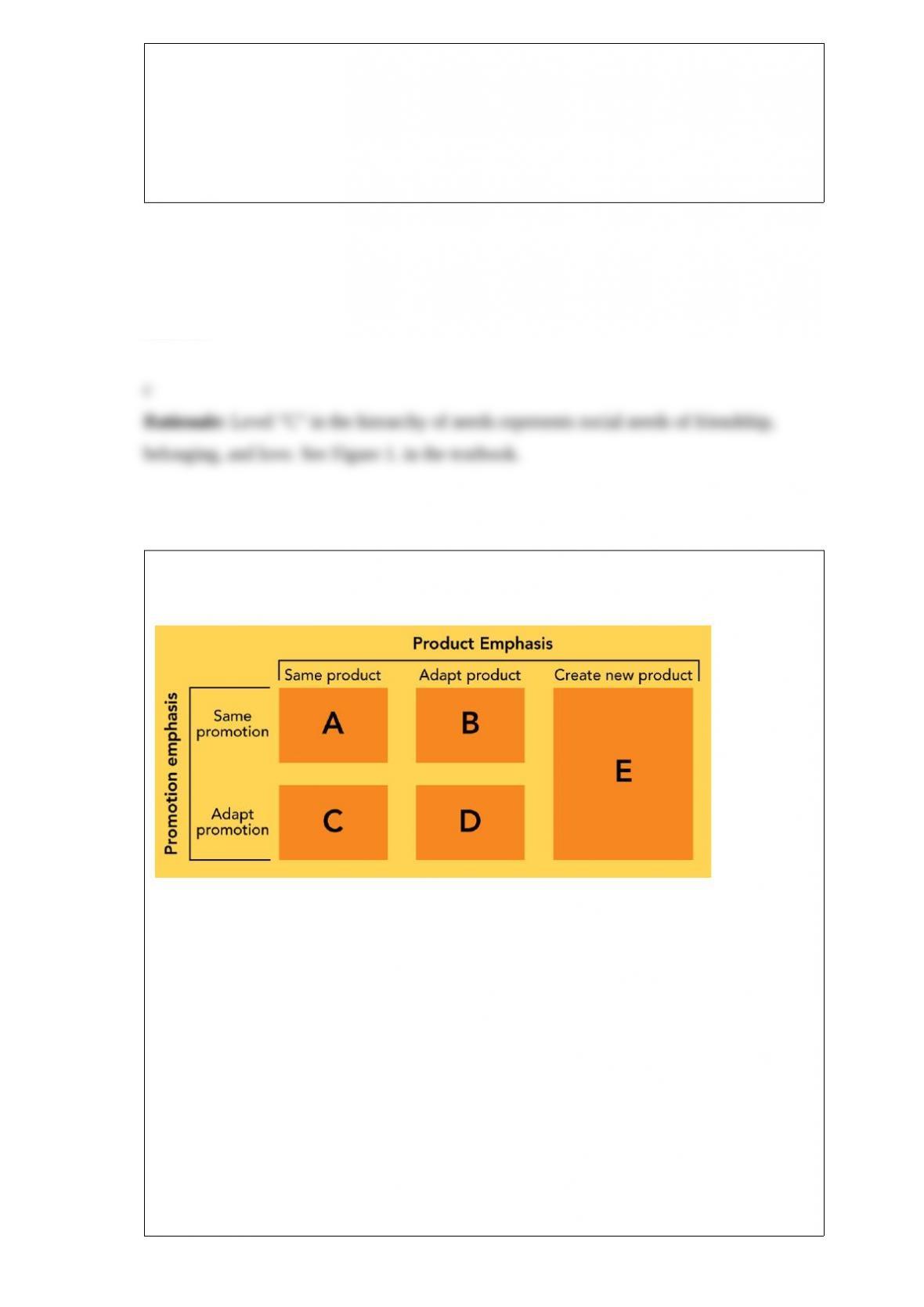
Figure 1.
Global companies have five strategies for matching products and their promotion
efforts to global markets. According to Figure 1. above, “E” refers to which type of
strategy?
a. product extension strategy
b. product adaptation strategy
c. dual adaptation strategy
d. product invention strategy
e. communication adaptation strategy
Answer:
The break-even point (BEP) = [Fixed cost (Unit price − __________)].
a. Total cost
b. Total expense
c. Marginal revenue
d. Unit variable cost
e. Total number of units produced or quantity
Answer:
Hindustan Lever realized it could not sell to the rural poor in India unless it found ways
to distribute its products such as soap, shampoos, and laundry detergents. Lever
provided start-up loans to women to buy stocks of products to sell to local villagers.
Today, over 45,000 poor women sell Lever products to 600,000 consumers in 135,000
villages in India. This effort was called __________.
a. Project Open Roads
b. Project Fresh Start
c. Project Tikva
d. Project Shakti
e. Project Helping Hand
Answer:
Eddie Bauer has leveraged its store, website, and catalog channels with impressive
results. At Eddie Bauer, every effort is made to make the apparel shopping and purchase
process for its customers the same as in its retail stores, catalog, and website. An Eddie
Bauer marketing manager says, “We don”t distinguish between channels because it’s all
Eddie Bauer to our customers.” Eddie Bauer is likely following a(n) __________
strategy.
a. cross-functional
b. interlocking marketing
c. dual distribution
d. multichannel marketing
e. market penetration
Answer:
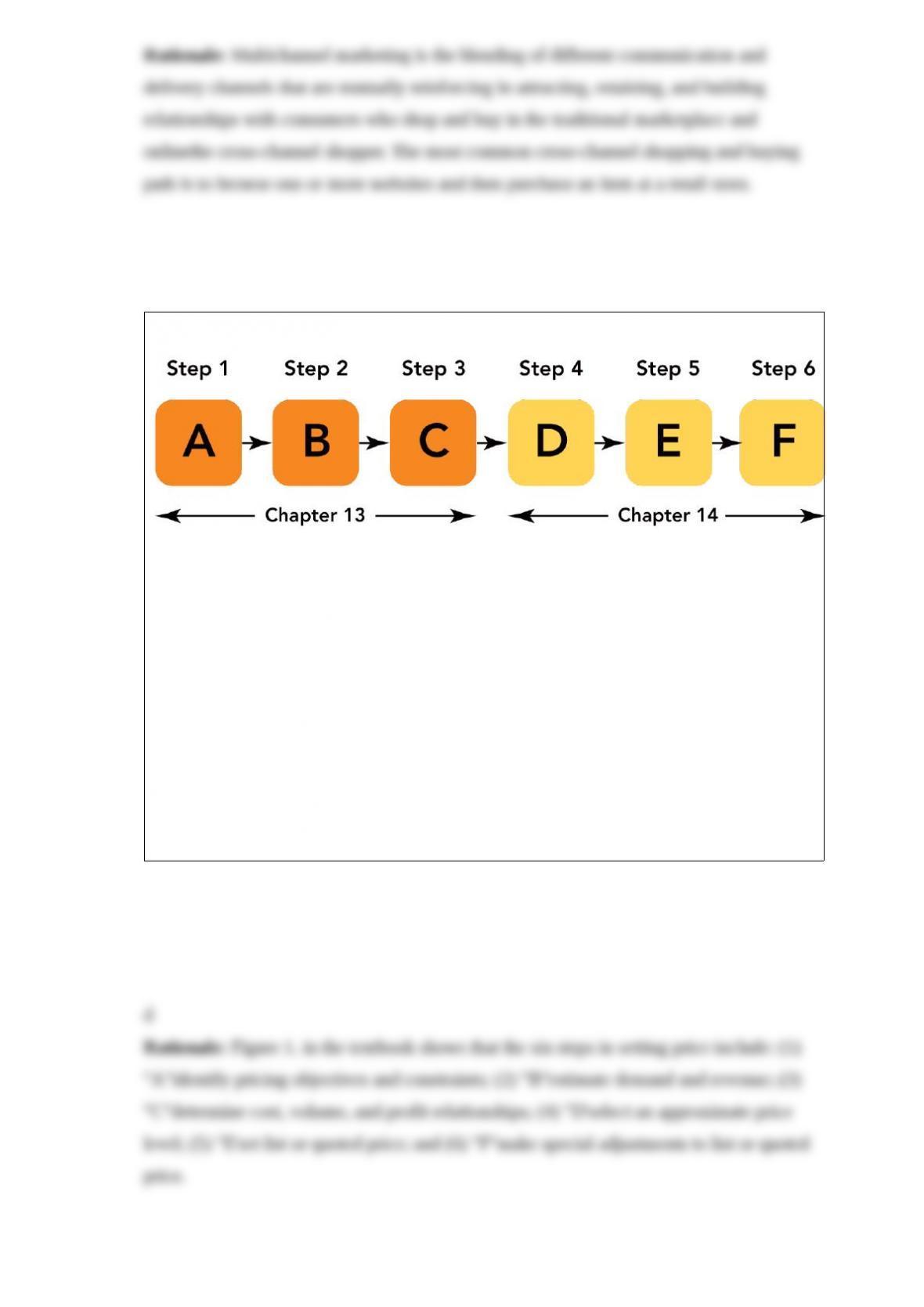
Figure 1.
Figure 1. above represents the six steps in setting price. “F” represents the step at which
a firm would
a. set list or quoted price.
b. select an approximate price level.
c. scan competitors for prices of similar products or services
d. make special adjustments to list or quoted price.
e. establish the price range.
Answer:
Investors should understand that when purchasing stock, the principle of __________ is
in effect. It behooves investors to do research on the company, so they will make a wise
purchase.
a. modus operandi
b. E Pluribus Unum
c. de facto marketing
d. cest la vie
e. caveat emptor
Answer:
If the cash discount terms for a $500 purchase are 4/10 net 30, the number 10 refers to
a. the percentage discounted if the bill is paid within 30 days.
b. the percentage increase in price if the bill is not paid within 10 days.
c. the number of days for which the discount is valid.
d. the discount in dollars per unit if the order is paid on time in 30 days.
e. the penalty in dollars if the bill is not paid within 10 days.
Answer:
The set of values, ideas, and attitudes that are learned and shared among the members
of a group is referred to as __________.
a. customs
b. morals
c. norms
d. culture
e. ethics
Answer:
The stage of the new-product process that positions and launches a new product in
full-scale production and sales refers to __________.
a. marketing program execution
b. disbursement
c. launch
d. commercialization
e. final distribution
Answer:
Figure 1.
The perceptual map in Figure 1. above shows how various drinks are seen in the minds
of adult consumers. Suppose this map describes accurately how adults see the drinks
shown. As one of these adults, you are a heavy consumer of mineral water. Moreover,
you are very concerned about nutrition and tend not to consume children’s drinks. From
this perceptual map, you conclude that mineral water is
a. more nutritious than tea.
b. a more adult-oriented beverage than sports drinks.
c. more nutritious and a more adult-oriented beverage than milk shakes.
d. a more adult-oriented beverage than nutritionally designed diet drinks.
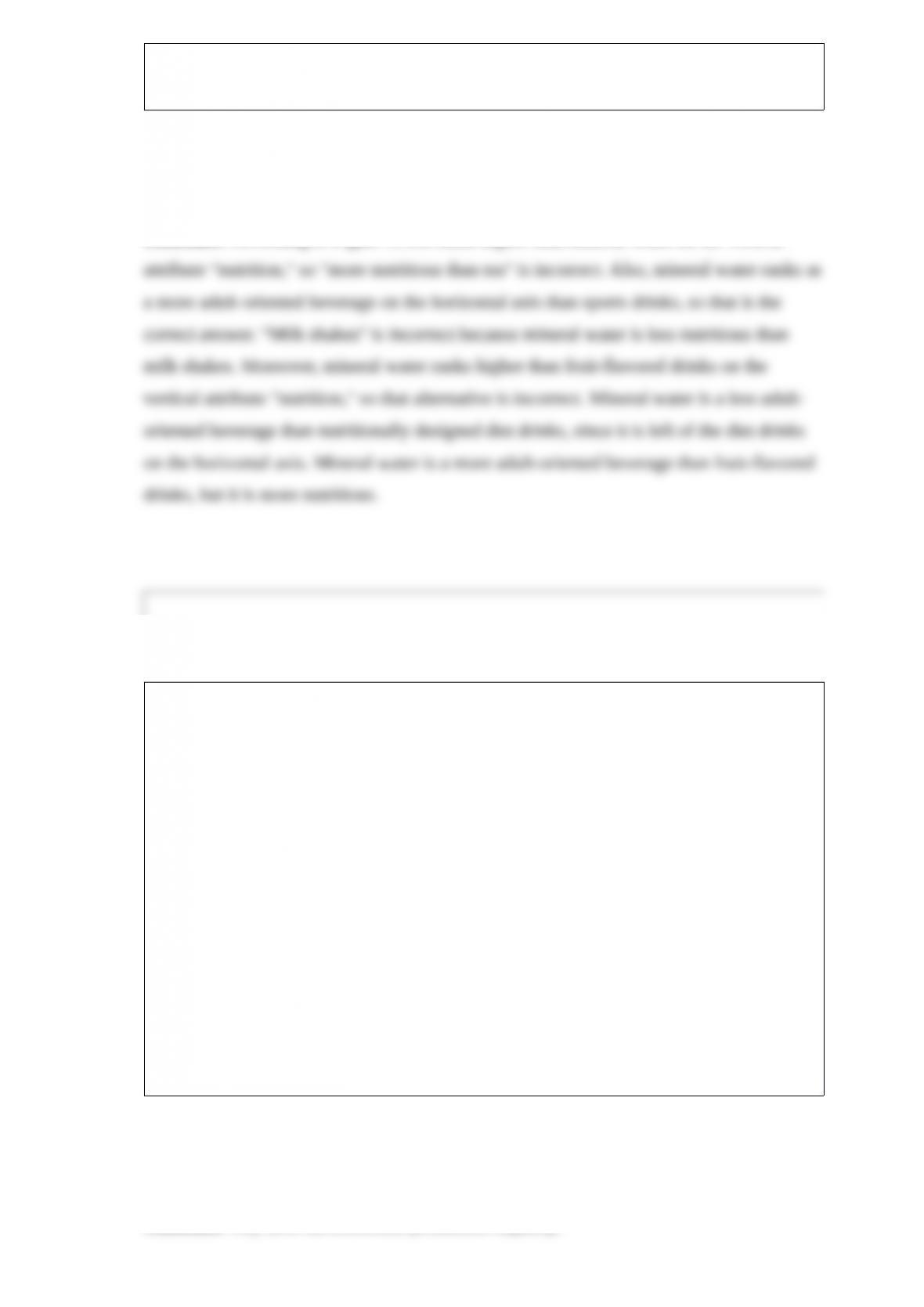
e. less nutritious and a more adult-oriented beverage than fruit-flavored drinks.
Answer:
Idle production capacity refers to
a. the minimum number of customers that a service provider can serve and still remain
profitable.
b. the maximum number of customers that a service provider must serve in order to
remain profitable.
c. the ability of a service provider to redirect its efforts so even when there is no
primary demand, employees are still able to meet selective demand.
d. a situation that occurs when a service provider is available but there is no demand for
the service.
e. a situation that occurs when the primary demand for a service exceeds that number of
service deliverers available to meet that demand.
Answer:
New Coke was repositioned as a slightly sweeter, less filling soft drink because the
Coca-Cola Company discovered that its 1984 market share in supermarkets was 2
percent behind Pepsi. This product repositioning strategy was __________.
a. to reach a new market
b. to catch a rising trend
c. to change the value offered
d. to change its target audience
e. to react to a competitor’s position
Answer:
Which of the following pieces of information is used in the development of the
marketing program, the third step of the planning phase of the strategic marketing
process?
a. marketing return on investment
b. market-product grids with target segments and product groupings
c. trends for industry and competitors
d. marketing mix actions
e. market potential studies
Answer: