
FedEx and UPS are converting their delivery trucks with standard diesel engines to
more fuel-efficient and cleaner hybrid-electric vehicles, which can cut fuel costs by half
and lower fuel emissions by 90 percent. This is an example of
a. demarketing.
b. triple-top line marketing.
c. preemptive compliance.
d. green marketing.
e. cause marketing.
Answer:
The Securities and Exchange Commission (SEC) works hard to prevent unscrupulous
companies from “cooking” their books to paint investors and regulators a better
financial picture than they really have. Yet, in the end, it is up to investors to research
the companies in which they want to invest because __________ is the norm when
investing in the stock market.
a. modus operandi
b. caveat emptor
c. de facto marketing
d. cest la vie
e. anguis in herba
Answer:
Another name for the steps in the service delivery process is __________.
a. service interactions
b. access points
c. path-analysis
d. service encounters
e. wheel of services
Answer:
Which of the following statements about the dynamics of world trade is most accurate?
a. Manufactured goods and commodities account for only 10 percent of world trade.
b. Three-fourths of world trade includes services such as telecommunications,
transportation, and banking.
c. World trade will likely exceed $25 trillion by 2015.
d. All nations participate equally in world trade.

e. There is still greater growth potential in developed countries than emerging ones.
Answer:
Websites play a multifaceted role in multichannel marketing because they can serve as
either a __________ or delivery channel.
a. cost
b. communication
c. choice
c. control
d. convenience
Answer:
OUT! International’s Hey! There’s A Monster In My Room spray with a bubble-gum
fragrance was designed to rid scary creatures from a kid’s bedroom. Although a clever
idea, it failed because it

a. did not satisfy customer needs on critical factors.
b. had poor product quality.
c. had bad timing.
d. had an incomplete market and product protocol.
e. had too little market attractiveness.
Answer:
Odd-even pricing is based on
a. retailers’ perceptions of price.
b. customers’ perceptions of price.
c. wholesalers’ markups.
d. manufacturers’ perceptions of price.
e. government regulators’ perceptions of price.
Answer:

Once a company has decided to enter the global marketplace, it must select a means of
market entry. Four general options exist: (1) __________; (2) licensing; (3) joint
venture; and (4) direct investment.
a. exporting
b. accreditation
c. multiparty
d. cooperative
e. franchising
Answer:
A(n) __________ involves starting with the last known value of the item being forecast,
listing the factors that could affect the forecast, assessing whether they have a positive
or negative impact, and making the final forecast.
a. direct forecast
b. lost-horse forecast
c. lost-cause forecast
d. indirect forecast
e. incremental forecast
Answer:
When developing a distribution strategy, marketers should avoid the anticompetitive
attempts of eliminating wholesalers or retailers if they want to avoid the possibility of
violating the __________ provisions of the Clayton Act or the Sherman Act.
a. resale restrictions
b. tying arrangements
c. exclusive dealing
d. refusal to deal
e. dual distribution
Answer:
Off-price retailing refers to the

a. differences between the final selling price and the retailer’s cost.
b. sale of brand name merchandise at lower than regular prices.
c. sales of merchandise at maintained markups.
d. amount added by the manufacturer to achieve the desired suggested retail price.
e. reduction in retail price usually expressed as the gross margin.
Answer:
Which of the following quotes from a new product adopter would signal the need for a
firm to counteract a risk barrier?
a. “It is against my religion.”
b. “What if I can”t make the monthly payments?”
c. “I don”t want to try this if it means I have to swallow it with milk.”
d. “Big deal, the only difference is the shape of the package.”
e. “Sure I”ll try it; why not!”
Answer:

A selling format that consists of information that must be provided in an accurate,
thorough, and step-by-step manner to inform the prospect is referred to as
a__________.
a. traditional hard sell
b. formula selling presentation
c. stimulus-response presentation
d. needs-satisfaction presentation
e. straight rebuy sales-pitch
Answer:
The most expensive stage in the new-product process for most products and services is
a. commercialization.
b. screening and evaluation.
c. business analysis.
d. development.
e. market testing.

Answer:
The executive vice president of Washburn Guitars has set a sales target of 2,000 units
for a new line of guitars. This type of objective is most closely related to a(n) ________
pricing objective.
a. profit
b. target return
c. unit volume
d. market share
e. survival
Answer:
Product form refers to __________.
a. a distinctive shape of a product life cycle
b. similarities within the product category
c. variations within the product class
d. variations from product lines in a product mix

e. shared characteristics within the product class
Answer:
If competitive market circumstances are such that there is no price competition, no
product differentiation, and the purpose of advertising is to increase demand for the
product class, then __________ must exist in the industry.
a. an oligopoly
b. monopolistic competition
c. a pure monopoly
d. pure competition
e. oligopolistic competition
Answer:
Which of the following quotes from a new product adopter would signal the need for a
firm to counteract a psychological barrier?

a. “But it might make me fat.”
b. “What if I can”t make the monthly payments?”
c. “I don”t want to try this if it means I have to swallow it with milk.”
d. “Big deal, the only difference is the shape of the package.”
e. “Sure I”ll try it; why not!”
Answer:
Michael Porter has identified four key elements in a nation’s competitive advantage:
factor conditions; __________; related and supporting industries; and company
strategy, structure, and rivalry.
a. demand conditions
b. ethnocentrism
c. barriers to entry
d. governmental regulation
e. suppliers
Answer:

Individuals and firms involved in the process of making a product or service available
for use or consumption by consumers or industrial users are referred to as a
a. marketing channel.
b. distribution matrix.
c. retailer.
d. wholesaler.
e. distributor.
Answer:
In order to deliver a product that the average consumer can afford, Vizio
a. handles product design and marketing in the United States and relies on contract
manufacturers in Taiwan to build the product.
b. uses mass customization in Taiwan and then ships the HDTVs to the United States.
c. purchased a small company in China to distribute its products under the Vizio name.
d. purchased a small company in Japan to distribute its products under the Vizio name.
e. relies solely on recycled materials to build high quality, no-frills products.

Answer:
Intensive distribution refers to
a. the distribution of products or services in markets where there are currently no other
competitors.
b. the distribution of products or services where the producer owns the entire channel of
distribution.
c. the density of distribution whereby a firm tries to place its products or services with
only one retail outlet in a specified geographical area.
d. the density of distribution whereby a firm tries to place its products or services in as
many outlets as possible.
e. the density of distribution whereby a firm tries to place its products or services in a
few retail outlets in a specific area.
Answer:
The process of turning corn into ethanol shows how BioFuel Energy, a Minnesota

ethanol producer, can create __________ utility.
a. time
b. place
c. possession
d. market
e. form
Answer:
When conducting marketing research, why would you ask the questions, “Did you like
the ending?” and “If not, how would you change it?” after the test screening of a movie?
a. to screen out people who simply want a free movie ticket
b. to change or clarify the ending of the movie
c. to determine the relationship between ticket prices and happy endings of movies
d. to identify people who frequently attend movies
e. to separate those aware of the movie ending from those who are not aware
Answer:

The concept of the diffusion of innovation shows how a product “diffuses” or spreads
through the population over time. The consumer population is divided into five
categories of product adopters based on when they adopt (i.e., first buy) a new product.
Each product adopter category has a unique profile. Consumers who have a fear of debt
and depend on neighbors and friends as their information sources are called
__________.
a. innovators
b. early adopters
c. early majority
d. late majority
e. laggards
Answer:
Semiotics refers to
a. a field of study in marketing linguistics that identifies the connotative meanings
behind words in order to create the most effective product or brand names.
b. a field of study in marketing linguistics that identifies the connotative meanings
behind words in order to create the most effective advertising messages.
c. a field of study that examines the correspondence between symbols and their role in
the assignment of meaning for people.

d. a field of linguistics that translates words into internationally recognized symbols to
help companies carry their product message across international boundaries.
e. the combination of a symbol from one language and the verbal message from another
in order for companies to standardize their brand across international boundaries.
Answer:
The key to setting a final price for a product is finding an approximate price level to use
as a reasonable starting point. Four common approaches to selecting an approximate
price level are: (1) demand-oriented; (2) cost-oriented; (3) __________; and (4)
competition-oriented approaches.
a. stakeholder-oriented
b. revenue-oriented
c. profit-oriented
d. distribution-oriented
e. cause-oriented
Answer:

The four utilities offered to consumers through retailing are
a. convenience, performance, possession, and form.
b. time, place, possession, and form.
c. product, price, place, and promotion.
d. people, productivity, process, and physical environment.
e. convenience, consistency, competition, and choice.
Answer:
People in __________ positions have the authority and responsibility to issue orders to
people who report to them.
a. staff
b. executive marketing officer
c. line
d. stakeholder
e. program champion
Answer:
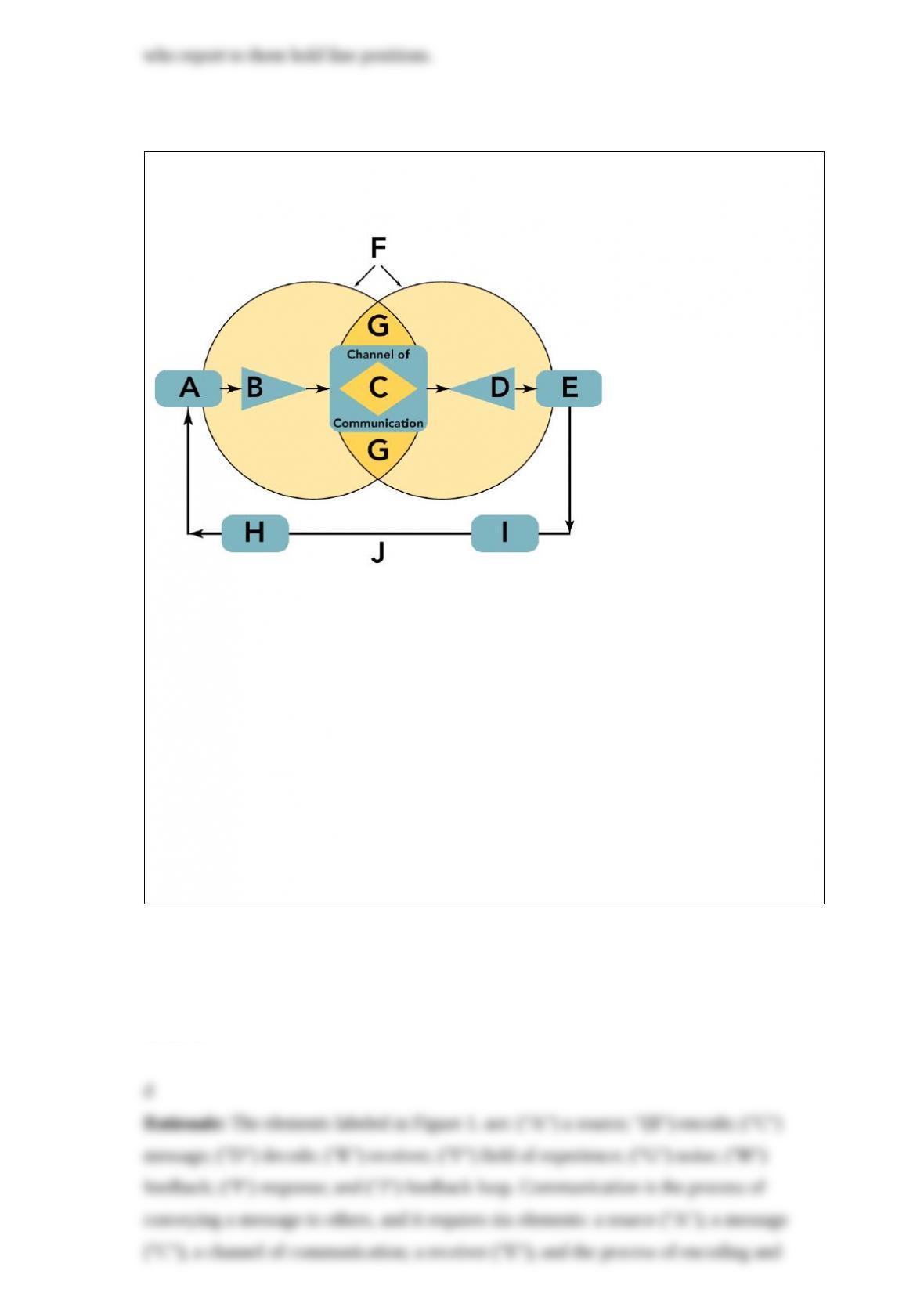
Figure 1.
Figure 1. above depicts the communication process, which consists of ten key elements
(“A” through “J”). The position labeled “J” is referred to as _________.
a. the source
b. the message
c. the receiver
d. the feedback loop
e. the field of experience
Answer:
In many societies outside the United States, during the __________ stage of the
personal selling process, considerable time is devoted to nonbusiness talk designed to
establish a rapport between buyers and sellers.
a. close
b. approach
c. preapproach
d. presentation
e. prospecting
Answer:
Gatorade successfully used a__________ strategy when it introduced Gatorade G2.
a. subbranding
b. multibranding
c. mixed branding

d. generic branding
e. family branding
Answer:
Organizational strategies vary in two ways, depending on
a. (1) the strategy’s level in the organization and (2) the offerings an organization
provides to its customers.
b. (1) the corporate level and (2) the SBU level in the organization.
c. whether an offering is (1) a product) or (2) a service.
d. whether they are (1) mission statements or (2) core values.
e. (1) the organizational culture and (2) its core values.
Answer:
Firms that have designed a unique approach for performing a service and wish to profit

by selling the franchise to others employ a __________.
a. customer-generated franchising system
b. service-sponsored retail franchise system
c. manufacturer-sponsored wholesale franchise system
d. manufacturer-sponsored retail franchise system
e. administered vertical marketing systems
Answer:
All of the following statements are true about the changing aspects of television as an
advertising medium EXCEPT:
a. a growing number of households have game consoles or DVRs.
b. many households have dropped their cable or satellite subscriptions and view limited
programming on alternative options such as YouTube, Hulu, Netflix, and other Internet
or streamed video services.
c. industry experts also predict that more than 100 million 3-D televisions will be sold
by 2014.
d. DVR manufacturers have removed the ‘skip” button on their remotes to limit
ad-zapping in response to advertiser complaints.
e. there are also many opportunities for out-of-home TV viewing as televisions are in
many bars, hotels, offices, airports, and on college campuses.
Answer: