A car collector, Mr. F. Hansen, who said his 1975 Chevrolet Corvette was certified as
the last Corvette convertible to be produced, sued General Motors to stop it from
manufacturing any more of the convertible sports cars. The suit also requested $1.
million in damages. Hansen claimed he bought the car for its collector’s value. It came
with a letter from GM dated August 25, 1975, which said that the car was “the last
Corvette convertible that General Motors Corp. would ever manufacture.” Hansen said
the value of his car has been decreasing ever since GM resumed manufacturing
Corvette convertibles in 1985. If the court ruled in favor of Mr. Hansen, what general
type of regulation would such a ruling represent?
a. protecting companies from one another
b. protecting consumers from unfair trade practices
c. protecting the future interests of society from dangerous business practices
d. protecting consumers from one another
e. protecting businesses from unfair consumer practices
Answer:
Shortly after World War II, Sam Jackson developed an idea for a biodegradable
lubricant that was superior to anything currently on the market. He was excited about
his new idea and persuaded a number of his friends to help produce samples. While
demand kept up with production at first, he soon found that he had to hire a sales force
to sell excess product to manufacturing companies in the area. He decided this was
primarily because his company had several strong competitors that had recently come
into the industry. This is an example of marketing behavior that would occur during the
__________ era of U.S. business history.
a. marketing concept
b. production
c. goods
d. sales
e. societal marketing concept
Answer:
The money or other considerations (including other products and services) exchanged
for the ownership or use of a product or service is referred to as __________.
a. fee
b. value
c. remuneration
d. price
e. exchange rate
Answer:

White Chemical Company is examining its selling strategy and one of the issues that
needs attention is the role its sales staff has in undertaking sales support (non-selling)
activities; yet it wants to keep the salespeople directed towards increasing sales for the
next year. If you did not know which plan the firm presently uses, what advice would
you give?
a. Provide a base salary and a commission on sales generated.
b. Give a raise to every salesperson as a motivational incentive.
c. Provide year-end bonuses to reward the salesforce personnel who perform the best.
d. Offer straight salaries and give raises if the sales go up.
e. Offer straight commission and if sales improve, raise the commission rates.
Answer:
Relative newcomers to the Internet who rarely spend money online but seek product
information are referred to as “__________.”
a. hunter-gatherers
b. click-and-mortar
c. ebivalent newbies
d. time-sensitive materialists
e. brand loyalists
Answer:
A global brand is a brand marketed under the same name in multiple countries with
similar and centrally coordinated marketing programs. However, adaptations of global
brands are made
a. if required by government regulations in the host market and for no other reason.
b. only in its initial introduction into a market and only until the brand is recognized.
c. by domestic competitors causing brand confusion and loss of market share.
d. only when necessary to better connect the brand to consumers in different markets.
e. when there is a serious drop in market share.
Answer:
Studies show that shoppers spend an average of __________ hour(s) researching cars
online before setting foot in a showroom.

a. 1
b. 2
c. 3
d. 4
e. 5
Answer:
Economic infrastructure refers to
a. a nation’s military-industrial complex.
b. a country’s governmental services.
c. the people and the wealth of a nation.
d. a country’s communication, transportation, financial, and distribution systems.
e. all of a country’s natural resources, whether or not they are currently being exploited.
Answer:

Society’s values and standards that are enforceable in the courts are referred to as
a. situational ethics.
b. cultural norms.
c. industry practices.
d. laws.
e. the Consumer Bill of Rights
Answer:
In keeping with its business mission, Ben & Jerry’s has
a. opened new ScoopShop franchises in preexisting, eco-friendly structures in order to
save natural resources.
b. created social entrepreneurship programs to help nonprofit organizations give jobs to
at-risk youth.
c. invested in research to create genetically engineered cows that will produce more
hypoallergenic milk.
d. limited its advertising to nonprint media.
e. packaged its next line of bulk ice cream in glass containers that not only keep the ice
cream colder, but are recyclable as well.
Answer:

A strategy of dropping a product from the product line during the decline stage of the
product life cycle is referred to as __________.
a. trimming
b. elimination
c. paring down
d. deletion
e. harvesting
Answer:
Internet users ages 15 and older are expected to buy _________ worth of products and
services online in 2015 (excluding travel, automobiles, and prescription medications).
a. $829 million
b. $997 million
c. $39 billion
d. $232 billion
e. $270 billion

Answer:
Which of the following statements about StubHub is most accurate?
a. StubHub recently purchased Amazon.com for $253 million dollars.
b. StubHub has established relationships with deal-making social networking firms
LivingSocial and Groupon.
c. StubHub had plans to enter the European market, but EU regulations made the plan
unfeasible.
d. StubHub and Ticketmaster have a nonbinding agreement to cater to separate market
segments (sports vs. concert) to avoid undue competition.
e. StubHub has had difficulty selling tickets in some states because they view the
brokering of tickets as ticket scalping, which is illegal.
Answer:
Practices such as filing warranty claims after the claim period, misredeeming coupons,
making fraudulent returns of merchandise, etc. are
a. acceptable provided the merchant providing the service has not violated the
Consumer Bill of Rights.

b. acceptable provided the salesperson doesn”t mind.
c. occasionally permitted when two different firms are competing for a customer’s
business and both are using equally less than ethical practices.
d. not acceptable because consumers also have an obligation to act ethically and
responsibly.
e. not acceptable unless the participants are nonprofit organizations or charities.
Answer:
The shapes of the product life cycle for high-learning, low-learning, fashion, and fad
products vary as does __________.
a. the actual length of time a given product stays in any given stage of the life cycle
b. the individual criteria selected to place a firm in a stage of the life cycle
c. the importance of the marketing mix elements
d. the importance of environmental forces
e. the importance of new product innovation
Answer:
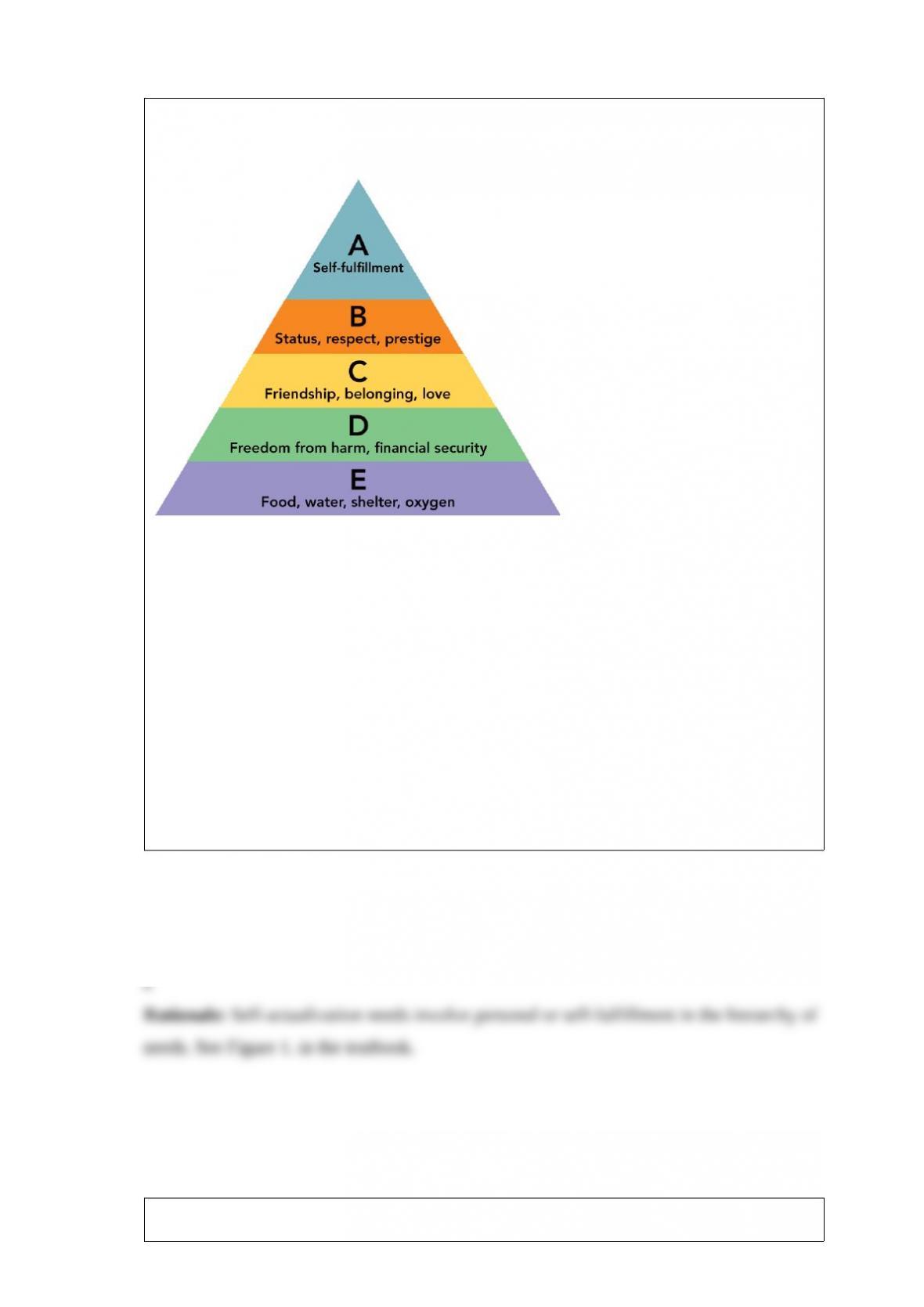
Figure 1.
According to Figure 1. above, self-fulfillment is an example of the highest-order needs
referred to as
a. physiological needs.
b. social needs.
c. safety needs.
d. personal needs.
e. self-actualization needs.
Answer:

Those needs that are concerned with love and friendship are referred to as__________
needs.
a. physiological
b. safety
c. social
d. personal
e. self-actualization
Answer:
Marketing tactics refer to the
a. long-term decisions made to implement the marketing program and the monitoring of
those decisions.
b. detailed day-to-day operational decisions essential to the overall success of
marketing strategies.
c. steps taken to develop an effective marketing plan.
d. development of marketing strategies to achieve the organization’s marketing
objectives.
e. refinement of the organization’s mission based on the results obtained from a
marketing audit.
Answer:
Demand factors refer to
a. the number of consumers who can afford to purchase a product or service.
b. the price that should be charged for a given product.
c. consumers’ willingness and ability to pay for goods and services.
d. the number of consumers who want to purchase a product.
e. the number of consumers who can purchase a product.
Answer:
The online advertising market has grown from its initial focus on simple text ads to a
much larger set of options. There are five key categories of online advertising. They
are: search, __________, classified, referral, and e-mail.
a. show
b. track
c. monitor
d. explain
e. display
Answer:
Gross sales minus returns and allowances equals
a. inventory shrinkage.
b. discounted return on investment.
c. gross sales.
d. net sales.
e. gross margin.
Answer:
Alamo, a car rental firm, targets 50 percent of its advertising to salespeople who rent a
car over 40 weeks per year. Alamo likely segments its market by
a. usage rate.
b. benefits offered.
c. demographics.
d. geography.
e. lifestyle.
Answer:
In setting research objectives, marketers have to be clear on the purpose of the research
that leads to marketing actions. The three main types of marketing research include
descriptive research, causal research, and __________ research.
a. virtual
b. interactive
c. financial
d. interdisciplinary
e. exploratory
Answer:
Which of the following statements about cost and its impact on online shopping is most
accurate?
a. Fixed pricing is commonly used online because there is no need to respond quickly to
changes in supply and demand conditions.

b. The margin for online goods is usually higher than those purchased in a traditional
marketplace.
c. Dynamic pricing is the most commonly used pricing strategy for Internet purchases.
d. Any price advantage for online purchases is lost in shipping and handling fees.
e. Lower external search costs is one of the major reasons for the popularity of online
shopping.
Answer:
Men’s Wearhouse (MW) caters to the man who doesn”t necessarily enjoy shopping. Its
stores are located in shopping centers so that customers can get in and out quickly.
Additionally, the MW targets the budget-conscious consumer with suit prices ranging
from $250 to $500. Earnings rose 23% recently, indicating that the location of its stores
and the pricing strategy both are part of MW’s
a. competitive advantage.
b. core values.
c. core benefit proposition.
d. marketing edge.
e. viable mission.
Answer:
Four general categories used to segment consumer markets are geographic
segmentation, demographic segmentation, __________, and behavioral segmentation.
a. supplier segmentation
b. demand segmentation
c. regional segmentation
d. psychographic segmentation
e. product segmentation
Answer:
As of late 2011, Facebook has approximately how many members around the globe?
a. 2 million
b. 7 million
c. 250 million
d. 770 million
e. 2 billion
Answer:
When American Express pioneered cause marketing, it raised $1. million to renovate a
national icon, increased usage among cardholders, and
a. became the only credit card accepted for admission to the sight.
b. decreased outstanding debt on previously unpaid credit cards.
c. was able to raise interest rates without facing customer complaints.
d. received a tax credit that more than paid for the original campaign.
e. attracted new cardholders.
Answer:
Many people are concerned about “eating healthy,” but many of these same people still
grab lunch at fast food restaurants because the restaurants are convenient and they like
cheeseburgers. Burger King has created a veggie burger that “tastes like the real thing
without all the fat.” Burger King is using a __________ strategy to attract this large
market that encompasses many different segments.
a. cost leadership strategy
b. cost focus strategy
c. differentiation strategy
d. different focus strategy
e. service focus strategy
Answer:
Using the telephone to interact with and sell directly to consumers is referred to as
__________.
a. digital marketing
b. telemarketing
c. solicitation marketing
d. direct contact marketing
e. direct selling
Answer:

Customer relationship management (CRM) is most closely related to the __________
era in U.S. business history.
a. customer relationship
b. production
c. sales
d. marketing concept
e. societal marketing
Answer: