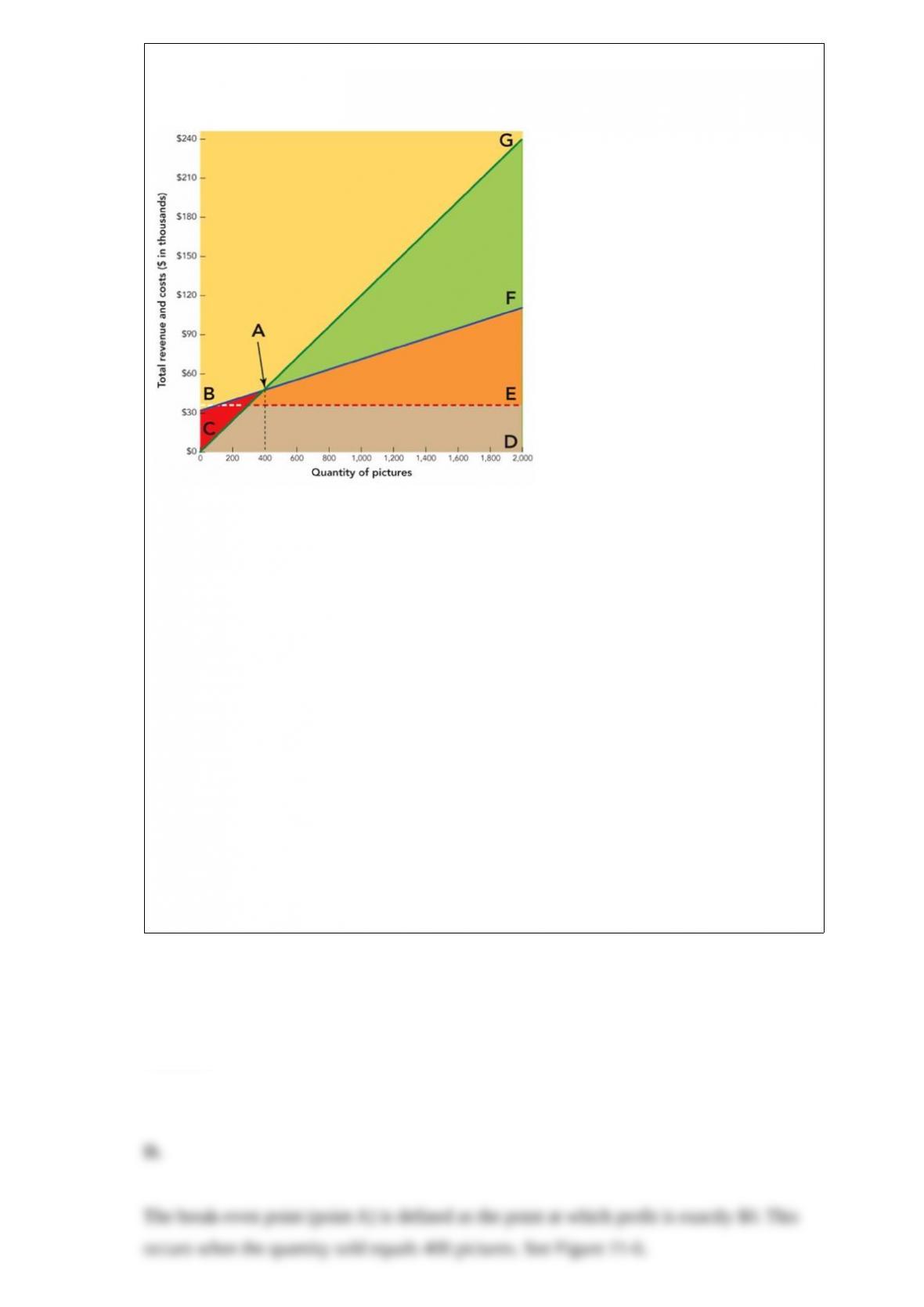
Figure 11-6
Suppose you are the owner of a picture frame store. Let’s assume that the average price
customers are willing to pay for each picture frame is $120. Also, suppose your fixed
costs (FC) total $32,000 (real estate taxes, interest on a bank loan, etc.) and unit
variable cost (UVC) for a picture frame is $40 (labor, glass, frame, and matting).
According to Figure 11-6 above, how much profit will your picture frame store make if
it sells 400 picture frames?
A. $48,000
B. $32,000
C. $16,000
D. $0
E. ($32,000)
Answer:
The objective of a(n) __________ is to inform a newspaper, radio station, or other
medium of an idea for a story.
A. infomercial
B. news flash
C. news release
D. news broadcast
E. news summary
Answer:
IBM is one of the world’s great business success stories because of its ability to reinvent
itself to satisfy shifting customer needs in a(n) __________ global marketplace.
A. stagnant
B. dynamic
C. inert
D. lethargic
E. apathetic
Answer:
In implementing capacity management, service providers use __________ to charge
different prices for different times of the day or week to help match the supply and
demand for their services.
A. off-peak pricing
B. dynamic pricing
C. capacity pricing
D. down-time pricing
E. yield management pricing
Answer:
Custom Foot operates six retail locations. At first glance, none looks different from a
typical boot store. But here the only boots on hand are display models, there is no
inventory for sale and customers go home empty-handed, awaiting their orders.
Customers browse the store, choosing style, color, and leather type, with about 100
displays to provide style guidelines. Custom Foot guarantees your boots will be ready
within three weeks. This is an example of
A. mass customization.
B. specialty customization.
C. virtual merchandising.
D. one product and multiple market segments.
E. multiple products and multiple market segments.
Answer:
The strategic marketing process
A. involves taking stock of where the firm or product has been recently, where it is now,
and where it is headed in terms of the organization’s marketing plans and the external
forces and trends affecting it.
B. is a technique to quantify performance measures and growth targets to analyze its
clients’ strategic business units (SBUs) as though they were a collection of separate
investments.
C. describes an organization’s appraisal of its internal strengths and weaknesses and its
external opportunities and threats.
D. is an approach whereby an organization allocates its marketing mix resources to
reach its target markets.
E. seeks opportunities by finding the optimum balance between marketing efficiencies
versus R&D-manufacturing efficiencies.
Answer:
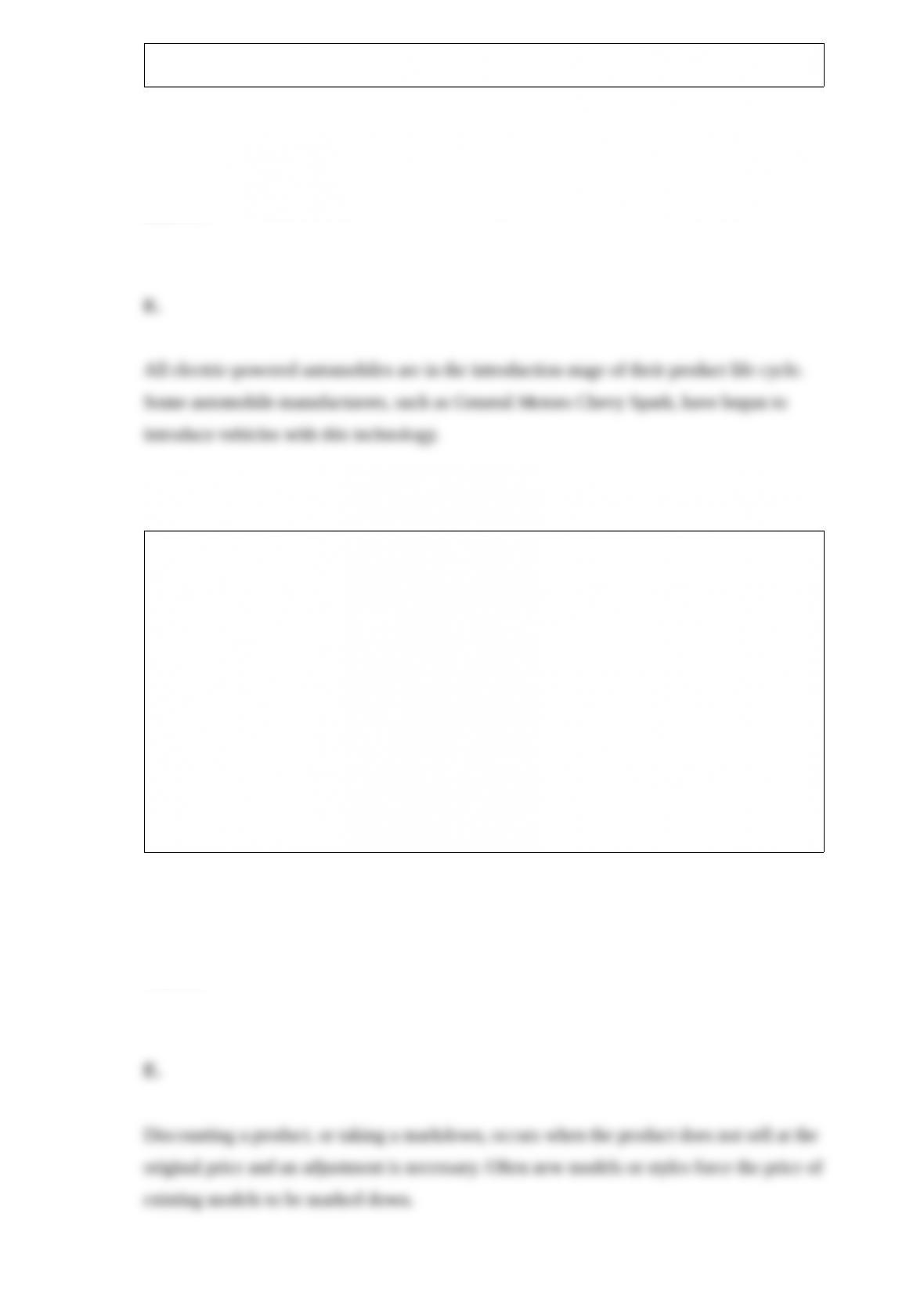
Chevy Spark Photo
All electric-powered automobiles such as the Chevy Spark shown in the photo above
are in which stage of their product life cycle?
A. growth
B. maturity
C. decline
D. accelerated development
E. introduction
Answer:
Often new models or styles force the price of existing models to be __________.
A. marked up
B. off-priced
C. value-subtracted
D. maintained
E. marked down
Answer:
The initial purchase of a product by a consumer is referred to as a(n) __________.
A. product sampling
B. first buy
C. trial
D. assessment
E. examination period
Answer:
One of the advantages associated with radio as an advertising medium is that it
A. has a long exposure time.
B. has a perishable message.
C. has an unlimited amount of advertising time available.
D. allows ads to be placed quickly.
E. is relatively simple to convey complex messages.
Answer:
A favorable attitude toward and consistent purchase of a single brand over time is
referred to as
A. stimulus generalization.
B. attitudinal discrimination.
C. brand loyalty.
D. behavioral loyalty.
E. consumer allegiance.
Answer:
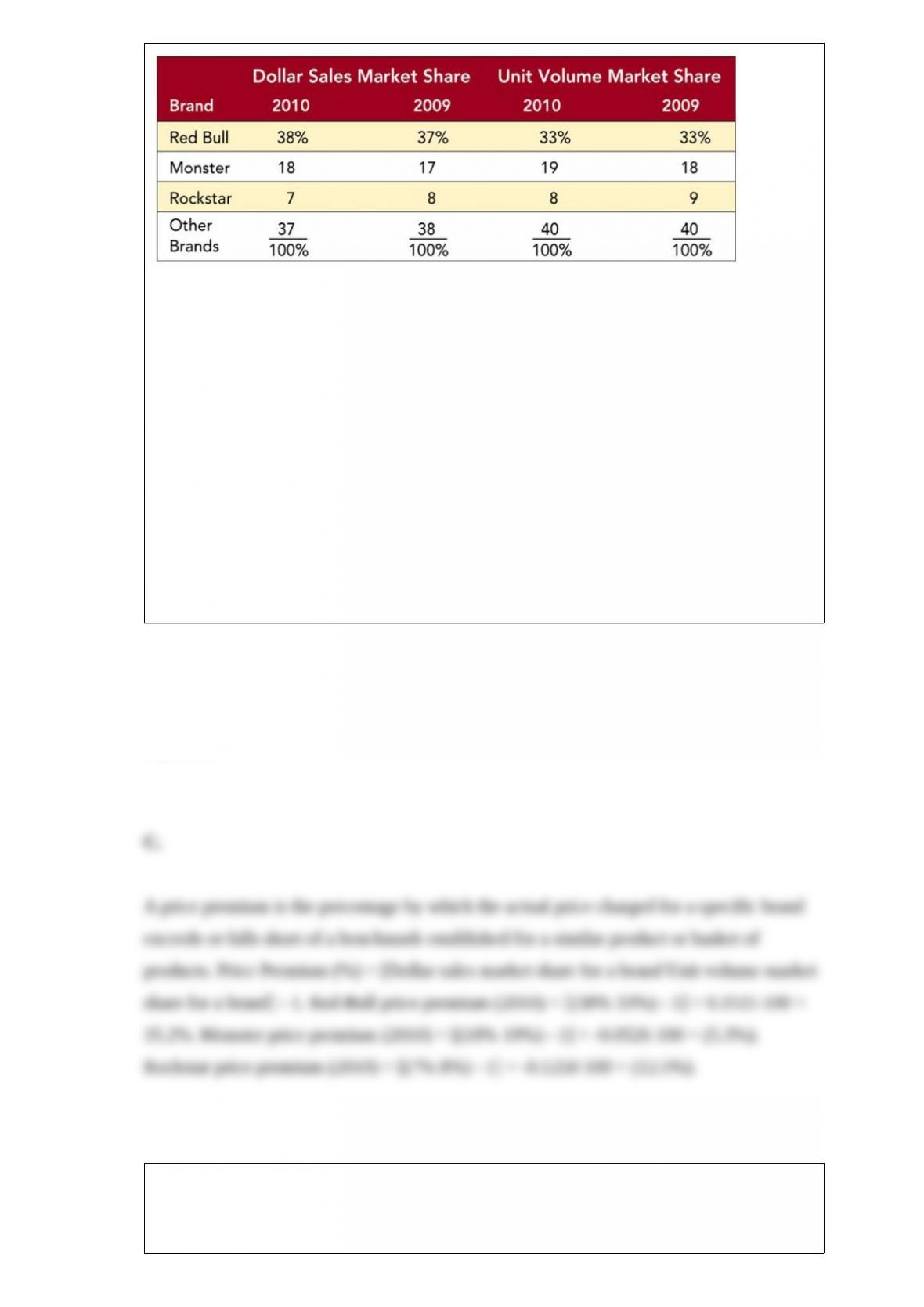
Price Premium Marketing Dashboard
The Price Premium Marketing Dashboard above shows the dollar and unit market
shares for selected energy drinks. What is the price premium for Monster in 2010?
A. -12.5%
B. -7.5%
C. -5.3%
D. 0%
E. 15.2%
Answer:
Compared with people-based services, equipment-based services do not have the
marketing concern of
A. intangibility.
B. insensitivity.
C. inventory.
D. inconsistency.
E. immeasurability.
Answer:
There are seven commonly used organizational buying criteria. One of them is
__________.
A. consumer demand
B. longevity
C. promotional incentives
D. technical capability
E. senior management directives
Answer:
Marketers produce a customer experience through seven website design elements: (1)
context; (2) content; (3) community; (4) customization; (5) communication; (6)
__________; and (7) commerce.
A. creativity
B. control
C. consistency
D. connection
E. collaboration
Answer:
One tool available for services when dealing with capacity management is to use
__________ to charge different prices during different times of the day or the week to
help match the supply and demand for their services.
A. variable hours of operation – opening or closing a store at different times
B. sales promotion incentives such as coupons
C. off-peak pricing
D. build-to-order service delivery systems
E. rationing
Answer:
A buy class situation affects buying center tendencies in different ways. If there are two
or three people involved, the problem definition has only minor modifications, and the
buying objective is the low-priced supplier, the buy class situation is most likely a
A. new buy.
B. modified rebuy.
C. conditional rebuy.
D. straight rebuy.
E. standard reorder.
Answer:
Which of the following best describes the goal for a firm’s inventory and transportation
costs?
A. focus more on minimizing required inventory costs
B. focus more on minimizing required transportation costs
C. minimize the sum of inventory and transportation costs
D. maximize the difference between required inventory and transportation costs
E. set a level of transportation costs and minimize the required inventory costs
Answer:
Which of the following products would have a high-learning product life cycle curve?
A. electric cars
B. Fusion razors
C. fleece bikinis
D. women’s hosiery
E. vinyl dresses
Answer:
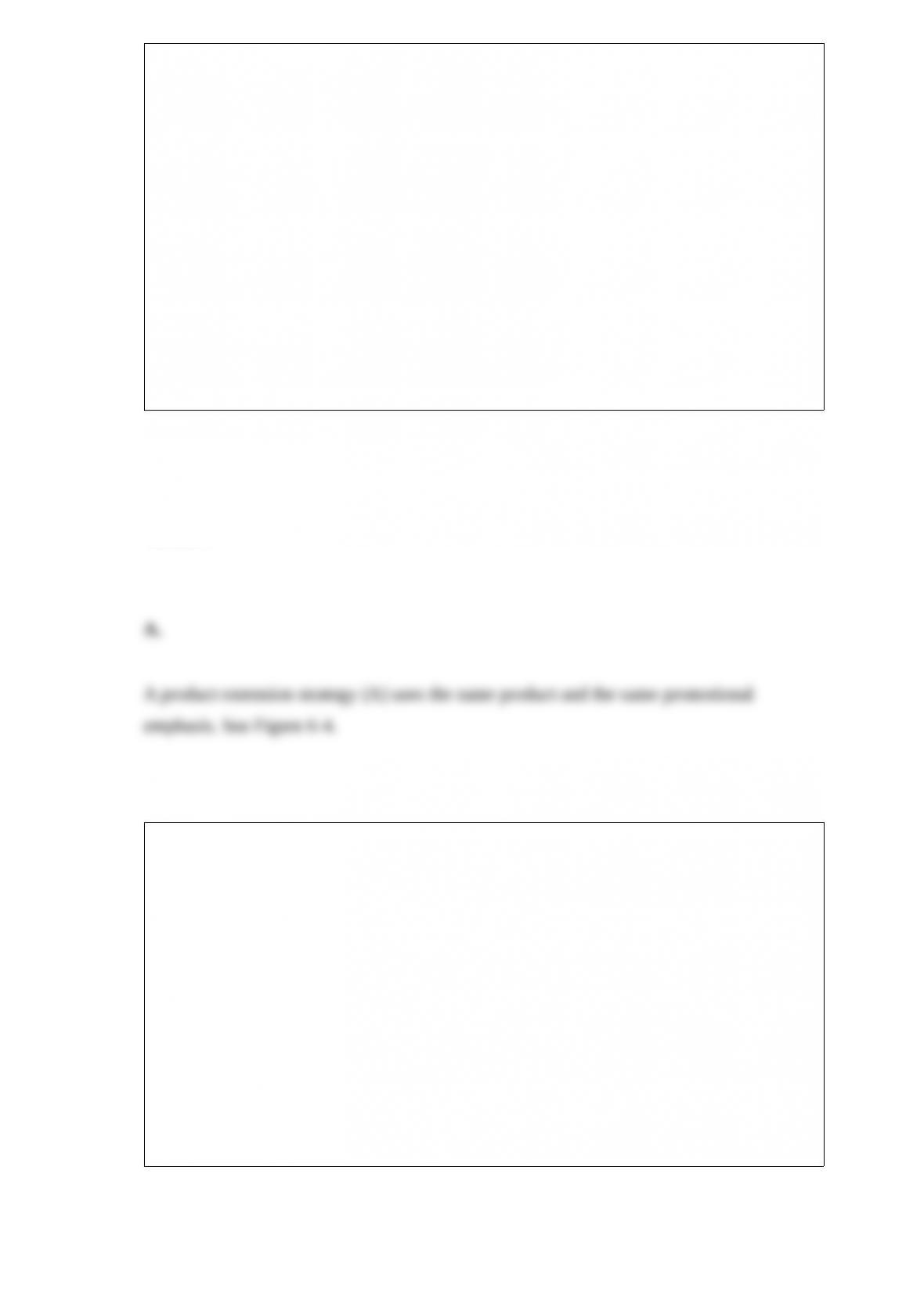
Figure 6-4
Global companies have five strategies for matching products and their promotion
efforts to global markets. According to Figure 6-4 above, A refers to which type of
strategy?
A. product extension strategy
B. communication adaptation strategy
C. product adaptation strategy
D. dual adaptation strategy
E. product invention strategy
Answer:
The stage of the new-product process that defines the role for a new product in terms of
the firm’s overall objectives is referred to as __________.
A. distinctive competency determination
B. new-product strategy development
C. strategic marketing process
D. strategic invention process
E. product protocol definition
Answer:
The four major types of limited-service merchant wholesalers are drop shippers, rack
jobbers, truck jobbers, and __________.
A. machine vendors
B. credit line wholesalers
C. transport vendors
D. cash and carry wholesalers
E. container transport vendors
Answer:
Spam refers to
A. communications that take the form of electronic junk mail or unsolicited e-mail.

B. published private, secret, and/or classified e-mails from anonymous sources.
C. computer-generated e-mails that are self-directed and self-perpetuating.
D. a marketer-generated cookie whose sole purpose is to block a consumer from
accessing competitors’ websites.
E. any non-personal electronically generated message sent via the Internet.
Answer:
Nielsen Media Research collects national TV ratings by using a “people meter.” This is
a box that is attached to TV sets, VCRs, DVRs, cable boxes, and satellite dishes in
about 20,000 households across the country. A viewer uses the remote to signal the
people meter that he or she is watching a TV program. The box then transmits the
viewing information to the Nielsen Company. The information Nielsen is collecting is
referred to as __________.
A. internal secondary data
B. interactive industry data
C. sensitivity data
D. external secondary data
E. observational data
Answer:
Allegra is an antihistamine. To create brand awareness, the company is offering people
who request information about the product a seat cushion to use at their favorite
sporting event. Its television ad shows a woman half-heartedly watching a sporting
event. The voiceover asks if she is bored or congested. In the next scene, the person is
having a great time and is decongested after taking Allegra. This use of the same
promotional theme throughout a company’s marketing campaign is an example of how
marketers use __________.
A. the retailing mix
B. integrated marketing communications (IMC)
C. the branding mix
D. coordinated channels of communication
E. marketing by objectives (MBO)
Answer:
Often companies must choose between a responsive supply chain and an efficient
supply chain. This decision is based on __________.
A. the specific needs of customer segments
B. monetary considerations
C. supplier alternatives
D. the business mission
E. a lack of an appropriate channel captain
Answer:
Ikea catalog photo
An IKEA mail order catalog (see photo above) is an example of __________ retailing.

A. intrusive
B. intertype
C. scrambled
D. nonstore
E. hypermarket
Answer:
Marketing efforts to produce, promote, and reclaim environmentally sensitive products
are referred to as
A. green marketing.
B. recycle marketing.
C. cause marketing.
D. environmental marketing.
E. recycling.
Answer:
A Taste of Greece, a restaurant chain that is known for its Extra Juicy Gyro sandwich,
wants to encourage repeat purchases and create long-term customers. Which sales
promotion should it employ?
A. a trading stamp program that allows buyers to earn free food after making ten
purchases
B. a two-for-the-price-of-one deal that is only offered on New Year’s Eve
C. a coupon for a free soft drink with a Gyro purchase
D. a game with food prizes
E. free Extra Juicy Gyro samples at local fairs and concerts
Answer:
An external evaluation with consumers that consists of preliminary testing of a
new-product idea rather than the actual product is referred to as
A. new-product strategy development.
B. idea generation.
C. crowdsourcing.
D. market testing.
E. a concept test.
Answer:
A salesforce survey forecast involves
A. asking prospective customers if they are likely to buy the product during some future
time period.
B. asking the firm’s salespeople to estimate sales during a coming period.
C. selecting the forecasting alternative that would allow a firm to survive financially
even if the forecasts were totally incorrect.
D. making decisions without any intervening steps.
E. averaging the projections obtained from just regional sales managers and then
making the final projection.
Answer: