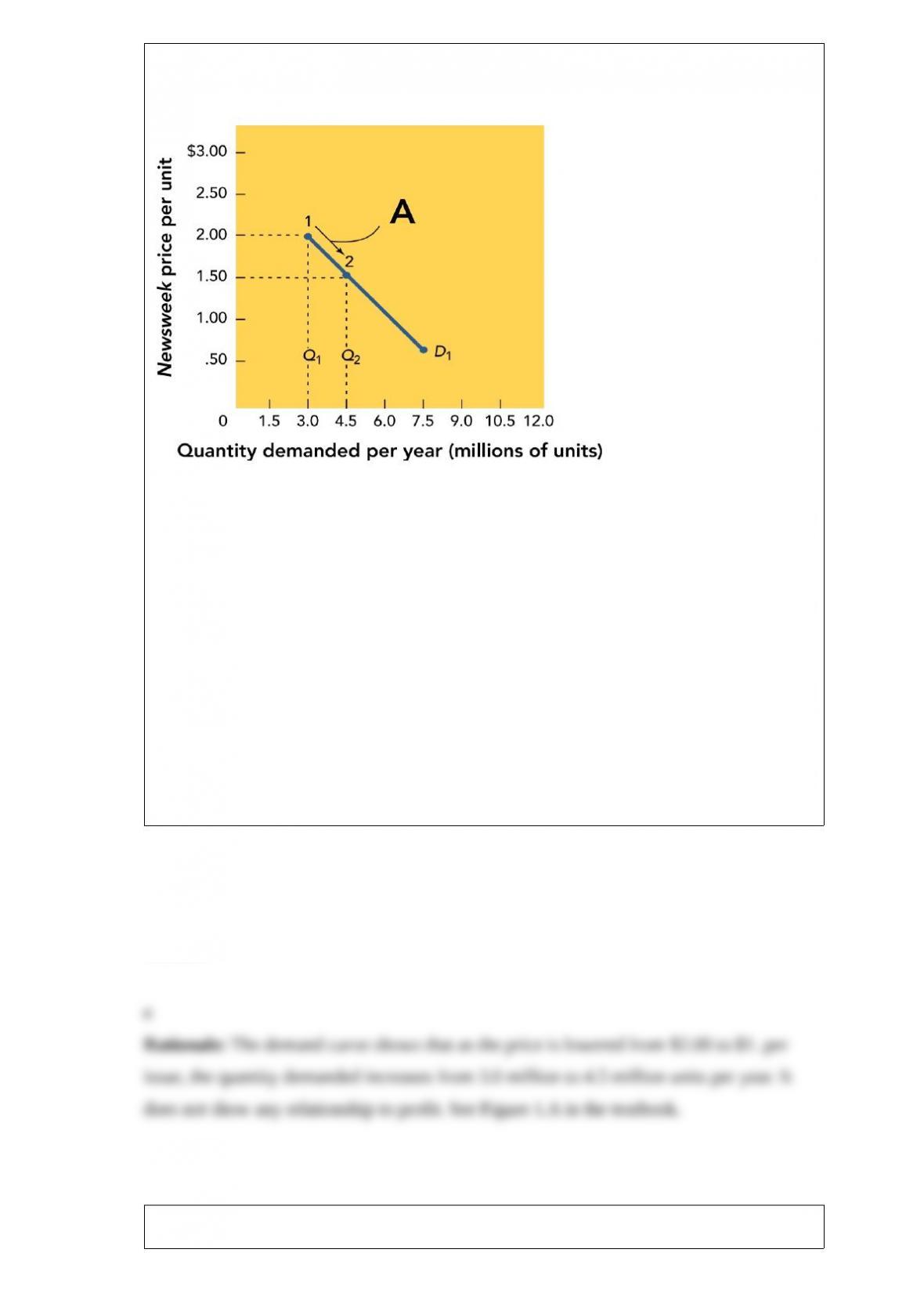
Figure 1.A
Figure 1.A above shows that when the quantity demanded moves from 3.0 to 4.5
million units along the demand curve D1, the profit
a. increases from $1. to $2.00 per unit.
b. decreases from $2.00 to $1. per unit.
c. stays the same per unit.
d. increases from $0.50 to $1. per unit.
e. Figure 1.A does not indicate what happens to profit when the quantity demanded
changes.
Answer:
Which of the following occurs during the decline stage of the product life cycle?
a. Sales decrease substantially.
b. Flanking product lines are added.
c. The product becomes less vulnerable to changes in the marketing environment.
d. Promotional support is increased.
e. Competition becomes intense as more competitors enter the market.
Answer:
Promotion objectives should possess three important qualities. They should be designed
for a well-defined target audience, cover a specified time period, and be
a. unique in character.
b. appealing.
c. measurable.
d. repeatable.
e. creative.
Answer:
If a brand manager wants to explain the benefits of using a complex product to
consumers, the best social network to use is
a. YouTube.
b. LinkedIn.
c. Facebook.
d. Twitter.
e. Google Chrome.
Answer:
Direct selling is likely to continue to have strong growth in markets
a. in which people prefer not to have a social shopping experience.
b. where convenience is not especially important.
c. in which consumers are knowledgeable shoppers.
d. where there is a lack of effective distribution channels.
e. that have an excellent infrastructure.
Answer:
Alka-Seltzer was made originally as a hangover remedy that cured the headache and
settled the stomach. Today you can buy Original Alka-Seltzer, Extra Strength
Alka-Seltzer, Alka-Seltzer Morning Relief (for morning headaches and fatigue), and
Alka-Seltzer Heartburn Relief. Each Alka-Seltzer product has a different formulation to
relieve a specific malady for a specific targeted market segment. The maker of
Alka-Seltzer is using
a. product segmentation.
b. market sectioning.
c. product differentiation.
d. product segmentation.
e. product base development.
Answer:
Among business products, which of the following would most likely be considered an
installation?
a. a factory
b. sheet rock
c. a cleaning service
d. a photocopier
e. a drill press
Answer:
Surveys that enable the interviewer to be flexible in asking probing questions or getting
reactions to visual materials would be best conducted using
a. individual interviews.
b. mail surveys.
c. telephone interviews.
d. fax surveys.
e. on-line surveys.
Answer:
Price elasticity of demand is determined by a number of factors, such as the availability
of substitutes, the necessity of the product or service, the cash outlay of purchase
relative to a person’s disposable income, and
a. whether the item is a luxury product or service.
b. the stage of the product or service in its product life cycle.
c. the degree of carrying costs for the manufacturer or distributor.
d. the financial resources of the organization itself.
e. the ability of the organization to meet sudden increases in demand.
Answer:
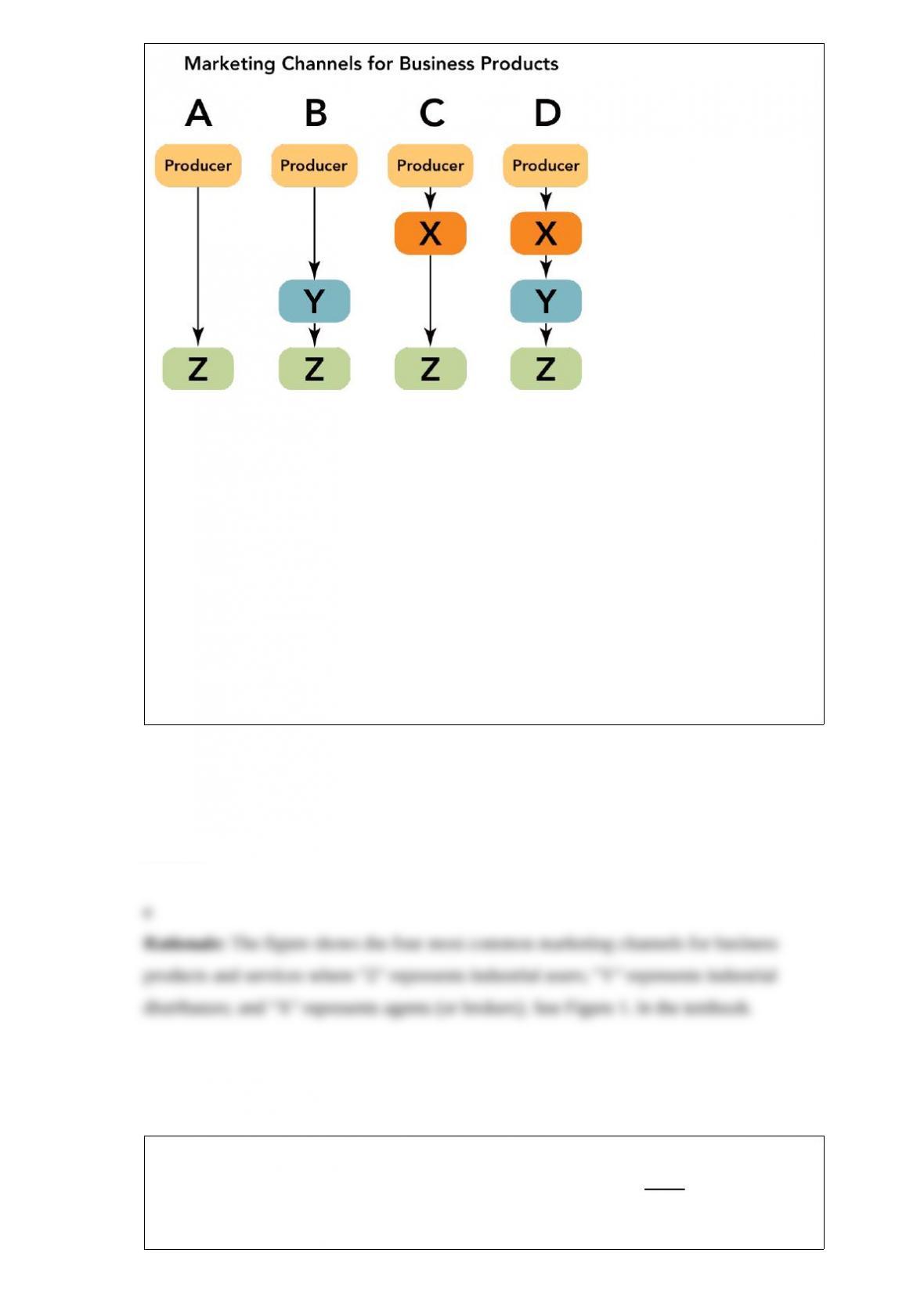
Figure 1.
Figure 1. above depicts the four most common marketing channels for business
products and services. “Y” represents
a. consumers.
b. industrial users.
c. dual distributors.
d. agents or brokers.
e. industrial distributors.
Answer:
Which of the following statements about promotional websites is NOT true?
a. Promotional websites can be used to support a company’s traditional marketing

channel.
b. Promotional websites provide information on how items can be used and where they
can be purchased.
c. Promotional websites are effective in generating interest in and trial of a company’s
products.
d. Promotional websites can cannibalize sales.
e. Promotional websites advertise and promote a company’s products and services.
Answer:
Web communities refer to
a. cooperative buying centers that allow individuals to purchase at the same bulk rate as
large organizations.
b. customers linked by a common Internet service provider.
c. virtual reality games that allow players to create their own worlds, countries, towns,
etc.
d. websites that allow people to congregate online and exchange views on topics of
common interest.
e. all customers served by a particular firm who are sent regular e-mails, sales
notifications, and coupons from the manufacturer.
Answer:
Zappos’ original target market customers consisted of people who wanted all of the
following EXCEPT:
a. to receive quick delivery of their merchandise.
b. to buy sustainable shoes, accessories, and clothing.
c. to shop online in the convenience of their own homes.
d. to allow for free returns of goods if dissatisfied.
e. to have a wide selection of shoes.
Answer:
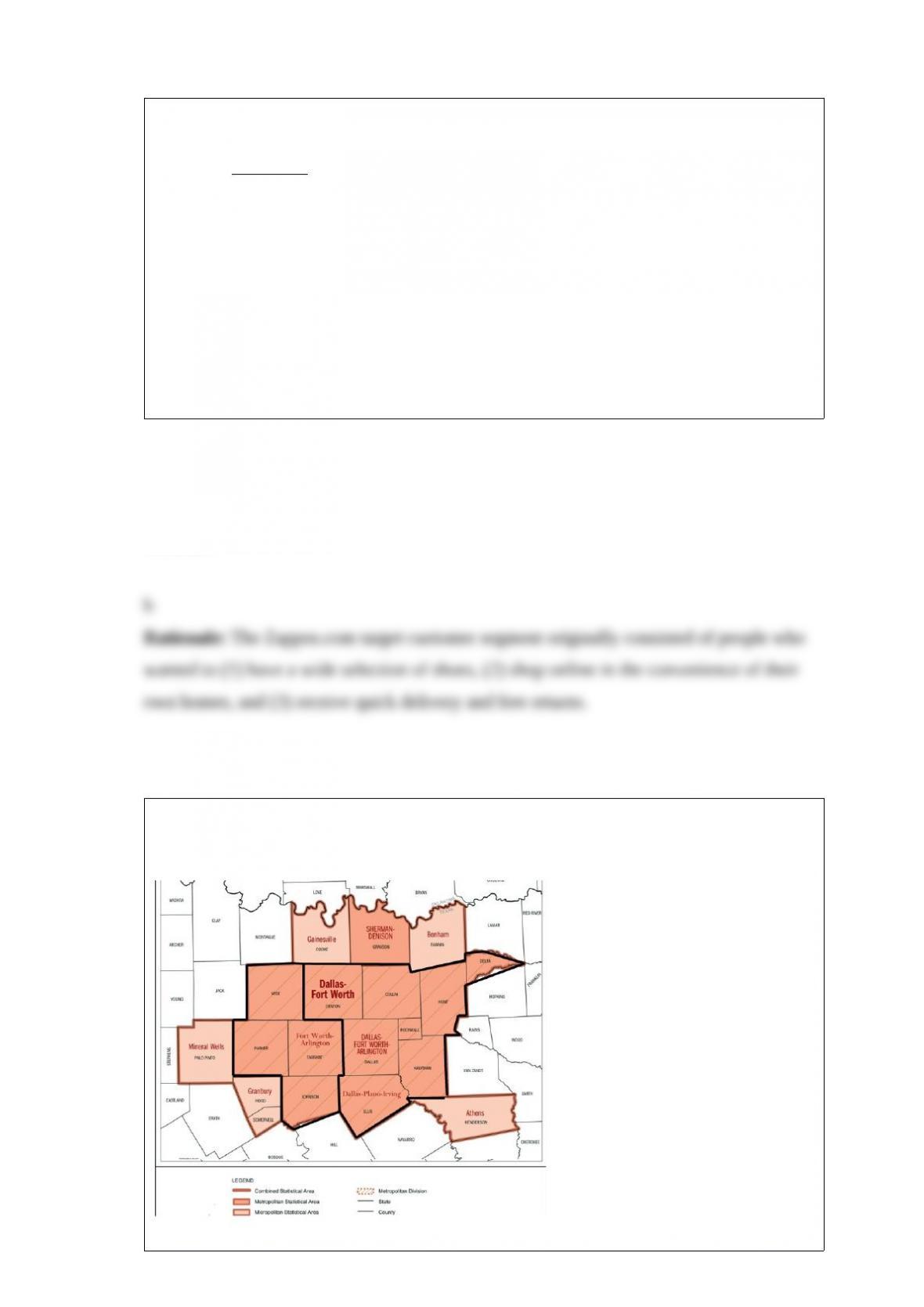
Figure 3-A
The U.S. Office of Management and Budget has developed a classification system that
defines geographic areas based on the size of the population that is contained within
them. The U.S. Census Bureau uses these statistical areas to collect, tabulate, and
publish various reports on demographic profiles and economic activity. Based on Figure
3-A above, which of the following best defines a metropolitan division within the
Dallas-Fort Worth metroplex?
a. the counties in the darker shaded areas (e.g. Grayson [Sherman-Denison], Collin,
Delta, Dallas, Kaufman, Johnson, Tarrant, Parker, Wise, etc.)
b. the cities of Mineral Wells, Gainesville, Bonham, Athens, and Granbury (within their
respective counties) in the lighter shaded areas
c. the counties of Wise, Parker, Tarrant, and Johnson bounded by the black line
d. the Fort Worth-Arlington area (within Tarrant county) that is within the darker shaded
area
e. the entire set of counties in the light and darker shaded areas
Answer:
Resale restrictions refer to when a supplier
a. requires a channel member to sell only its products.
b. requires a channel member to finance all loans through the seller’s bank.

c. stipulates to whom distributors may resell the supplier’s products and in what specific
geographical areas or territories they may sell.
d. attempts to sell used or pre-owned products as new.
e. attempts to sell used products that have expired or will soon become obsolete without
informing the buyer.
Answer:
While working at 3M, Windorski and his team observed and questioned students about
how they read textbooks, took notes, and prepare for exams to
a. discover a potentially new way to satisfy student needs by creating a new product.
b. convince them of 3M’s superiority over other competitors.
c. determine how much the average college student traditionally spends on office
supplies.
d. find possible correlations between students’ study styles and their final grades.
e. develop advertising that relates more effectively with a younger student population.
Answer:
One disadvantage of using the Internet as an advertising medium is
a. as a relatively new medium, it has attracted limited use.
b. the click-through rate has been declining because consumers are developing “banner
blindness.”
c. pay-per-click search ads on Google are expensive and ineffective.
d. it is difficult to translate messages that can be used in social media networks like
Facebook and Twitter.
e. it often creates more traffic than a firm can actually handle.
Answer:
In trend extrapolation, the pattern used to describe a straight line is called __________.
a. causal analysis
b. non-parametric regression
c. planning gap analysis
d. infinite dimension
e. linear trend extrapolation
Answer:
The quantity at which total revenue and total cost are equal is referred to as
a. break-even point.
b. tipping point.
c. profitability point.
d. incremental return on investment.
e. sustainability.
Answer:
Product advertisements refer to advertisements that focus on
a. a product class rather than on an individual brand.
b. building goodwill or an image for an organization.
c. counteracting negative opinions.
d. selling a product or service.
e. clarifying misconceptions.
Answer:
A Toyota dealership in British Columbia, Canada, donated $50 to the Make-A-Wish
Foundation of Canada for each Toyota purchased during a particular month. This is an
example of how a small business can engage in
a. philanthropic marketing.
b. cause marketing.
c. marketing altruism.
d. public relations marketing.
e. societal marketing.
Answer:
Measures of success refer to
a. the goals the decision maker seeks to achieve in solving a problem.
b. criteria or standards used in evaluating proposed solutions to a problem.
c. identification of acceptable alternatives for collecting data to solve a problem.
d. objective data used to identify the most profitable solution to a marketing problem.
e. subjective data used to identify the most profitable solution to a marketing problem.
Answer:
All of the following statements about Generation X are true EXCEPT:
a. Generation X is not prone to extravagance.
b. Generation X is replacing baby boomers as the largest segment of business travelers.
c. Generation X is the first generation to have less than the previous generation.
d. Generation X was born during the “baby bust” era because the number of children
born each year was declining.
e. Generation X was born during the “echo boom” or “baby boomlet” era because the
number of children born each year was rising.
Answer:
Horizontal conflict refers to conflict that occurs between
a. two different levels in a marketing channel.
b. members of upper management who make the marketing channel decisions and
lower management who must implement these decisions.
c. two producers of the same product vying for the same distribution channel members.
d. two members in the same level of a marketing channel.
e. a firm’s and its customers’ goals.
Answer:
The environmental challenges of packaging and labeling are often global in nature.
These include all of the following EXCEPT __________.
a. the shortage of viable landfill sites
b. growth of solid waste
c. the composition of packaging materials
d. cultural norms
e. recycling
Answer:
Procter & Gamble introduced Old Spice High Endurance antiperspirant, targeted to
teen-aged boys who don”t watch much TV. P&G did grassroots marketing, including
handing out samples at skateboarding events and sponsoring a contest for high-school
football player of the year. P&G emphasized which promotional element in this
example?
a. sales promotion
b. advertising
c. personal selling
d. public relations
e. word-of-mouth
Answer:
Which of the following statements regarding service branding is MOST accurate?
a. Because services are intangible and more difficult to describe, brand names and logos
are of critical importance.
b. Because the classification of services is so complex, it is far more difficult to find a
brand name that hasn”t already been taken.
c. Services must include the word ‘service” in all their brand names to assure that
customers understand they are not purchasing a product.
d. Service firms with a well-established brand reputation and service firms without a
brand reputation both find it easy to introduce new services.
e. Service logos and brands must designated by the “” symbol while consumer products
are designated by the “SM” symbol.
Answer:
Larry’s Lawn Care allows customers to use a credit card for purchases. Larry pays 4
percent of the sale to the credit card company. To promote more business, Larry decides
to offer a lower price to customers paying cashthat price being 3 percent less than the
standard list price. Larry is giving his customers a(n)
a. functional discount.
b. trade-in allowance.
c. promotional allowance.
d. discount-for-cash.
e. everyday low price.
Answer:
Which of the following statements regarding direct selling is most accurate?
a. Unlike other forms of nonstore retailing, direct selling takes place in the business
market.
b. Direct selling is found exclusively in the United States.
c. Direct selling succeeds because it provides customers with convenience and
personalized service.
d. Direct sales have been declining rapidly in the United States since the 1980s.
e. By definition, direct selling can only take place in a home.
Answer:
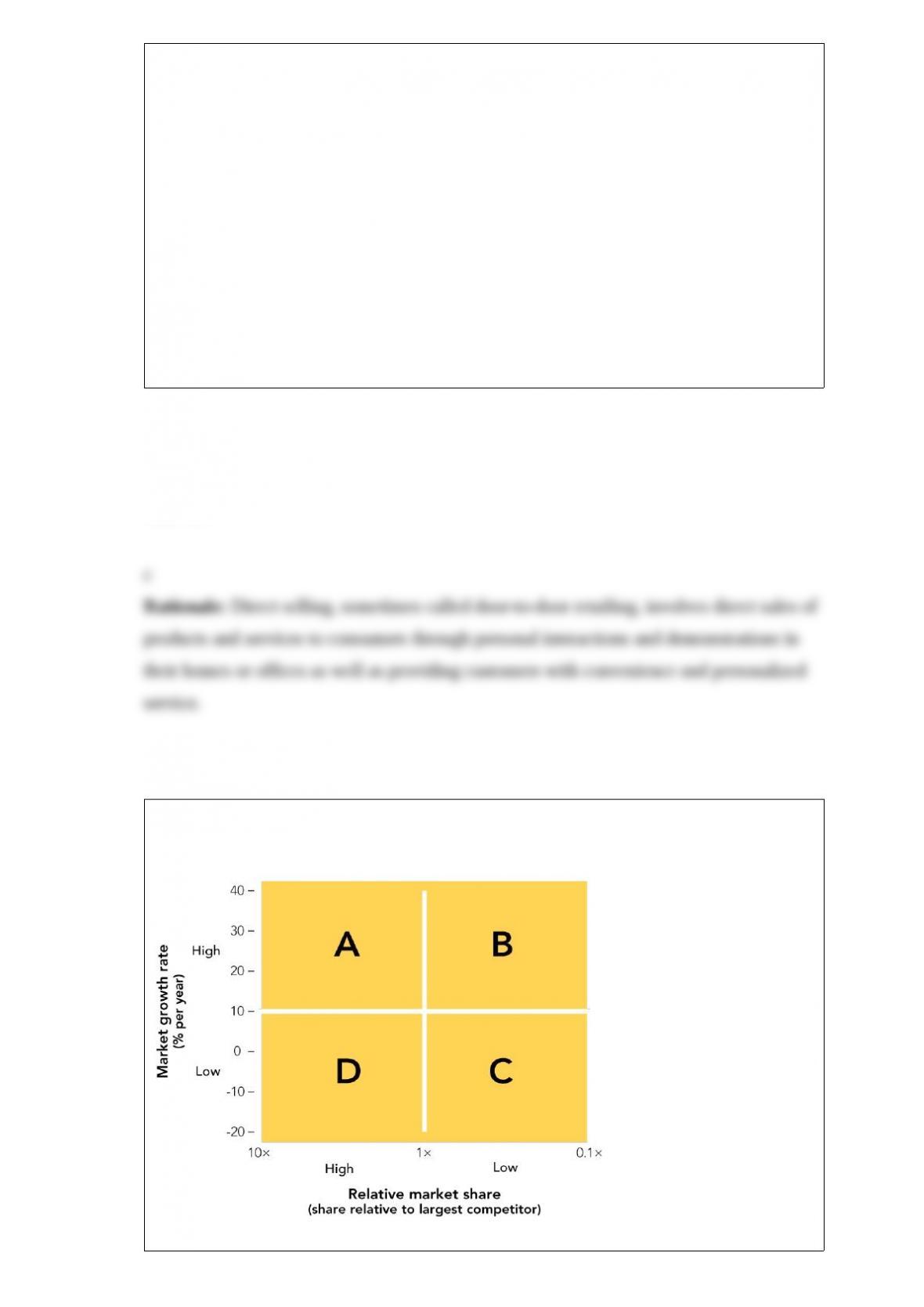
Figure 1.

In Figure 1. shown above, SBUs found in quadrant “A” would be called __________.
a. cash cows
b. question marks
c. dogs
d. hedgehogs
e. stars
Answer: