
A motorcycle moving at 50 km/h skids 10 m with locked brakes. How far will it skid
with locked brakes when traveling at 150 km/h?
A) 10 m
B) 30 m
C) 50 m
D) 90 m
Answer:
The equilibrium rule, ΣF = 0, applies to
A) objects or systems at rest.
B) objects or systems in uniform motion in a straight line.
C) both of these
D) neither of these
Answer:
Harry takes a space voyage and returns to find his twin sister has aged more than he
has. This is evidence that
A) she has changed frames of reference.
B) he has changed frames of reference.

C) both have changed frames of reference.
D) neither has changed frames of reference
Answer:
One kilogram of peaches has more skin area than one kilogram of
A) blueberries.
B) grapefruits.
C) grapes.
D) all of the above
Answer:
Earth’s gravitational field extends
A) only above and beyond Earth’s surface and cancels inside Earth.
B) both inside and outside Earth and throughout the entire universe.
C) neither of these

Answer:
If oxygen were used as nuclear fuel, it would be best
A) fused.
B) fissioned.
C) either of these
Answer:
As more lamps are connected in a parallel circuit, the overall current in the power
source
A) increases.
B) decreases.
C) stays the same.
Answer:
A pair of sunglasses and a pair of clear reading glasses are left in the sunlight. The
hotter glasses will be the

A) sunglasses.
B) reading glasses.
C) both of these
D) neither of these
Answer:
Acceleration due to gravity on the Moon is less than on Earth, and the Moon is smaller
than Earth. This means that compared to an Earth satellite, a satellite in close orbit
about the Moon would travel
A) slower.
B) faster.
C) the same.
D) need more information
Answer:
A pair of action-reaction forces always
A) act on the same object.
B) occur simultaneously.
C) comprise a pair of interactions.

D) all of the above
E) none of the above
Answer:
Pour a liter of water at 40o C into a liter of water at 20oC and the final temperature of
the two becomes
A) less than 30o C.
B) at or about 30o C.
C) more than 30o C.
Answer:
The tapered shape of the wheel rims that ride on railroad tracks allows opposite wheels
to
A) in effect, vary their diameters.
B) travel at different linear speeds for the same rotational speed.
C) both of these
D) none of these

Answer:
A light aluminum ball and a heavy lead ball of the same size roll down an incline. When
they are halfway down the incline, they will have identical
A) kinetic energies.
B) potential energies.
C) momentum.
D) inertias.
E) none of the above
Answer:
A creature that is scaled up in size, keeping its proportions,
A) will be stronger relative to its greater weight.
B) will be weaker relative to its greater weight.
C) both of these
D) neither of these
Answer:

Light will pass through a pair of Polaroids when their axes are
A) 45 degrees to each other.
B) parallel.
C) either of these
D) neither of these
Answer:
A weight suspended from a spring bobs up and down over a distance of 1 meter in two
seconds. Its frequency is
A) 0.5 hertz.
B) 1 hertz.
C) 2 hertz.
D) none of the above
Answer:
Two pulses of light, one red and one blue, have the same energy. The pulse with the
greater number of photons is the
A) red pulse.

B) blue pulse.
C) both the same
Answer:
There are about as many atoms of air in our lungs at any moment as there are breaths of
air in the atmosphere of
1) a large auditorium.
2) a large city.
3) North America.
4) the whole world.
If all the atoms exhaled by Isaac Newton in his last dying breath are still in the
atmosphere, then we breathe about one of those atoms with each
5) single breath.
6) day of breathing.
7) month of breathing.
8) year of breathing.
9) none, for some people may inhale Newton’s atoms occasionally while others may
take years.
Answer:

Compared with the energy produced by fissioning a gram of uranium, the energy
produced by fusing a gram of deuterium is
A) more.
B) less.
C) the same.
Answer:
The lowest temperature possible in nature is
A) 0 degrees C.
B) -273 degrees C.
C) 4 K.
D) none of the above
Answer:
In free space, electromagnetic waves travel at a
A) variety of speeds.
B) single speed.

C) speed depending on frequency.
Answer:
When voltage is induced in a coil of wire, current is
A) also induced.
B) not induced.
C) cancelled.
Answer:
The pendulum with the greatest frequency is one with the
A) shortest length.
B) longest length.
C) neither of these
Answer:

A yellow candle flame reflects from opposite surfaces of a piece of red glass.
A) both images are yellow
B) one image is yellow and the other red
C) both images are red
D) both images are reddish yellow
Answer:
In a smoke detector americium (A = 95) transmutes to neptunium (A = 93) by
A) beta emission.
B) alpha emission.
C) gamma emission.
D) none of the above
Answer:
The frequency of induced voltage in a wire coil depends on
A) the frequency of current producing it.
B) how frequently a magnet dips in and out of the coil.

C) the number of loops in the coil.
Answer:
The planet Earth loses heat primarily by
A) conduction.
B) convection.
C) radiation.
D) all of the above
Answer:
If there were no greenhouse effect, Earth’s average temperature would likely be
A) near absolute zero.
B) a frigid -18C.
C) comfortably cooler.
D) warmer than now.

Answer:
Two charged particles repel each other with a force F. If the charge of one of the
particles is doubled and the distance between them is also doubled, then the force will
be
A) F.
B) 2 F.
C) F/2.
D) F/4.
E) none of the above
Answer:
If you can’t avoid being hit by a fast-moving object, you’ll suffer a smaller contact force
if you can extend that force over a
A) longer time.
B) shorter time.
C) both the same
Answer:

If a piece of iron and a cup of water at the same temperature are heated so the internal
energy of each doubles
A) the water will have the higher temperature.
B) the iron will have the higher temperature.
C) both will have the same temperature.
D) need more information
Answer:
Rainbows exist because light in water drops is
1) reflected.
2) refracted.
3) both of these
And the main reason drops disperse different colors involves light’s different
4) frequencies.
5) speeds.
6) directions.
7) energies.
Answer:
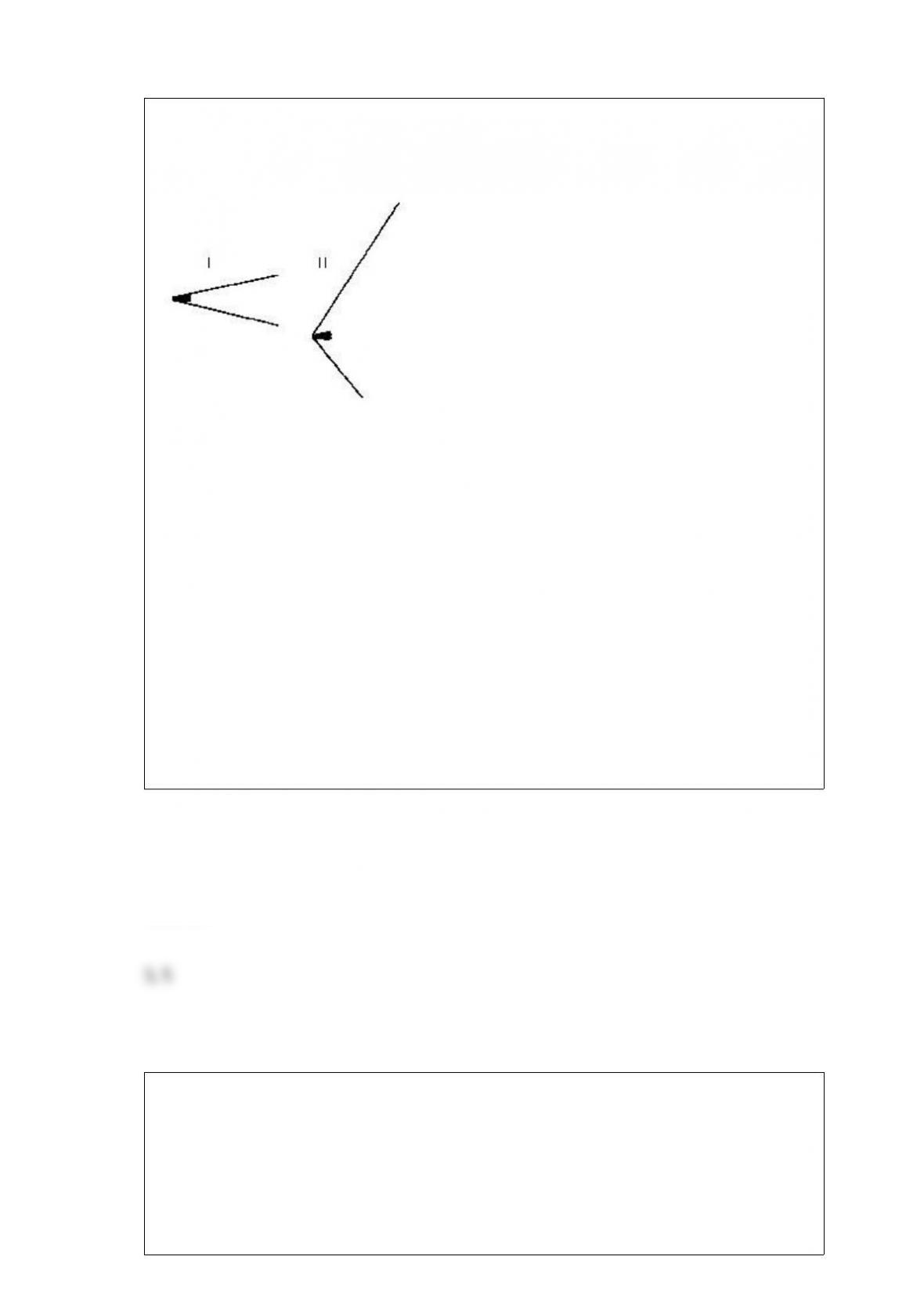
Figure S-3
A V-shaped bow wave is produced when a boat moves
1) more slowly than the velocity of waves in the water.
2) as fast as the waves in the water.
3) faster than the velocity of waves in the water.
4) at any speed, slower or faster than the water waves.
Which bow wave corresponds to the faster-moving boat?
5) I
6) II
Answer:
If a constant net force is applied to a body, the body is
1) accelerating.
2) moving at constant speed.
3) at rest or moving at constant velocity.

If a body is moving at constant velocity, it must have
4) a constant net force acting upon it.
5) constant non-zero acceleration.
6) constant speed.
7) none of the above.
Answer:
Which of these following statements about atoms is valid?
1) The atom is the smallest particle that exists.
2) There are thousands of kinds of atoms, accounting for the great variety of substances.
3) There are nearly 100 different kinds of atoms found in nature.
4) Atoms are small building blocks of nature, being so small they cannot be
photographed.
The word molecule can be at least partly identified by the following statement:
5) The molecule is the smallest particle that exists.
6) The molecule is the smallest subdivision of matter that still retains the chemical
properties of the substance from which it originates.
7) Combinations of molecules form atoms.
8) The chemical elements consist of 105 different molecules, a list that keeps growing.
Answer:

In the process of evaporation
1) heavier atoms are most prone to leave the liquid,
2) there is a net gain in the number of atoms in the liquid,
3) energy is absorbed by the liquid,
4) all of these,
5) none of these,
and the average rate of molecular motion for the atoms remaining in the liquid
6) increases.
7) decreases.
8) remains unchanged.
Answer:
Pitch corresponds to
1) frequency,
2) noise,
3) loudness,
whereas amplitude corresponds to
4) frequency.
5) noise.

6) loudness.
Answer:
Provided that in each case heat input is the same, boiling takes place more quickly
1) at sea level.
2) in a valley.
3) in the mountains.
This is because
4) increased pressure on the surface of a liquid lowers its boiling point.
5) decreased pressure on the surface of a liquid lowers its boiling point.
6) water always boils quickest at sea level.
Answer:
A lunar month is about 28 days. If the Moon were closer to Earth than it now is, the
lunar month would be
1) less than 28 days,
2) more than 28 days,
3) still 28 days,

mainly because
4) centripetal force would lessen with decreased distance.
5) a closer Moon means an increase in both gravitational force and speed, which in a
smaller orbit means shorter time.
6) orbital speed about the center of mass of Earth-Moon system is not dependent upon
the distance between Earth and Moon.
7) of tidal friction.
Answer:
If the mass of Earth somehow increased with no change in radius, your weight would
1) increase also.
2) decrease.
3) remain the same.
If instead, both Earth’s mass and its radius doubled, your weight at Earth’s surface
would be
4) half before the changes.
5) the same as before the changes.
6) twice.
7) four times greater.
Answer:

The Uncertainty Principle states that
1) all measurements are essentially incorrect to some degree.
2) no measurement is exact.
3) we cannot in principle know both the position and momentum (or energy and time)
of a particle with absolute certainty.
4) science itself is essentially uncertain.
The Uncertainty Principle is applicable
5) only in the atomic domain.
6) in all physical domains, from the nuclear to the cosmic.
7) in all areas of good theory, scientific or otherwise.
Answer:
A projectile is launched vertically upward at 40 m/s. If air resistance is negligible, its
speed upon returning to its starting point is
1) less than 40 m/s.
2) 40 m/s.
3) more than 40 m/s.
All along the ball’s trajectory, its acceleration is
4) g downward.
5) g at an angle.
6) zero.
If air resistance does affect motion, then the ball’s speed upon returning to its starting

point is
7) less than 50 m/s.
8) 50 m/s.
9) more than 50 m/s.
Answer:
Radioactive by-products mostly occur when atomic nuclei
1) break apart,
2) combine together,
and radioactive by-products are a chief result of atomic nuclei
3) breaking apart.
4) combining together.
5) doing neither.
Answer:
The speedometer of a car indicates a constant speed of 30 miles per hour. From this we
can say that the acceleration of the car is
1) zero.

2) nonzero.
3) can’t really say.
This is because
4) no net force is acting on the car.
5) any reading (other than zero) on the speedometer indicates acceleration.
6) the car may be changing its direction.
Answer:
If the Sun collapsed to a neutron star or black hole, Earth would
1) spiral into the Sun’s core,
2) remain in its present orbit,
3) spiral away from the Sun,
4) itself undergo collapse,
for the variable that changes in Newton’s gravitational equation is
5) distance.
6) the mass of the Sun.
7) the mass of Earth.
8) all of these.
9) none of these.
Answer:

Figure N-10
As the ball rolls from A to B its velocity increases and its acceleration
1) increases;
2) decreases;
3) remains constant;
and when it rolls from B to C its acceleration along the path
4) increases.
5) decreases.
6) remains constant.
Answer:
The density of a 57-kg (126-lb) person who can float in salt water but not in fresh water
is about
1) 505 kg/m3 (32 lb/ft3)
2) 1010 kg/m3 (63 lb/ft3)

3) 2020 kg/m3 (126 lb/ft3)
4) 4040 kg/m3 (252 lb/ft3)
and has a volume of about
5) 1 ft3.
6) 2 ft3.
7) 3 ft3.
8) 4 ft3.
9) need more information
Answer: