
The final stage for a star which is as massive as the Sun is a ________.
A) black hole
B) main-sequence star
C) red giant
D) white dwarf
Sedimentary rocks with marine fossils are exposed at the top of Mt. Everest. Which
scientists would make most use of this observation in their study?
A) Meteorologists, because they could use the fossils as a guide to ancient climates
B) Geologists, because their elevation is related to physical geology and fossils are
related to Earth history
C) Oceanographers, because the fossils can tell us about periods when the earth was
covered with water to the height of Mt. Everest
D) Astronomers, because they can study how life came from outer space to Earth
If you live at high latitude, when do you expect to see the aurora?
A) at times of high sunspot activity, during the active sun

B) at intermediate periods when sunspots are present but not prominent
C) during low sun spot activity, when solar flares are most abundant
D) at times when the earth’s magnetic field has temporarily been weakened
You run a business selling bait to fisherman near the tip of a large sand spit. A sand and
gravel company owns coastal property up the coast from youthe other direction from
the tip of the spit. The sand and gravel company plans to dredge sand from the beach
and mine the sand and gravel from a seacliff that is eroding in the coastal zone. What
should be your opinion on this sand and gravel operation?
A) You should go into business with the sand and gravel operator and have them deliver
sand to your beach to help tourism.
B) There is no problem; the operator will increase sediment supply to the beach which
will help your little sand spit.
C) There is no problem; the longshore drift is away from you. It is people up the coast
who should be concerned.
D) You should look for a lawyer or a real estate agent because the sand and gravel
operation will destroy your sand spit in time
The largest lithospheric plate is the ________.
A) Caribbean Plate

B) North American Plate
C) Pacific Plate
D) Eurasian Plate
If you observe an angular unconformity, you would infer that the region had
experienced ________.
A) deposition in shallow water, uplift or lowering of sea level enough to expose the
rocks to erosion and non-deposition for a period of time, and subsequent resubmergence
of the remaining sedimentary units where they experience new deposition
B) uplift and tilting of sedimentary units that exposes them to erosion over a period of
time with subsequent renewed deposition
C) intrusion of igneous rocks into a depositional setting, forcing the sedimentary layers
upward and possibly deforming them, followed by subsidence of the remaining
sedimentary layers and renewed deposition.
D) deposition of sedimentary layers on crystalline igneous or metamorphic rocks that
are exposed at the surface of the earth
Assume that man’s recorded history can be stretched back to 4600 years before the
present. This is approximately what fraction of geologic time?

A) one ten-thousandth
B) one millionth
C) one billionth
D) one hundred-thousandth
What was the test of the Big Bang Hypothesis discussed in your text?
A) The universe should be expanding.
B) There should be more expansion in older galaxies than in young ones.
C) We should be able to model how the galaxies have moved and reconstruct the
original explosion.
D) We should be able to detect remnants of the initial heat of the universe.
E) We should be able to measure how atoms have changed through fusion since the
original explosion.
A ________ is the largest discordant body of intrusive, igneous rock.
A) lopolith
B) laccolith

C) pluton
D) batholith
Which of the following is not an element that influences weather?
A) humidity
B) clouds
C) wind
D) longitude
E) temperature
Many reptile groups became extinct at the close of the Cenozoic era.

Important weather phenomena typically occurs in the ________.
A) stratosphere
B) troposphere
C) thermosphere
D) mesosphere
E) all of the above
When water is pumped from a well, a depression is often produced in the water table.
Such a depression is a(n) ________.
A) perched water table
B) pumping dimple
C) cone of depression
D) artesian well
Which of the following is not considered a form of electromagnetic radiation?

A) radio waves
B) gravity
C) gamma rays
D) visible light
E) X-rays
In the folk song “Wasn’t That a Mighty Storm,” the singer describes an event during the
Galveston hurricane of 1900: “The trains they were loaded, with people leaving town,
but the tracks gave way with the water, the trains they went on down.” What hurricane
phenomena was the author of this song describing?
A) tornadoes embedded in the eye wall
B) heavy rain and winds blowing a trestle over
C) storm surge
D) river flooding washing out train trestles
Seawater has become more acidic since the industrial revolution and this is commonly
attributed to ________.
A) the increase in CO2 being put into the atmosphere and then absorbed into the oceans.
B) the loss of calcite-secreting organisms and reef-builders in the oceans due to
pollution.
C) a decrease in the amount of base compounds to neutralize the natural acids in
seawater
D) human dumping of large quantities of waste materials into the oceans that increase
the acid content of the water
E) global climate change, which is changing the temperature of seawater and producing
a related change in the water chemistry
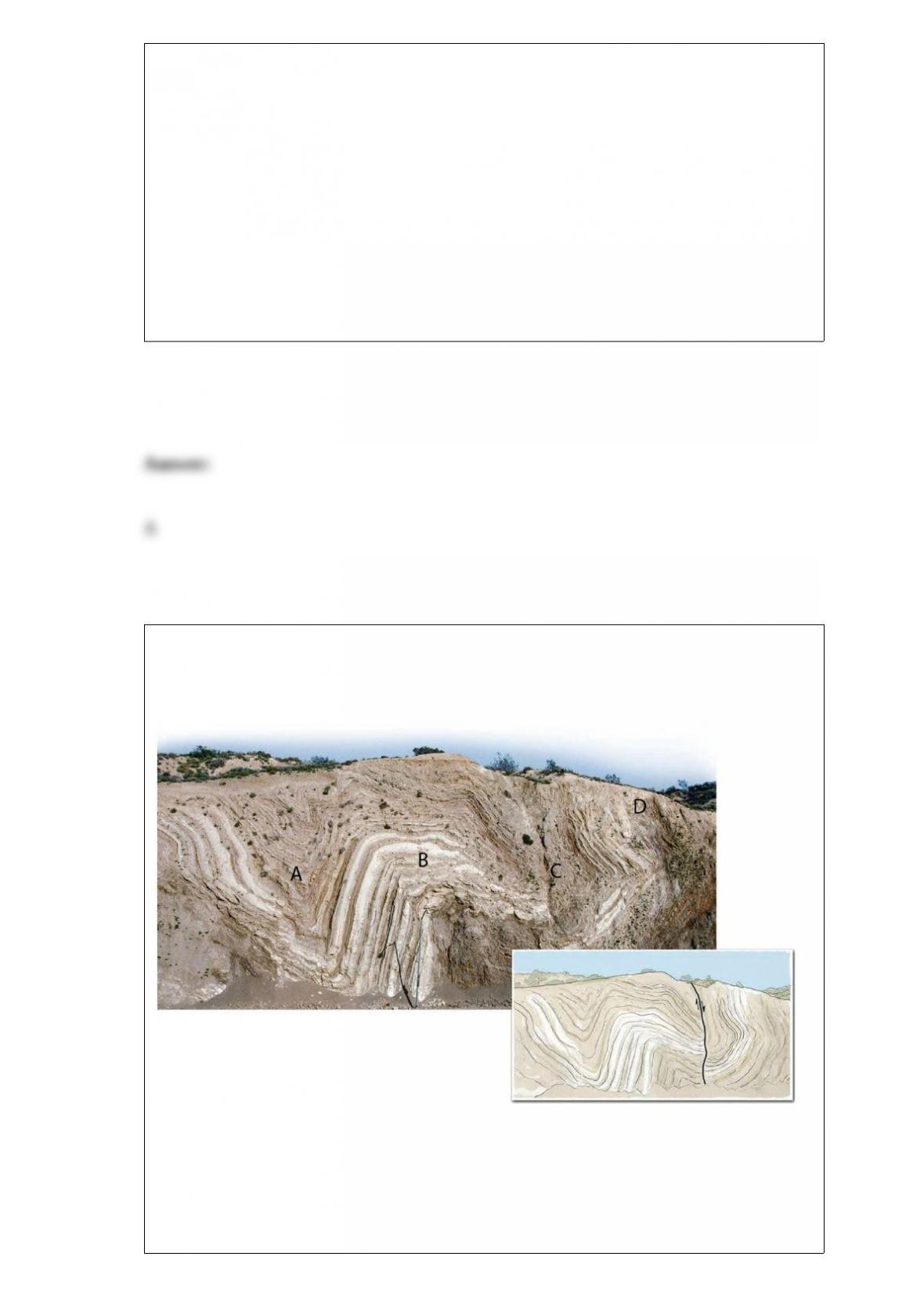
Use the figure below to answer the following questions.
The material in the figure was ________ when the folding occurred.
A) ductile
B) elastic

C) brittle
D) strong
Liquifaction, where normally solid material behaves more like a fluid during an
earthquake, occurs because ________.
A) pore spaces between particles in unconsolidated sediments close and displace fluids
B) rock particles dissolve and mix with the fluids in the subsurface to become a liquid
C) friction from the vibrations melt rock and produce magmas
D) cracking in the rocks allows fluids to flow into the area and increase the amount of
liquids in the subsurface
Temperatures in the deep oceans are ________ at low latitudes compared to high
latitudes.
A) higher
B) lower
C) about the same
D) highly variable

E) very constant
The Rocky Mountains of western North America were produced in an orogeny called
the ________.
A) Absaroka orogeny
B) Laurentide orogeny
C) Uinta orogeny
D) Laramide orogeny
Why are boulders not a mineral?
A) They are not naturally occurring.
B) They are organic.
C) They are not solid.
D) They do not have an orderly crystalline structure.
E) They do not have a well-defined chemical composition.

The Coalescence-Collision Process applies to ________ .
A) super cooled water vapor in a cloud
B) coexisting ice and water droplets in a cloud
C) warm clouds
D) cold clouds
Milankovitch cycles are used to explain the cycles of cold and warm climates that
characterized the Ice Ages based on ________.
A) plate tectonics and sea level rise
B) solar flares and variations in the moon’s orbit over time
C) evolution of plants and animals and human impact
D) variations in the earth’s orbit about the sun and precession of the earth’s axis

Birds evolved from ________.
A) tree-climbing amphibians
B) pterosaurs
C) apatosaurus
D) archaeopteryx
E) gymnosperms
Venus is usually described as a runaway greenhouse effect world, which is true in the
sense that the atmosphere is mostly CO2. However, there is an important factor that
relates to earth weather that is slightly different. The slow rotation of Venus produces a
huge heat influx difference from the day to night side of the planet, which produces
descending air on the night side and ascending air on the day side. Because the
atmosphere is so dense, this means air rises to high elevations on the day side, and
descends to surface on the night side. As a result, the night side of the planet is nearly as
hot, or even hotter, than the day side. What would be the principal reason for this?
A) The winds must be very, very high, and transport the heat efficiently from one side
of the planet to the other.
B) The air is so dense it has a large heat capacity.
C) As the air descends on the night side of the planet, it is heated by adiabatic
compression to a very high temperaturea grand scale equivalent of Chinook or Santa
Ana winds on Earth.
D) None of these makes sense.

In the interior of continents the earth’s crust is typically about 40km thick and the
elevation is near sea level. In an area where the crust is 20km thick, isostasy would
suggest the elevation in this area would be ________ unless the density changes from
one area to the other.
A) below sea level
B) near sea level
C) slightly above sea level
D) high mountains
As they formed, due to their high temperatures and comparatively weak gravitational
fields, which planets were unable to retain appreciable amounts of hydrogen, helium,
and ammonia?
A) Jupiter and Neptune
B) Mercury and Earth
C) Uranus and Pluto
D) Jupiter and Uranus
E) Neptune and Uranus

The Himalayan Mountains and adjacent Tibet are a mountain system formed by
________.
A) subduction
B) sea floor spreading
C) back-arc contraction
D) continental collision
A sidereal day is defined as ________.
A) 24 hours in a day
B) the time for one complete revolution of the earth relative to the celestial reference
C) the time between periods when the sun is at the exact same height in the sky, for
example, noon
D) 24 hours at Greenwich, England
The mercurial barometer was invented by ________.
A) Torricelli

B) Galileo
C) Newton
D) Watt
Latent heat that is the energy source for many storms can be transported by ________.
A) water vapor
B) carbon dioxide
C) ozone
D) dust
E) aerosols
A volcanic deposit comprised of red to black lapilli-sized pyroclastic material
associated with pahoehoe lava flows was probably deposited on ________.
A) a large composite volcano
B) a shield volcano
C) a cinder cone

D) a satellite shield volcano on a rhyolitic caldera
Limestone is formed primarily through ________.
A) direct precipitation from seawater
B) chemical interactions between ocean bottom sediments and ions in sea water
C) biochemical sediments secreted by marine organisms
D) evaporation of calcite rich seawater
Much of the city of New Orleans is below sea level, yet it was not an ocean when the
city was first settled. How did it get below sea level?
A) Drainage canals and groundwater withdrawal produced subsidence that dropped the
land below sea level.
B) The area was dredged to build levees, and so it was left below sea level.
C) Oil production withdrew oil and produced land subsidence.
D) Sea level is just rising.
High air pressure systems are usually associated with ________.
A) diverging winds
B) descending air
C) clear weather
D) all of these
Any accreted crustal fragment that has a geologic history distinct from that of the
adjoining fragments is termed a(n) ________.
Examine the words and/or phrases for each question below and determine the
relationship among the majority of words/phrases. Choose the option which does not fit
the pattern.

Use one of the following five terms to fill in the blanks for the questions below:
Continental crust, Asthenosphere, Mantle, Lithosphere, Oceanic crust
________ has an average density of 2.7 g/cc.
Modern geochronology studies recognize that most radiometric dates record a time
when a mineral cools below a temperature where the mineral closes to gain or loss of
parent and daughter isotopes. This “closure temperature” varies between different
minerals and different isotopic systems. This has allowed the absolute dating of
sedimentary rocks through dating of single crystals. For example, if a rock is heated
above the closure temperature of the rocks constituent minerals, the date of that mineral
provides a minimum age. In contrast, if the rock contains a mineral with a closure
temperature higher than the maximum temperature reached by the rock, that mineral
will retain the age from its source. The mineral zircon dated by U-Pb methods is an
example.
So, you look at a rock that has Cretaceous fossils in it, but your paleontologist friend
looks at them and cannot determine if they are Early or Late Cretaceous in age. The
rock contains the mineral apatite, which accumulates He through the decay or U and
Th, but closes to He loss at temperature of around 75oC. You know from the
stratigraphic section that the rocks were originally buried at least 3km. The local
geothermal gradient is about 35oC/km. You obtain an apatite He date of 105 +/- 2
million years. You also date 100 grains of zircon from the rock. The zircons yield dates
that range in age from 2.1 billion years to 125 million years. Three different zircon
grains yield ages between 125 and 127 million years. You google “cretaceous time
scale” and learn that the Cretaceous begins at about 144 million years and ends at about
65 million years ago. The Early Cretaceous ends about 100 million years ago. How old
are these sedimentary rocks?

________ clouds that form sheets or layers that cover much of the sky.
When a metamorphic rock exhibits a layered or banded appearance, it is said to exhibit
a(n) ________ texture.
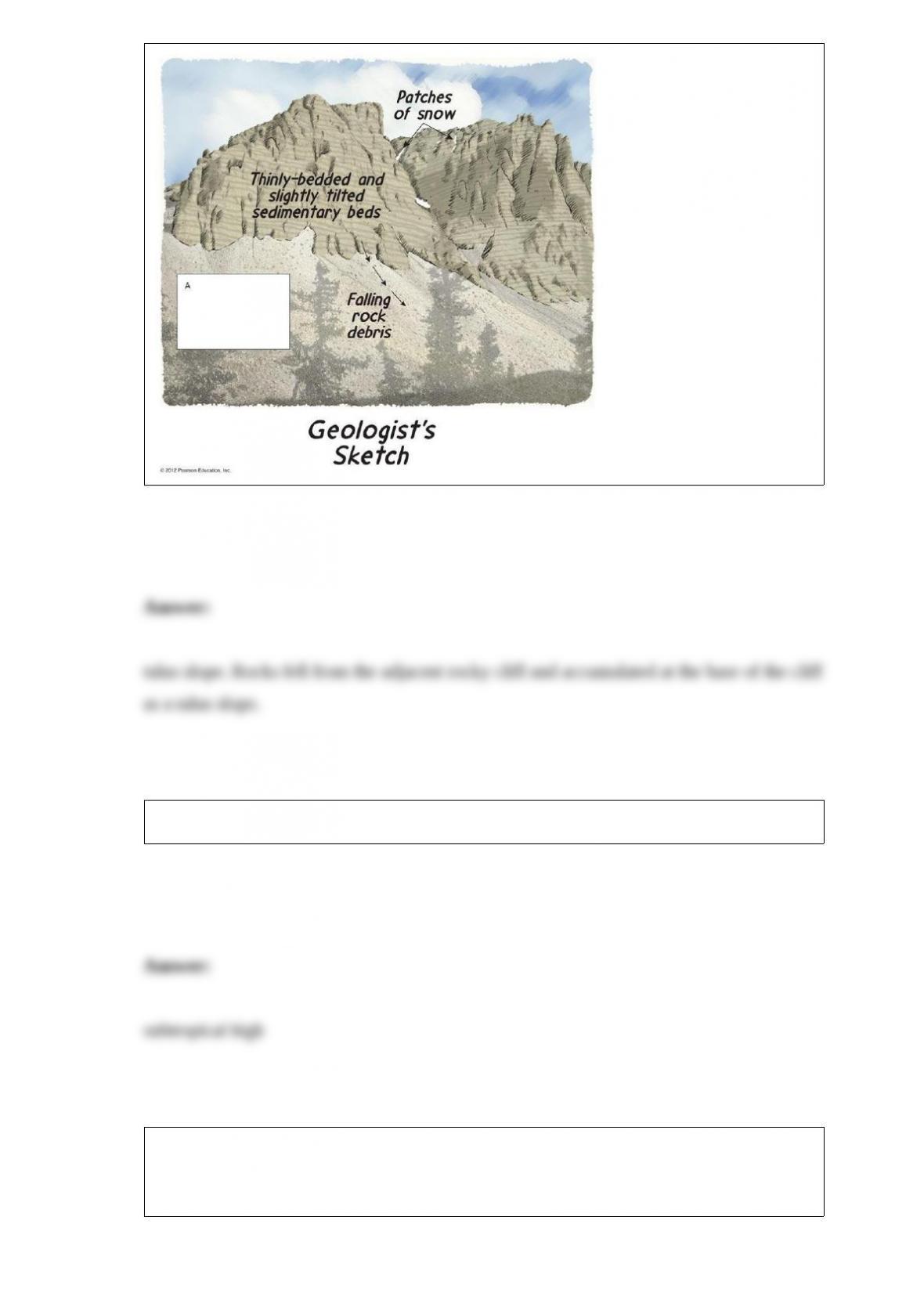
What is the feature labeled “A” in the diagram below? Also, how did it form?
Earth’s low-latitude deserts and steppes coincide with the ________ pressure belts.
Oceanic plateaus and seamounts are both bathymetric highs on the seafloor. When they
encounter a subduction zone oceanic plateaus are generally accreted to become a(n)
________ whereas seamounts typically are ________.
The textbook makes the point that stream transport is a mechanism for sorting material.
Explain how a stream sorts rocks.
Match the name of the tectonic feature with the Figure.
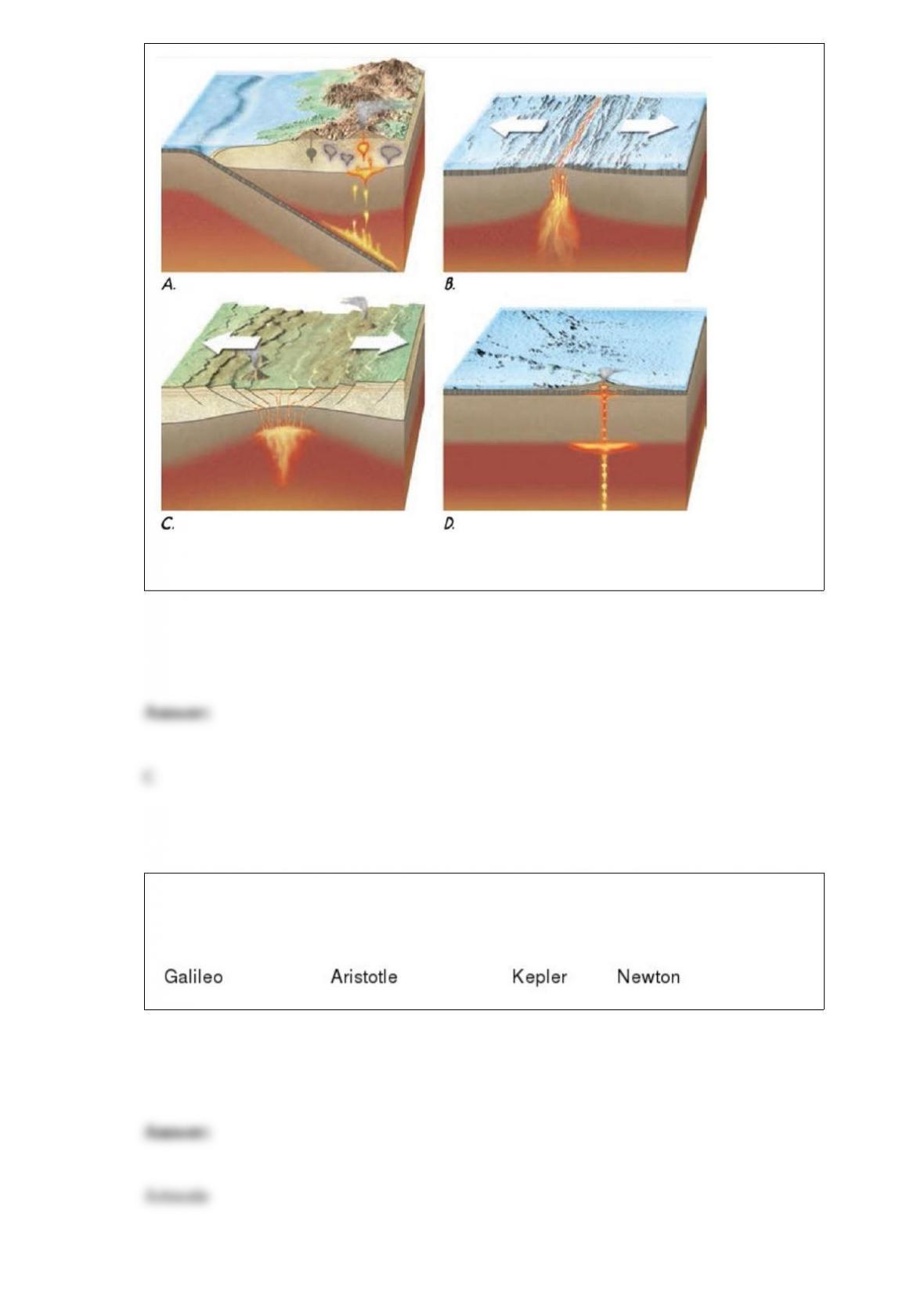
continental rift
Examine the words and/or phrases for each question below and determine the
relationship among the majority of words/phrases. Choose the option which does not fit
the pattern.
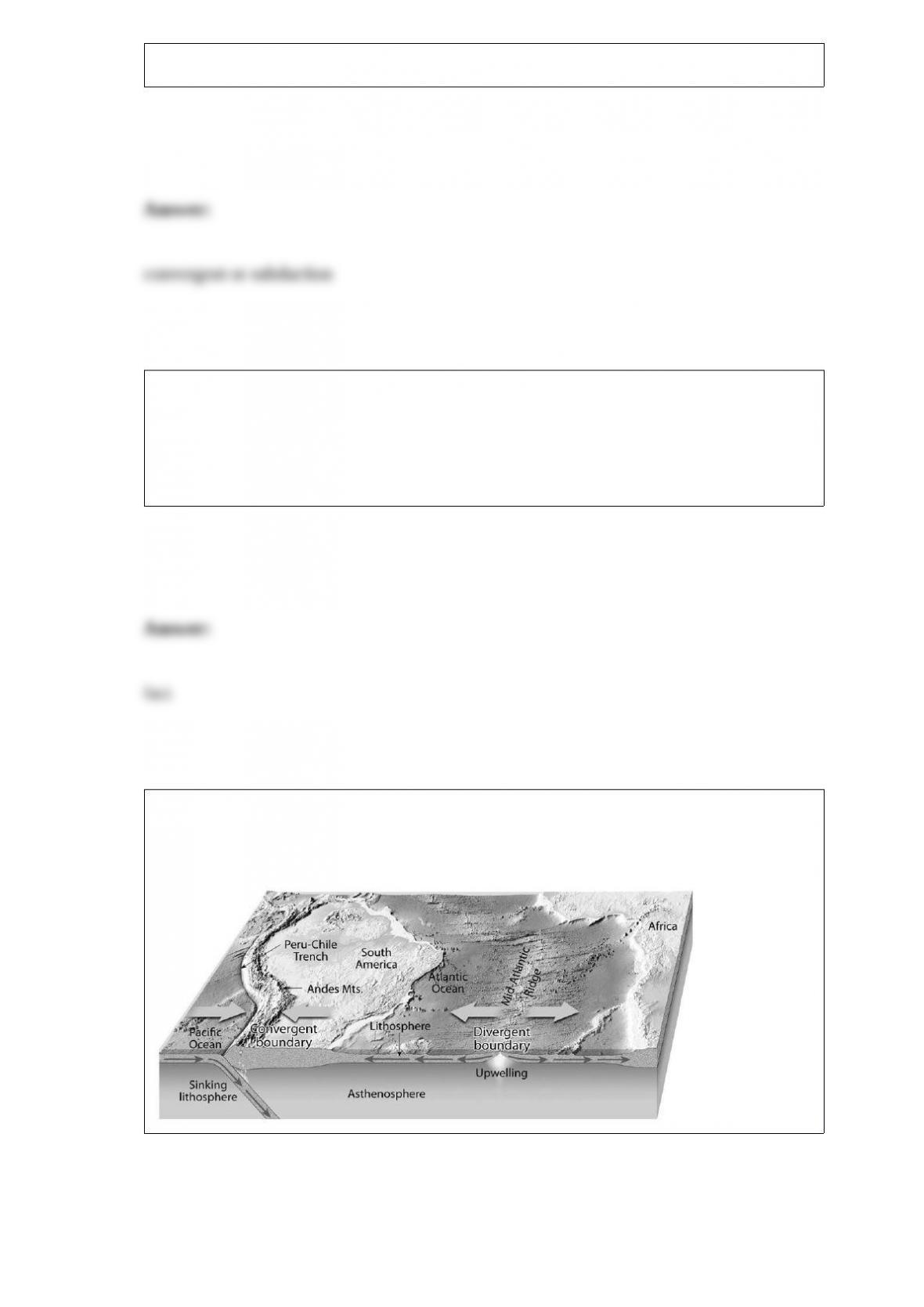
Most earthquakes occur along ________ plate boundaries.
Examine the words and/or phrases for each question below and determine the
relationship among the majority of words/phrases. Choose the option which does not fit
the pattern.
hypothesis theory fact observation
What is the relationship of the dense oceanic crust that is produced at a divergent plate
boundary to the convergence or collision of an oceanic plate and a continental plate,
such as the western margin of South America in the diagram below?

The ________ effect causes ocean currents to be deflected to the right of their path of
motion in the Northern Hemisphere.