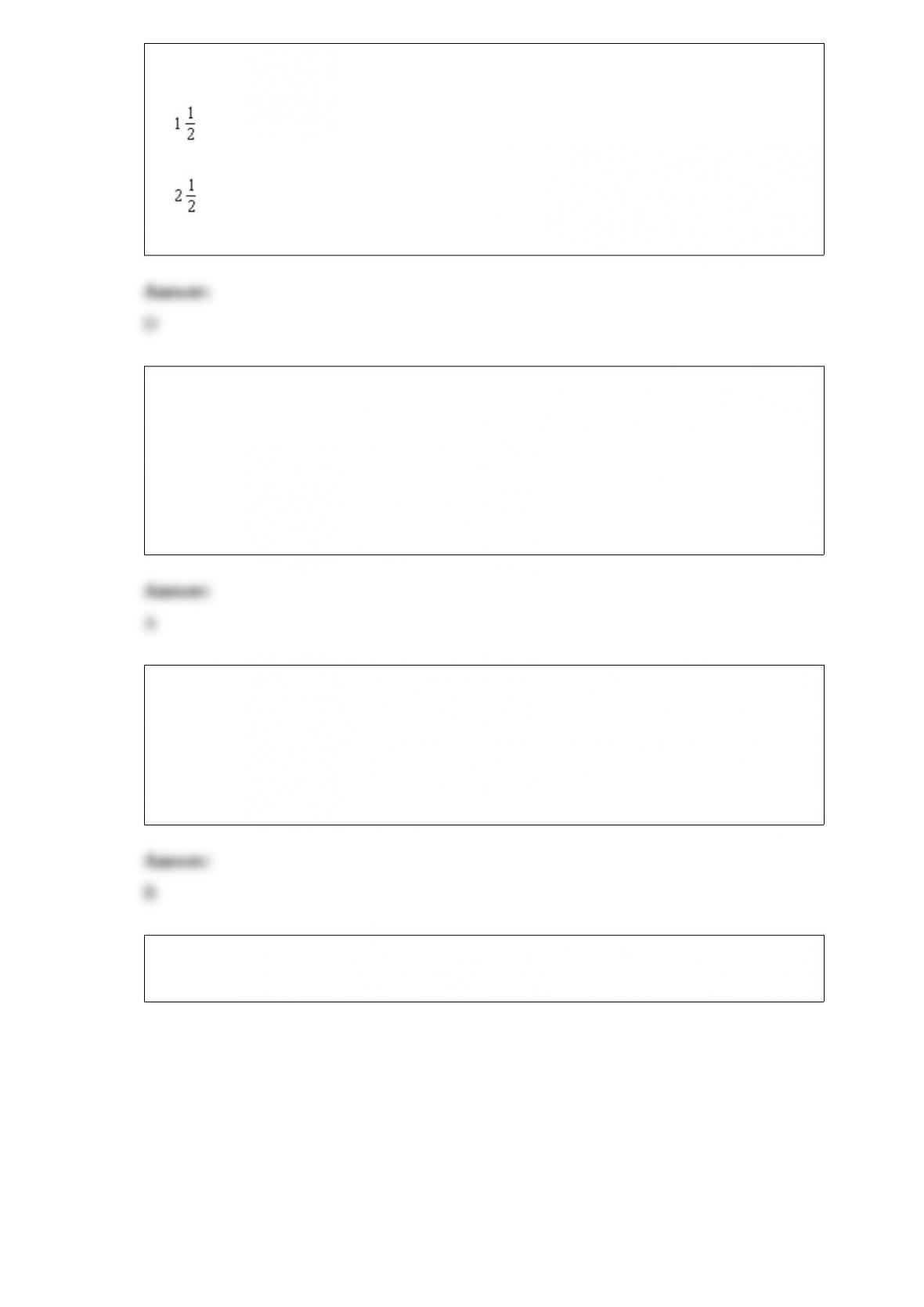
The bond order in the NO molecule is
A)1
B)
C)2
D)
E)3
The bond angles about the carbon atom in the formaldehyde molecule, H2C=O, are
about:
A)120°
B)60°
C)109°
D)180°
E)90°
The standard temperature for gases is
A)100°C
B)0°C
C)32°C
D)212°F
E)0°F
The following questions refer to the hypothetical reaction A + B –> products. The
kinetics data given can be analyzed to answer the questions.
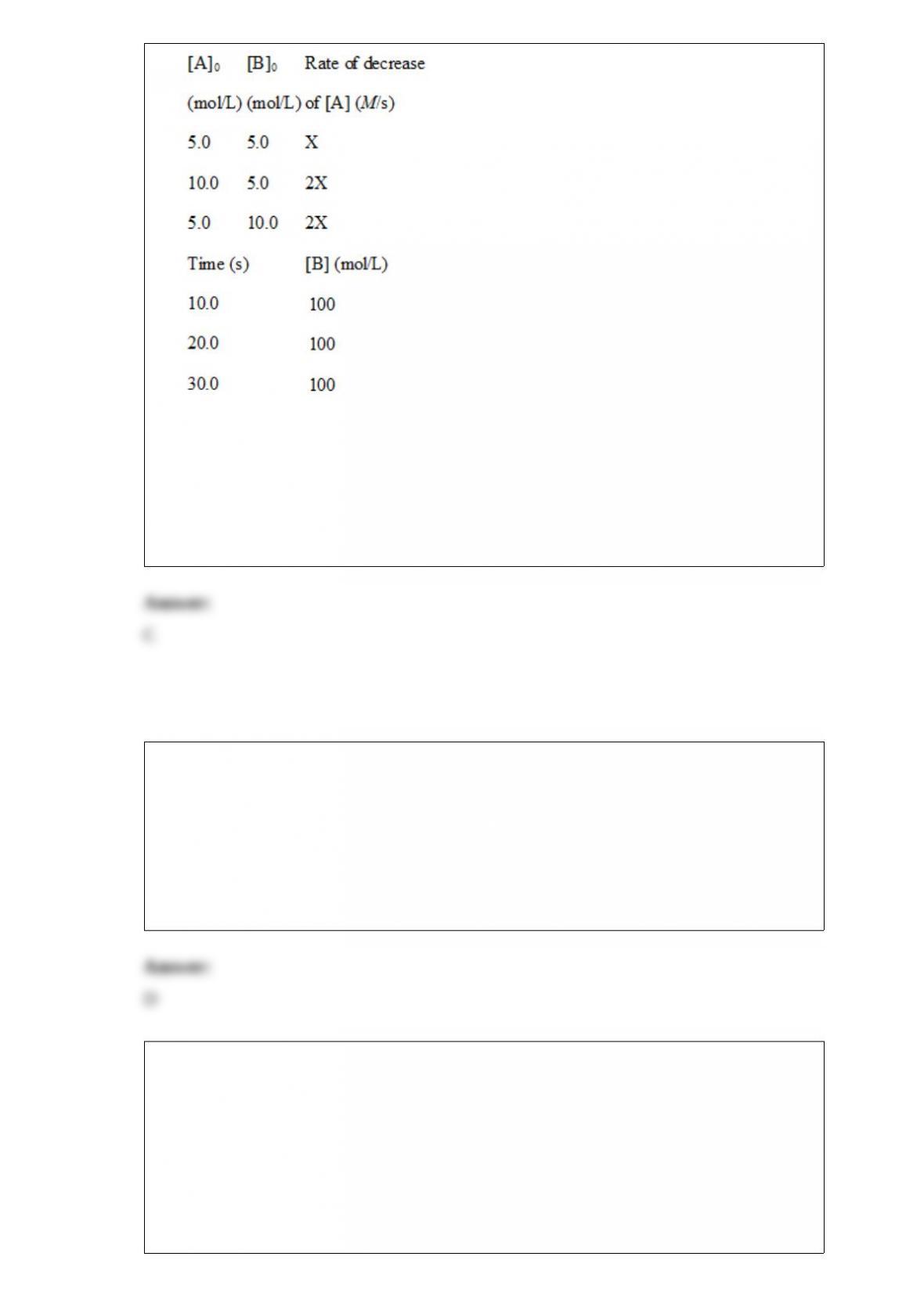
The rate law for the reaction is Rate = k[A]x[B]y. What are the values of x and y?
A)x = 0 y = 1
B)x = 1 y = 0
C)x = 1 y = 1
D)x = 2 y = 1
E)x = 1 y = 2
Which of the following metals (M) is mostly likely to form a chloride of the formula
MCl5?
A) Sc
B) Ti
C) Cr
D) V
E) Mn
Consider the following gas samples:
Sample A Sample B
S2(g) O2(g)
n = 1 mol n = 2 mol
T = 800 K T = 400 K
P = 0.20 atm P = 0.40 atm
Which of the following statements is false?
A)The volume of sample A is twice the volume of sample B.
B)The average kinetic energy of the molecules in sample A is twice the average kinetic
energy of the molecules in sample B.
C)The fraction of molecules in sample A, having a kinetic energy greater than some
high fixed value, is larger than the fraction of molecules in sample B, having kinetic
energies greater than that same high fixed value.
D)The mean square velocity of molecules in sample A is twice as large as the mean
square velocity of molecules in sample B.
E)Assuming identical intermolecular forces in the two samples, sample A should be
more nearly ideal than sample B.
Determine the rate law for the reaction: C2H4Br2+ 3KI –> C2H4+ 2KBr +KI3, given
the initial rate data below?
A)rate = k[KI]
B)rate = k[C2H4Br2]
C)rate = k[KI]2
D)rate = k[KI][C2H4Br2]
E)rate = k[KI][C2H4Br2]2
What effect does a) increasing the total pressure and b) increasing the temperature have
on the equilibrium H2(g) + CO2(g) H2O(g) + CO(g), Ho= 41.2 kJ/mol.
A) a) equilibrium shifts towards products, b) equilibrium shifts towards products.
B) a) equilibrium shifts towards reactants, b) equilibrium shifts towards products.
C) a) equilibrium shifts towards products, b) equilibrium shifts towards reactants.
D) a) no change in the equilibrium, b) equilibrium shifts towards products.
E) a) no change in the equilibrium, b) equilibrium shifts towards reactants.
Which of the following nuclides would be most expected to undergo positron emission?
A) 86As
B) 127I
C) 252Es
D) 9C
E) 171Ir
Consider the following electrode potentials:
Which one of the reactions below will proceed spontaneously from left to right?
A) Mg2++ V –> V2++ Mg
B) Mg2++ 2Cu+–> 2Cu2++ Mg
C) V2++ 2Cu+–> V + 2Cu2+
D) V + 2Cu2+–> V2++ 2Cu+
E) none of these
Consider two perfectly insulated vessels. Vessel #1 initially contains an ice cube at 0°C
and water at 0°C. Vessel #2 initially contains an ice cube at 0°C and a saltwater solution
at 0°C. In each vessel, consider the ‘system” to be the ice, and the ‘surroundings” to be
the liquid.
Determine the sign of Ssys, Ssurr, and Sunivfor the contents of
Vessel #1
A) 0 0 0
B) + – 0
C) + + +
D) + – +
E) + 0 +
Which of the following solutions is INCORRECTLY described?
I.0.2 M NaCN has a pH > 7.
II.0.2 M FeBr3is acidic
III.0.25 M NH4Cl is acidic
A) II only
B) II and III only
C) I and II only
D) I and III only
E) All are correctly described
Consider the skeletal structure shown below:
N—C—C—N
Draw the Lewis structure and answer the following:
How many pi bonds does the molecule contain?
A)0
B)2
C)4
D)6
E)7
The following reaction is allowed to reach equilibrium is a glass bulb at a given
temperature. 2 HgO(s) 2 Hg(l) + O2(g) H = 43.4 kcal/mol. The mass of HgO in the
bulb could be increased by:
A) removing some Hg
B) reducing the volume of the bulb
C) adding more Hg
D) increasing the temperature
E) removing some O
Consider the following molecules.
I.BF3
II.CHBr3(C is the central atom)
III.Br2
IV.XeCl2
V.CO
VI.SF4
Select the molecule(s) that fit the given statement.
These molecules have a trigonal bipyramidal electron pair arrangement.
A)II, IV, VI
B)I, IV
C)IV, VI
D)VI only
E)none of them
Which of the following compounds is NOT chiral?
A) CHBrClF
B) CH3CBrCl2
C) 2,3-dimethylpentane
D) 3-methylhexane
E) They are all chiral
Calculate the ratio of the rate of effusion of CO2to He.
A)0.090/1
B)0.30/1
C)3.3/1
D)11/1
E)12/1
Which of these solutions 0.1 m NaCl, 0.15 m glucose, 0.1 m CaCl2would have
I. the lowest vapor pressure
II. the lowest boiling point
A)0.1 m CaCl2, 0.1 m CaCl2
B) 0.15 m glucose, 0.1 m CaCl2
C)0.1 m CaCl2, 0.15 m glucose
D)0.15 m glucose, 0.15 m glucose
E)0.1 m NaCl, 0.1 m CaCl2
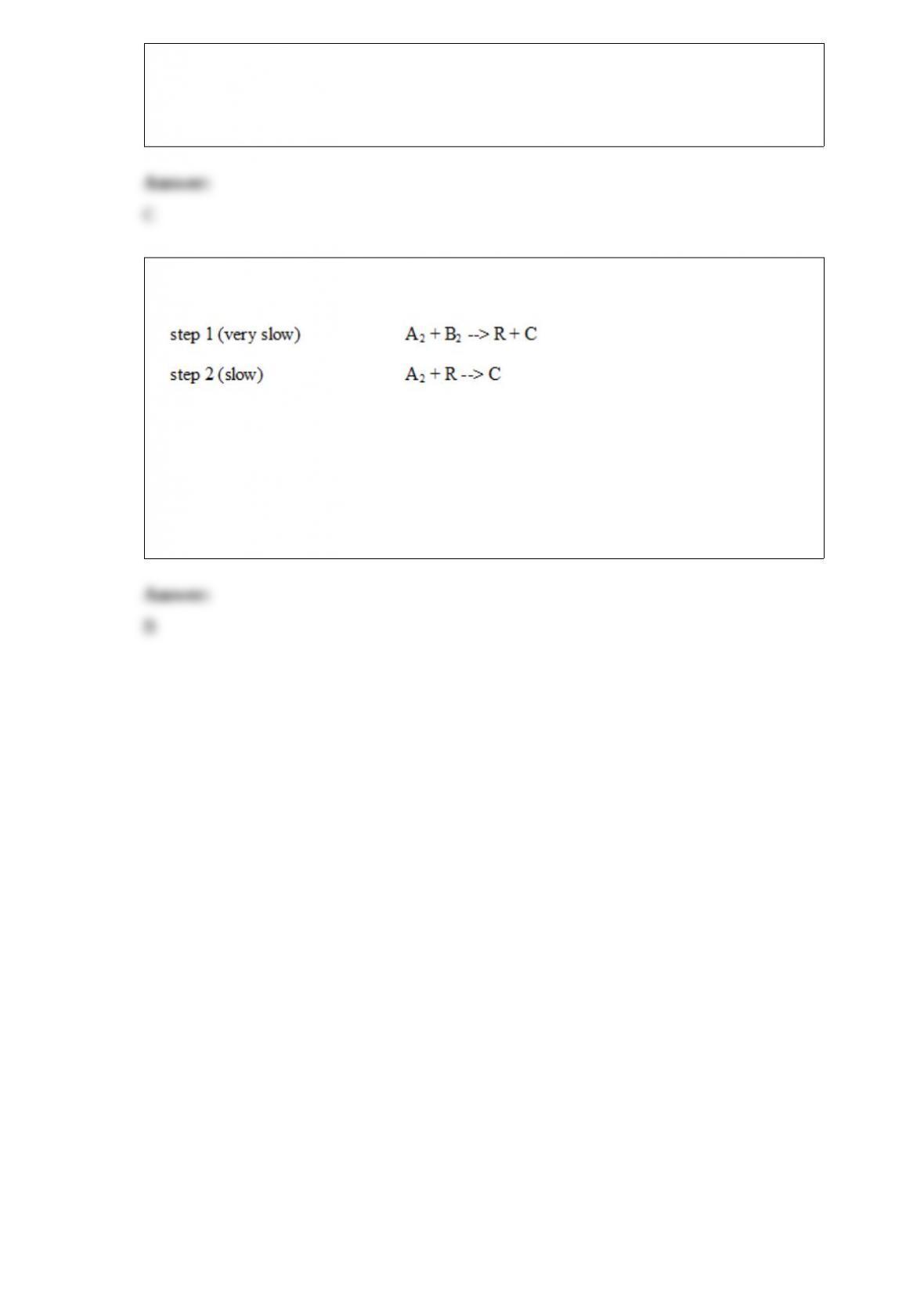
The following questions refer to the reaction 2A2 + B2 –> 2C The following
mechanism has been proposed:
Which step is rate determining?
A)both steps
B)step 1
C)step 2
D)a step that is intermediate to step 1 and step 2
E)none of these