
Which functional group does this molecule contain?
A. acid
B. alcohol
C. amine
D. ester
The “ozone layer” is found
A. only around the equator.
B. in the troposphere.
C. in the stratosphere.
D. in the mesosphere.
Calculate the mass of 2.50 104 molecules of nitrogen gas.
A. 5.81 1019 g

B. 1.16 1018 g
C. 7.00 105 g
D. 5.38 1026 g
CO2 emissions in China declined by 9% over the five-year period ending in 2000. If
5.00 108 metric tons (t) of CO2 was emitted in 1995, how much CO2 was released in
2000?
A. 4.55 109 t
B. 4.55 108 t
C. 4.50 108 t
D. 4.55 107 t
Which conclusion was considered “very likely” in the 2007 report of the
Intergovernmental Panel on Climate Change?
A. Human-caused emissions are the main factor causing warming since 1950.
B. The observed warming of the past 100 years is due solely to climate variability.
C. The Arctic Sea ice thickness decreased approximately 40% during late summer/early

fall.
D. Summer droughts have increased.
Consider the process of condensation polymerization. Which statement is false?
A. A small molecule like water is often formed as the monomers combine to form the
polymer.
B. The product contains all of the atoms of the starting materials.
C. PET is formed using this process.
D. Nylon is formed using this process.
Water has one of the highest specific heats of any known liquid. This means that the
temperature of a water sample _____ with the input of a _____ amount of energy.
A. decreases greatly; small
B. decreases only slightly; large
C. increases only slightly; large
D. increases greatly; small

The attractions between anions and cations throughout a crystal are known collectively
as
A. covalent bonds.
B. polar covalent bonds.
C. hydrogen bonds.
D. ionic bonds.
The burning of coal produces sulfur dioxide, SO2, a pollutant that slowly reacts in air to
form SO3. Sulfur trioxide dissolves into airborne water droplets to form a very
corrosive solution of sulfuric acid. Which is a product of burning coal that hastens the
transformation of sulfur dioxide into sulfur trioxide?
A. carbon dioxide
B. carbon monoxide
C. nitrogen dioxide
D. particles of ash

In the Chapman cycle, ozone formation depends upon a sufficient concentration of
oxygen atoms. Which step in the Chapman cycle produces oxygen atoms?
A. absorption of light (λ ≤ 320 nm) by ozone molecules
B. absorption of light (λ ≤ 320 nm) by oxygen molecules
C. absorption of light (λ ≤ 242 nm) by ozone molecules
D. absorption of light (λ ≤ 242 nm) by oxygen molecules
As compared to high-level nuclear waste, low-level nuclear waste
A. has longer half-lives.
B. is contaminated with smaller quantities of radioactive material.
C. includes spent fuel rods.
D. can be disposed of in landfills.

Which component of the air is an element?
A. H2O
B. NO2
C. O2
D. CO2
The EPA limit for CO is 9 ppm. Express this number as a percentage.
A. 90%
B. 9%
C. 0.09%
D. 0.0009%
The top graph shows the mean temperature over the past 160,000 years as determined
from ice-core data. Which of graphs A through D best represents the carbon dioxide
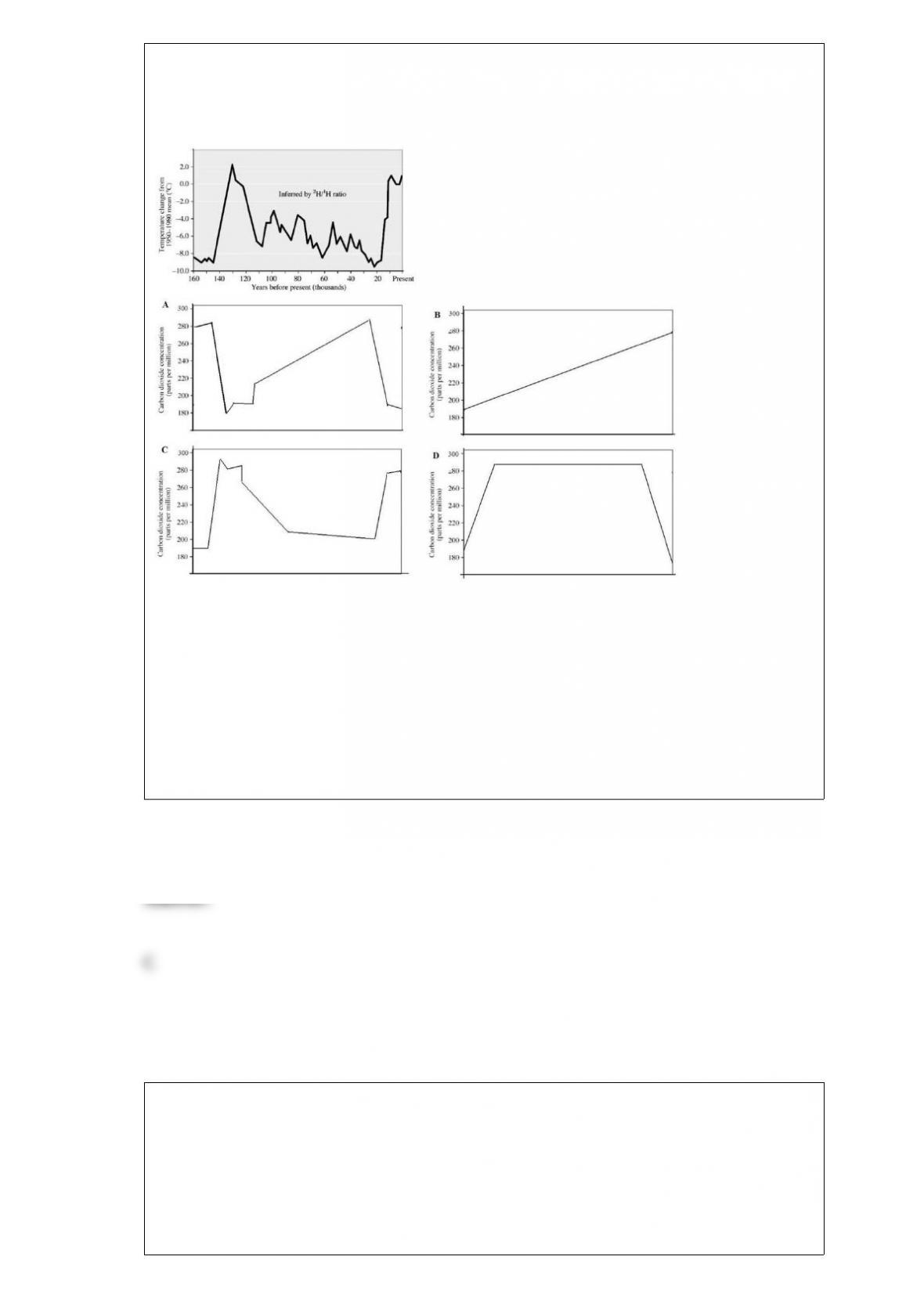
concentration in air over the same time period as measured from air bubbles trapped in
the ice cores?
A. Graph A
B. Graph B
C. Graph C
D. Graph D
How does using hydrogen as the fuel in an electric power plant compare with using
hydrogen as the fuel in a fuel cell?
A. H2 used as a fuel in a power plant must be more pure than the H2 used in a fuel cell.
B. Burning H2 in a power plant produces many more pollutants than using H2 in a fuel

cell.
C. A fuel cell using hydrogen operates at a higher overall efficiency than would a power
plant burning hydrogen as a fuel.
D. Using H2 in a fuel cell generates far more heat than burning it in a power plant.
What sort of energy is associated with energy from wind?
A. Potential energy
B. Thermal energy
C. Kinetic energy
D. Chemical energy
Will synthetic polymers always have to be made from crude oil?
A. Yes, because although other technologies exist, they are too costly for large scale
use.
B. No, but there are no funds to research new technologies needed.
C. Yes, but more crude oil will have to be diverted from other uses.
D. No, new technologies are being developed to use bio-based raw materials.

If the lead concentration in water is 1 ppm, then we should be able to recover 1 mg of
lead from ____ L of water.
A. 0.01
B. 0.1
C. 1
D. 10
The critical pieces of information that helped Watson and Crick decipher the structure
of DNA were
I. Chargaff’s rule.
II. the X-ray structure of DNA.
III. anti-Chargaff’s rule.
IV. ultraviolet spectrum of DNA.
A. I and II only
B. I and III only
C. II and III only

D. I and IV only
The EPA has determined a solid waste management hierarchy. Which is the most
preferred method?
A. incineration and land filling
B. recycling and composting
C. source reduction and reuse
D. condensation
Which process plays the most important role in the greenhouse effect?
A. Energy from the sun is reflected back into the atmosphere.
B. Energy from the sun is absorbed by the earth.
C. Energy from the sun is absorbed by the atmosphere.
D. Energy radiated by the earth is absorbed by the atmosphere.

The drawing shows two water molecules. Which statement is correct?
A. A: covalent bond; B: hydrogen bond; B is stronger
B. A: hydrogen bond; B: covalent bond; A is stronger
C. A: covalent bond; B: hydrogen bond; A is stronger
D. A: hydrogen bond; B: covalent bond; B is stronger
Except in the case of hydrocarbons, when naming virtually all compounds made up of
two elements, the second element mentioned
A. ends in “ide.”
B. is preceded by “mono” (or occasionally “mon”).
C. is always the more metallic element.
D. is the one present in the greater number of atoms.

The carbon cycle refers to the
A. mechanism by which carbon dioxide causes global warming.
B. frequency of light energy that affects the rotational energy of carbon dioxide.
C. oxidation of glucose to form carbon dioxide and water.
D. movement of carbon through living organisms, the atmosphere, the sea, and the
earth.
Mark the True statement
A. In carbon containing compounds, carbon usually forms four bonds, nitrogen usually
forms three bonds, oxygen usually forms two bonds, and hydrogen only forms one
bond.
B. In carbon containing compounds, carbon usually forms four bonds, nitrogen usually
forms five bonds, oxygen usually forms six bonds, and hydrogen only forms one bond.
C. In carbon containing compounds, carbon usually forms four bonds, nitrogen and
oxygen usually form two bonds, and hydrogen only forms one bond.
D. In carbon containing compounds, carbon usually forms three bonds, nitrogen and
oxygen usually form two bonds, and hydrogen only forms one bond.

The speed of light in air
A. depends only on the frequency of the light.
B. depends only on the wavelength of light.
C. is independent of the wavelength and frequency of light.
D. depends on both the wavelength and the frequency of light.
Which differentiates a compound from a mixture of two or more elements?
A. The elements in a compound may be present in varying proportions.
B. A compound does not exhibit the individual properties of the elements of which it is
composed.
C. A compound is made up of only one element.
D. A compound cannot be made up of more than two elements.
Which of the following is not carried out by bacteria in soil?

A. Atmospheric nitrogen is fixed in soils.
B. Ammonium is converted into nitrites.
C. Nitrites are converted to nitrates.
D. All of these are carried out by bacteria.
Consider the following equation that describes the complete combustion of propane,
C3H8.
The bond energies are: C H 416 kJ/mol; C C 356 kJ/mol; O O 498 kJ/mol; C O
803 kJ/mol; H O 467 kJ/mol. Which is the amount of energy gained on making all the
bonds in carbon dioxide and water according to the equation?
A. -1270 kJ/mol
B. -2540 kJ/mol
C. -4277 kJ/mol
D. -8554 kJ/mol
Which statement best fits the data presented?
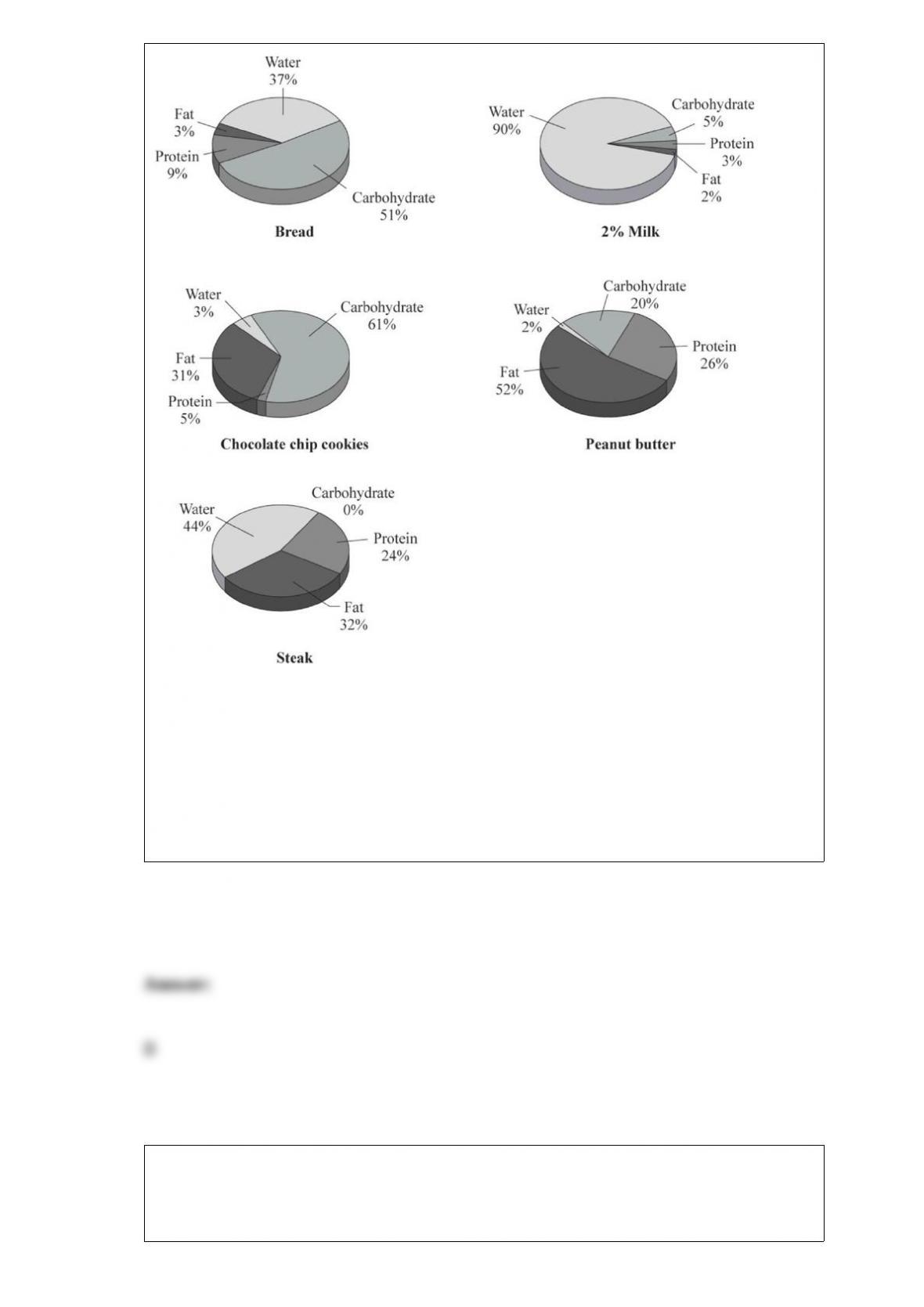
A. Meat has the highest fat and protein content.
B. Peanut butter has the highest protein and fat content.
C. Cookies have the highest carbohydrate and lowest protein content.
D. Milk has the highest water and lowest carbohydrate content.
The O2 molecule breaks apart at lower wavelengths than the O3 molecule.What is the
main reason for this?(Hint: Draw the Lewis structures)

A. O2 is more reactive than O3
B. O3 is more reactive than O2
C. The average bond in O3 is shorter and strongerthan that of O2
D. The average bond in O2 is shorter andstronger than that of O3
Which is the following incorrectly represents a combustion reaction?
A. CH4 + 2O2 → CO2 + 2 H2O
B. S8 + 8 O2 → 8 SO2
C. N2 + 2O2 → 2 NO2
D. C3H8 + O2 → 3 CO2