1) In the absence of magnetic or electric fields, cathode rays ________.
A) do not exist
B) travel in straight lines
C) cannot be detected
D) become positively charged
E) bend toward a light source
2) In which aqueous system is CaF2least soluble?
A) H2O
B) 0.5 M HF
C) 0.2 M HF
D) 1.0 M HNO3
E) 0.8 M KF
3) At what velocity (m/s) must a 417.3 g object be moving in order to possess a kinetic
energy of 3.2 J?
A) 0.12 m/s
B) 26 m/s
C) 0.015 m/s
D) 0.0038 m/s
E) 0.00024 m/s
4) In general, ________ are the most reactive hydrocarbons.
A) alkenes
B) alkynes
C) alkanes
D) cycloalkanes
E) olefins
5) The half-life of a radionuclide ________.
A) is constant
B) gets shorter with passing time
C) gets longer with passing time
D) gets shorter with increased temperature
E) gets longer with increased temperature
6) When the phase diagram for a substance has a solid-liquid phase boundary line that
has a negative slope (leans to the left), the substance ________.
A) can go from solid to liquid, within a small temperature range, via the application of
pressure
B) sublimes rather than melts under ordinary conditions
C) cannot go from solid to liquid by application of pressure at any temperature
D) cannot be liquefied above its triple point
E) melts rather than sublimes under ordinary conditions
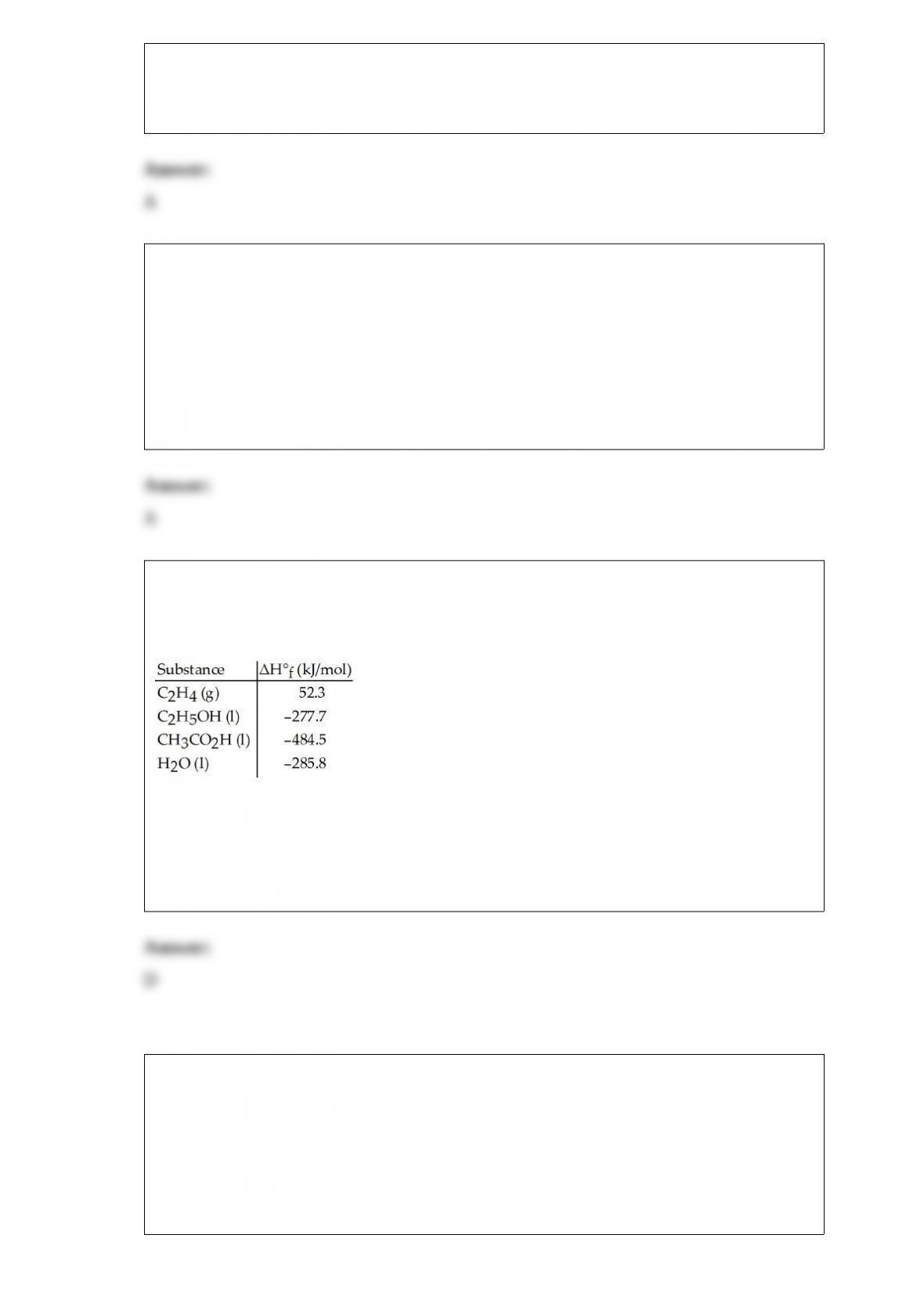
7) Given the data in the table below, ΔH°rxn for the reaction
C2H5OH (l) + O2 (g) → CH3CO2H (l) + H2O (l)
is ________ kJ.
A) -79.0
B) -1048.0
C) -476.4
D) -492.6
E) The value of ΔH°f of O2 (g) is required for the calculation.
8) Which solution contains the largest number of moles of chloride ions?
A) 10.0 mL of 0.500 M BaCl2
B) 4.00 mL of 1.000 M NaCl
C) 7.50 mL of 0.500 M FeCl3
D) 25.00 mL of 0.400 M KCl
E) 30.00 mL of 0.100 M CaCl2
9) Which one of the following is true about the liter?
A) It is the SI base unit for volume.
B) It is equivalent to a cubic decimeter.
C) It is slightly smaller than a quart.
D) It contains 106 cubic centimeters.
E) It is slightly smaller than a gallon.
10) What is the oxidation number of Ni in [Ni(CN)5]3-?
A) 1+
B) 2+
C) 3+
D) 4+
E) 5+
11) A molecule of water contains hydrogen and oxygen in a 1:8 ratio by mass. This is a
statement of ________.
A) the law of multiple proportions
B) the law of constant composition
C) the law of conservation of mass
D) the law of conservation of energy
E) none of the above
12) The volume of hydrogen gas at 38.0 °C and 763 torr that can be produced by the
reaction of 4.33 g of zinc with excess sulfuric acid is ________ L.
A) 1.68
B) 2.71 x 10⁻⁴
C) 3.69 x 10⁴
D) 2.84
E) 0.592
13) The most electronegative atom of the ones listed below is ________.
A) B
B) Al
C) Ga
D) In
E) Tl
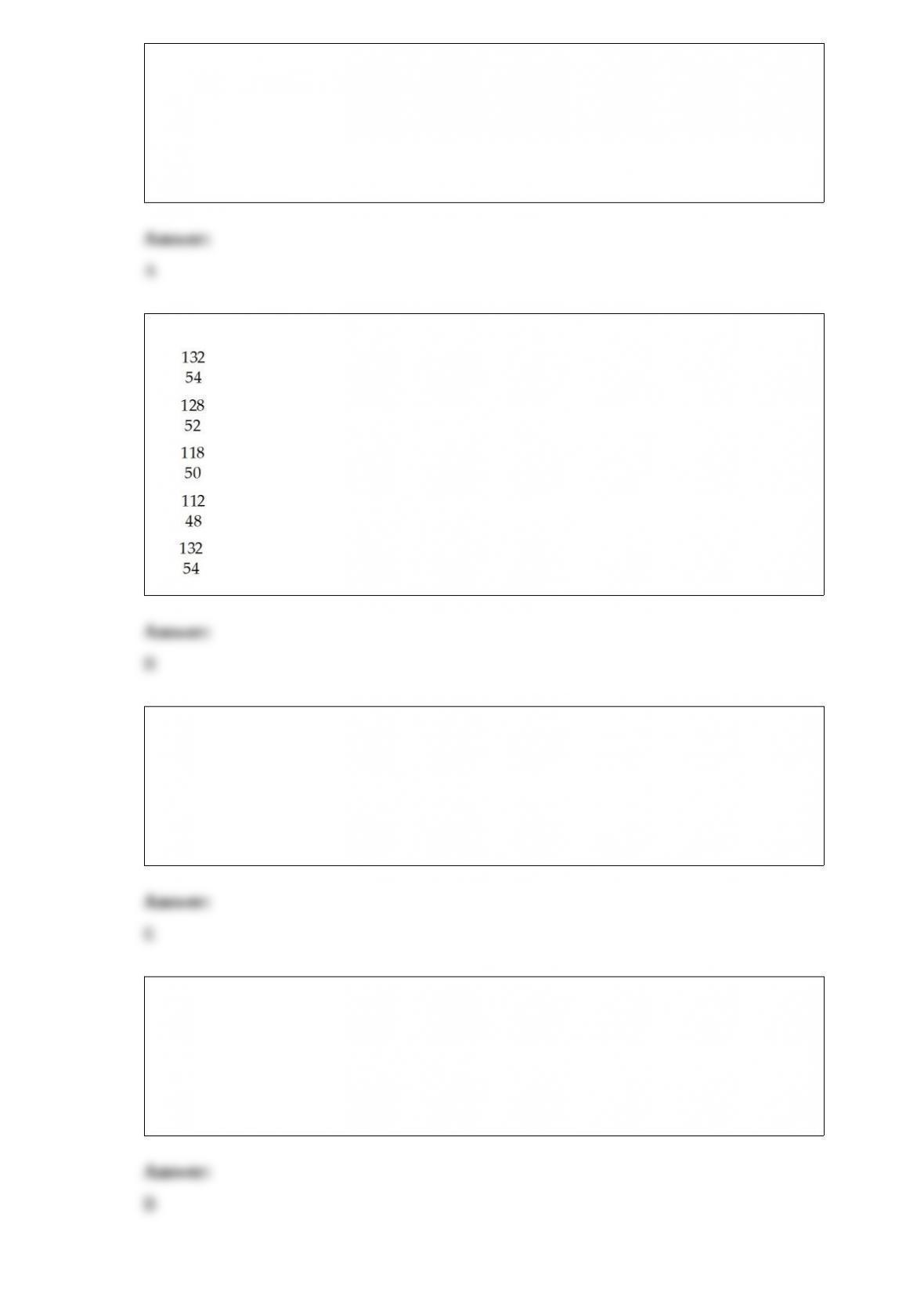
14) Which species has 54 electrons?
A) Xe+
B) Te2-
C) Sn2+
D) Cd
E) Xe2+
15) Elements ________ exhibit similar physical and chemical properties.
A) with similar chemical symbols
B) with similar atomic masses
C) in the same period of the periodic table
D) on opposite sides of the periodic table
E) in the same group of the periodic table
16) Viscosity is ________.
A) the ‘skin” on a liquid surface caused by intermolecular attraction
B) the resistance to flow
C) the same as density
D) inversely proportional to molar mass
E) unaffected by temperature

17) How many molecules of CH4 are in 48.2 g of this compound?
A) 5.00 x 1024
B) 3.00
C) 2.90 x 1025
D) 1.81 x 1024
E) 4.00
18) The acidic water of a lake (V = 4 108 L) must be neutralized with lime, CaO. It will
require a minimum of ______ grams of lime to adjust the pH from 5.6 to 6.5.
A) 2 104
B) 5 104
C) 1 105
D) 3 104
E) 5