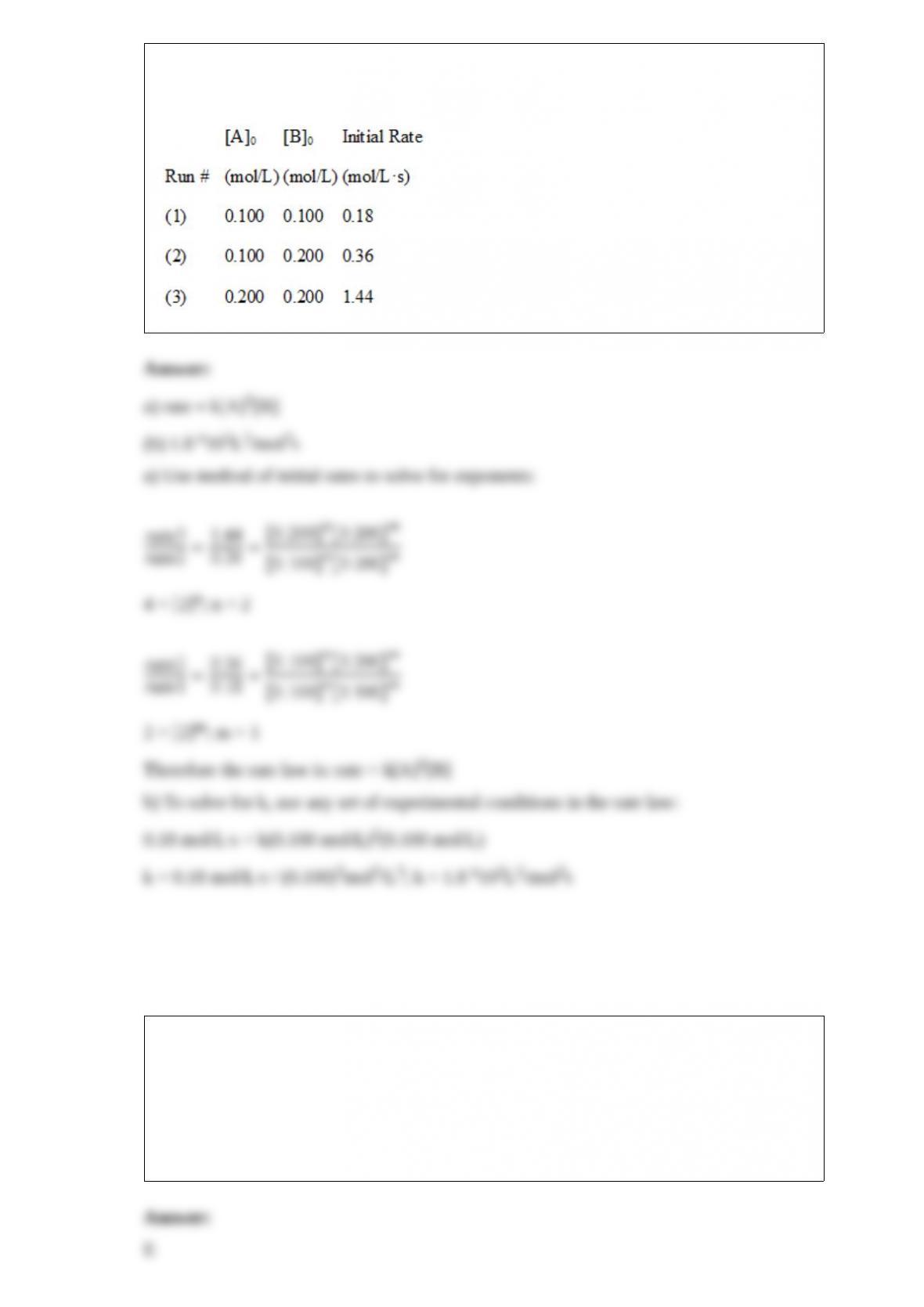
Determine (a) the rate equation and (b) the rate constant for the hypothetical reaction
A+B–>C given the following initial concentrations and initial rate data.
Which charge(s) on an N2ion would give a bond order of 2.5?
A)-2
B)-1
C)+1
D)+2
E)two of the choices
Which of the following statements is false?
A) HBrO3is a stronger acid than HBrO2
B) H2S is a stronger acid than H2O
C) nitrite is a stronger base than nitrate
D) HClO3is a weaker acid than H2SO3
E) SbH3is a weaker acid than H2Te
Consider the compounds CH3OH, CCl4, and CH3Br. For each compound, list the
strongest intermolecular force that operates within a sample of that compound.
A)H–bonding is the strongest intermolecular force in CH3OH, dispersion is the
strongest intermolecular force in CCl4, and dipole–dipole is the strongest intermolecular
force in CH3Br
B)Dispersion is the strongest intermolecular force in CH3OH, dispersion is the
strongest intermolecular force in CCl4, and dispersion is the strongest intermolecular
force in CH3Br.
C)Ion–dipole is the strongest intermolecular force in CH3OH, Ion–dipole is the strongest
intermolecular force in CCl4, and dipole–dipole is the strongest intermolecular force in
CH3Br.
D)Dipole–induced dipole is the strongest intermolecular force in CH3OH, dispersion is
the strongest intermolecular force in CCl4, and dipole–dipole is the strongest
intermolecular force in CH3Br.
E)Ion–induced dipole is the strongest intermolecular force in CH3OH, dispersion is the
strongest intermolecular force in CCl4, and H–bonding is the strongest intermolecular
force in CH3Br.
NaHCO3is the active ingredient in baking soda. How many grams of oxygen are in
0.52g of NaHCO3?
Give the bond order for each of the following:
a)H2
b)H2
+
c)H2
–
d)CN–
e)CN
f)CN+
Which of the following substances should be the most soluble in ethanol
(CH3CH2OH)?
A)CH4
B)O2
C)CH2Cl2
D)NaCl
E)Mg3(PO4)2