
1) Which one of the following substances would be the most soluble in CCl4?
A) C4H10
B) Li2O
C) NH3
D) HCl
E) CH3CH2CH2OH
2) According to valence bond theory, which orbitals overlap in the formation of the
bond in Br2?
A) 3s
B) 3p
C) 4s
D) 4p
E) 3d
3) Of the following, ________ radiation has the shortest wavelength and ________
radiation has the greatest energy.
gamma
ultraviolet
visible
A) gamma, visible
B) visible, gamma
C) visible, ultraviolet
D) ultraviolet, gamma
E) gamma, gamma
4) A gas vessel is attached to an open-end manometer containing a nonvolatile liquid of
density 0.791 g/mL as shown below.
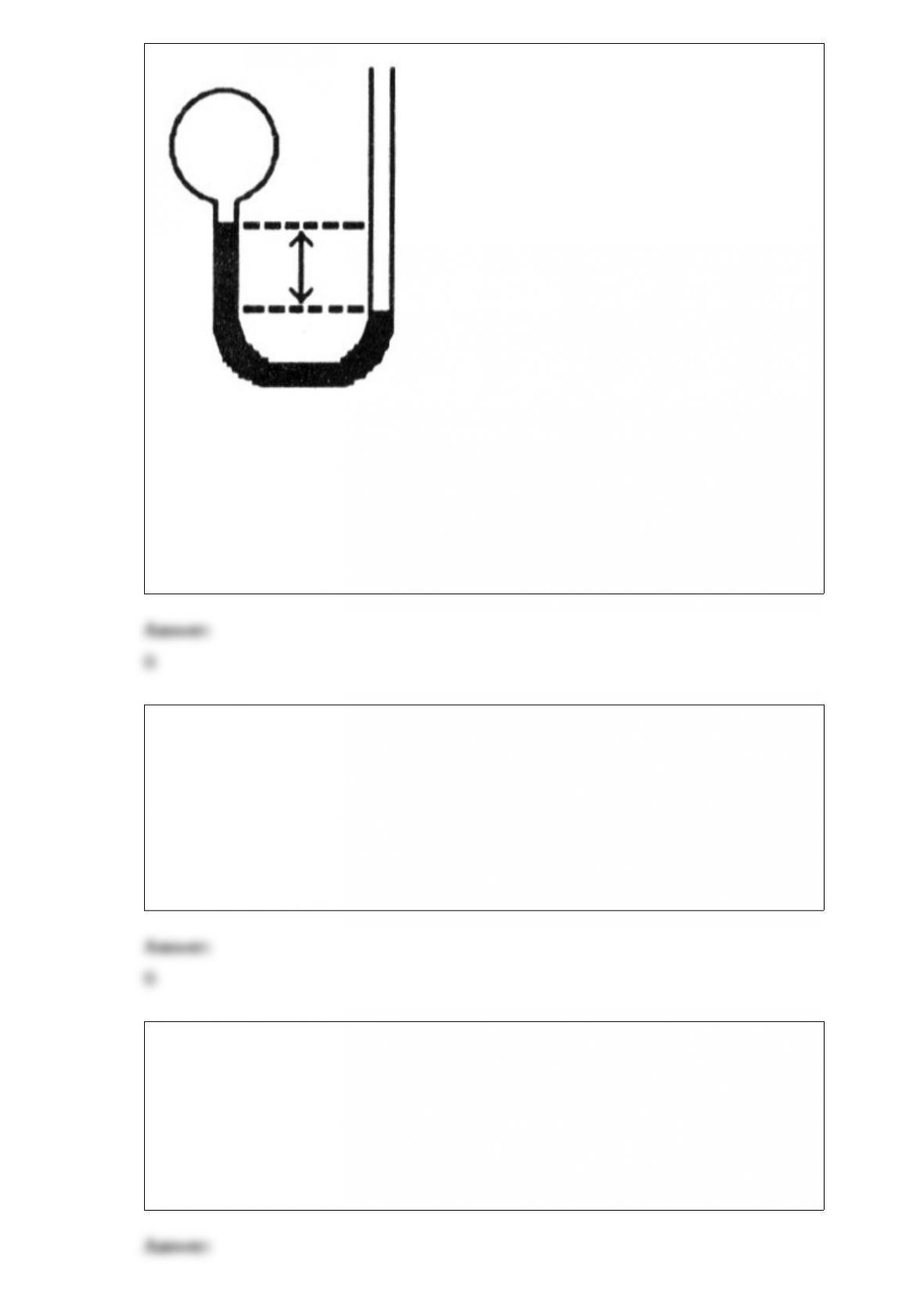
The difference in heights of the liquid in the two sides of the manometer is 43.4 cm
when the atmospheric pressure is 755 mm Hg. Given that the density of mercury is 13.6
g/mL, the pressure of the enclosed gas is ________ atm.
A) 1.03
B) 0.967
C) 0.993
D) 0.990
E) 0.987
5) The formula of the carbonate ion is ________.
A) CO2
2-
B) CO3
2-
C) CO3
3-
D) CO2
–
E) CO–
6) The molecular geometry of the IF5 molecule is ________, and this molecule is
________.
A) trigonal bipyramidal, polar
B) trigonal bipyramidal, nonpolar
C) trigonal planar, polar
D) square pyramidal, polar
E) square pyramidal, nonpolar

7) Which species below is the sulfate ion?
A) CN–
B) SO4
2-
C) OH–
D) SO3
2-
E) None of the above
8) Consider the following electron configurations to answer the questions that follow:
(i)1s2 2s2 2p6 3s1
(ii)1s2 2s2 2p6 3s2
(iii)1s2 2s2 2p6 3s2 3p1
(iv)1s2 2s2 2p6 3s2 3p4
(v)1s2 2s2 2p6 3s2 3p5
The electron configuration of the atom that is expected to have a positive electron
affinity is ________.
A) (i)
B) (ii)
C) (iii)
D) (iv)
E) (v)
9) If a iron atom loses 2 electrons to make an ion, what is the charge on that ion?
A) 2+
B) 1+
C) 3+
D) 2-
E) 1-
10) The vapor pressure of pure water at 25 oC is 23.8 torr. Determine the vapor pressure
(torr) of water at 25 oC above a solution prepared by dissolving 25 g of urea (a
nonvolatile, non-electrolyte,

MW = 60.0 g/mol) in 75 g of water.
A) 2.9
B) 0.42
C) 22
D) 27
E) 0.91
11) A radio station broadcasts at 99.5 MHz. The wavelength of the signal is ________
m.
A) 3.10
B) 3.02
C) 2.90
D) 2.75
E) 4.71
12) In balancing the nuclear reaction C –> E + e, the identity of element E is
________.
A) B
B) N
C) C
D) O
E) none of the above
13) The pH of a solution prepared by mixing 40.0 mL of 0.125 M Mg(OH)2 and 150.0
mL of 0.125 M HCl is ________.
A) 6.29
B) 4.11
C) 1.14
D) 5.78
E) 1.34

14) There are ________ protons, ________ neutrons, and ________ electrons in I–.
A) 131, 53, 54
B) 131, 53, 52
C) 53, 78, 54
D) 53, 131, 52
E) 78, 53, 72
15) There are ________ hydrogen atoms in 25 molecules of C4H4S2.
A) 25
B) 3.8 x 1024
C) 6.0 x 1025
D) 100
E) 1.5 x 1025
16) What types of intermolecular forces exist between NH3 and HF?
A) dispersion forces and dipole-dipole forces
B) dispersion forces and hydrogen bonds
C) dispersion forces, dipole-dipole forces, and hydrogen bonds
D) dispersion forces
E) dispersion forces, hydrogen bonds, and ion-dipole forces
17) Calcium carbide (CaC2) reacts with water to produce acetylene (C2H2):
CaC2 (s) + 2H2O (g) → Ca(OH)2 (s) + C2H2 (g)
The complete reaction of 57.4 g of CaC2 requires consumption of ________ g of H2O.
A) 0.895
B) 64.1
C) 32.3
D) 1.79
E) 18.0

18) The mass of a proton is 1.00728 amu and that of a neutron is 1.00867 amu. What is
the binding energy per nucleon (in J) of a Co nucleus? (The mass of a cobalt-60
nucleus is 59.9338 amu.)
A) 1.37 x 10⁻¹²
B) 3.04 x 10⁻¹²
C) 2.49 x 10⁻¹²
D) 9.43 x 10⁻¹³
E) 7.01 x 10⁻¹⁴
19) Which of the following would have to gain two electrons in order to achieve a noble
gas electron configuration?
A) Br
B) Sr
C) Na
D) O, Se
E) Sr, O, Se
20) What is the frequency of light (s-1) that has a wavelength of 3.12 X 10⁻³ cm?
A) 3.69 s-1
B) 2.44 X 10¹⁶ s-1
C) 9.62 X 10¹² s-1
D) 4.10 X 10⁻¹⁷ s-1
E) 1.04 X 10⁻¹³ s-1