
Consider the reaction between Mg(s) and HCl(aq) to produce aqueous magnesium
chloride and hydrogen gas. How many liters of hydrogen gas at STP will be produced
when 12.15 g of magnesium reacts with an excess of hydrochloric acid?
A)1.00 L
B)2.00 L
C)5.60 L
D)11.2 L
E)22.4 L
Select the correct electron configuration for Cu.
A)[Ar]4s23d9
B)[Ar]4s13d10
C)[Ar]4s24p63d3
D)[Ar]4s24d9
E)[Ar]3d10
How many of the following are true concerning balanced chemical equations?
I.The number of molecules is conserved.
II.The coefficients for the reactants tell you how much of each reactant you are given.
III.Atoms are neither created nor destroyed.
IV.The coefficients indicate the mass ratios of the substances used.
V.The sum of the coefficients on the reactant side equals the sum of the coefficients on
the product side.
A)1
B)2
C)3
D)4
E)5
For each of the following pairs of substances, select the one expected to have the lower
melting point:
I.H2O, H2SII.HCl, NaClIII.CH4, C3H8
A)H2O, HCl, C3H8
B)H2O, NaCl, C3H8
C)H2O, HCl, CH4
D)H2S, HCl, CH4
E)H2S, NaCl, CH4
Balance the following redox equation in acidic solution. What is the coefficient of the
H+ion? CH3OH(aq) + Cr2O72-(aq) –> CH2O(aq) + Cr3+(aq)
A) 1
B) 2
C) 3
D) 4
E) 8
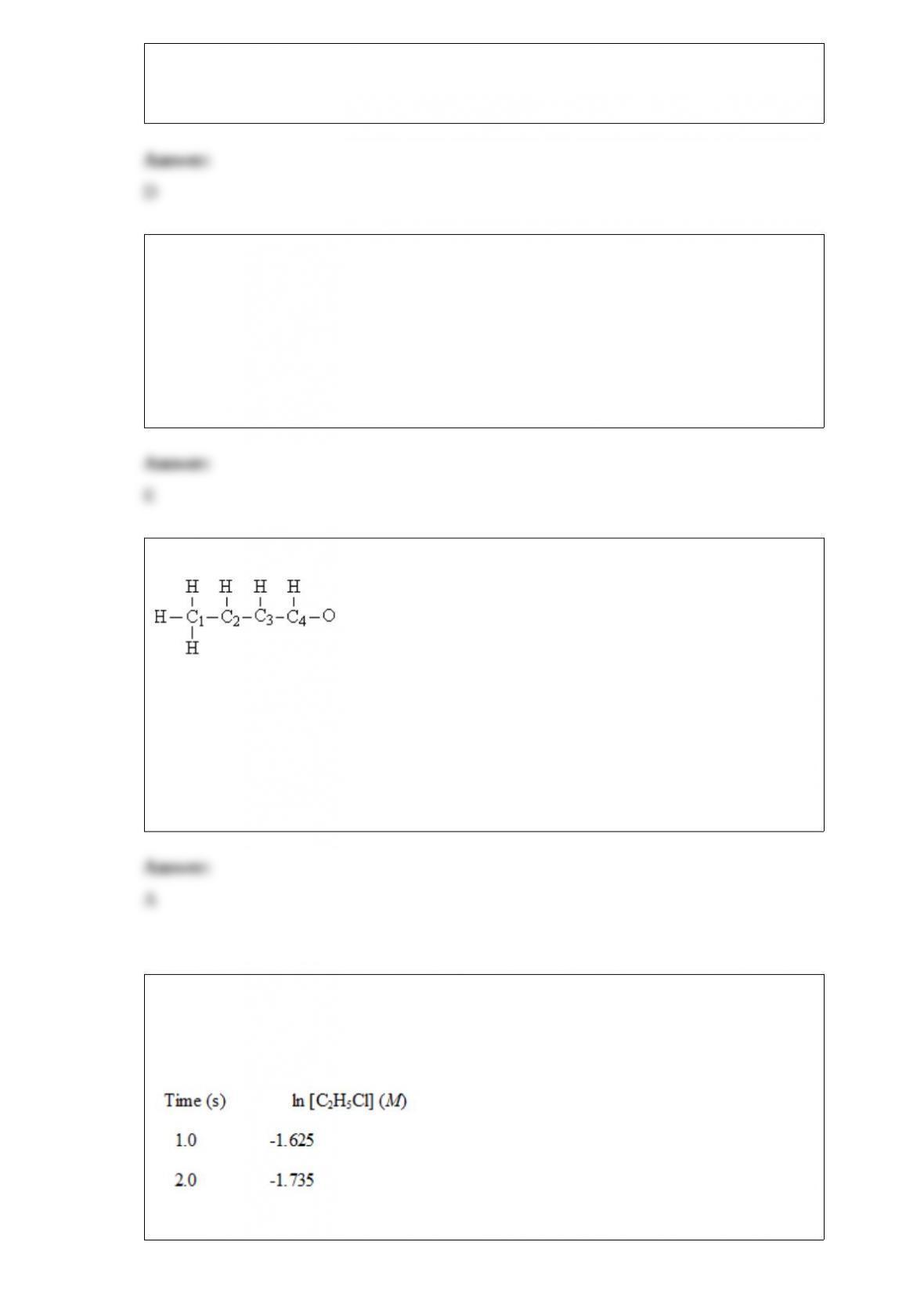
Consider the compound crotonaldehyde, whose skeleton is:
Which of the following molecules contains a double bond?
A)CO2
B)NH3
C)H2O
D)all
E)none
The following questions refer to the gas-phase decomposition of ethylene chloride.
C2H5Cl –> products
Experiment shows that the decomposition is first order.
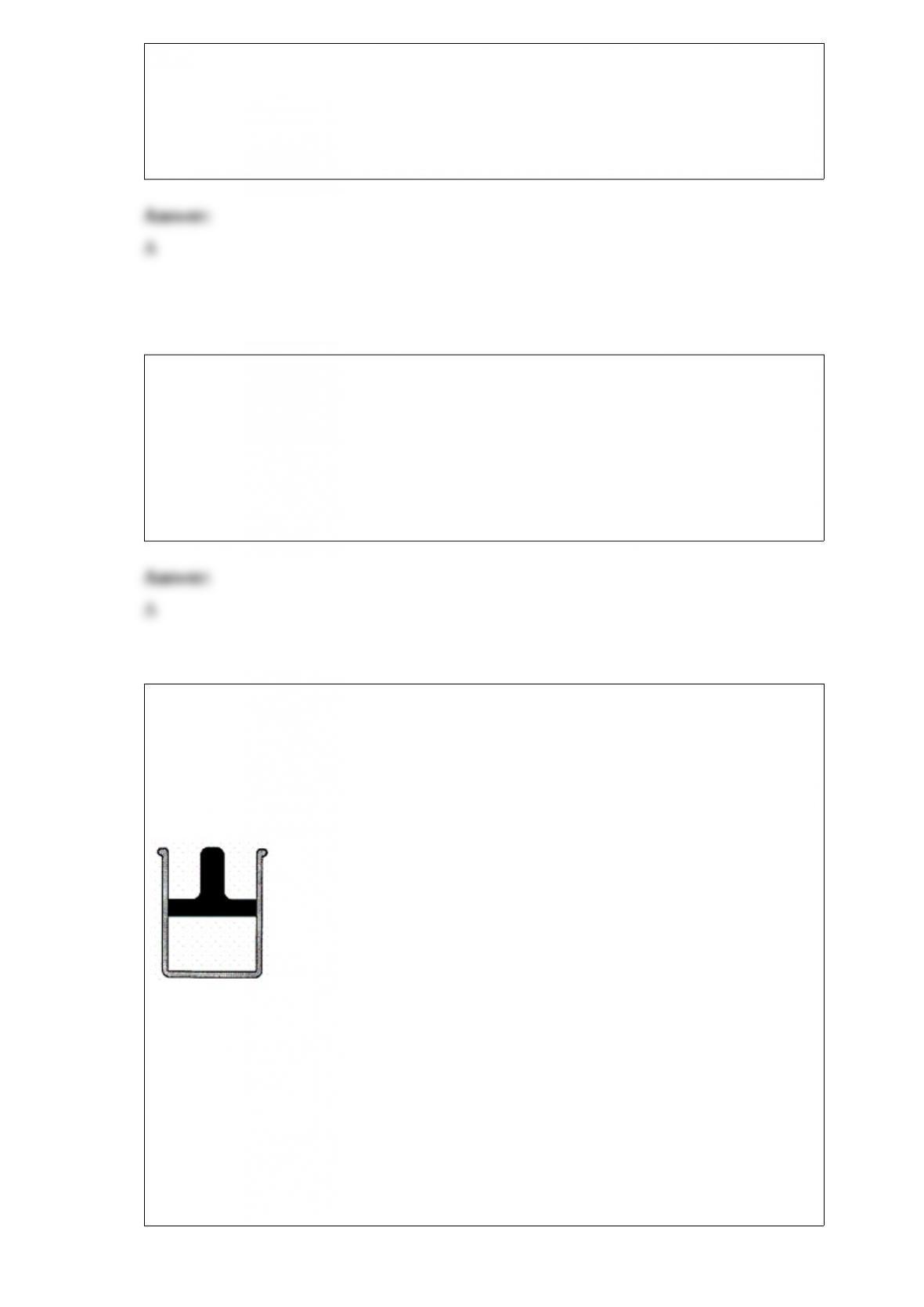
The following data show kinetics information for this reaction:
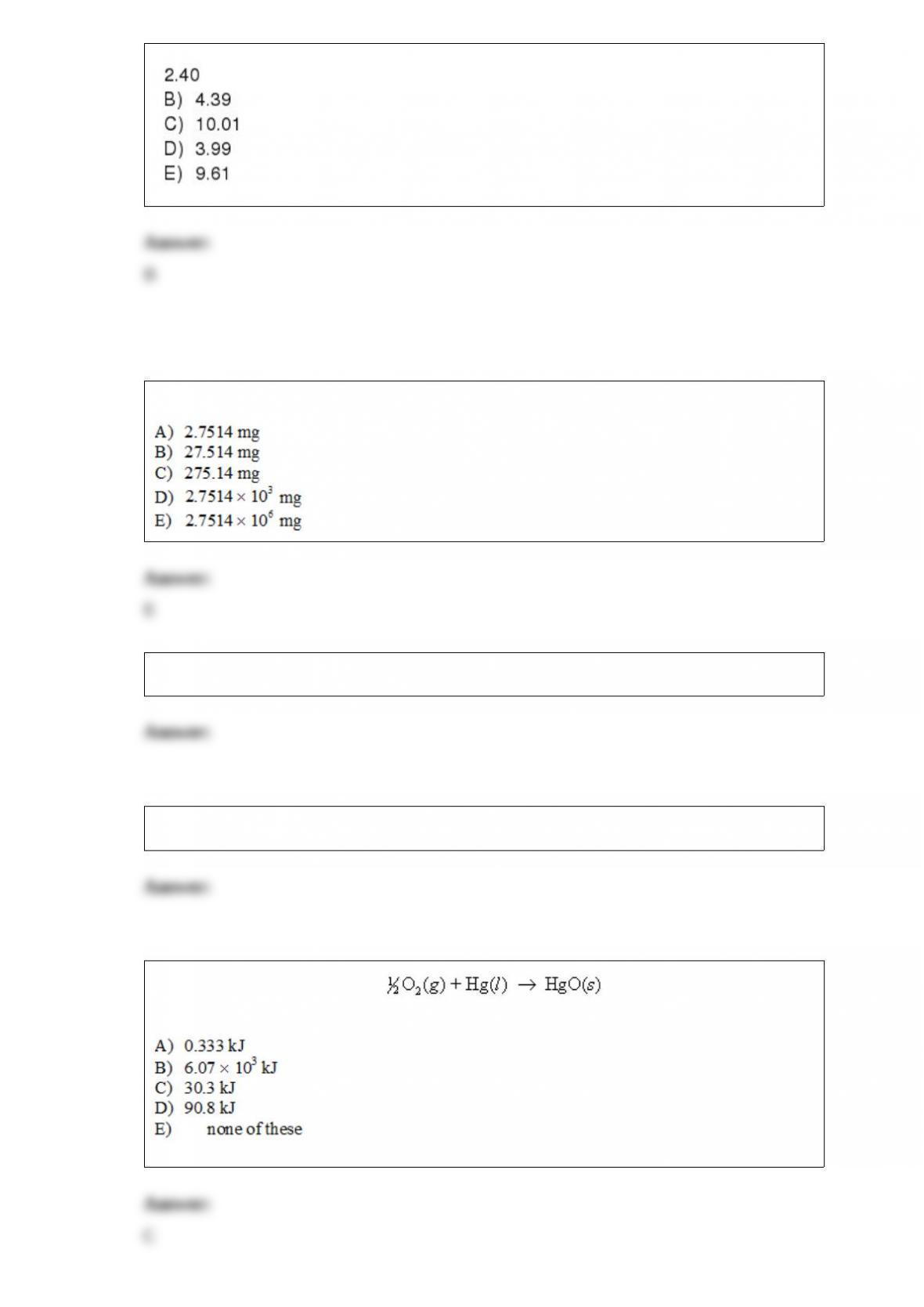
What would the concentration be after 5.0 seconds?
A)0.13 M
B)0.08 M
C)0.02 M
D)0.19 M
E)0.12 M
Which of the following compounds is incorrectly named?
A)Mg(OH)2is magnesium dihydroxide
B)CaO is calcium oxide
C)NH4NO3is ammonium nitrate
D)K3PO4is potassium phosphate
E)MgSO3is magnesium sulfite
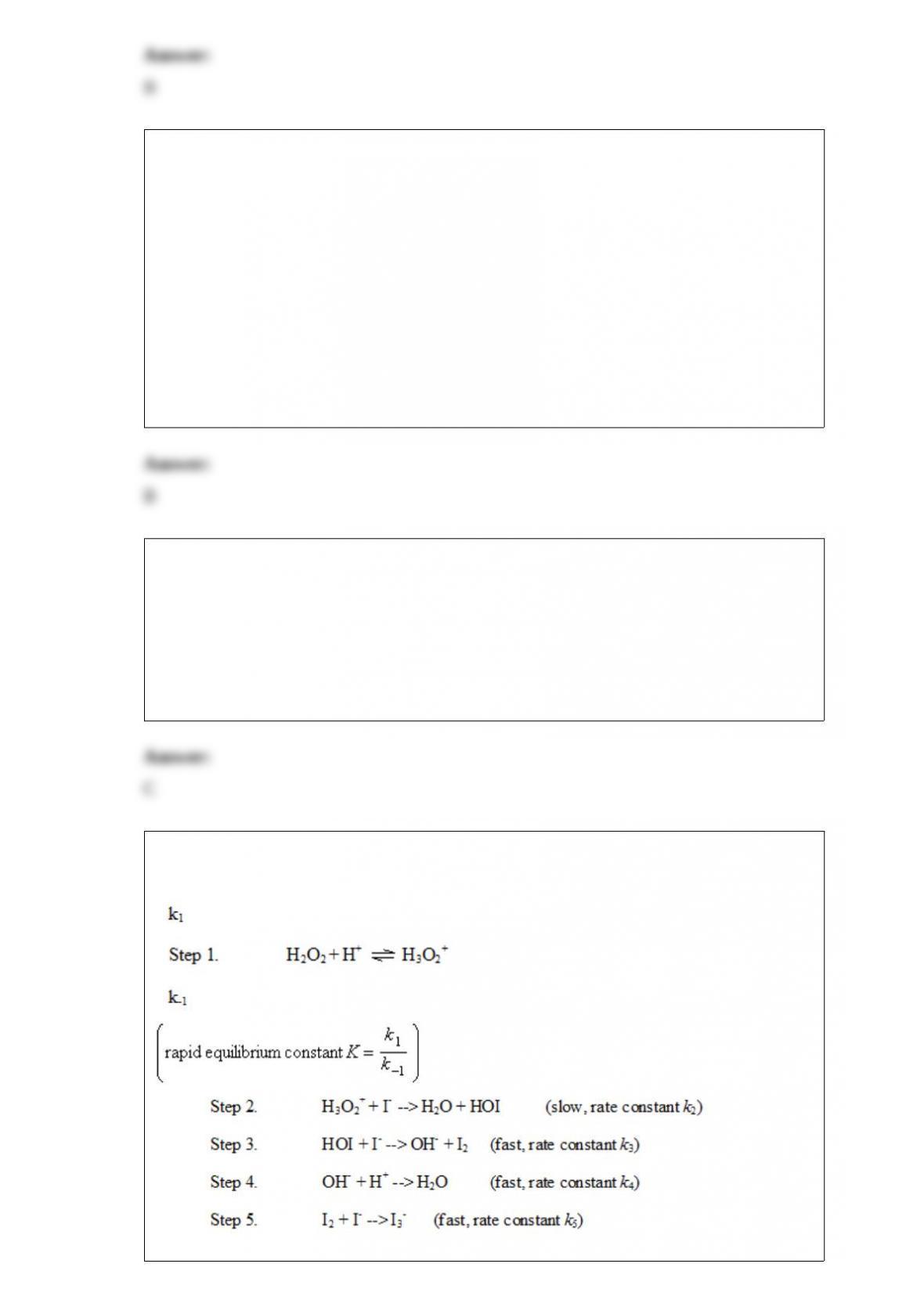
Consider a sample of helium gas in a container fitted with a piston, as pictured below.
The piston is frictionless, but has a mass of 10.0 kg. How many of the following
processes will cause the piston to move away from the base and decrease the pressure
of the gas? Assume ideal behavior.
10.0 kg
¯
base
I.heating the helium
II.removing some of the helium from the container
III.turning the container on its side
IV.decreasing the pressure outside the container
A)0
B)1
C)2
D)3
E)4
When a hydrogen electron makes a transition from n = 3 to n = 1, which of the
following statements is true?
I.Energy is emitted.
II.Energy is absorbed.
III.The electron loses energy.
IV.The electron gains energy.
V.The electron cannot make this transition.
A)I, IV
B)I, III
C)II, III
D)II, IV
E)V
Which has these types of electromagnetic radiation arranged in order of decreasing
frequency?
A)visible, ultraviolet, x-ray
B)radiowaves, visible, ultraviolet
C)ultraviolet, visible, infrared
D)x-ray, visible, ultraviolet
E)gamma, microwave, visible
Under certain conditions the reaction H2O2 + 3I– + 2H+ –> I3– + 2H2O occurs by the
following series of steps:
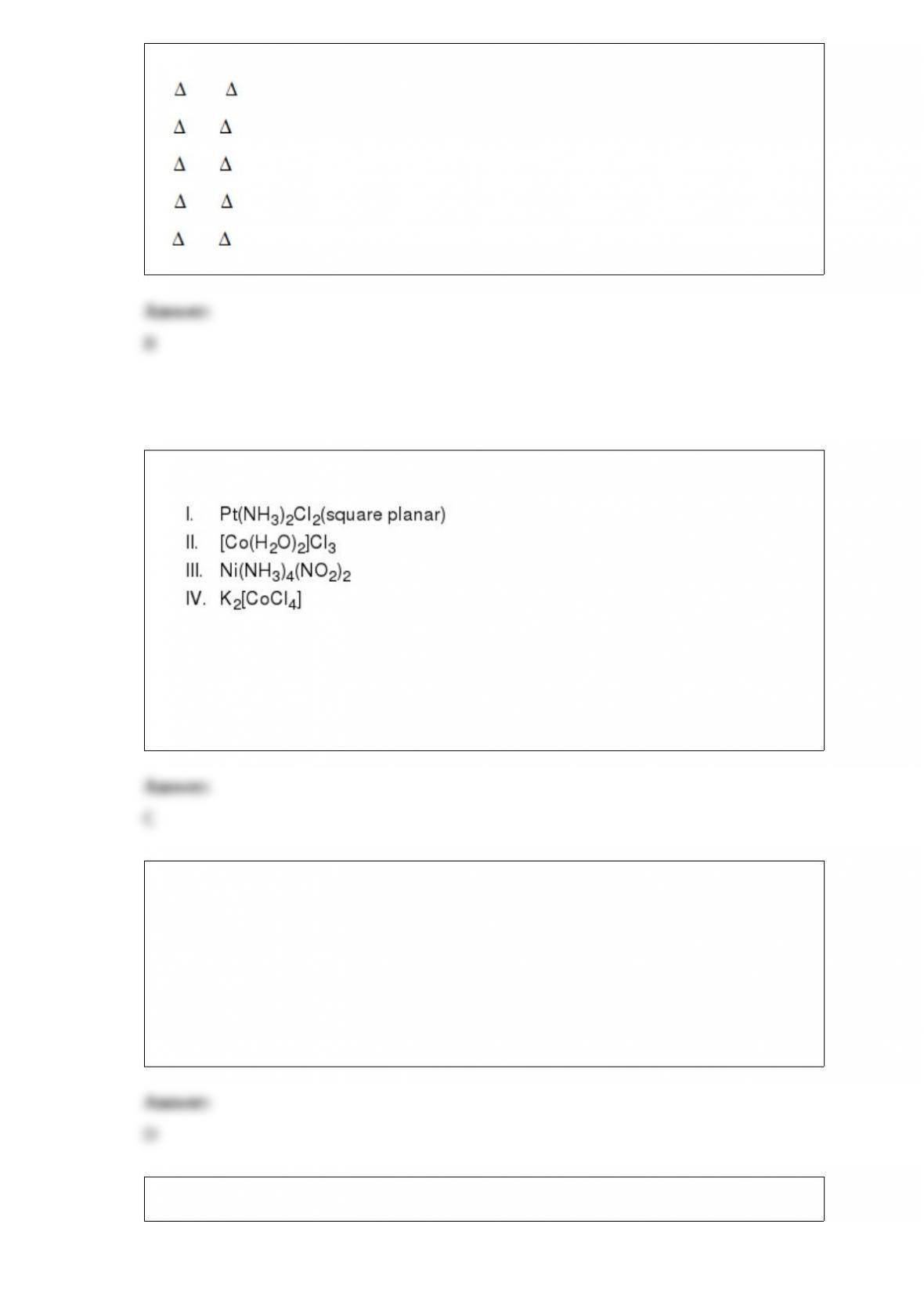
The rate law for the reaction would be:
A) [I3]/ t = k[H2O2]
B) [I3]/ t = k[H2O2][H+][I–]
C) [I3]/ t = k[H2O2][H+]
D) [I3]/ t = k[H2O2][I–]
E) [I3]/ t = k[H2O2][H+]2[I–]-3
How many of the following compounds exhibit geometric isomers?
A) 0
B) 1
C) 2
D) 3
E) 4
Tellurium consists of 3 common isotopes. Half of tellurium atoms have a mass of 127,
and another 0.45 of tellurium atoms weigh 128. What is the mass of the remaining
isotope? The atomic mass of tellurium is 127.6.
A)126
B)127
C)129
D)130
E)131
What monomer(s) is (are) needed to make the polymer shown below?
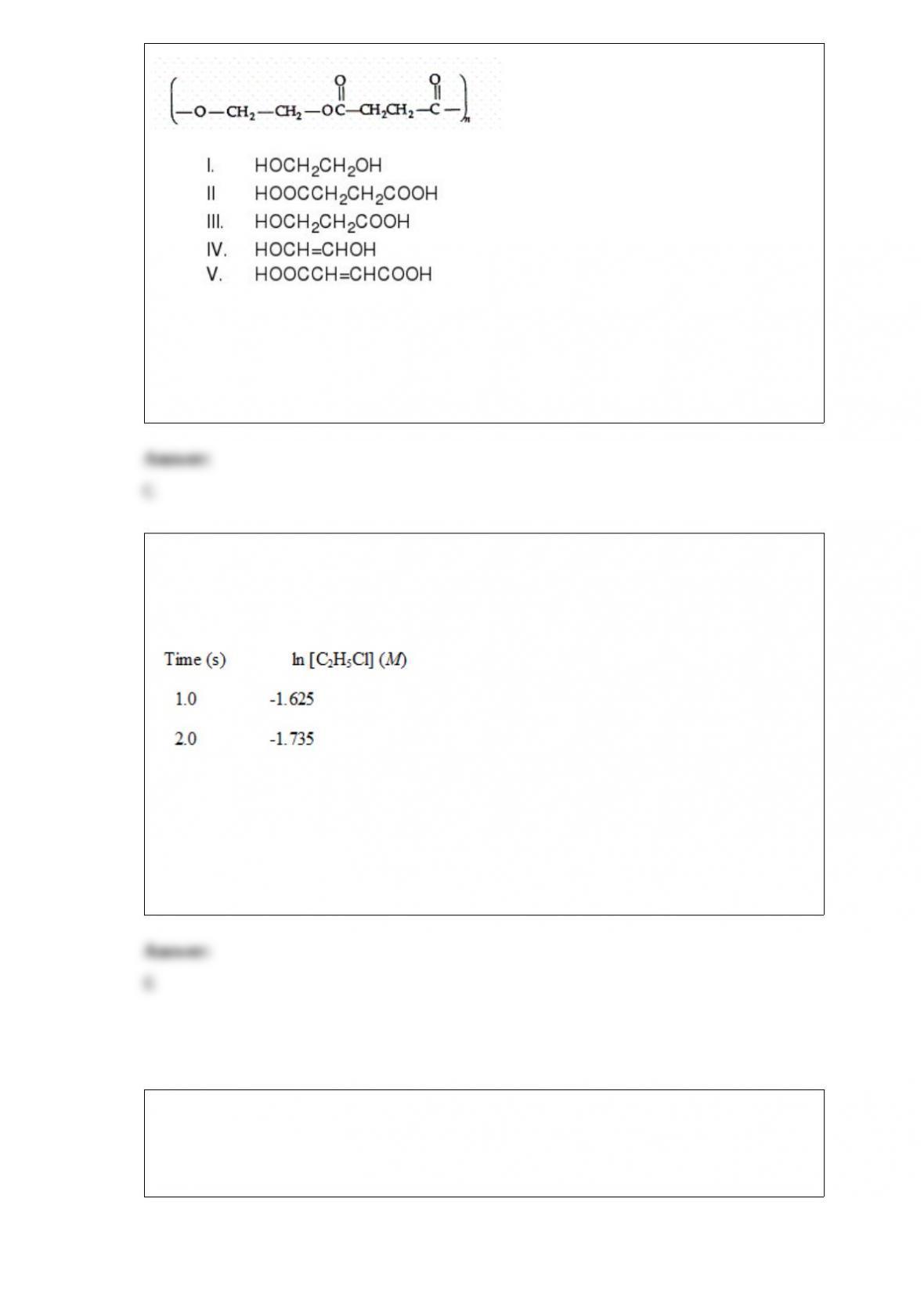
A) II
B) III
C) I and II
D) IV and V
E) II and III
The following questions refer to the gas-phase decomposition of ethylene chloride.
C2H5Cl –> products
Experiment shows that the decomposition is first order.
The following data show kinetics information for this reaction:
What was the initial concentration of the ethylene chloride?
A)0.29 M
B)0.35 M
C)0.11 M
D)0.02 M
E)0.22 M
What is the pH for a buffer that consists of 0.25 M benzoic acid, C6H5COOH and 0.40
M potassium benzoate C6H5COOK? Kaof C6H5COOH = 6.4 x 10⁻⁵
A)
Convert 2751.4 g to mg.
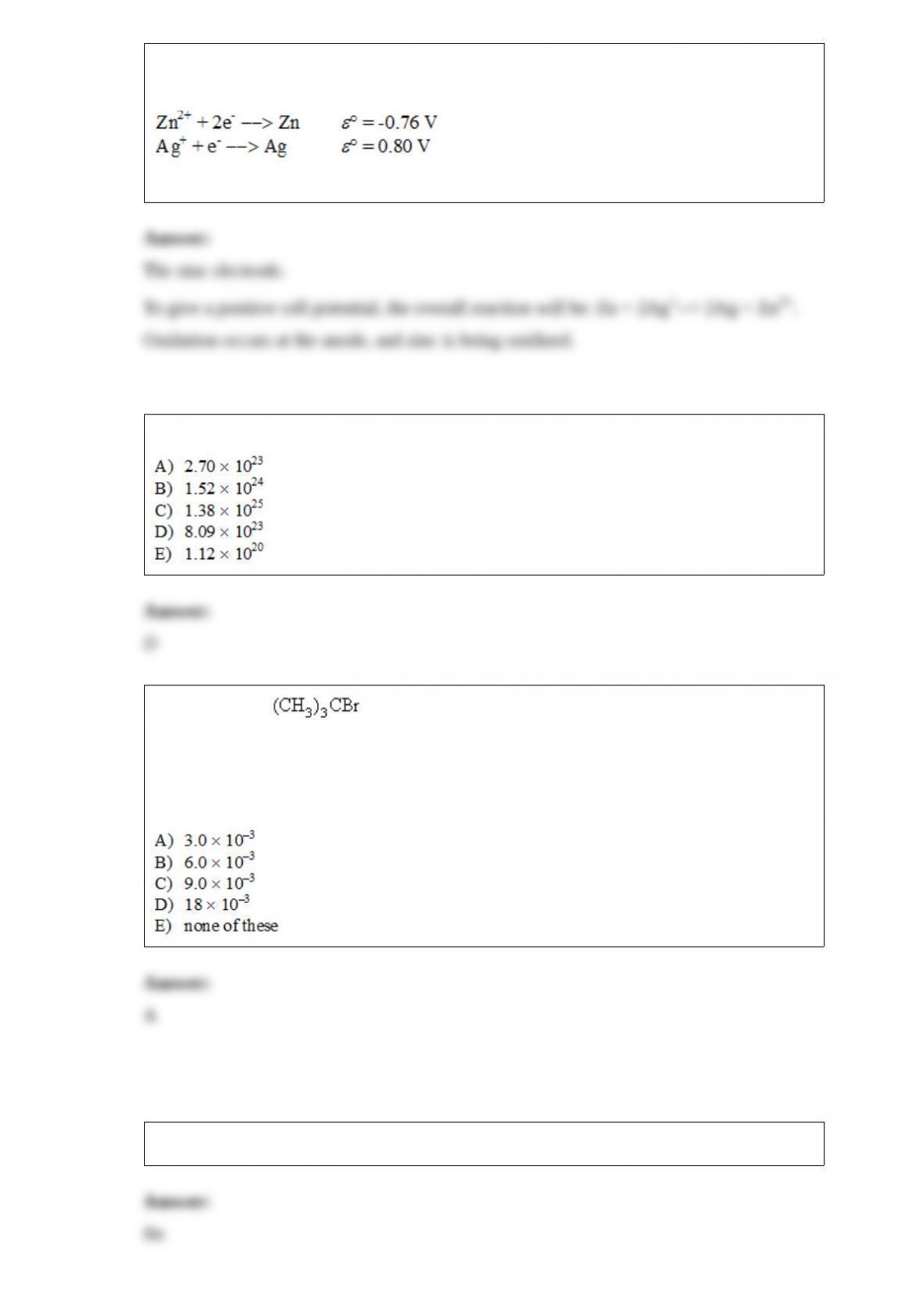
The DH value for the reaction is -90.8 kJ. How much
heat is released when 66.9g Hg is reacted with oxygen?
Consider a galvanic cell with a zinc electrode immersed in 1.0 M Zn2+and a silver
electrode immersed in 1.0 M Ag+.
Which of the electrodes is the anode?
How many atoms of hydrogen are present in 7.63g of ammonia?
The reaction of with hydroxide ion proceeds with the formation of .
The following data were obtained at 550C.
What will the initial rate (in mol/L·s) be in Experiment 4?
Larger first ionization energy, Li or Be