
Use the following information to answer the question(s) below.
Nudibranchs, a type of predatory sea slug, can have various protuberances (that is,
extensions) on their dorsal surfaces. Rhinophores are paired structures, located close to
the head, which bear many chemoreceptors. Dorsal plummules, usually located
posteriorly, perform respiratory gas exchange. Cerata usually cover much of the dorsal
surface and contain nematocysts at their tips.
If nudibranch rhinophores are located at the anterior ends of these sea slugs, then they
contribute to the sea slugs’ _____.
A) segmentation
B) lack of torsion
C) cephalization
D) identity as lophotrochozoans
Which of the following statements about epitopes are correct?
I) B-cell receptors bind to epitopes.
II) T-cell receptors bind to epitopes.
III) There can be 10 or more different epitopes on each antigen.
IV) There is a one-to-one correspondence between antigen and epitope.
A) only I and III
B) only II and IV
C) only I, II, and III
D) only II, III, and IV

In humans, the transport epithelial cells in the ascending loop of Henle _____.
A) are the largest epithelial cells in the body
B) are not in contact with interstitial fluid
C) have plasma membranes of low permeability to water
D) are not affected by high levels of nitrogenous wastes
When an arborist prunes a limb off a valuable tree, he or she may paint the cut surface.
The primary purpose of the paint is to_____.
A) minimize water loss by evaporation from the cut surface
B) improve the appearance of the cut surface
C) stimulate growth of the cork cambium to “heal” the wound
D) block entry of pathogens through the wound

As the size of some animals has evolved to greater sizes, the effectiveness of their
adaptations that promote exchanges with the environment have also increased. For
example, in many larger organisms, evolution has favored lungs and a digestive tract
with _____.
A) more branching or folds
B) increased thickness
C) larger cells
D) decreased blood supply
Materials are returned to the blood from the filtrate by which of the following
processes?
A) filtration
B) selective reabsorption
C) secretion
D) excretion
Canada thistle is a dicot that spreads via growth from lateral roots. You want to use a
root miner insect for weed control. What would you need to observe in the underground
growth to verify that this weed spreads via lateral roots and not by underground stems?

A) an epidermis at the periphery
B) vascular bundles in a ring around the outside of a cross section
C) a vascular bundle in the center surrounded by parenchyma tissue
D) meristematic tissue at the tips of the branches
Plasmodesmata can change in number, and when dilated can provide a passageway for
_____.
A) macromolecules such as ribonucleic acid (RNA) and proteins
B) ribosomes
C) chloroplasts
D) mitochondria
What is the maximum number of hydrogen atoms that can be covalently bonded in a
molecule containing two carbon atoms?
A) 2
B) 4

C) 6
D) 8
Among human males, both semen and urine normally travel along the _____.
A) vas deferens
B) seminal vesicle
C) urethra
D) ureter
Which of the following is the best explanation for why vegetable oil is a liquid at room
temperature while animal fats are solid?
A) Vegetable oil has more double bonds than animal fats.
B) Vegetable oil has fewer double bonds than animal fats.
C) Animal fats have no amphipathic character.
D) Vegetable oil has longer fatty-acid tails than animal fats have.

Reinforced, threadlike pseudopods that can perform phagocytosis are generally
characteristic of _____.
A) forams
B) water molds
C) dinoflagellates
D) oomycetes
Which principle of heat exchange is the most important explanation for why birds look
larger in colder weather because they fluff their feathers?
A) Fluffing feathers results in less cooling by radiation because feathers emit less
infrared radiation than other tissues do.
B) Fluffing decreases the amount of heat lost by conduction when the bird makes
contact with cold objects in its environment.
C) Fluffing creates a pocket of air near the bird that acts as insulation.
D) Fluffing decreases the surface-area-to-volume ratio, thus decreasing the amount of
heat lost to the environment.

Use the following information to answer the questions below.
Theodor W. Engelmann illuminated a filament of algae with light that passed through a
prism, thus exposing different segments of algae to different wavelengths of light. He
added aerobic bacteria and then noted in which areas the bacteria congregated. He
noted that the largest groups were found in the areas illuminated by the red and blue
light.
What did Engelmann conclude about the congregation of bacteria in the red and blue
areas?
A) Bacteria congregated in these areas due to an increase in the temperature of the red
and blue light.
B) Bacteria congregated in these areas because these areas had the most oxygen being
released.
C) Bacteria are attracted to red and blue light and thus these wavelengths are more
reactive than other wavelengths.
D) Bacteria congregated in these areas due to an increase in the temperature caused by
an increase in photosynthesis.
You are a physician, and you are seeing a patient who complains of abnormal fatigue
during exercise. You find that the immediate problem is a buildup of carbon dioxide in
the tissues. What is the most likely cause?
A) abnormally shaped platelets
B) abnormal carbonic anhydrase
C) abnormal hemoglobin

D) not enough hemoglobin
The main goal of sustainable development is to _____.
A) involve more countries in conservation efforts
B) use only natural resources in the construction of new buildings
C) use natural resources such that they do not decline over time
D) reevaluating and re-implementing management plans over time
One important difference between the anatomy of roots and the anatomy of leaves is
that _____.
A) only leaves have phloem and only roots have xylem
B) root cells have cell walls and leaf cells do not
C) a waxy cuticle covers leaves but is absent from roots
D) vascular tissue is found in roots but is absent from leaves
E) leaves have epidermal tissue but roots do not
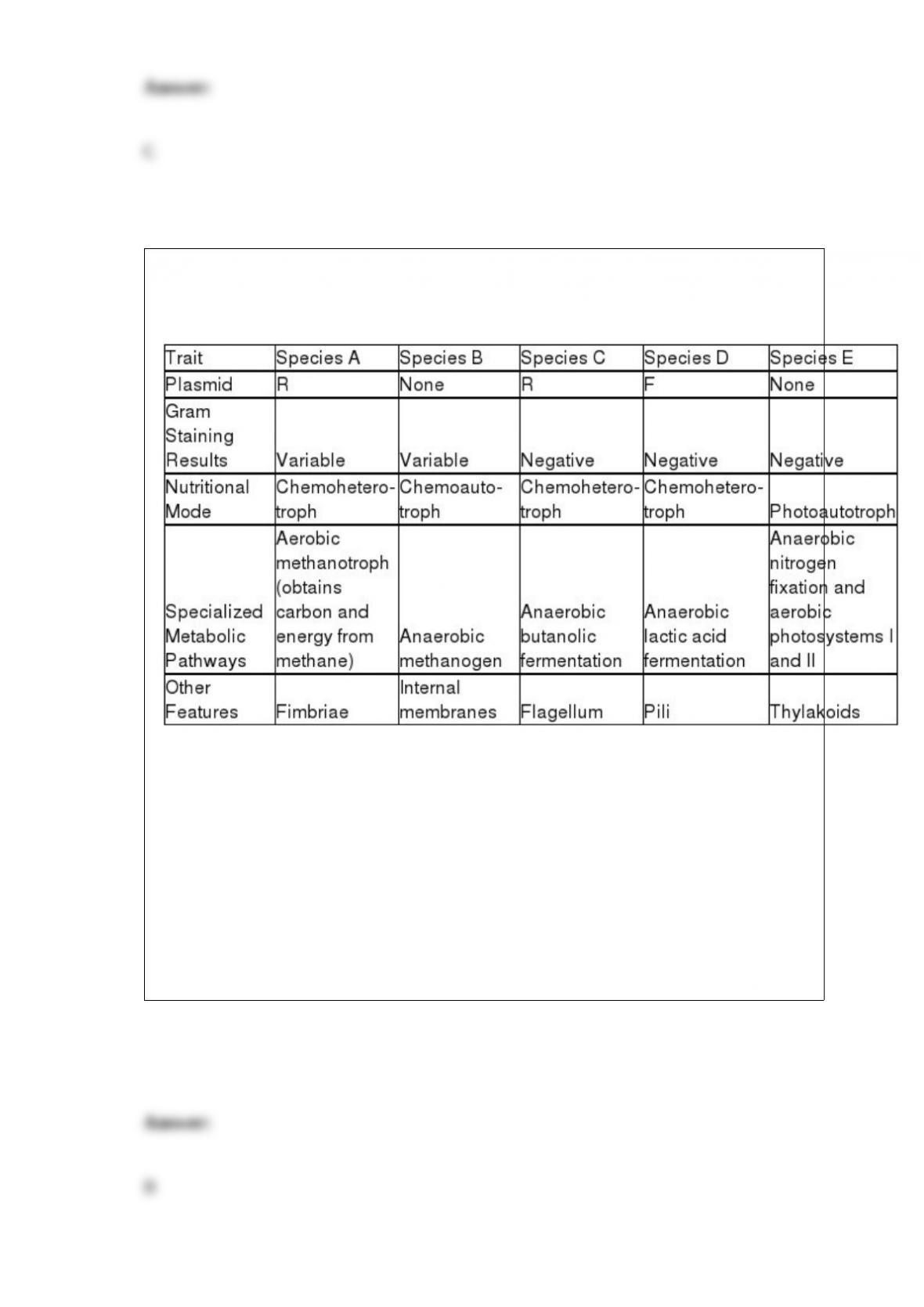
The following table depicts characteristics of five prokaryotic species (A-E). Use the
information in the table to answer the question(s) below
Which species is most likely to be found in sewage treatment plants and in the guts of
cattle?
A) species A
B) species B
C) species C
D) species D

Approximately how many kilograms (kg) of carnivore (secondary consumer) biomass
can be supported by a field plot containing 1000 kg of plant material?
A) 1000
B) 100
C) 10
D) 1
Cells that are infected, damaged, or have reached the end of their functional life span
often undergo “programmed cell death.” This controlled cell suicide is called apoptosis.
Select the appropriate description of this event on a cell’s life cycle.
A) Apoptosis is regulated by cell surface receptors that signal when a cell has reached
its density-dependent limits.
B) During apoptosis, dying cells leak out their contents including digestive enzymes
that also destroy healthy cells.
C) During apoptosis, cellular agents chop up the DNA and fragment the organelles and
other cytoplasmic components of a cell.
D) Each cell organelle has protein signals that initiate the breakdown of the organelle’s
components which leads to cell death.

Which structure is NOT part of the endomembrane system?
A) nuclear envelope
B) chloroplast
C) Golgi apparatus
D) plasma membrane
An endoskeleton is the primary body support for the _____.
A) annelids, including earthworms
B) insects, including beetles
C) cartilaginous fishes, including sharks
D) bivalves, including clams
Why does total biomass (graph e in the figure above) not vary with AMF diversity?
A) Plant growth is unaffected by fungal diversity.
B) Most of the plants in this system do not form mycorrhizal associations.
C) Bromus erectus is the dominant plant species.
D) Lotus corniculatus is a rare species.
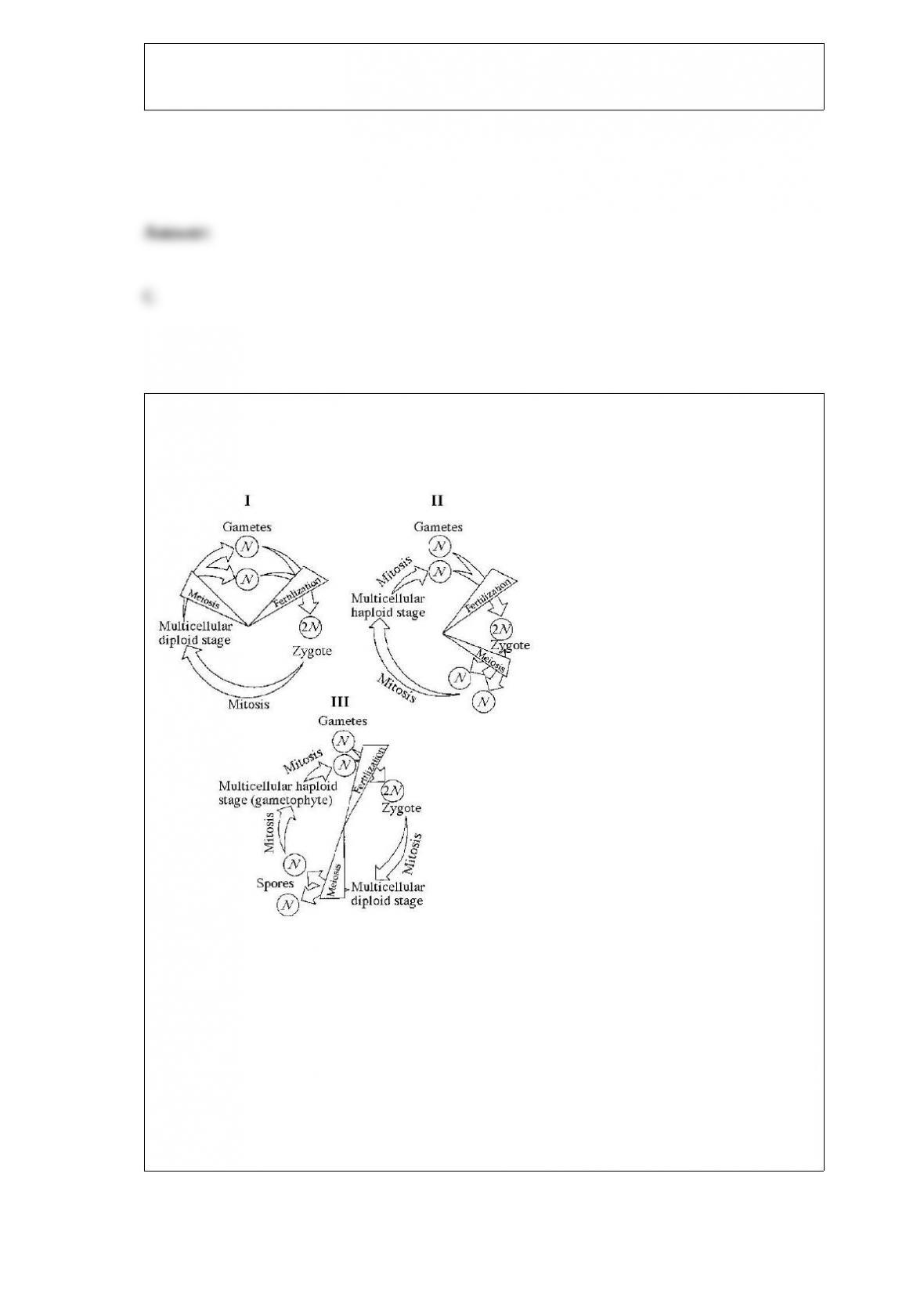
Refer to the life cycles illustrated in the figure below to answer the following
question(s).
Which of the life cycles is typical for plants and some algae?
A) I only
B) II only
C) III only
D) I and III

Which of the following can be used to determine a twig’s age?
A) Number of apical bud scar rings
B) Number of leaf scars
C) Number and arrangement of axillary buds
D) Length of internodes
A small number of birds arrive on an island from a neighboring larger island. This small
population begins to adapt to the new food plants available on the island, and their
beaks begin to change. About twice a year, one or two more birds from the neighboring
island arrive. These new arrivals _____.
A) speed up the process of speciation
B) tend to promote adaptation to the new food plants
C) tend to retard adaptation to the new food plants
D) represent a colonizing event

The genetic code is essentially the same for all organisms. From this, one can logically
assume which of the following?
A) A gene from an organism can theoretically be expressed by any other organism.
B) DNA was the first genetic material.
C) The same codons in different organisms translate into different amino acids.
D) Different organisms have different types of amino acids.
In general, a signal transmitted via phosphorylation of a series of proteins _____.
A) results in a conformational change to each protein
B) requires binding of a hormone to an intracellular receptor
C) activates a transcription event
D) generates ATP in the process of signal transduction
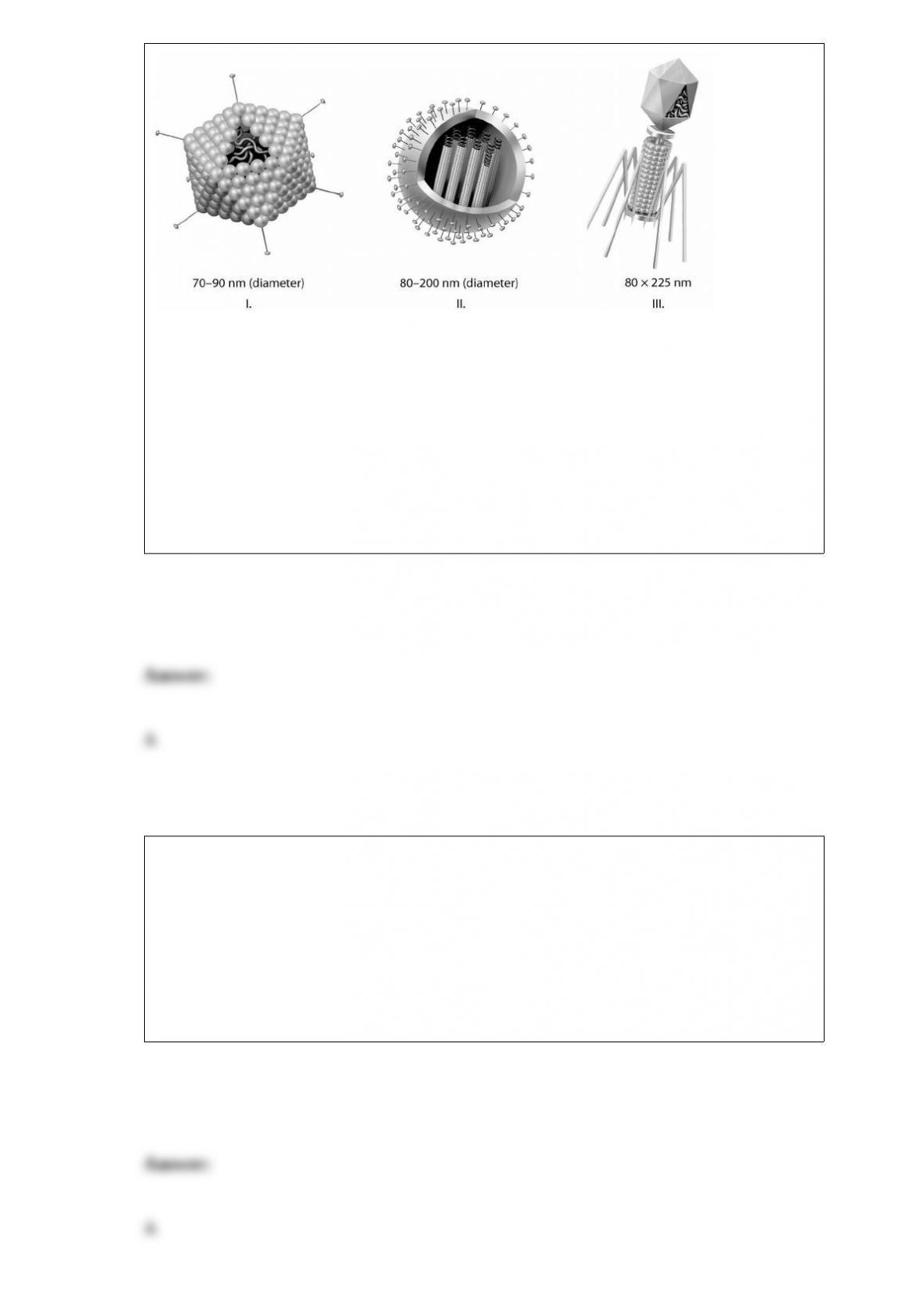
Which of the following supports the argument that viruses are nonliving?
A) They are not cellular.
B) Their DNA does not encode proteins.
C) They have RNA rather than DNA.
D) They do not evolve.
Asexual reproduction results in offspring that are genetically identical to their parent.
What type of cell process occurs to generate this type of offspring?
A) mitosis
B) meiosis
C) cell fusion

Generalized global air circulation and precipitation patterns are caused by _____.
A) rising, warm, moist air masses that cool and release precipitation as they rise and
then, at high altitude, cool and sink back to the surface as dry air masses after moving
north or south of the tropics
B) air masses that are dried and heated over continental areas that rise, cool aloft, and
descend over oceanic areas followed by a return flow of moist air from ocean to land,
delivering high amounts of precipitation to coastal areas
C) polar, cool, moist high-pressure air masses from the poles that move along the
surface, releasing precipitation along the way to the equator, where they are heated and
dried
D) the revolution of Earth around the sun