
Menstruation
A) is triggered by an LH surge.
B) is triggered by HCG.
C) is triggered by an increase in the levels of estrogen and progesterone.
D) coincides with the beginning of the pre-ovulatory phase of the ovarian cycle.
NADH is also used by cells when making certain molecules. Based on your knowledge
of NADH’s role in cellular respiration, what do you think NADH’s role is in
biosynthesis of molecules?
A) oxidizing molecules
B) reducing molecules
C) phosphorylating molecules
D) dehydrating molecules
Scientists are attempting to make a chicken look like a dinosaur (“dino-chicken”) by
using drugs or proteins to turn on certain homeotic genes during the development of a
chicken embryo. If the scientists are successful in creating both male and female
“dino-chickens,” and then the “dino-chickens” mate together, what type of offspring
would the two “dino-chickens” have?

A) a male or female “dino-chicken”
B) a male or female normal chicken
C) You can’t know for sure because of random fertilization.
D) You can’t know for sure because it depends on whether the modified homeotic genes
are dominant or recessive.
The autonomic nervous system
A) integrates sensory inputs to the brain.
B) carries signals to and from skeletal muscles.
C) regulates the internal environment of the body.
D) is part of the central nervous system.
The process of a white blood cell engulfing a bacterium is
A) osmosis.
B) receptor-mediated endocytosis.
C) pinocytosis.

D) phagocytosis.
Red maples and other wind-pollinated plants invest relatively little in producing
________ but must invest a great deal in producing ________ to achieve good
pollination rates.
A) floral scents; showy petals
B) showy or scented flowers; massive amounts of pollen
C) pollen; showy or scented flowers
D) seeds; massive amounts of pollen
What force is responsible for the cohesiveness of water?
A) osmosis
B) hydrogen bonding between water molecules
C) negative pressure created by evaporation
D) ionic bonding

A nucleic acid probe is
A) a virus that transfers DNA to a recipient cell.
B) a piece of radioactively labeled DNA that is used to locate a specific gene.
C) an enzyme that locates a specific restriction site on RNA.
D) a plasmid that recognizes a specific DNA sequence.
Multiple sclerosis results from an autoimmune disease that primarily involves
A) destruction of the hippocampus.
B) destruction of the myelin sheath.
C) destruction of regions of the motor cortex.
D) deterioration of parts of the spinal cord.

Structure in the living world is organized into hierarchical levels. Which of the
following correctly lists these from least inclusive to most inclusive?
A) cell, molecule, organ, organ system, tissue, organism
B) molecule, cell, tissue, organ, organ system, organism
C) molecule, cell, organ, organ system, tissue, organism
D) cell, molecule, tissue, organ, organ system, organism
During a summer study abroad program, you travelled to Austria to study genetics at
the University of Vienna. While you were there, a momentous discovery was made:
some of Gregor Mendel’s original lab books and notes were found to be buried outside
of the abbey where he lived. It just so happened that the professor you were working
with obtained copies of these notes and enlisted your help to decipher them.
You hired a translator to translate Mendel’s notes from Czech to English, and using your
knowledge of modern genetics (which Mendel did not have!) you were able to construct
a partial Punnett square (shown below). Because the notebook was damaged from being
buried for so long, this is the only information that you have regarding a cross that
Mendel must have performed. Your professor has tasked you with figuring out more
about this experiment.
In pea plants, round peas are dominant (R) and shriveled peas are recessive (r,) and
yellow peas (shown as light gray in Punnett square) are dominant (Y) and green peas
(dark gray) are recessive (y). Using this information and the partial Punnett square
above, what phenotype should be in the square labeled B?
A) round and yellow
B) shriveled and yellow
C) shriveled and green

D) round and green
Which of the following is a unique feature of echinoderms?
A) bilateral symmetry
B) a water vascular system
C) radial symmetry
D) a deuterostome pattern of development
When a bacterial cell with a chromosome-borne F factor conjugates with another
bacterium, how is the transmitted donor DNA incorporated into the recipient’s genome?
A) It is substituted for the equivalent portion of the recipient’s chromosome by the
process of crossing over.
B) It circularizes and becomes one of the recipient cell’s plasmids.
C) The genes on the donor DNA of which the recipient does not have a copy are added
to the recipient chromosome; the remainder of the donor DNA is degraded.
D) The donor and recipient DNA are both chopped into segments by restriction
enzymes, and a new, composite chromosome is assembled from the fragments.

Labored breathing, coughing, lung infections, and respiratory failure are characteristics
defining
A) asthma.
B) meningitis.
C) chronic obstructive pulmonary diseases.
D) myasthenia gravis.
What is the source of energy that provides the boost for electrons during
photosynthesis?
A) light
B) NADPH
C) cellular respiration
D) ATP

Gas exchange in most land plants occurs through structures called
A) stomata.
B) apical meristems.
C) vascular tissue.
D) cuticles.
Humans use the calories they obtain from ________ as their source of energy.
A) food
B) water
C) sunlight
D) minerals
As a result of glycolysis, there is a net gain of ________ ATP(s).
A) 0
B) 1
C) 2
D) 36
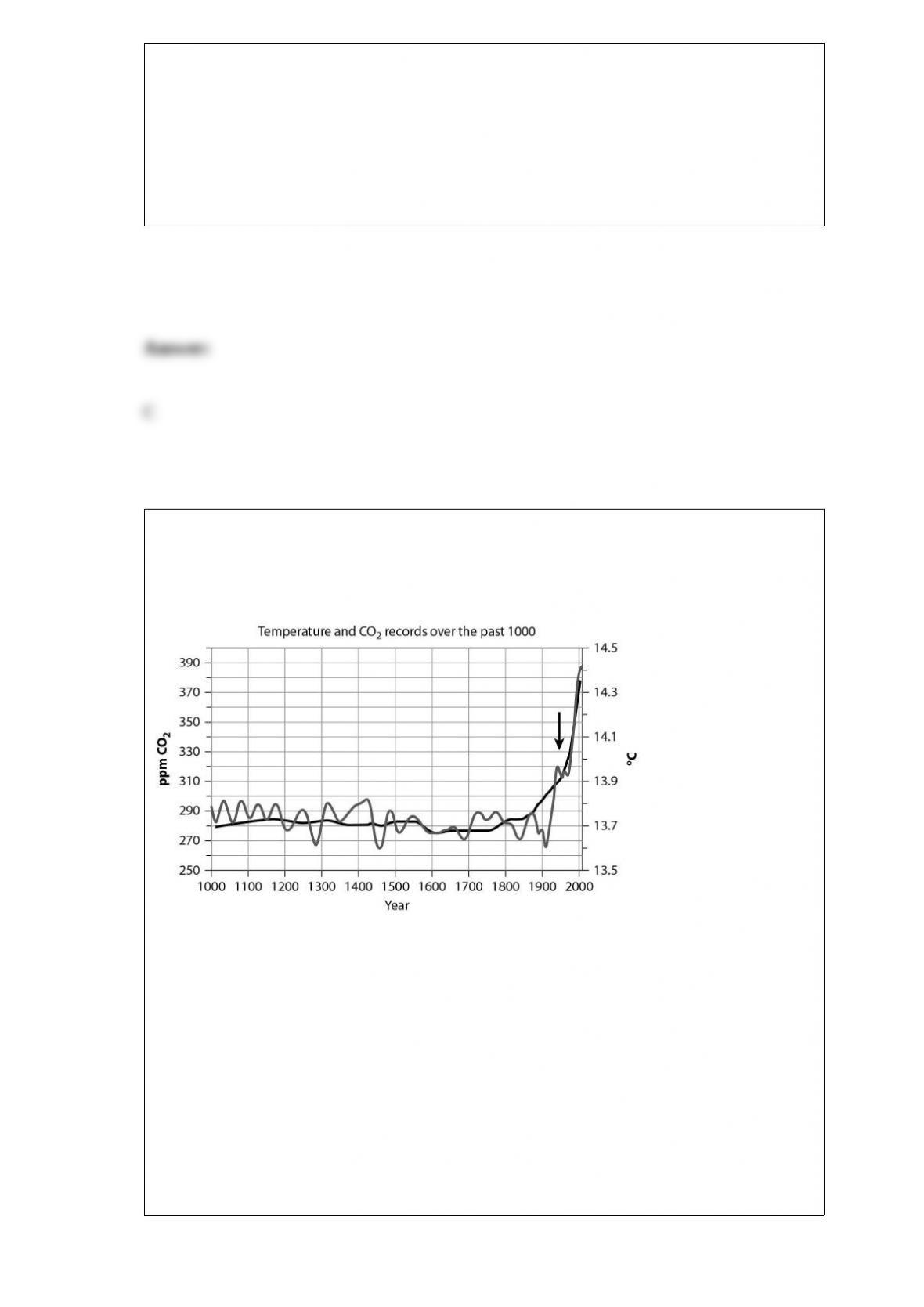
The graph below shows records of temperature (light gray line) and CO2 (dark gray
line) over the past 1,000 years. CO2 is recorded in parts per million (ppm).
If the trends shown in the graph continue, how might this affect photosynthesis?
A) Photorespiration may increase, leading to an increase in photosynthetic production
of sugar.
B) Photorespiration may increase, leading to a decrease in photosynthetic production of
sugar.
C) C4 and CAM plants would be unable to photosynthesize.
D) There would be no effect on photosynthesis, since CO2 and temperature are stable.

Parkinson’s disease is associated with a deficiency in
A) dopamine.
B) serotonin.
C) acetylcholine.
D) endorphins.
The last common ancestor of animals and fungi was probably ________, like the spores
of ________ fungi.
A) flagellated; chytrid
B) flagellated; mold
C) multicellular; chytrid
D) nonflagellated; yeast

In the logistic growth model, as population size increases, birth rates
A) remain constant and death rates increase.
B) decline but death rates remain steady.
C) and death rates increase.
D) decline and/or death rates increase.
Which of the following shows the greatest promise as a cancer chemotherapy agent?
A) a drug that interferes with cellular respiration
B) a drug that prevents mitotic spindle from forming
C) a drug that prevents crossing over
D) a drug that prevents tetrad formation
Which of the following lists the set of plant macronutrients that make up about 98% of
a plant’s dry weight?
A) carbon, oxygen, hydrogen, potassium, zinc, and copper
B) carbon, nitrogen, potassium, manganese, sulfur, and phosphorus

C) nitrogen, potassium, manganese, sulfur, copper, and phosphorus
D) carbon, oxygen, hydrogen, nitrogen, sulfur, and phosphorus
Which of the following organisms has a respiratory system that does not require
assistance from a circulatory system for gas exchange?
A) grasshopper
B) mouse
C) carp
D) crayfish
When you are breathing normally, exhalation results mainly from
A) the contraction of muscles in the chest.
B) the contraction of the diaphragm.
C) the relaxation of the chest muscles and diaphragm.
D) low pressure in the lungs.

You prepare a genomic library and use this as a source to produce recombinant proteins
in E. coli. However, after producing the proteins you find that they are all too long or
too short. In fact, you don’t find a single protein that is the correct size. What is the best
explanation for this result?
A) Since a genomic library was used as the source of the genes, the introns were
included during transcription and translation.
B) Since bacteria were used to produce the proteins, sugar groups were not properly
added on to the proteins that were being made.
C) Since a genomic library was used as the source, the recombinant bacterial plasmid
DNA was likely incorporated into the proteins being made.
D) Since bacteria were used to produce the proteins, the native bacterial plasmid DNA
was likely incorporated into the proteins being made.
The tendency of water molecules to stick together is referred to as
A) adhesion.
B) polarity.
C) cohesion.
D) transpiration.

The Salalizard is a fictional vertebrate that lives in the forest and appears to be half
salamander and half lizard. You are not allowed to collect any wild animals, so you
decide to take a video of it to show your colleagues. What behavior best distinguishes
the Salalizard as either a salamander (amphibian) or a lizard (reptile)?
A) what the animal eats
B) if it lives in trees
C) where it reproduces
D) whether it is active at night
Which of the following enzymes does HIV use to synthesize DNA on an RNA
template?
A) ligase
B) RNA polymerase
C) reverse transcriptase
D) DNA convertase

A colorblind woman marries a man who is not colorblind. All of their sons, but none of
their daughters, are colorblind. Which of the following statements correctly explains
these results?
A) The gene for color vision is incompletely dominant to the gene for sex
determination.
B) The gene for color vision is codominant with the gene for sex determination.
C) The gene for color vision is found on the X chromosome.
D) The gene for color vision is found on the Y chromosome.
Speciation often occurs when a habitat becomes more heterogeneous. In Lake Victoria
different species of cichlids are found in different areas of the lake. The best
explanation for this speciation is that
A) natural selection favored different heritable variations in different parts of the lake.
B) male cichlids that lived in deep water needed to be seen by females, so they became
colorful.
C) food was scarce in the lake, so some fish had to learn how to scrape algae, some had
to learn to eat insects, and some had to learn to bite leaves.
D) humans selected for many different traits in cichlids in order to market them to the
aquarium trade.

Unlike sharks and rays, ray-finned fishes have
A) an operculum.
B) a lateral line system.
C) a flexible skeleton made of cartilage.
D) hinged jaws.
When genetic variation in one nucleotide is found in at least 1% of the population, it is
known as a
A) single nucleotide polymorphism.
B) short tandem repeat.
C) recombinant DNA molecule.
D) genomic library.
The increase in girth associated with production of wood and bark in trees occurs as a
consequence of
A) primary growth.

B) secondary growth.
C) growth in apical meristems.
D) indeterminate growth.