
Human social behavior appears to be
A) exclusively a product of our genes.
B) determined by the environment.
C) a product of our genes, external influences, and environment.
D) unrelated to genetics.
Guppies from Trinidad form two distinct populations that differ in several life history
traits. These traits appear to relate to the local predator populations, pike-cichlids or
killifish. Which of the following experiments would best test the heritability of these
traits?
A) Raise both populations with cichlids to see if the population of smaller,
faster-maturing guppies reproduces more quickly.
B) Raise both populations without predators to see if they maintain their life history
traits.
C) Introduce cichlids into a habitat with killifish.
D) Provide additional food to the guppies from cichlid habitats to see if they will grow
to the same size as guppies from the killifish habitat.
A cell is initially diploid, but it has a unique cell cycle in that this cell goes through two

S phases instead of one. What would the remainder of its cell cycle consist of if this cell
is to produce four identical diploid daughter cells at the end of its cell cycle?
A) two rounds of mitosis and one round of cytokinesis
B) one round of mitosis and one round of cytokinesis
C) one round of mitosis and two rounds of cytokinesis
D) two rounds of mitosis and two rounds of cytokinesis
If you expose a photosynthesizing plant to water that contains both radioactive H and
radioactive O, in which of the products of photosynthesis will the radioactive H and O
show up?
A) H and O both in glucose
B) H in glucose; O in water
C) H in water; O in glucose
D) H in glucose and water; O in O2
Which structure is found in angiosperms but not gymnosperms?
A) fruit

B) spores
C) seeds
D) ovule
What is the current standard tool used for DNA profiling by forensic scientists?
A) STR analysis
B) gene cloning
C) genetic engineering
D) RFLP analysis
A main force that moves water through a plant is
A) transpiration.
B) photosynthesis.
C) pressure flow.
D) adhesion.

Which of the following statements about water is false?
A) Ice is more dense than liquid water.
B) Water naturally exists in all three physical states on Earth.
C) Floating ice on a pond insulates the liquid water below, slowing its rate of freezing.
D) If ice sank, the oceans would eventually freeze solid.
Scientists have studied the effects of television watching on the metabolic rate of
children and its potential implications for childhood obesity. In a study of 15 obese
children and 16 normal weight children, it was found that the metabolic rate of all
children significantly decreased while watching television compared to their metabolic
rate when they were at normal rest. The drop was greater for obese children, but the
difference in drops between the two groups of children was not statistically significant.
What is a reasonable conclusion to draw from this study?
A) Television watching does not affect childhood obesity.
B) Television watching is an activity that should be carefully considered when studying
factors that may affect adult obesity.
C) Television watching contributes more to childhood obesity than the
overconsumption of sugary foods.
D) Television watching is an activity that should be carefully considered when studying
factors that may affect childhood obesity.

After reading the paragraph below, answer the questions that follow.
The first fossil of Archaeopteryx, which lived about 150 million years ago, was found in
the Solnhofen Quarry in Germany. Archaeopteryx has an interesting collection of
characters that led to the hypothesis that it represented an evolutionary transition
between modern-day birds and small bipedal dinosaurs. The fossil reveals the imprint
of feathers, which connect Archaeopteryx to birds, although they do not present direct
evidence of flight. Unlike birds, however, Archaeopteryx was shown by the fossil
record to have had teeth, functional claws on the wings that may have been used for
climbing trees or holding prey, and a long, bony tail. Birds have a fused collarbone,
which was found in Archaeopteryx as well. However, the structure of the sternum
differed between the two. In birds, the sternum is keeled (raised and slightly concave);
the keel of the sternum serves as an attachment site for the flight muscles.
Archaeopteryx had a flat sternum, similar to that found in reptiles.
The feathers of Archaeopteryx may have been used for flight. However, it is likely that
they were originally used for
A) insulation.
B) protection from predators.
C) nest building.
D) protection from parasites.
Which of the following is a function of tracheids?
A) food storage

B) photosynthesis
C) production of sex cells
D) water conduction
To conserve precious salts, freshwater fish
A) produce small amounts of urine and exert as little energy as possible.
B) drink almost no water and produce large amounts of dilute urine.
C) excrete salt ions and small amounts urine
D) eliminate water by osmosis and swim in short, small bursts of energy.
Which of the following options lists major events in the history of life on Earth in the
proper order, from earliest to most recent?
A) first prokaryotes, photosynthesis, colonization of land by plants and fungi, first
eukaryotes
B) first eukaryotes, photosynthesis, colonization of land by plants and fungi, first
prokaryotes
C) first prokaryotes, first eukaryotes, photosynthesis, colonization of land by plants and

fungi
D) first prokaryotes, photosynthesis, first eukaryotes, colonization of land by plants and
fungi
Which of the following environments is thought to have promoted the dehydration
synthesis of polypeptides and other macromolecules from smaller organic monomers on
a prebiotic Earth?
A) freshwater swamps and marshes
B) deep-sea hydrothermal vents
C) hot sand, clay, or rock along the seashore
D) sediments at the bottom of the world’s oceans
The ultimate source of all the food we eat and the oxygen we breathe is
A) cellular respiration.
B) photosynthesis.
C) glycolysis.
D) anaerobic metabolism.
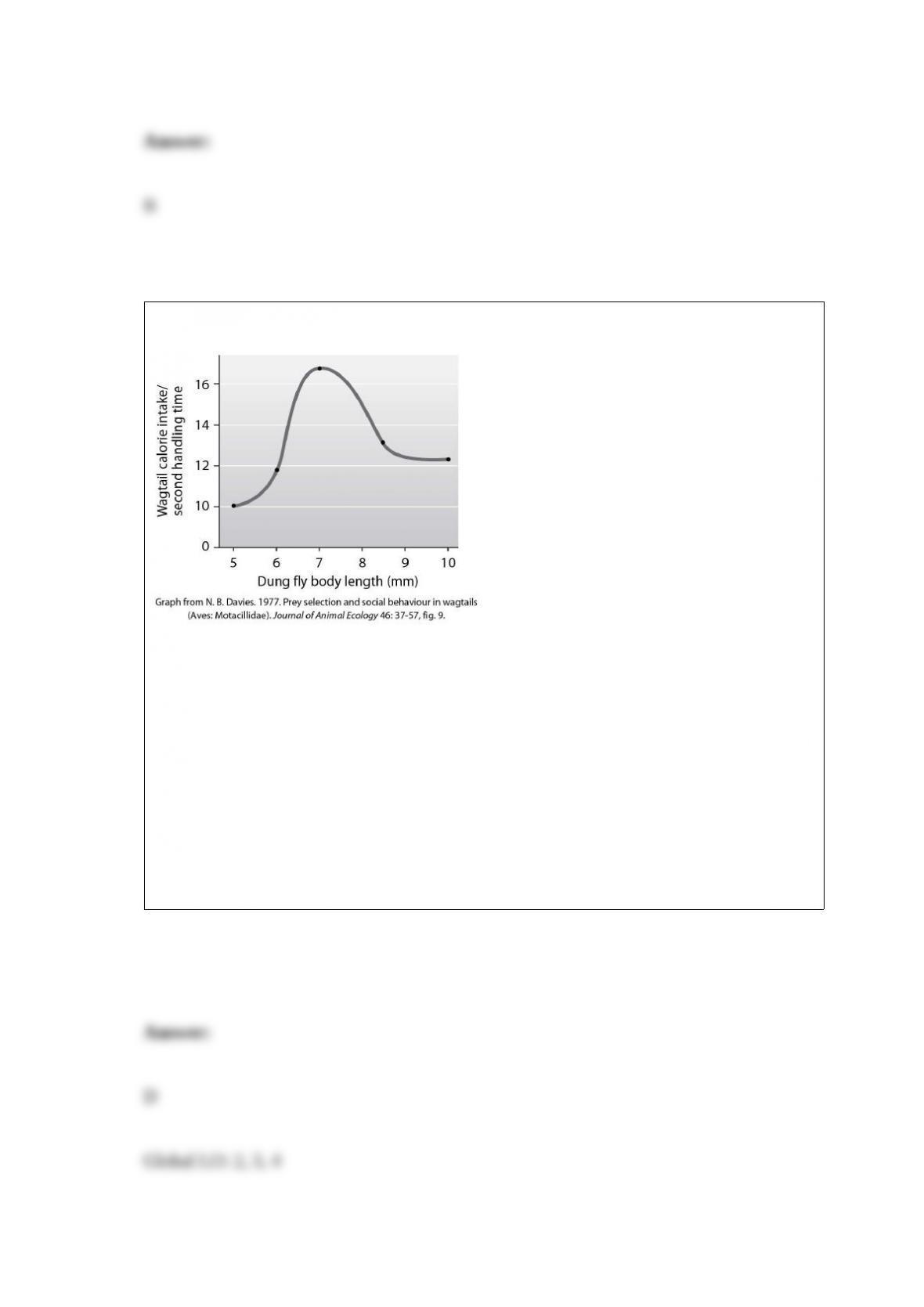
Which of the following conclusions is supported by this graph?
A) Prey size does not affect the number of calories gained per second of handling time
by wagtails.
B) Wagtails get more calories per second of handling time with larger flies than with
smaller ones.
C) Wagtails get more calories per second of handling time with smaller flies than with
larger ones.
D) Wagtails get more calories per second of handling time with 7-mm flies than with
either larger or smaller ones.

Looking into your microscope, you spot an unusual cell. Instead of the typical rounded
cell shape, the cell has a very narrow middle separating two bulging ends. It sort of
looks like the number 8! You realize that this cell is
A) undergoing cytokinesis.
B) in the S phase of interphase.
C) in the G1 phase of interphase.
D) about to undergo mitosis.
Which of the following statements about the phosphorus cycle is false?
A) The main abiotic reservoir for phosphorus is in the soil.
B) Plants release dissolved phosphate ions into the soil.
C) Phosphates that drain from soils into the sea becomes part of new rock and will
cycle back into living organisms.
D) Guano can be used by farmers to add phosphorus to the soil.
A growth-producing region of cell division, known as a/an ________, is found near the
tips of stems and roots.
A) sporangium

B) cuticle
C) apical meristem
D) lignin
You are adrift in the Atlantic Ocean and, being thirsty, drink the surrounding seawater.
As a result,
A) you quench your thirst.
B) your cells become turgid.
C) you dehydrate yourself.
D) your cells lyse from excessive water intake.
A racehorse cannot stand on one leg, but when it runs it rarely has more than one leg on
the ground. Why is a running horse more stable than a standing one?
A) Its legs tilt so the hooves fall in line with its center of gravity.
B) Its momentum gives it stability.
C) Its internal organs act like a gyroscope.

D) It uses its neck for balance the way a tightrope walker uses a pole.
For speciation to occur there must be
A) sexual reproduction.
B) genetic variation.
C) isolation.
D) natural selection.
Which of the following statements about locomotion is true?
A) Locomotion requires animals to overcome friction and gravity.
B) Gravity is a greater locomotion problem for animals in water than for those on land.
C) Overcoming friction is a greater locomotion problem for land animals than for those
that live in water.
D) Bone strength is more important than body shape in the locomotion of land animals.

Which of the following statements regarding the urinary system is true?
A) Bowman’s capsule envelops the glomerulus.
B) Most glomeruli are located in the renal medulla.
C) The urinary bladder receives ammonia for excretion.
D) The urethra is responsible for transporting urea from the kidney to the urinary
bladder.
Shoot branching is controlled mainly by the interaction of
A) auxins and gibberellins.
B) auxins and cytokinins.
C) gibberellins and cytokinins.
D) cytokinins and abscisic acid.

In plants, the vascular tissue that consists of living cells that distribute sugars
throughout the plant is called
A) xylem.
B) phloem.
C) conducting tissue.
D) meristem.
Which of the following plant cells or tissues help regulate the movement of carbon
dioxide into and out of a leaf?
A) guard cells
B) root hairs
C) sieve tubes
D) xylem
Relaying a message from a membrane receptor to a molecule that performs a specific
function within a cell occurs when
A) a signaling molecule binds to a protein that extends to the outside of the cell.

B) a protein receptor on the interior of the membrane become bounds by a signaling
molecule.
C) the extracellular matrix is moved to the inside of the cell.
D) glycoproteins are recognized by other cells.
Many species of which protist group have modified mitochondria that lack functional
electron transport chains?
A) excavates
B) rhizarians
C) ciliates
D) unikonts
Evolutionary adaptations for survival on land produced tetrapods, which later evolved
into
A) only amphibians.
B) amphibians, reptiles, and mammals.
C) only reptiles.

D) only birds.
If these four cells resulted from cell division of a single cell with diploid chromosome
number 2n = 4, what best describes what just occurred?
A) normal meiosis
B) translocation
C) inversion
D) nondisjunction