
Which molecule shown above can function as a base?
A) A
B) B
C) C
D) D
Which of the following is a true statement about asexual reproduction in plants?
A) Clones of plants do not occur naturally.
B) Cloning, although achieved in animals, has not been demonstrated in plants.
C) Making cuttings of ornamental plants is a form of fragmentation.
D) Reproduction of plants by cloning may be either sexual or asexual.

Deuteromycetes _____.
A) represent the phylum in which all the fungal components of lichens are classified
B) are the group of fungi that have, at present, no known sexual stage
C) are the group that includes molds, yeasts, and lichens
D) include the imperfect fungi that lack hyphae
Use the following information to answer the question(s) below.
In onions (Allium), cells of the sporophyte have 16 chromosomes within each nucleus.
Match the number of chromosomes present in each of the following onion tissues.
How many chromosomes should be in a generative cell nucleus?
A) 8
B) 16
C) 24
D) 32

In a plant cell, DNA may be found _____.
A) only in the nucleus
B) only in the nucleus and chloroplasts
C) in the nucleus, mitochondria, and chloroplasts
D) in the nucleus, mitochondria, chloroplasts, and peroxisomes
What is the relationship between the wavelength of light and the quantity of energy per
photon?
A) They have a direct, linear relationship.
B) They are inversely related.
C) They are logarithmically related.
D) They are separate phenomena.
Bottlenose dolphins breathe air but can sleep in the ocean because _____.
A) they sleep for only thirty minutes at a time, which is the maximum interval they can
cease breathing
B) they fill their swim bladder with air to keep their blowholes above the surface of the

water while they sleep
C) they move to shallow water to sleep, so they do not need to swim to keep their
blowholes above the surface of the water
D) they alternate which half of their brain is asleep and which half is awake
Clonal selection and differentiation of B cells activated by antigen exposure leads to the
production of _____.
A) large quantities of the antigen initially recognized
B) vast numbers of B cells with random antigen-recognition receptors
C) long-lived erythrocytes that can later secrete antibodies for the antigen
D) short-lived plasma cells that secrete antibodies for the antigen
In glycolysis, for each molecule of glucose oxidized to pyruvate _____.
A) two molecules of ATP are used and two molecules of ATP are produced.
B) two molecules of ATP are used and four molecules of ATP are produced.
C) four molecules of ATP are used and two molecules of ATP are produced.
D) two molecules of ATP are used and six molecules of ATP are produced.
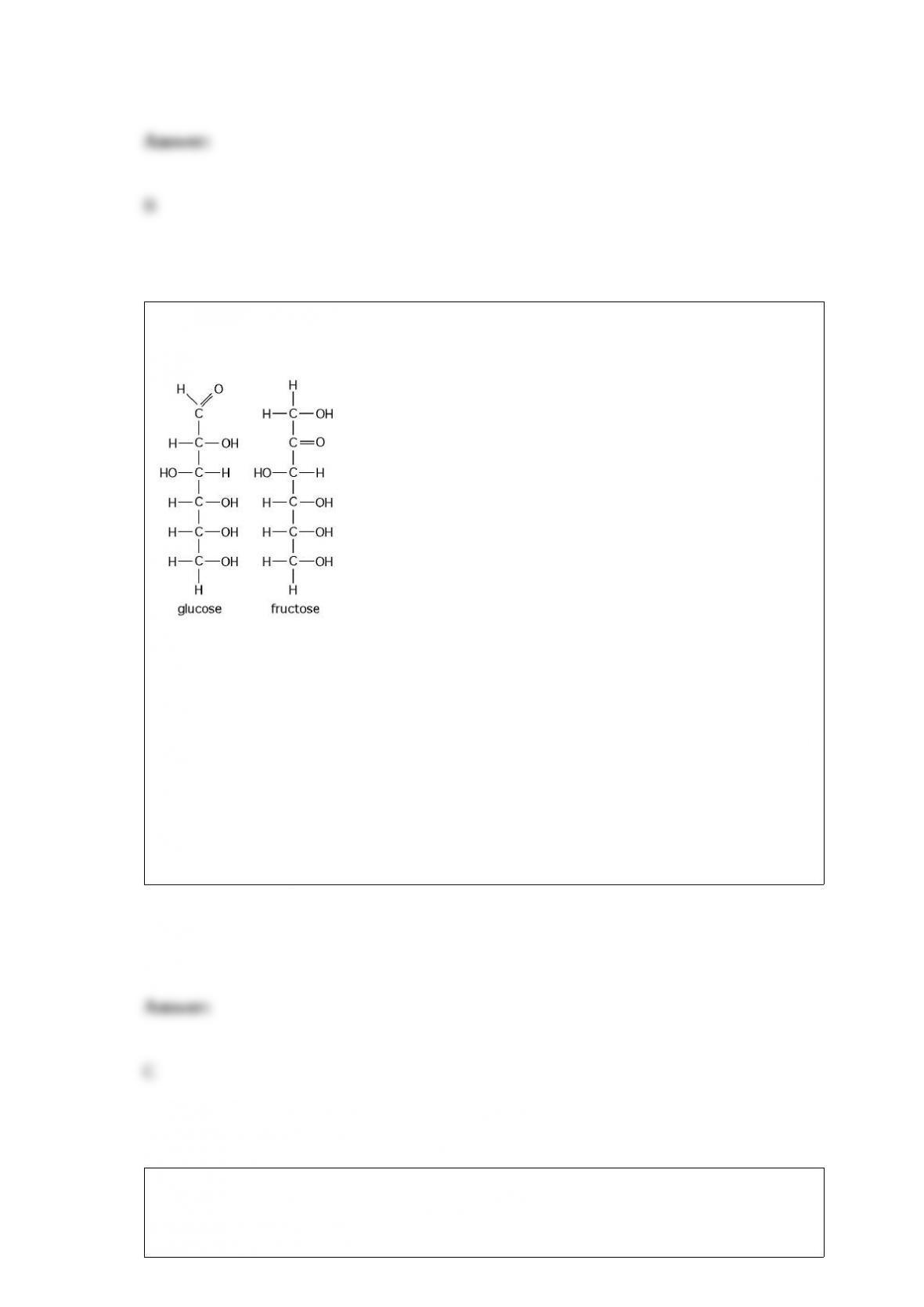
The figure above shows the structures of glucose and fructose. These two molecules
differ in the _____.
A) number of carbon, hydrogen, and oxygen atoms
B) types of carbon, hydrogen, and oxygen atoms
C) arrangement of carbon, hydrogen, and oxygen atoms
D) number of oxygen atoms joined to carbon atoms by double covalent bonds
Which of the following statements about quorum sensing is FALSE? Quorum sensing
_____.
A) is cell-cell communication in eukaryotes
B) is species specific
C) may result in biofilm formation
D) is particularly well studied because of its medical importance
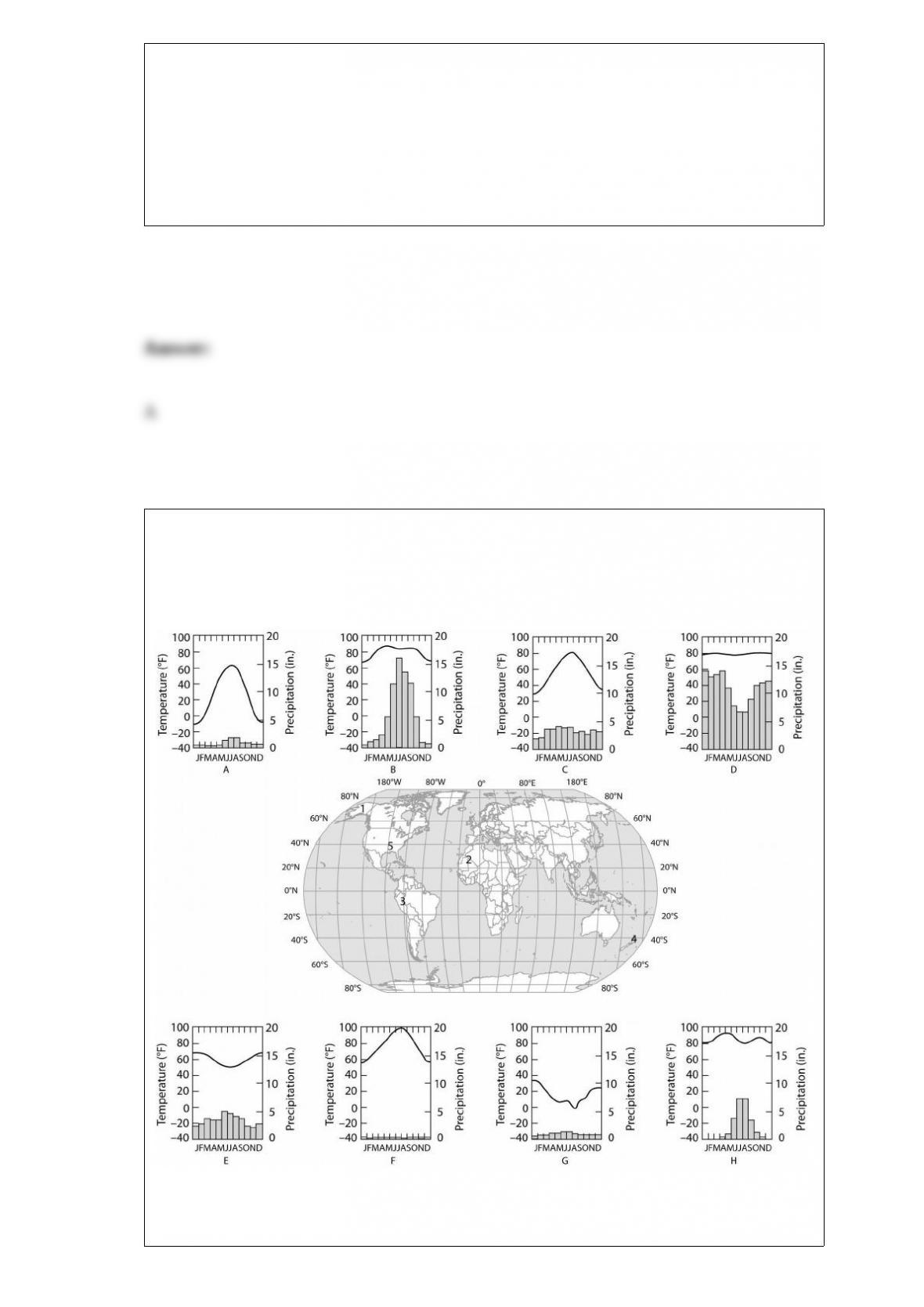
The eight climographs below show yearly temperature (line graph and left vertical axis)
and precipitation (bar graph and right vertical axis) averages for each month for some
locations on Earth.
Which climograph shows the climate for location 5?

A) A
B) C
C) D
D) H
Bacterial cells protect their own DNA from restriction enzymes (endonucleases) by
_____.
A) adding methyl groups to adenines and cytosines
B) using DNA ligase to seal the bacterial DNA into a closed circle
C) adding histones to protect the double-stranded DNA
D) forming ‘sticky ends” of bacterial DNA to prevent the enzyme (endonuclease) from
attaching
Which of the following is true of embryonic stem cells but not of adult stem cells?
A) They normally differentiate into only eggs and sperm.
B) They can give rise to all cell types in the organism.
C) They can continue to reproduce for an indefinite period.
D) One aim of using them is to provide cells for repair of diseased tissue.
What is the primary function of the Calvin cycle?
A) use NADPH to release carbon dioxide
B) split water and release oxygen
C) transport RuBP out of the chloroplast
D) synthesize simple sugars from carbon dioxide
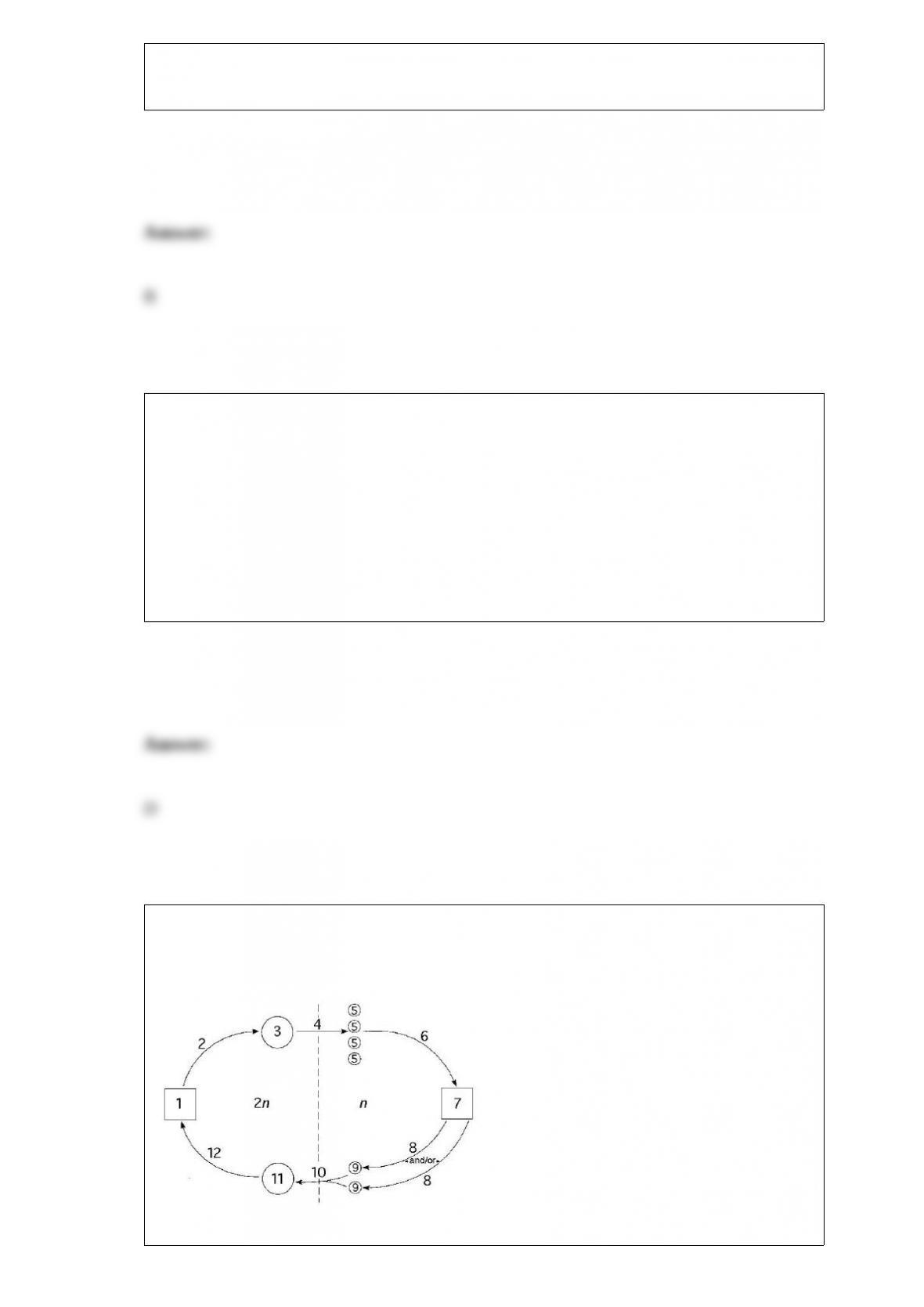
The following questions refer to the generalized life cycle for land plants shown in the
figure below. Each number within a circle or square represents a specific plant or plant
part, and each number over an arrow represents either meiosis, mitosis, or fertilization.

In the figure above, the process labeled “6” involves _____.
A) mitosis
B) meiosis
C) fertilization
D) binary fission
When a plant cell, such as one from a rose stem, is submerged in a very hypotonic
solution, what is likely to occur?
A) The cell will burst.
B) Plasmolysis will shrink the interior.
C) The cell will become flaccid.
D) The cell will become turgid.
Transcription in eukaryotes requires which of the following in addition to RNA
polymerase?
A) start and stop codons
B) ribosomes and tRNA

C) several transcription factors
D) aminoacyl-tRNA synthetase
Rank, from low to high, the pH of blood, stomach acid, and urine.
A) blood, urine, and stomach acid
B) stomach acid, blood, and urine
C) urine, blood, stomach acid
D) stomach acid, urine, blood
An obstetrician knows that one of her patients is a pregnant woman whose fetus is at
risk for a serious disorder that is detectable biochemically in fetal cells. The obstetrician
would most reasonably offer which of the following procedures to her patient?
A) karyotyping of the woman’s somatic cells
B) X-ray
C) amniocentesis or CVS
D) blood transfusion

Quaking aspen can send out underground stems for asexual reproduction. Sexual
reproduction is not as common, but when it does happen, the haploid gametes have 19
chromosomes. How many chromosomes are in the cells of the underground stems?
A) 9
B) 10
C) 19
D) 38
Zinc, an essential trace element for most organisms, is present in the active site of the
enzyme carboxypeptidase. The zinc most likely functions as _____.
A) a noncompetitive inhibitor of the enzyme
B) an allosteric activator of the enzyme
C) a cofactor necessary for enzyme activity
D) a coenzyme derived from a vitamin

Which of the following would, if it had acted upon a gene, prevent this gene from
acting as a reliable molecular clock?
A) neutral mutations
B) genetic drift
C) mutations within introns
D) natural selection
Which of the following triggers the cell’s passage past the G2 checkpoint into mitosis?
A) PDGF
B) MPF
C) cyclin
D) Cdk

Refer to the following information to answer the question*s) below.
Fossils of Lystrosaurus, a dicynodont therapsid, are most common in parts of
modern-day South America, South Africa, Madagascar, India, South Australia, and
Antarctica. The animal apparently lived in arid regions, and was mostly herbivorous. It
originated during the mid-Permian period, survived the Permian extinction, and
dwindled by the late Triassic, though there is evidence of a relict population in Australia
during the Cretaceous period. Some dicynodonts had two large tusks, extending down
from their upper jaws. The tusks were not used for food gathering, and in some species
were limited to males. Food was gathered using an otherwise toothless beak. Judging
from the fossil record in sedimentary rocks, these pig-sized organisms were the most
common mammal-like reptiles of the Permian.
Which of the following is the most likely explanation for the modern-day distribution of
dicynodont fossils? The dicynodonts were_____.
A) carnivores that traveled widely to find prey
B) evenly distributed throughout all of Pangaea
C) most abundantly distributed throughout Gondwanaland
D) amphibious and able to swim long distances
Use the following information to answer the question(s) below.
The most recently discovered phylum in the animal kingdom (1995) is the phylum
Cycliophora. It includes three species of tiny organisms that live in large numbers on
the outsides of the mouthparts and appendages of lobsters. The feeding stage
permanently attaches to the lobster via an adhesive disk and collects scraps of food
from its host’s feeding by capturing the scraps in a current created by a ring of cilia. The
body is sac-like and has a U-shaped intestine that brings the anus close to the mouth.
Cycliophorans are coelomates, do not molt (though their host does), and their embryos
undergo spiral cleavage.
Which of these features is LEAST useful in assigning the phylum Cycliophora to a
clade of animals?
A) having a true coelom as a body cavity

B) having a body symmetry that permits a U-shaped intestine
C) having embryos with spiral cleavage
D) lacking ecdysis (molting)
Which of the following can be found in the mesohyl of a sponge?
1. amoebocytes
2. spicules
3. spongin
4. zygotes
5. choanocytes
A) 1 and 2
B) 2, 3, 4
C) 1, 2, 3, and 4
D) 1, 2, 3, 4, and 5

Pseudogenes are _____.
A) composed of RNA, rather than DNA
B) the same things as introns
C) unrelated genes that code for the same gene product
D) nonfunctional vestigial genes
Which of the following would be most significant in understanding the structure of an
ecological community?
I) determining how many species are present overall
II) determining which particular species are present
III) determining the kinds of interactions that occur among organisms of different
species
IV) determining the relative abundance of species
A) only I and III
B) only II and IV
C) only I, II, and III
D) I, II, III, and IV

A recessive allele on the X chromosome is responsible for red-green color blindness in
humans. A woman with normal vision whose father is color blind marries a color-blind
male. What is the probability that this couple’s first son will be color blind?
A) 1/4
B) 1/2
C) 2/3
D) 3/4
How do cells at the completion of meiosis compare with cells that are in prophase of
meiosis I? They have _____.
A) half the number of chromosomes and half the amount of DNA.
B) the same number of chromosomes and half the amount of DNA.
C) half the number of chromosomes and one-fourth the amount of DNA.
D) half the amount of cytoplasm and twice the amount of DNA.
Heartwood and sapwood consist of _____.

A) periderm
B) secondary xylem
C) secondary phloem
D) cork
Some viruses can be crystallized and their structures analyzed. One such virus is yellow
mottle virus, which infects beans. This virus has a single-stranded RNA genome
containing about 6300 nucleotides. Its capsid is 25-30 nm in diameter and contains 180
identical capsomeres.
If the yellow mottle virus begins its infection of a cell by using its genome as mRNA,
which of the following would you expect to be able to measure?
A) replication rate
B) transcription rate
C) translation rate
D) formation of new transcription factors
In the process of carbon fixation, RuBP attaches a CO2 to produce a six-carbon
molecule, which is then split to produce two molecules of 3-phosphoglycerate. After
phosphorylation and reduction produces glyceraldehyde 3-phosphate (G3P), what more

needs to happen to complete the Calvin cycle?
A) addition of a pair of electrons from NADPH
B) regeneration of ATP from ADP
C) regeneration of RuBP
D) regeneration of NADP+
A water molecule could move all the way through a plant from soil to root to leaf to air
and pass through a living cell only once. This living cell would be a part of which
structure?
A) a guard cell
B) the root epidermis
C) the endodermis
D) the root cortex