
What is the atomic number of the cation formed in the reaction illustrated above?
A) 8
B) 10
C) 11
D) 16
The adaptive advantage associated with the filamentous nature of fungal mycelia is
primarily related to _____.
A) the ability to form haustoria and parasitize other organisms
B) the potential to inhabit almost all terrestrial habitats
C) the increased probability of contact between different mating types
D) an extensive surface area well suited for invasive growth and absorptive nutrition

If there is a strong genetic link for type II diabetes mellitus in your family, how might
you minimize your risk of developing the disorder?
A) monitor your blood glucose levels daily
B) take oral insulin daily
C) maintain a healthy weight, eat a balanced direct, and exercise
D) eat complex carbohydrates like starch instead of sweets
Which of the following is in the correct order for one cycle of polymerase chain
reaction (PCR)?
A) Denature DNA; add fresh enzyme; anneal primers; add dNTPs; extend primers.
B) Anneal primers; denature DNA; extend primers.
C) Extend primers; anneal primers; denature DNA.
D) Denature DNA; anneal primers; extend primers.
Which of the following can be effective in preventing the onset of viral infection in
humans?
A) taking vitamins

B) getting vaccinated
C) taking antibiotics
D) taking drugs that inhibit transcription
Where does the Calvin cycle take place?
A) stroma of the chloroplast
B) thylakoid membrane
C) interior of the thylakoid (thylakoid space)
D) outer membrane of the chloroplast
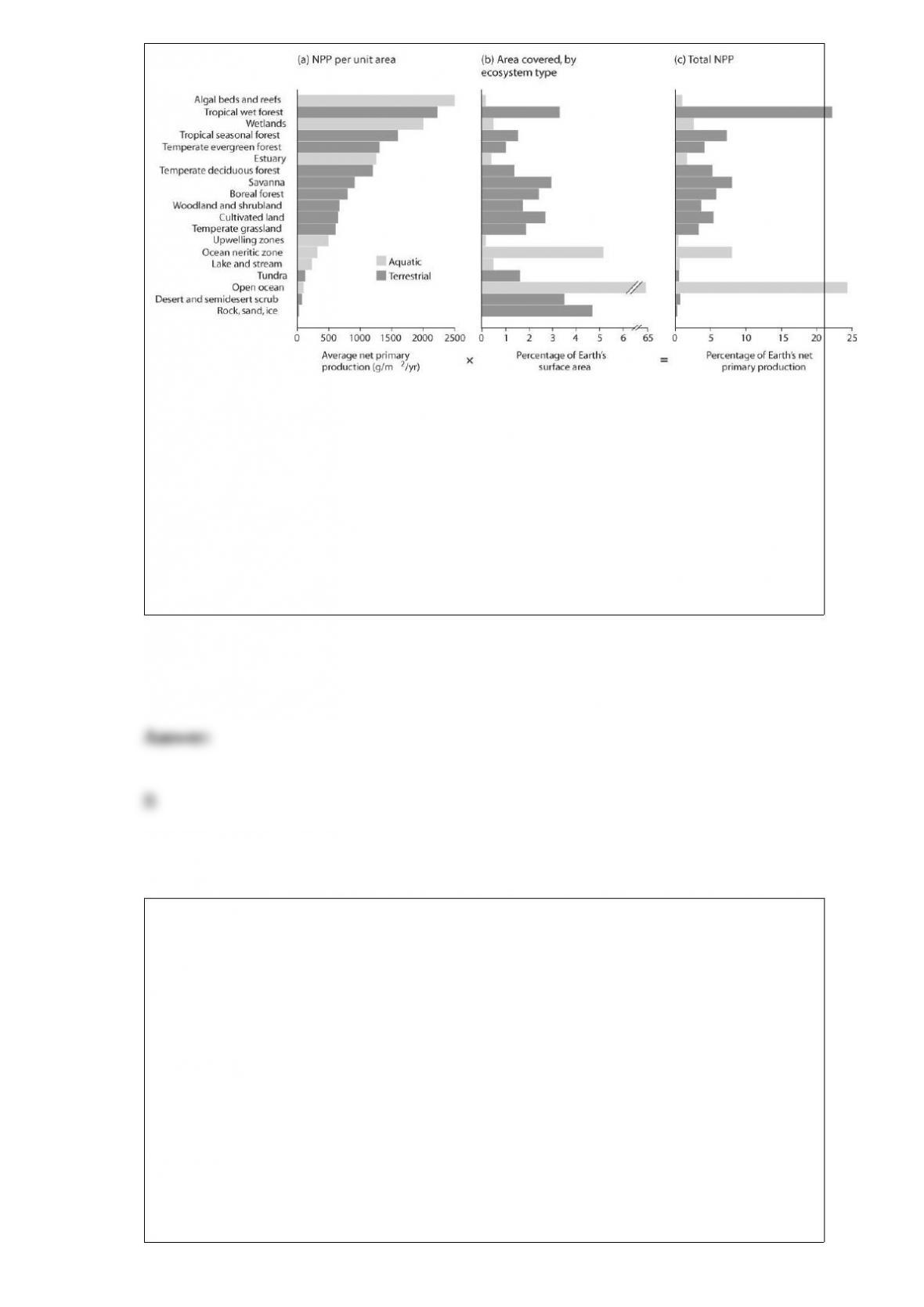
Which habitat types in the figure above cover the largest area?
A) tropical wet forest plus the ocean neritic zone
B) open ocean
C) algal beds and reefs plus the ocean neritic zone
D) wetlands plus the ocean neritic zone
Endosymbiosis is an evolutionary theory that explains the origin of eukaryotes and
suggests a specific order in which this might have occurred. Ancestral cells engulfed
and then began to use the metabolic processes of the smaller cells. Based on shared core
processes and features, which statement most accurately describes the order, the theory
and the evolutionary implications for all organisms within domain Eukarya?
A) Ancestral heterotrophic eukaryotes most likely engulfed both a heterotrophic and an
autotrophic prokaryote, whereas ancestral photosynthetic eukaryotes probably provided
the host cell for the first mitochondria. Over time, natural selection favored these
relationships and these cells became ancestors of all eukaryotes.
B) All ancestral eukaryotes would have most likely consumed a nucleus-like prokaryote
that eventually became the eukaryotic nucleus. These new eukaryotic cells would have
had an advantage over prokaryotic cells by acquiring a nuclear command center for

regulating cellular activities.
C) As carbon dioxide levels were increasing over time, natural selection would have
favored organisms that acquired a photosynthetic prokaryote to convert carbon dioxide
into sugars. These would have likely been the first eukaryotic cells. At which point,
these ancestral cells engulfed mitochondria-like prokaryotes that would have provided
an even greater advantage for cells in this environment.
D) As Earth was becoming more aerobic, mitochondria would have provided an
advantage to host cells by converting “toxic” oxygen into energy for heterotrophic cells.
Since mitochondria are found in all eukaryotes, these combinations likely evolved first.
Photosynthetic eukaryotes probably acquired an autotrophic prokaryote, which
developed an advantageous symbiotic relationship with the host cell.
In the presence of oxygen, the three-carbon compound pyruvate can be catabolized in
the citric acid cycle. First, however, the pyruvate (1) loses a carbon, which is given off
as a molecule of CO2, (2) is oxidized to form a two-carbon compound called acetate,
and (3) is bonded to coenzyme A.
The three listed steps result in the formation of _____.
A) acetyl CoA, O2, and ATP
B) acetyl CoA, FADH2, and CO2
C) acetyl CoA, NADH, and CO2
D) acetyl CoA, NAD+, ATP, and CO2
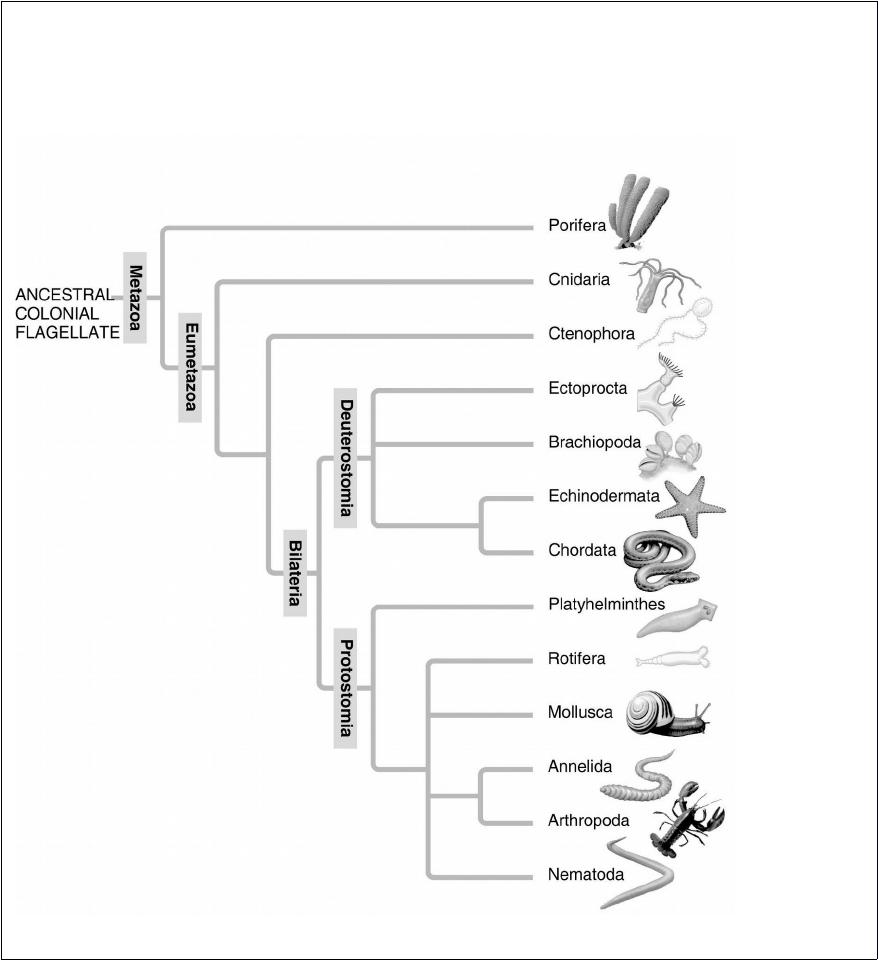
A: Morphological phylogeny.
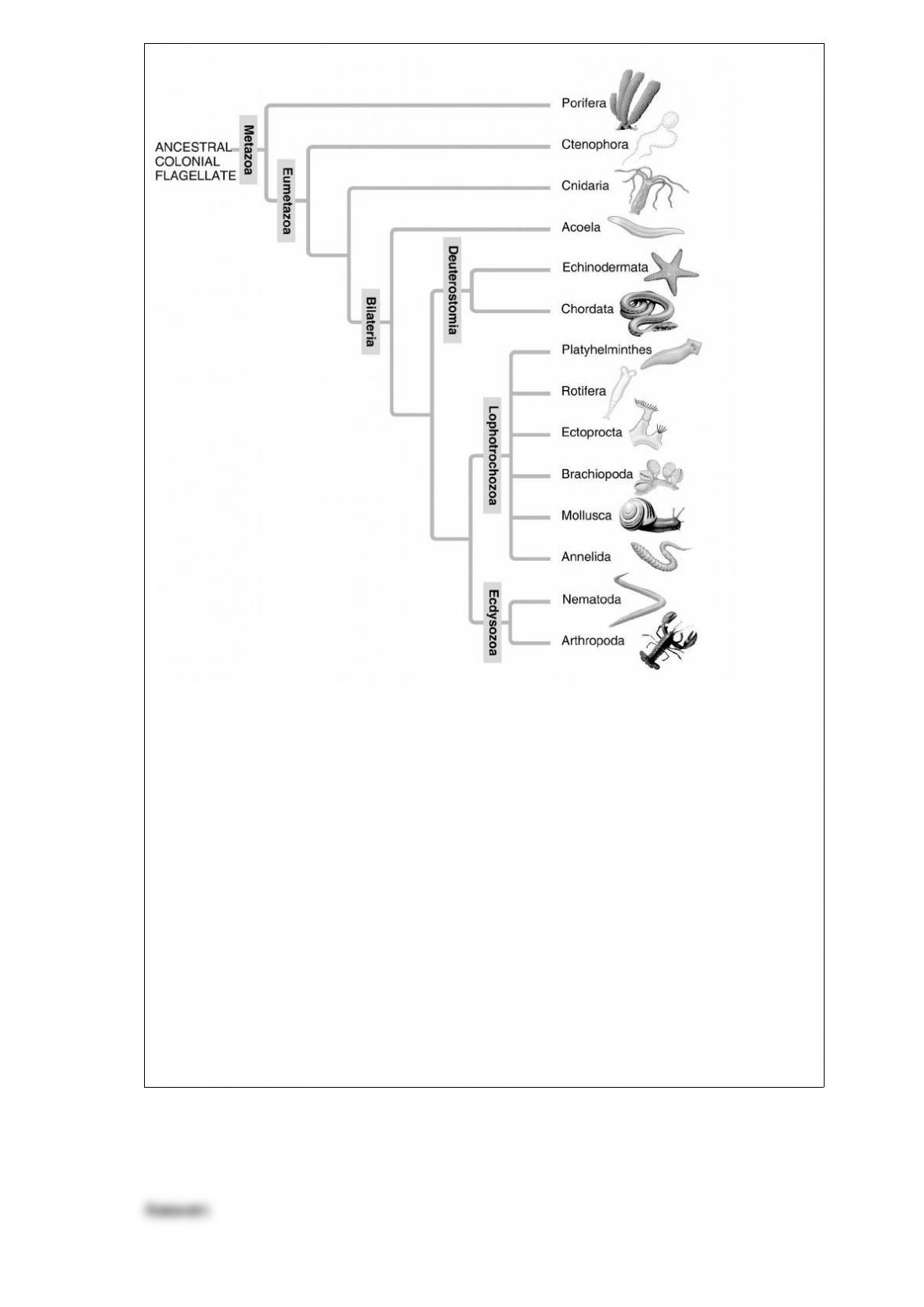
B: Molecular phylogeny.
In the traditional phylogeny (A), the phylum Platyhelminthes is depicted as a sister
taxon to the rest of the protostome phyla and as having diverged earlier from the lineage
that led to the rest of the protostomes. In the molecular phylogeny (B), Platyhelminthes
is depicted as a lophotrochozoan phylum. What probably led to this change?
A) Platyhelminthes ceased to be recognized as true protostomes.
B) The removal of the acoel flatworms (Acoela) from the Platyhelminthes allowed the
remaining flatworms to be a monophyletic clade clearly tied to the Lophotrochozoa.
C) All Platyhelminthes must have a well-developed lophophore as their feeding
apparatus.
D) Platyhelminthes’ close genetic ties to the arthropods became clear as their Hox gene
sequences were studied.

Embryonic induction, the influence of one group of cells on another group of cells,
plays a critical role in embryonic development. In 1924, Hans Spemann and Hilde
Mangold transplanted a piece of tissue that influences the formation of the notochord
and neural tube, from the dorsal lip of an amphibian embryo to the ventral side of
another amphibian embryo. If embryonic induction occurred, which of the following
observations justifies the claim of embryonic induction?
A) The transplanted tissue induced multiple limbs to develop on the ventral side of the
recipient embryo.
B) The transplanted tissue inhibited normal cell division on the dorsal side of the
recipient embryo that lead to its death.
C) The transplanted tissue had no effect on either the ventral or dorsal side of the
recipient embryo so it continued to develop normally.
D) The transplanted tissue induced the formation of a second notochord and neural tube
on the ventral side of the developing embryo.
Within a gymnosperm megasporangium, what is the correct sequence in which the
following should appear during development, assuming that fertilization occurs?
1. sporophyte embryo
2. female gametophyte
3. egg cell
4. megaspore
A) 4 → 2 → 3 → 1
B) 4 → 1 → 2 → 3

C) 1 → 4 → 3 → 2
D) 1 → 4 → 2 → 3
The sodium-potassium pump is called an electrogenic pump because it _____.
A) pumps equal quantities of Na+ and K+ across the membrane
B) contributes to the membrane potential
C) ionizes sodium and potassium atoms
D) is used to drive the transport of other molecules against a concentration gradient
Which of the following happens at the conclusion of meiosis I?
A) Homologous chromosomes of a pair are separated from each other.
B) The chromosome number per cell remains the same.
C) Sister chromatids are separated.
D) Four daughter cells are formed.

After the drought of 1977, researchers hypothesized that on the Galpagos island Daphne
Major, medium ground finches with large, deep beaks survived better than those with
smaller beaks because they could more easily crack and eat the tough Tribulus cistoides
fruits. A tourist company sets up reliable feeding stations with a variety of bird seeds
(different types and sizes) so that tourists can get a better look at the finches. Which of
these events is now most likely to occur to finch beaks on this island?
A) evolution of yet larger, deeper beaks over time, until all birds have relatively large,
deep beaks
B) evolution of smaller, pointier beaks over time, until all birds have relatively small,
pointy beaks
C) increased variation in beak size and shape over time
D) no change in beak size and shape over time
Changing a single amino acid in a protein consisting of 325 amino acids would _____.
A) alter the primary structure of the protein but not its tertiary structure or function
B) cause the tertiary structure of the protein to unfold
C) always alter the biological activity or function of the protein
D) always alter the primary structure of the protein, sometimes alter the tertiary
structure of the protein, and sometimes affect its biological activity
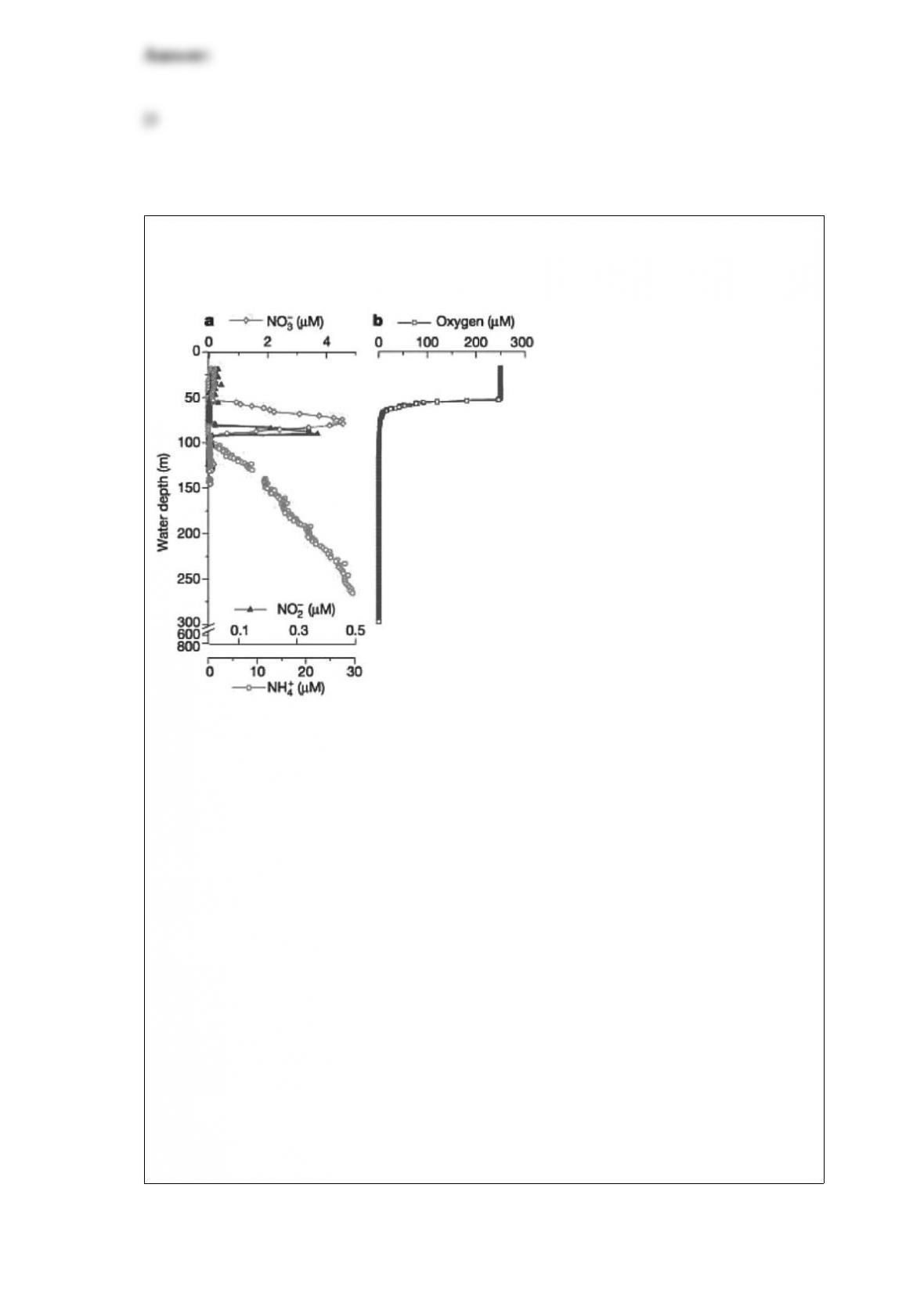
Bacteria able to perform the NH4
+ + NO2
– → N2 + 2H2O reaction have been discovered
in laboratory bioreactors and wastewater treatment systems. Researchers predicted that
these bacteria should exist in oceans. They measured the concentration of NH4
+, NO2
–,
NO3
–, and O2 in the Black Sea as a function of water depth (M. Kuypers et al. 2003
Anaerobic ammonium oxidation by anammox bacteria in the Black Sea. Nature
422:608-11) to determine where in the sea the bacteria might live. Analyzing data
presented in the figure above, at what depth would you expect to find the bacteria?
(Note: In the figure, different scales are used to show concentrations of NH4
+, NO2
–,
NO3
–, and O2.)
A) in the top 50 meters
B) at a depth of 75 meters
C) at a depth of 92 meters
D) below 100 meters

Why have biologists hypothesized that the first land plants had a low, sprawling growth
habit?
A) They were tied to the water for reproduction and thus needed to remain in close
contact with the moist soil.
B) The ancestors of land plants, green algae, lack the structural support to stand erect in
air.
C) Land animals of that period were small and could not pollinate tall plants.
D) There was less competition for space so they simply spread out flat.
In E. coli replication the enzyme primase is used to attach a 5 to 10 base ribonucleotide
strand complementary to the parental DNA strand. The RNA strand serves as a starting
point for the DNA
polymerase that replicates the DNA. If a mutation occurred in the primase gene, which
of the following would you expect?
A) Replication would only occur on the leading strand.
B) Replication would only occur on the lagging strand.
C) Replication would not occur on either the leading or lagging strand.
D) Replication would not be affected as the enzyme primase in involved with RNA
synthesis.

Interstitial fluid is _____.
A) the internal environment inside animal cells
B) identical to the composition of blood
C) a common site of exchange between blood and body cells
D) found only in the lumen of the small intestine
Which of the following is an example of aposematic coloration?
A) the brightly colored patterns of poison dart frogs
B) eye color in humans
C) green color of a plant
D) a katydid whose wings look like a dead leaf

Evidence that parthenogenic whiptail lizards are derived from sexually reproducing
ancestors includes _____.
A) the requirement for male-like behaviors in some females before their partners will
ovulate
B) the development and then regression of testes prior to sexual maturation
C) the observation that all of the offspring are haploid
D) the persistence of a vestigial penis among some of the females
Cinnabar eyes is a sex-linked, recessive characteristic in fruit flies. If a female having
cinnabar eyes is crossed with a wild-type male, what percentage of the F1 males will
have cinnabar eyes?
A) 0%
B) 25%
C) 50%
D) 100%
A sodium-potassium pump _____.
A) moves three potassium ions out of a cell and two sodium ions into a cell while

producing an ATP for each cycle
B) move three sodium ions out of a cell and two potassium ions into a cell while
consuming an ATP for each cycle
C) moves three potassium ions out of a cell and two sodium ions into a cell while
consuming 2 ATP in each cycle
D) move three sodium ions out of a cell and two potassium ions into a cell and
generates an ATP in each cycle
In autumn, the leaves of deciduous trees change colors. This is because chlorophyll is
degraded and _____.
A) carotenoids and other pigments are still present in the leaves
B) the degraded chlorophyll changes into many other colors
C) water supply to the leaves has been reduced
D) sugars are sent to most of the cells of the leaves
Skin color in a certain species of fish is inherited via a single gene with four different
alleles. One fish of this type has alleles 1 and 3 (S1S3) and its mate has alleles 2 and 4
(S2S4). If each allele confers a unit of color darkness such that S1 has one unit, S2 has
two units, and so on, then what proportion of their offspring would be expected to have
five units of color?
A) 1/4
B) 1/8
C) 1/2
D) 0
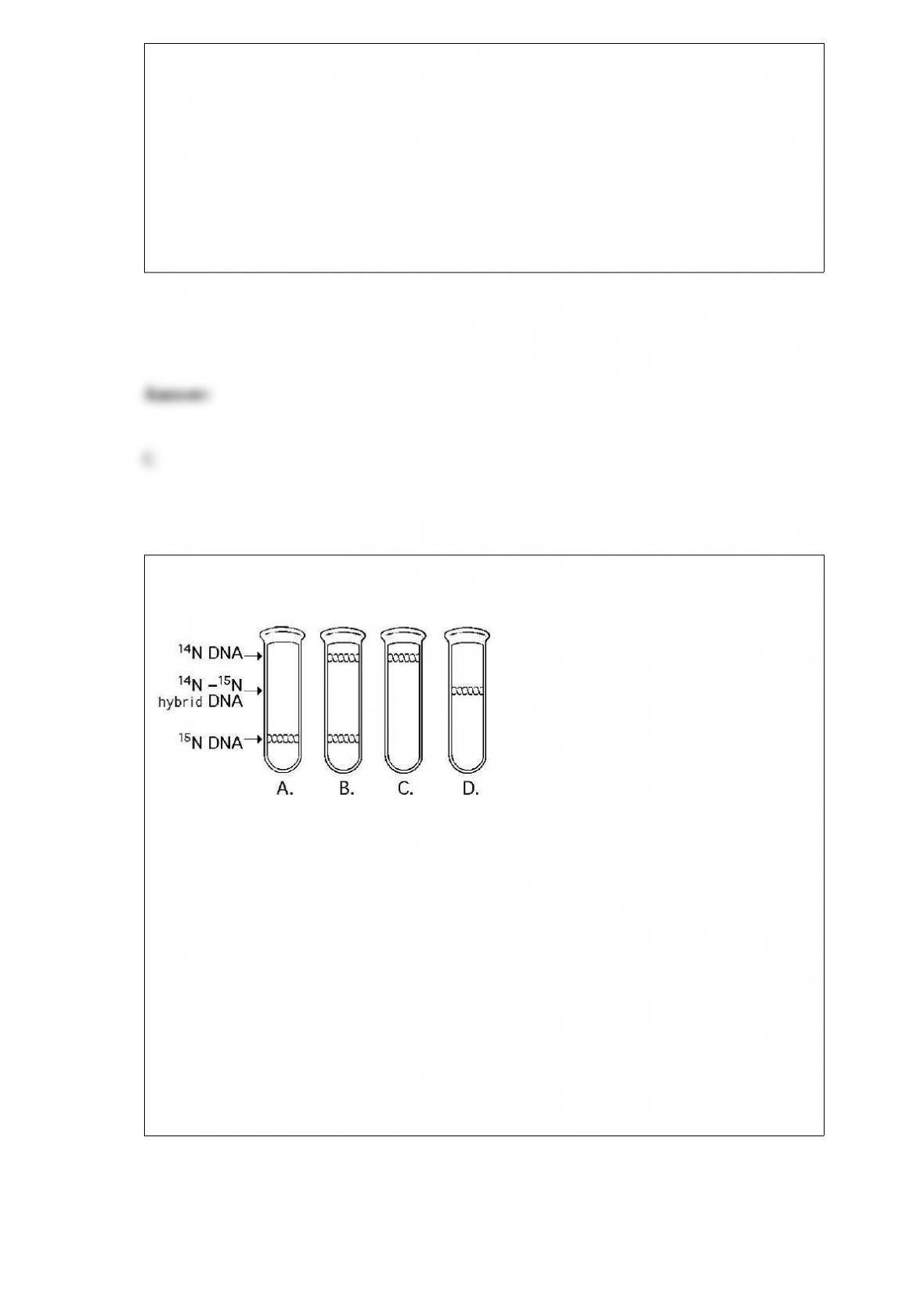
A space probe returns with a culture of a microorganism found on a distant planet.
Analysis shows that it is a carbon-based life-form that has DNA. You grow the cells in
15N medium for several generations and then transfer them to 14N medium. Which
pattern in the figure above would you expect if the DNA was replicated in a
conservative manner?
A) A
B) B
C) C
D) D

How is net ecosystem production (NEP) typically estimated in ecosystems?
A) the amount of heat energy released by the ecosystem
B) the net flux of carbon dioxide or oxygen in or out of an ecosystem
C) the rate of decomposition by detritivores
D) the annual total of incoming solar radiation per unit of area
Tay-Sachs disease is a human genetic abnormality that results in cells accumulating and
becoming clogged with very large, complex, undigested lipids. Which cellular organelle
must be involved in this condition?
A) the endoplasmic reticulum
B) the Golgi apparatus
C) the lysosome
D) mitochondrion

The osmoregulatory/excretory system of an earthworm is based on the operation of
_____.
A) protonephridia
B) metanephridia
C) Malpighian tubules
D) nephrons
How would one explain a testcross involving F1 dihybrid flies in which more
parental-type offspring than recombinant-type offspring are produced?
A) The two genes are closely linked on the same chromosome.
B) The two genes are linked but on different chromosomes.
C) Recombination did not occur in the cell during meiosis.
D) Both of the characters are controlled by more than one gene.
Yeast cells are frequently used as hosts for cloning because they _____.
A) easily form colonies
B) can remove exons from mRNA

C) do not have plasmids
D) are eukaryotic cells
Introduced species can have deleterious effects on biological communities by _____.
I) preying on native species
II) competing with native species for food or light
III) displacing native species
IV) competing with native species for space or breeding/nesting habitat
A) only I and III
B) only II and IV
C) only II, III, and IV
D) I, II, III and IV
Lactose, a sugar in milk, is composed of one glucose molecule joined by a glycosidic
linkage to one galactose molecule. How is lactose classified?
A) as a hexose

B) as a monosaccharide
C) as a disaccharide
D) as a polysaccharide