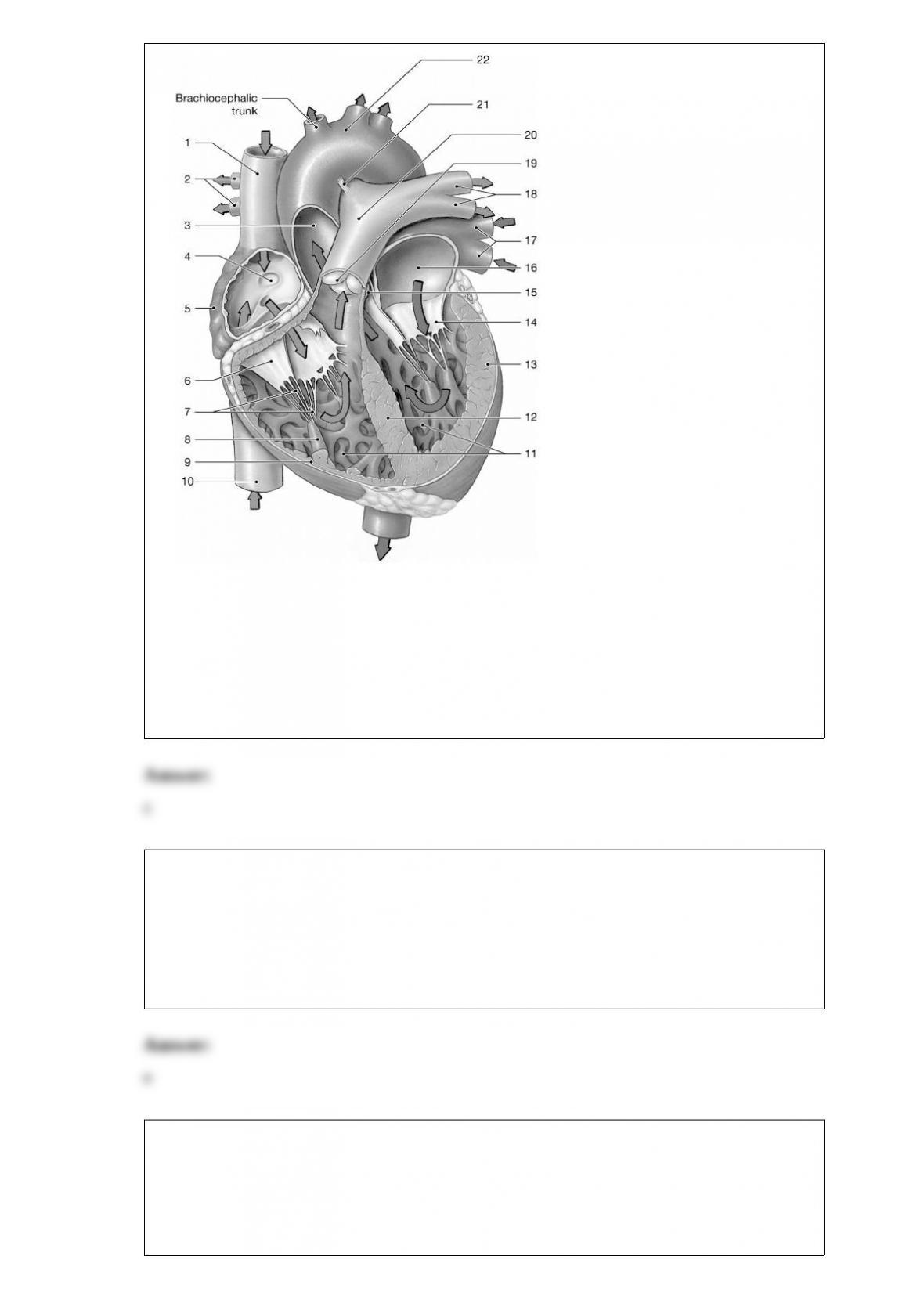
1)
figure 20-1 the heart
which chamber receives oxygenated blood from the pulmonary circuit?
a) 5
b) 10
c) 16
d) 13
e) both 5 and 16
2) intercalated discs serve to transfer ________ from cell to cell.
a) ionic currents
b) action potentials
c) the force of contraction
d) electrical signals
e) all of the answers are correct.
3) the ________ covers the anterior surface of the neck.
a) buccinator
b) epicranium
c) occipitofrontalis
d) orbicularis oris
e) platysma
4) the elastic cartilage that covers the opening to the larynx during swallowing is the
a) thyroid cartilage.
b) cricoid cartilage.
c) corniculate cartilage.
d) cuneiform cartilage.
e) epiglottis.
5) plasma proteins essential in body defense are the
a) albumins.
b) fibrinogens.
c) immunoglobulins.
d) metalloproteins.
e) lipoproteins.
6) cells that secrete the organic components of the bone matrix are called
a) osteocytes.
b) osteoprogenitor cells.
c) osteoblasts.
d) osteoclasts.
e) chondrocytes.
7) during sympathetic activation, ________ occurs.
a) elevated heart rate
b) elevated blood pressure
c) sweating
d) elevated blood glucose
e) all of the answers are correct.
8) all of the following are true of the process known as cotransport, except that
a) only neutral compounds such as sugars are transported.
b) more than one molecule or ion is moved through the cell membrane at one time.
c) atp is not required by the transport protein.
d) saturation phenomenon can be observed.
e) molecules can be moved against a concentration gradient.
9) the following are the main steps in the generation of an action potential.
1. sodium channels are inactivated.
2. voltage-gated potassium channels open and potassium moves out of the cell,
initiating repolarization.
3. sodium channels regain their normal properties.
4. a graded depolarization brings an area of an excitable membrane to threshold.
5. a temporary hyperpolarization occurs.
6. sodium channel activation occurs.
7. sodium ions enter the cell and depolarization occurs.
the proper sequence of these events is
a) 4, 6, 7, 3, 2, 5, 1
b) 4, 6, 7, 1, 2, 3, 5
c) 6, 7, 4, 1, 2, 3, 5
d) 2, 4, 6, 7, 1, 3, 5
e) 4, 2, 5, 6, 7, 3, 1
10) the movements known as dorsiflexion and plantar flexion involve moving the
a) hand.
b) arm.
c) foot.
d) leg.
e) hip.
11) which neuron delivers sensations to the cns?
a) first-order neuron
b) second-order neuron
c) third-order neuron
d) fourth-order neuron
e) sensory receptor
12) intramural ganglia in the digestive, urinary, and reproductive organs are innervated
by the ________ nerves.
a) spinal
b) splanchnic
c) chain
d) pelvic
e) collateral
13) when homeostatic mechanisms fail, an individual will experience the symptoms of
________.
14) the portion of the urethra that penetrates the urogenital diaphragm is the ________.
15) the blood vessel that supplies blood to the upper arm is the ________.
16) what role do the fontanels play in infant development?
17) when the ph falls below 7.35, a state of ________ exists.
18) the adult skeleton contains ________ major bones.
19) the frontal and parietal bones articulate at the ________ suture.