Use the following description to answer the question(s) below.
On the Bahamian island of Andros, mosquitofish populations live in various,
now-isolated, freshwater ponds that were once united. Currently, some predator-rich
ponds have mosquitofish that can swim in short, fast bursts; other predator-poor ponds
have mosquitofish that can swim continuously for a long time. When placed together in
the same body of water, the two kinds of female mosquitofish exhibit exclusive
breeding preferences.
What is the best way to promote fusion between two related populations of
mosquitofish, one of which lives in a predator-rich pond and the other of which lives in
a predator-poor pond?
A) Build a canal linking the two ponds that permits free movement of mosquitofish, but
not of predators.
B) Transfer only female mosquitofish from a predator-rich pond to a predator-poor
pond.
C) Perform a reciprocal transfer of females between predator-rich and predator-poor
ponds.
D) Remove predators from a predator-rich pond and transfer them to a predator-poor
pond.
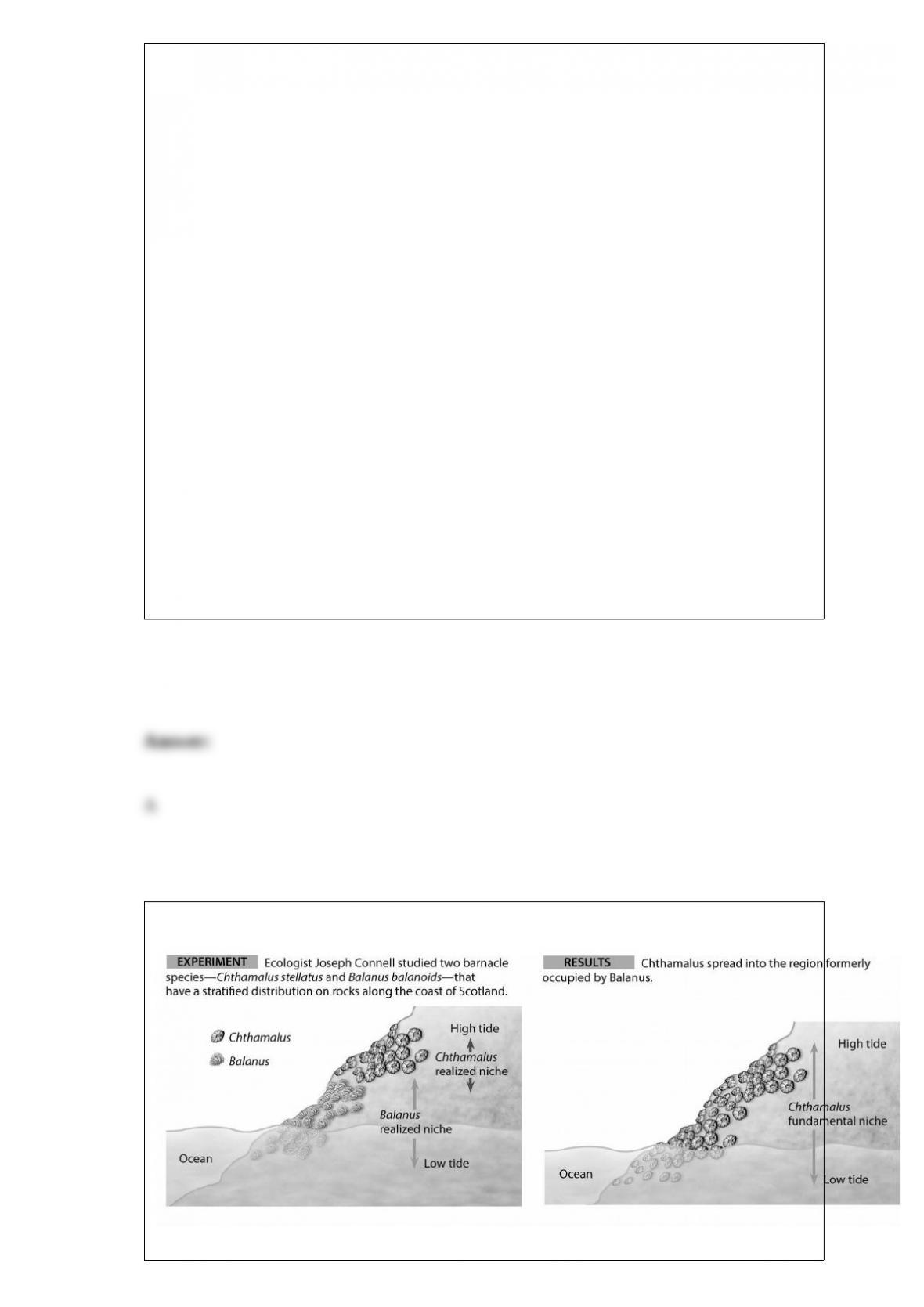
Use the following diagram to answer the question(s) below.

In this experiment, Balanus was removed from the habitat shown on the left.
Which of the following statements is a valid conclusion of this experiment?
A) Balanus can survive only in the lower intertidal zone because it is unable to resist
desiccation.
B) Balanus is inferior to Chthamalus in competing for space on rocks lower in the
intertidal zone.
C) The two species of barnacles do not compete with each other because they feed at
different times of day.
D) The removal of Balanus shows that the realized niche of Chthamalus is smaller than
its fundamental niche.
The primary difference between estrous and menstrual cycles is that _____.
A) the endometrium shed by the uterus during the estrous cycle is reabsorbed with no
extensive fluid flow out of the body, whereas the shed endometrium of menstrual cycles
is excreted from the body
B) behavioral changes during estrous cycles are much less apparent than those of
menstrual cycles
C) season and climate have less pronounced effects on estrous cycles than they do on
menstrual cycles
D) copulation normally occurs across the estrous cycle, whereas in menstrual cycles
copulation only occurs during the period surrounding ovulation

What information is critical to the success of polymerase chain reaction (PCR) itself?
A) The DNA sequence of the ends of the DNA to be amplified must be known.
B) The complete DNA sequence of the DNA to be amplified must be known.
C) The sequence of restriction-enzyme recognition sites in the DNA to be amplified
must be known.
D) The sequence of restriction-enzyme recognition sites in the DNA to be amplified and
in the plasmid where the amplified DNA fragment will be cloned must be known.
In eukaryotic cells, chromosomes are composed of _____.
A) DNA and RNA
B) DNA only
C) DNA and proteins
D) DNA and phospholipids
The following questions refer to the pedigree chart in the figure below for a family,
some of whose members exhibit the dominant trait, W. Affected individuals are
indicated by a dark square or circle.
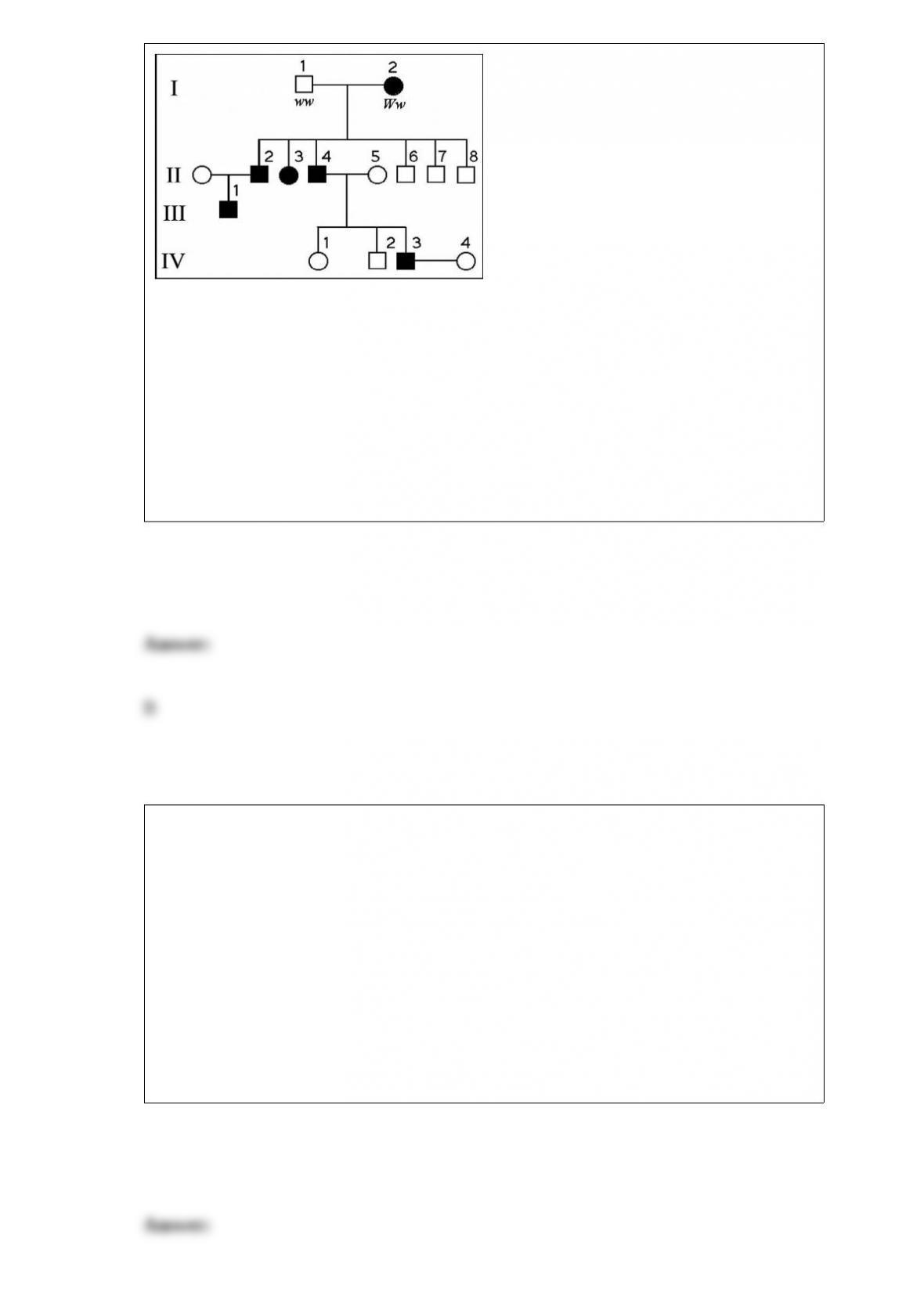
What is the likelihood that the progeny of IV-3 and IV-4 will have the trait?
A) 0%
B) 50%
C) 75%
D) 100%
In mountainous areas of western North America, north-facing slopes would be expected
to _____.
A) receive more sunlight than similar southern exposures
B) be warmer and drier than comparable southern exposed slopes
C) support biological communities similar to those found at lower elevations on similar
south-facing slopes
D) support biological communities similar to those found at higher elevations on
similar south-facing slopes

In an open circulatory system, blood is _____.
A) always inside of vessels and is under higher pressure than in closed circulatory
systems
B) not always confined to blood vessels and is under higher pressure than in closed
circulatory systems
C) always inside of vessels and is under lower pressure than in closed circulatory
systems
D) not always confined to blood vessels and is under lower pressure than in closed
circulatory systems
You need to write down information about a molecule, but need to indicate only the
type and number of atoms it contains. Which representation would work best?
A) molecular formula
B) structural formula
C) ball-and-stick model
D) space-filling model
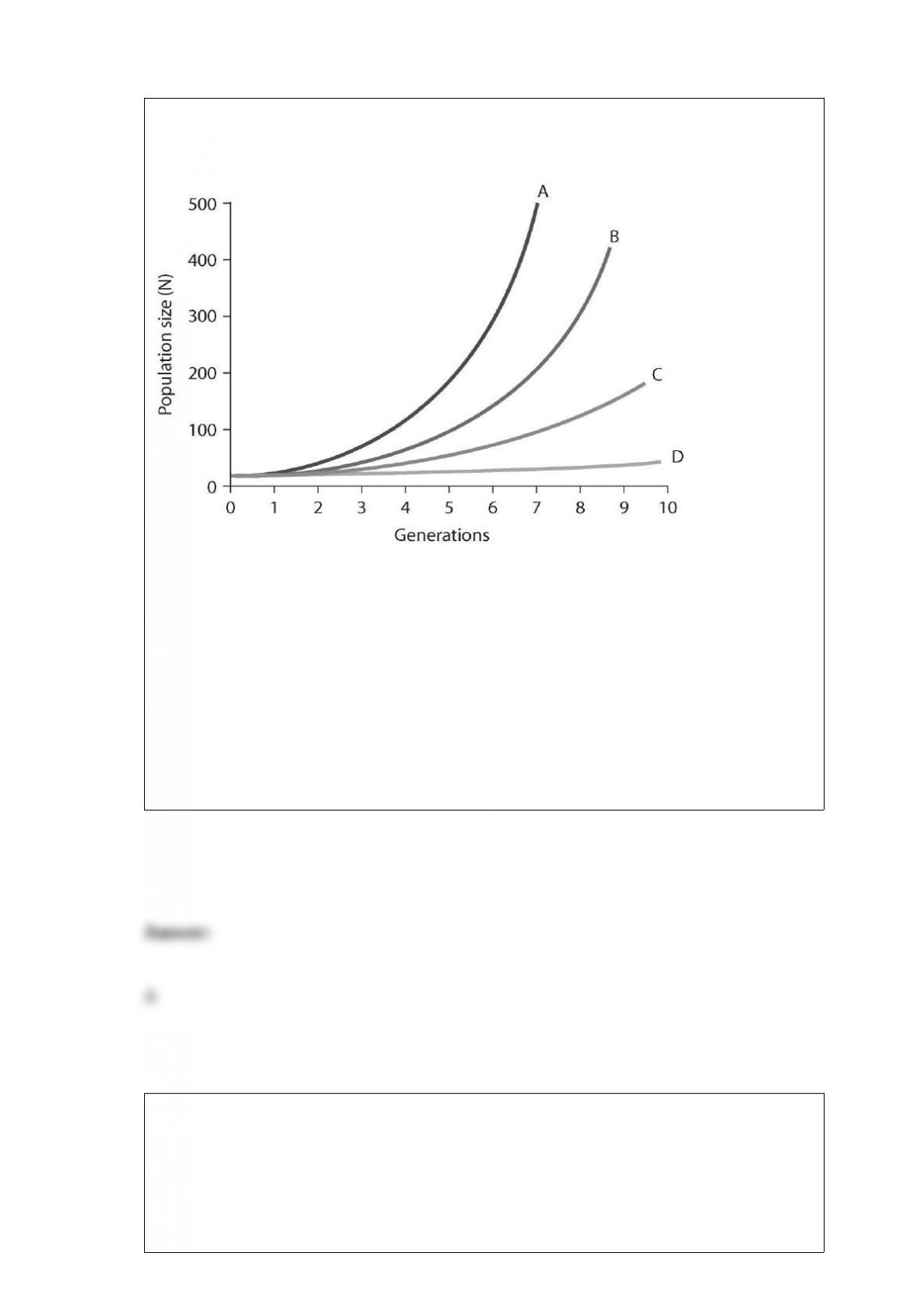
In the figure above, which of the lines represents the highest per-capita rate increase
(r)?
A) line A
B) line B
C) line C
D) line D
What is a critical load?
A) the amount of nutrient augmentation necessary to bring a depleted habitat back to its
former level
B) the level of a given toxin in an ecosystem that is lethal to 50 percent of the species
present
C) the amount of added nutrient that can be absorbed by plants without damaging
ecosystem integrity
D) the number of predators an ecosystem can support that effectively culls prey
populations to healthy levels
Which of the following is common to the development of birds and mammals?
A) the formation of an embryonic epiblast and hypoblast
B) the formation of an embryonic trophoblast
C) the formation of an embryonic yolk plug
D) the formation of an embryonic gray crescent
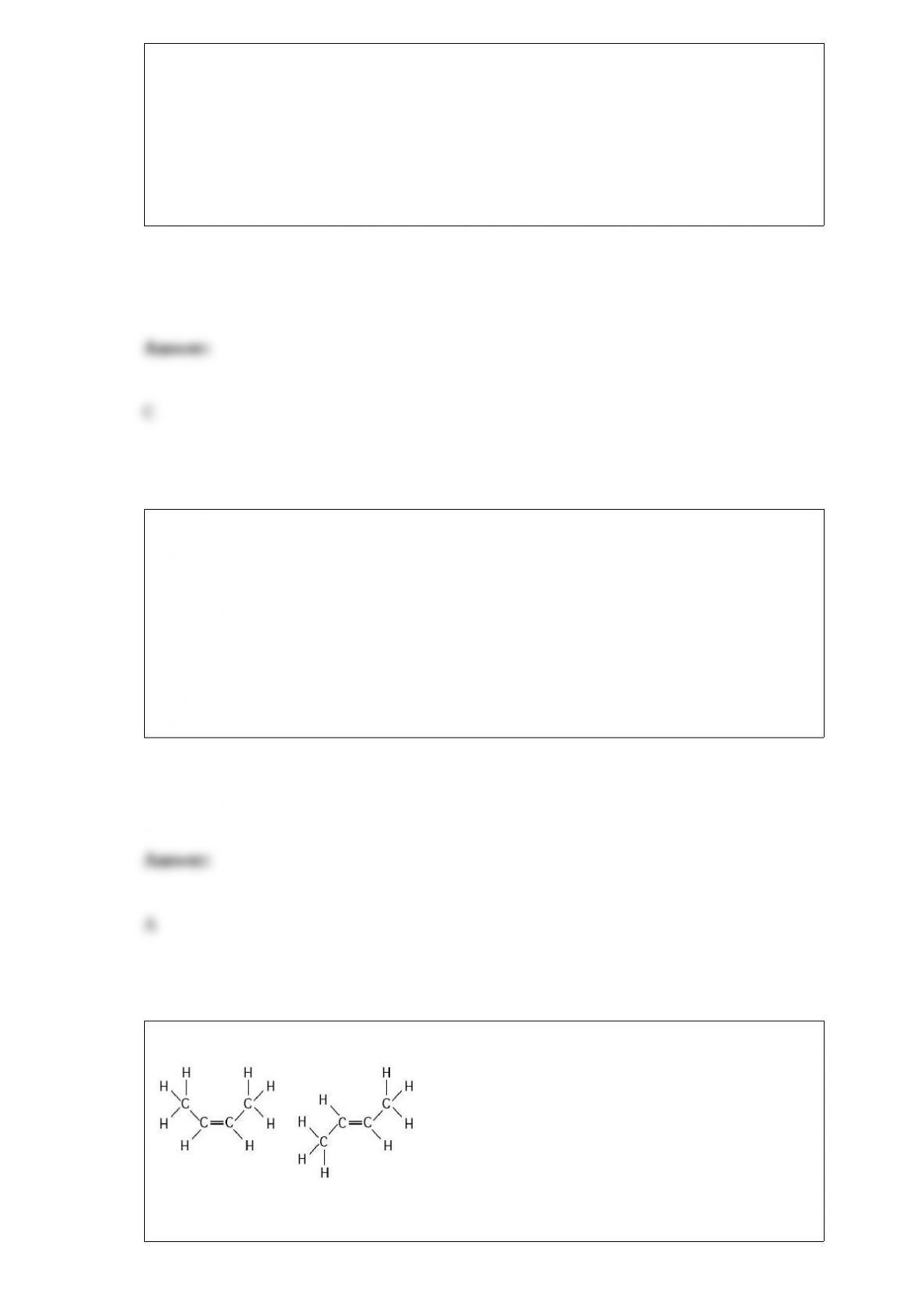
The two molecules shown in the figure below are best described as _____.
A) enantiomers

B) radioactive isotopes
C) structural isomers
D) cis-trans isomers
Seed packets give a recommended planting depth for the enclosed seeds. The most
likely reason some seeds are to be covered with only -inch of soil is that the_____.
A) seedlings do not have an etiolation response
B) seeds require light to germinate
C) seeds require a higher temperature to germinate
D) seeds are very sensitive to waterlogging
A nonsense mutation in a gene _____.
A) changes an amino acid in the encoded protein
B) has no effect on the amino acid sequence of the encoded protein
C) introduces a premature stop codon into the mRNA

D) alters the reading frame of the mRNA
Often the growth cycle of one population has an effect on the cycle of another. As
moose populations increase, for example, wolf populations also increase. Thus, if we
are considering the logistic equation for the wolf population,
dN/dt = rN ,
which of the factors accounts for the effect of the moose population?
A) r
B) N
C) rN
D) K
Suppose a young boy is always tired and fatigued, suffering from a metabolic disease.
Which of the following organelles is most likely involved in this disease?
A) lysosomes
B) Golgi apparatus
C) ribosomes

D) mitochondria
Which of these is an example of inductive reasoning?
A) Hundreds of individuals of a species have been observed and all are photosynthetic;
therefore, the species is photosynthetic.
B) These organisms live in sunny regions. Therefore, they are using photosynthesis.
C) If protists are all single-celled, then they are incapable of aggregating.
D) If two species are members of the same genus, they are more alike than each of them
could be to a different genus.
The microtubule-organizing center found in animal cells is an identifiable structure
present during all phases of the cell cycle. Specifically, it is known as the _____.
A) microtubulere
B) centrosome
C) centromere
D) kinetochore

A normal event in the process of blood clotting is the _____.
A) production of erythropoietin
B) conversion of fibrin to fibrinogen
C) activation of prothrombin to thrombin
D) synthesis of hemoglobin
What is the function of topoisomerase?
A) relieving strain in the DNA ahead of the replication fork
B) elongating new DNA at a replication fork by adding nucleotides to the existing chain
C) unwinding of the double helix
D) stabilizing single-stranded DNA at the replication fork

Why does planting a cover crop help conserve soil?
I) controls weed populations
II) reduces soil loss due to wind and water erosion
III) increases soil nutrients when plowed under and allowed to decompose
A) only I
B) I and II
C) II and III
D) I, II, and III
Differences among organisms are caused by differences in the _____.
A) elemental composition from organism to organism
B) types and relative amounts of organic molecules synthesized by each organism
C) sizes of the organic molecules in each organism
D) types of inorganic compounds present in each organism
Of the following types of molecules, which can function as both neurotransmitters and
hormones?
A) glucocorticoids
B) second messengers
C) catecholamines
D) adipocytes
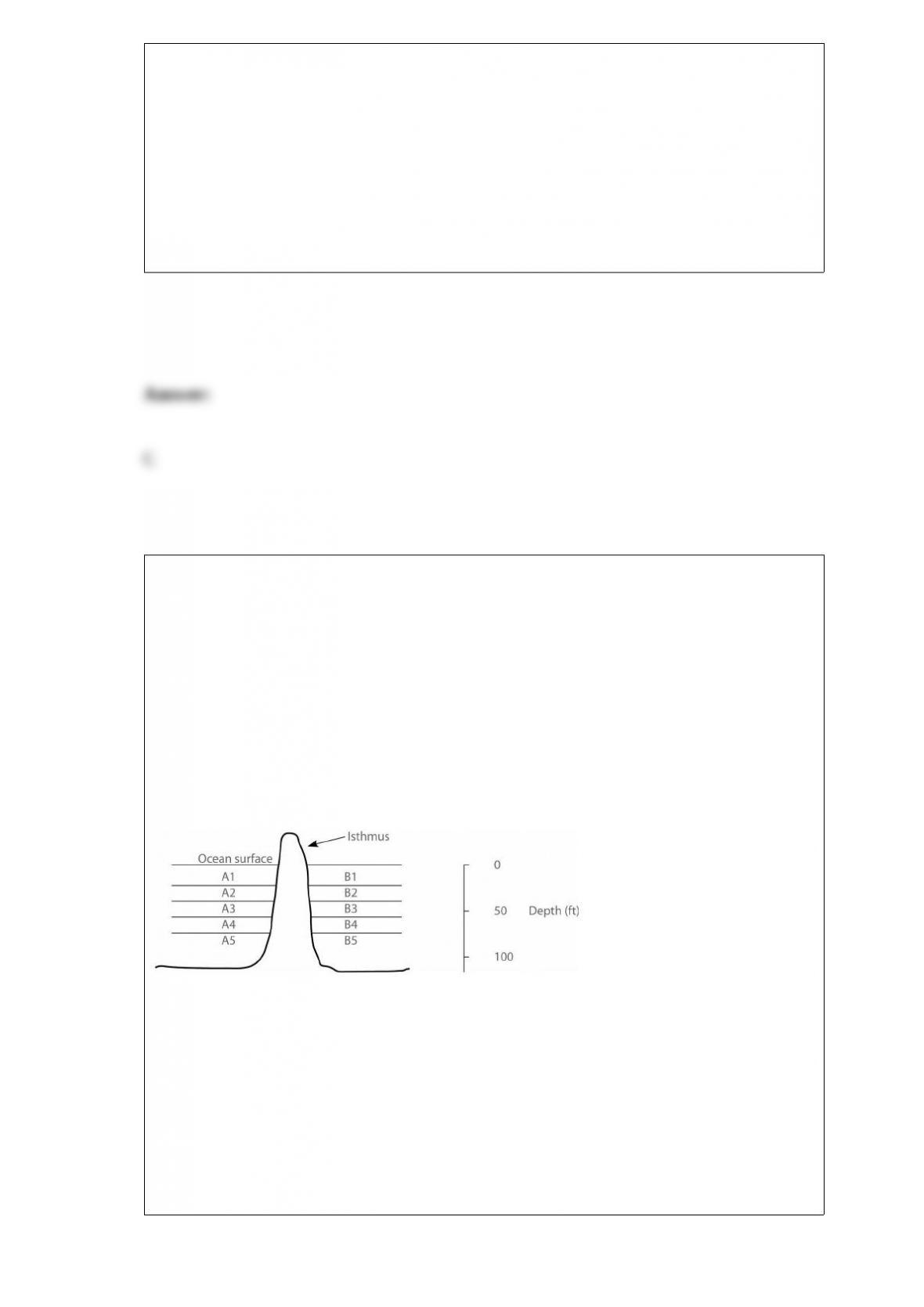
Use the following description to answer the question(s) below.
In the ocean, on either side of the Isthmus of Panama, are thirty species of snapping
shrimp; some are shallow-water species, others are adapted to deep water. There are
fifteen species on the Pacific side and fifteen different species on the Atlantic side. The
Isthmus of Panama started rising about ten million years ago. The oceans were
completely separated by the isthmus about three million years ago.
In the following figure, the isthmus separates the Pacific Ocean on the left (side A)
from the Atlantic Ocean on the right (side B). The seawater on either side of the isthmus
is separated into five depth habitats (1-5), with 1 being the shallowest.
Which of these habitats is likely to harbor the most recently diverged species?
A) A5
B) B4
C) A3
D) A1

According to bottom-up and top-down control models of community organization,
which of the following expressions would imply that an increase in the size of a
carnivore (C) population would negatively impact its prey (P) population, but not vice
versa?
A) P ← C
B) P → C
C) C ↔ P
D) P ← C → P
Which of the following is the best natural example of uniform distribution?
A) bees collecting pollen in a wildflower meadow
B) snails in an intertidal zone at low tide
C) territorial songbirds in a mature forest during mating season
D) mushrooms growing on the floor of an old growth forest

Use the following description to answer the question(s) below.
Oviparous (egg-laying) animals have internal fertilization (sperm cells encounter eggs
within the female’s body). Yolk and/or albumen is (are) provided to the embryo, and a
shell is then deposited around the embryo and its food source. Eggs are subsequently
deposited in an environment that promotes their further development, or are incubated
by one or both parents.
The yolk of an animal egg has what type of analog in angiosperms?
A) endosperm
B) carpels
C) fruit
D) seed coat
One way to understand how early environment influences behaviors in similar species
is through the “cross-fostering” experimental technique. Suppose that the
curly-whiskered mud rat differs from the bald mud rat in several ways, including being
much more aggressive. How would you set up a cross-fostering experiment to
determine if environment plays a role in the curly-whiskered mud rat’s aggression?
A) You would cross curly-whiskered mud rats and bald mud rats and hand-rear the
offspring to see if any grew up to be aggressive.
B) You would place newborn curly-whiskered mud rats with bald mud rat parents and
place newborn bald mud rats with curly-whiskered mud rat parents. Finally, let some
mud rats of both species be raised by their own species. Then you would compare the
outcomes.
C) You would remove the offspring of curly-whiskered mud rats and bald mud rats
from their parents, raise them in the same environment but without parents, and then
compare the outcomes.
D) You would replace normal newborn mud rats with deformed newborn mud rats to

see if it triggered an altruistic response.
Trace elements are those required by an organism in only minute quantities. Which of
the following is a trace element that is required by humans and other vertebrates, but
not by other organisms such as bacteria or plants?
A) calcium
B) iodine
C) sodium
D) phosphorus
Use the following information to answer the question(s) below.
A large population of laboratory animals has been allowed to breed randomly for a
number of generations. After several generations, 25% of the animals display a
recessive trait (aa), the same percentage as at the beginning of the breeding program.
The rest of the animals show the dominant phenotype, with heterozygotes
indistinguishable from the homozygous dominants.
What is the estimated frequency of allele A in the gene pool?
A) 0.25
B) 0.50

C) 0.75
D) 0.125