
1) suppose that you try to pick up an object and discover that it is much heavier than
you expected. which process must occur in the muscle to increase tension so you can
pick up the object?
a) wave summation
b) isotonic contraction
c) complete tetanus
d) recruitment
e) treppe
2) the organ that surrounds the urethra and produces an alkaline secretion is the
a) seminal gland (seminal vesicle).
b) bulbourethral gland.
c) prostate gland.
d) preputial gland.
e) bartholin’s gland.
3) impaired fat absorption in the intestine would interfere with the absorption of
a) vitamin a.
b) vitamin b12.
c) vitamin c.
d) niacin.
e) riboflavin.
4) facilitated diffusion differs from ordinary diffusion in that
a) facilitated diffusion consumes no atp.
b) facilitated diffusion moves molecules from an area of higher concentration to lower
concentration.
c) the rate of molecular movement is limited by the number of available carrier
molecules.
d) facilitated diffusion never eliminates the concentration gradient.
e) the rate of molecular movement is not limited by the number of available carrier
molecules.
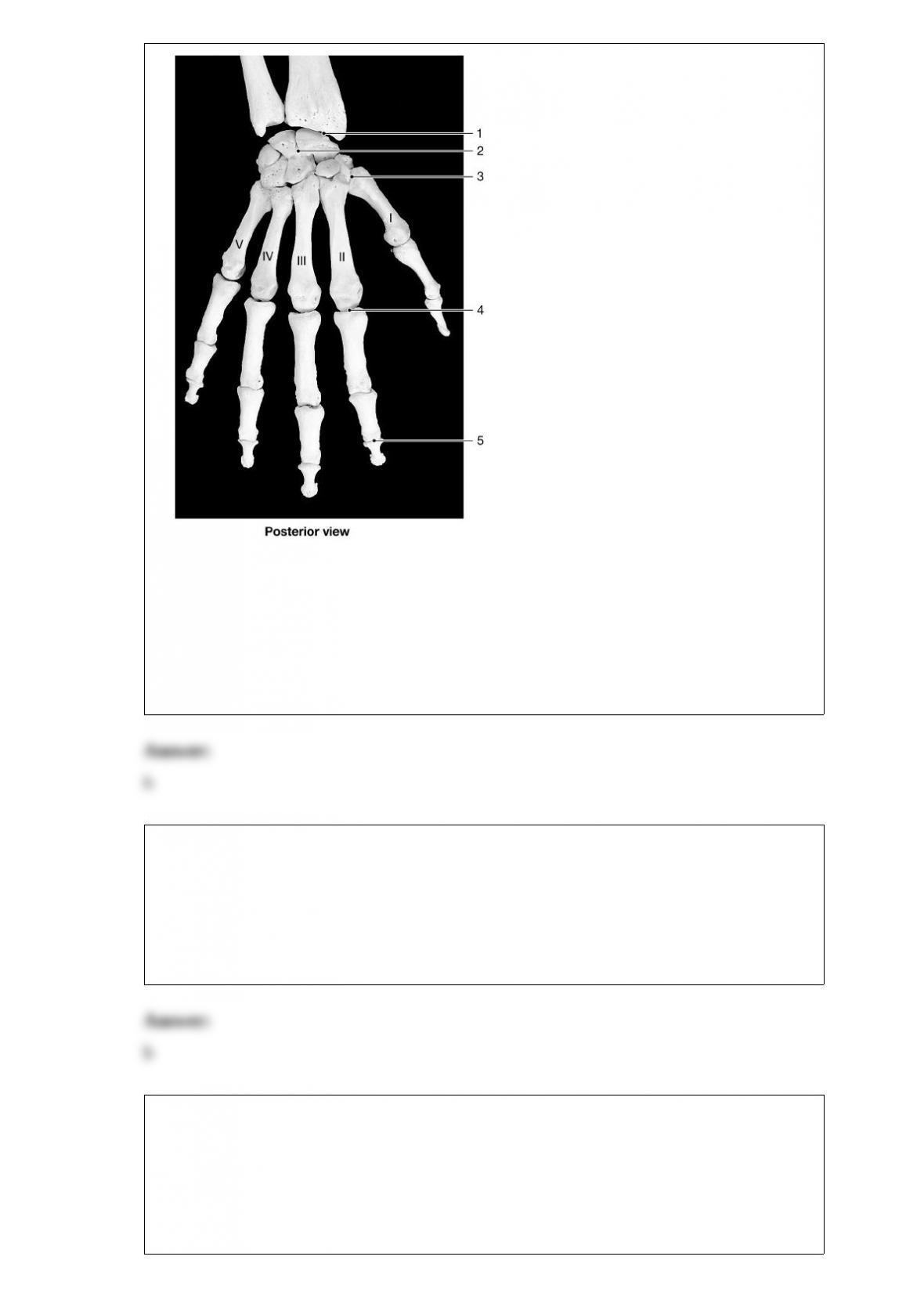
5)
figure 9-1 bones of the wrist and hand
identify the type of joint at label “1”
a) hinge
b) condylar
c) gliding
d) saddle
e) pivot
6) the delicate layer of serous membrane that covers the testis is called the
a) median raphe.
b) tunica vaginalis.
c) tunica albuginea.
d) dartos.
e) lamina propria.
7) the two major types of cell layering in epithelia are
a) simple and proper.
b) stratified and pseudostratified.
c) squamous and simple.
d) simple and stratified.
e) cuboidal and columnar.

8) what bone articulates with the coxal bone at the acetabulum?
a) sacrum
b) femur
c) humerus
d) tibia
e) fibula
9) ________ neurons are small and have no anatomical features that distinguish
dendrites from axons.
a) multipolar
b) anaxonic
c) unipolar
d) bipolar
e) sensory
10) when a skeletal muscle fiber contracts,
a) the h bands and i bands get smaller.
b) the zones of overlap get larger.
c) the z lines get closer together.
d) the width of the a band remains constant.
e) all of the answers are correct.
11) during deglutition,
a) the soft palate elevates.
b) the larynx elevates and the epiglottis closes.
c) the lower esophageal sphincter opens.
d) smooth muscle contracts.
e) all of the answers are correct.

12) the wrist is ________ to the elbow.
a) proximal
b) distal
c) lateral
d) medial
e) horizontal
13) the role of antigen-presenting cells in immunity is to
a) activate t cells.
b) display antigen fragments.
c) process antigens.
d) bind antigens to glycoproteins.
e) all of the answers are correct.
14) wrinkles in elderly individuals are the result of
a) increased production of epidermis.
b) loss of elastic filaments in the reticular layer of the dermis.
c) increased keratinization of the epidermis.
d) the loss of glands and hair follicles from the skin.
e) decreased thickness of the dermis.
15) the statement “its ganglia are usually near or within the end organ” is
a) true only for the parasympathetic nervous system.
b) true only for the sympathetic nervous system.
c) true for both the parasympathetic and sympathetic nervous systems.
d) not true for either the parasympathetic or sympathetic nervous systems.
e) true only for the somatic nervous system.
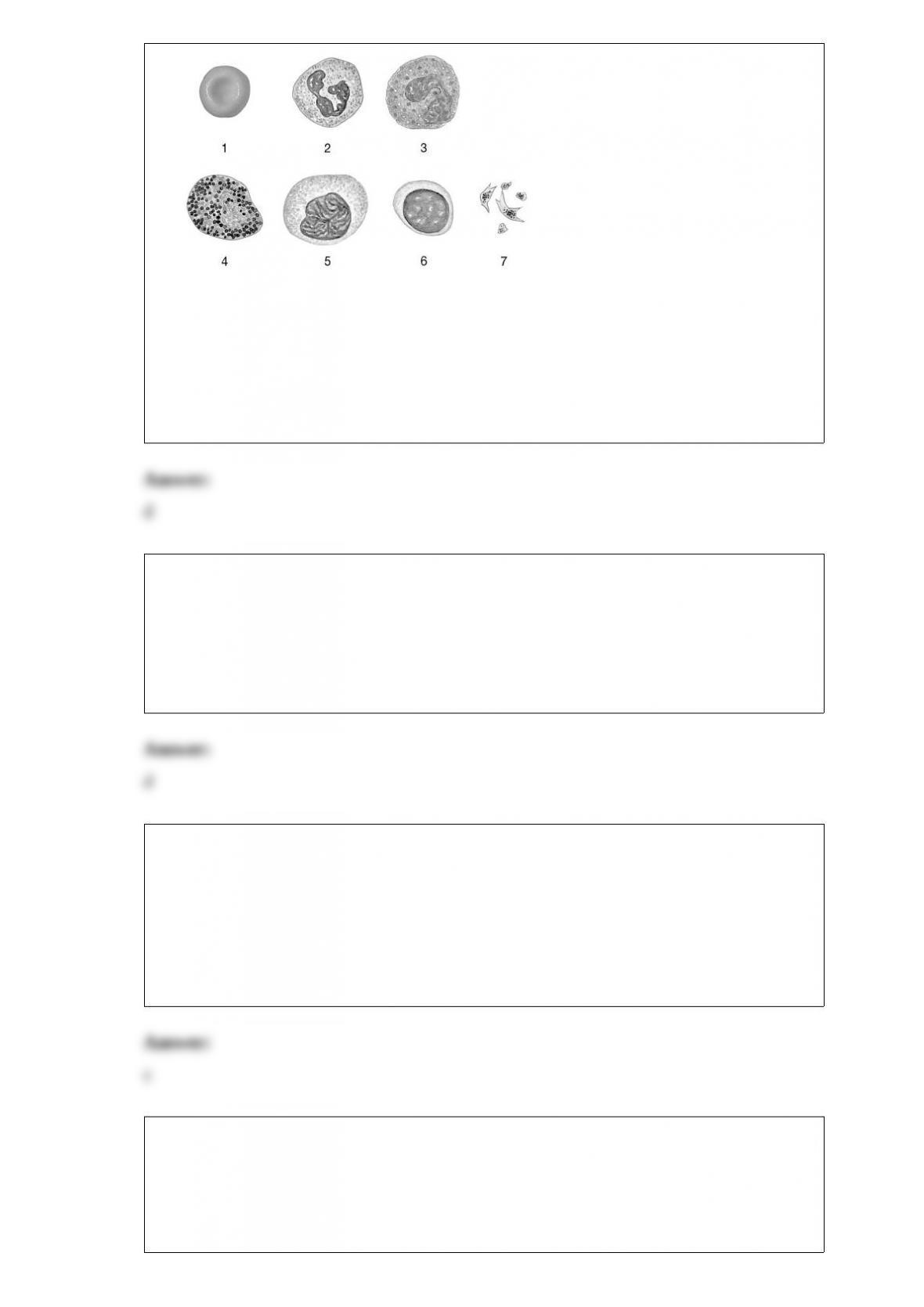
16)
figure 19-1 the origins and differentiation of formed elements
identify the cell labeled “4”
a) neutrophil
b) lymphocyte
c) platelet
d) basophil
e) monocyte
17) olfactory glands
a) house the sense of smell.
b) support the olfactory epithelium.
c) react to aromatic molecules.
d) coat the olfactory epithelium with a pigmented mucus.
e) group as olfactory bulbs.
18) the most common lever systems in the body are those that have the applied force
between the fulcrum and the load. these are called ________ levers.
a) first-class
b) second-class
c) third-class
d) fourth-class
e) fifth-class
19) autonomic tone is an important aspect of ans function because it
a) allows ans neurons to be silent under normal conditions.
b) allows ans neurons to increase activity on demand but not decrease their activity.
c) allows ans neurons to decrease their activity on demand but not increase their
activity.

d) allows ans neurons to increase or decrease their activity, providing a range of control
options.
e) provides for a narrow range of control options that keeps target tissues constantly
active.
20) in the condition known as a(n) ________, the nasal septum has a bend in it.
21) the hydrolysis of atp yields adp, phosphate ion, and ________.
22) the cardiac ________ is the difference between the resting and maximal cardiac
output.
23) when an antibody binds to its specific antigen a(n) ________ is formed.
24) explain why sunburned skin peels rather than being shed as a powder.
25) within the oral cavity, both mechanical and chemical ________ begin.