
As a patch of scraped skin heals, the cells fill in the injured area but do not grow
beyond that. This is an example of
A) density-independent inhibition.
B) density-dependent inhibition.
C) anchorage independence.
D) growth factor inhibition.
The alleles of a gene are found at ________ chromosomes.
A) the same locus on nonhomologous
B) different loci on homologous
C) different loci on nonhomologous
D) the same locus on homologous
According to scientists, about what percentage of men currently living in Central Asia
may be descended from the Mongolian ruler Genghis Khan?
A) 4%
B) 8%

C) 25%
D) 40%
The emergence of a new plant species over a brief period of time followed by a long
period of little change is consistent with which of the following theories?
A) the gradual model of speciation
B) allopatric speciation
C) punctuated equilibrium
D) adaptive radiation
Which of the following statements regarding exercise is true?
A) The main source of energy during aerobic exercise is ATP from aerobic respiration.
B) For an activity such as jogging or long-distance running, the primary source of
energy is stored ATP and PCr.
C) During a short burst of activity such as a sprint, the main source of energy is aerobic
respiration.
D) If the demand for ATP outstrips oxygen supply, muscles switch to aerobic

fermentation.
Fungi contact and absorb food through the ________, a branching network of
________.
A) mycelium; hyphae
B) hyphae; mycelia
C) mycorrhiza; mushrooms
D) mushroom; hyphae
A molecule with the formula C55H110O55 is probably a(n)
A) oil.
B) steroid.
C) protein.
D) polysaccharide.
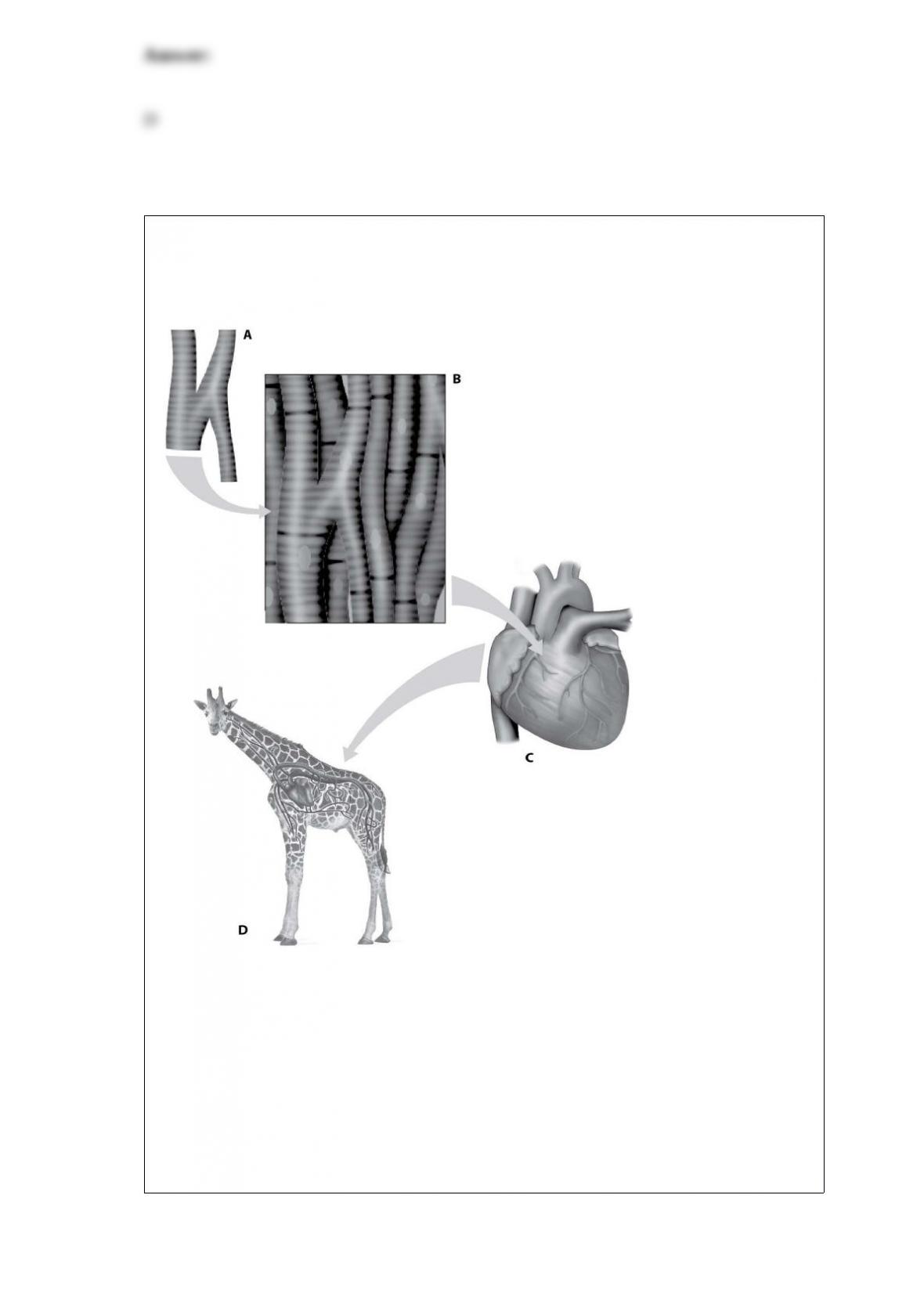
Use the figure below to answer the questions that follow.
Which part of the figure above shows a tissue?
A) part A
B) part B
C) part C
D) part D

In an ecosystem, energy
A) cycles along with chemical nutrients.
B) typically flows from consumers to producers to decomposers.
C) typically flows from producers through a series of consumers.
D) comes ultimately from bacteria.
You’ve made a hot drink by dissolving a teaspoon of instant coffee and a teaspoon of
sugar in a cup of hot water. Which of the following statements is true?
A) You’ve just prepared an aqueous solution.
B) The water is the solute portion of the drink.
C) The instant coffee and sugar are solvents.
D) The instant coffee and sugar dissolve because they have no charged regions to repel
the partial positive and partial negative regions of the water molecules.

In 2012, scientists studied modern Marchantia liverwort plants and observed that they
not only are able to make their own food using energy from sunlight but also absorb
chemical nutrients from plant material in aquatic environments. They classified this
plant as a
A) chemoheterotroph.
B) photoautotroph.
C) mixotroph.
D) chemoautotroph.
It is a cool winter evening, and you are feeling a little chilled. To warm yourself up, you
sip some hot tea. As you swallow, you can feel the tea warm your mouth and throat. The
drink is warming you up by the process of
A) convection.
B) induction.
C) conduction.
D) radiation.

Two important contributions that cleavage makes to development are to
A) establish the basic tissues of the body and define the future nervous system.
B) create a multicellular embryo and partition the embryo into developmental regions.
C) create a multicellular embryo and establish the basic tissues of the body.
D) establish the basic body plan and determine the location of the mouth and anus.
Cats normally have a total of 18 toes, 5 on each front paw and 4 on each back paw. But
some cats express the dominant phenotype for polydactyly, which results in the
development of extra toes on one or more paws. Jake, a Canadian tabby cat, has 28 toes
and is recognized by the Guinness Book of World Records as the cat with the most toes.
Suppose that Jake mates with a female cat, Lucy, who has 18 total toes. Over several
years, they have multiple litters and a total of 16 kittens (10 males and 6 females). The
total number of toes on each kitten ranges from 21 to 25.
Along with having a variable number of toes, some kittens from Jake and Lucy’s litter
had a white spot on their nose. In fact, out of the 16 kittens, all 10 males had the white
spot, but none of the 6 females had the white spot. Jake has a white spot on his nose,
but Lucy does not. What can you conclude from this information?
A) A sex-linked gene that controls the expression of the white spot is found on the Y
chromosome.
B) A sex-linked gene that controls the expression of the white spot is found on the X
chromosome.
C) The genes for the white spot and for polydactyly are linked.
D) The genes for the white spot and for polydactyly are not linked.

Oxytocin is a hormone produced by the posterior pituitary gland that causes female
uterine muscles to contract during childbirth and female mammary glands to eject milk
during nursing. Oxytocin also occurs naturally in males and is involved in movement of
sperm and production of testosterone. It has been given the common name of “the love
hormone” because oxytocin is linked to human behaviors including sexual arousal and
trust.
In 2012, The Atlantic (a popular news source) published a brief online news summary
that explained that when scientists in Germany gave men who were in a monogamous
relationship with a woman a nasal spray containing oxytocin, the men were less
attracted to an attractive female stranger than men who were given a nasal spray with
no oxytocin. While The Atlantic provided a link to the original scientific study, they
drew conclusions and stated implications of it that included the following:
1. In men, oxytocin promotes monogamous relationships because it keeps them from
communicating with women who are attractive to them.
2. If a man is unable to obtain a nasal spray with oxytocin, there are other means by
which oxytocin release can be stimulated during a monogamous relationship: sexual
intercourse, hand-holding, and touching.
In addition to biological reasons, what other implications does the role of oxytocin
have?
A) Oxytocin can decrease the amount of time it takes for a female to give birth.
B) Oxytocin can decrease the chance that women in monogamous relationships will be
attracted to men other than their mate.
C) Oxytocin can affect human social behaviors.
D) Oxytocin can weaken the bond that men and women share in a relationship.

Which of the following is a typical characteristic of molluscs?
A) a gastrovascular cavity with only one opening
B) a sessile lifestyle
C) an internal skeleton and segmented body plan
D) a rasping organ called the radula
Digestion is the
A) absorption of nutrients suspended in water.
B) conversion of glycogen to glucose.
C) breakdown of food into molecules small enough for the body to absorb.
D) churning of food in the stomach and intestine.
A salamander is a vertebrate that spends part of its life cycle in water (juvenile stage)
and part on land (adult stage). In both life stages, the salamander’s body temperature
depends on its surrounding environment, so the salamander demonstrates _________
behavior.
A) endothermic

B) ectothermic
C) huddling
D) regulatory
All the offspring of a cross between a black-eyed Mendelian and an orange-eyed
Mendelian have black eyes. What is the expected phenotypic ratio of a cross between
two orange-eyed Mendelian?
A) 3 black-eyed:1 orange-eyed
B) 0 black-eyed:1 orange-eyed
C) 1 black-eyed:3 orange-eyed
D) 1 black-eyed:0 orange-eyed
Which of the following is a function of the nasal cavities in humans?
A) secreting enzymes for digestion
B) warming inhaled air
C) secreting excess carbon dioxide into exhaled air
D) determining O2 content in inhaled air

Which of the following statements regarding enzymes is true?
A) Enzymes are inorganic.
B) An enzyme’s function is unaffected by changes in pH.
C) Enzymes catalyze specific reactions.
D) All enzymes depend on protein cofactors to function.
The expression of both alleles for a trait in a heterozygous individual illustrates
A) incomplete dominance.
B) codominance.
C) pleiotropy.
D) polygenic inheritance.

Nervous system effector cells
A) are white cells found in the circulatory system.
B) consist of sensory cells.
C) include muscle cells and gland cells.
D) provide automatic responses to stimuli.
Which of the following statements about anabolic steroids is false?
A) They cause a general buildup of muscle mass.
B) They often cause the body to reduce its normal output of sex hormones.
C) They promote bone growth.
D) They can stimulate mood swings and violent behavior.
Visual information is carried from the retina to the brain via
A) the optic nerve.
B) rhodopsin.

C) photopsins.
D) the blind spot.
Plants grow toward light through the action of
A) hormones.
B) nerves.
C) solar energy.
D) chloroplasts.
Which of the following types of reproductive barriers separates a pair of species that
could interbreed but for the fact that one mates at dusk and the other at dawn?
A) temporal isolation
B) habitat isolation
C) behavioral isolation
D) mechanical isolation

The body structure where gas exchange occurs is called the
A) integumentary surface.
B) respiratory surface.
C) exchange network.
D) capillary network.
One kind of vaccine consists of
A) buffered antibodies.
B) B cells.
C) a harmless variant strain of a disease-causing microbe.
D) antibiotics.

Mothers and teachers often say they need another pair of eyes on the backs of their
heads. And another pair of hands would come in handy in many situations. You can
imagine that these traits would have been advantageous to our early hunter-gatherer
ancestors as well. According to sound evolutionary reasoning, what is the most likely
explanation for why humans do not have these traits?
A) Because they actually would not be beneficial to the fitness of individuals who
possessed them. Natural selection always produces the most beneficial traits for a
particular organism in a particular environment.
B) Because every time they have arisen before, the individual mutants bearing these
traits have been killed by chance events. Chance and natural selection interact.
C) Because these variations have probably never appeared in a healthy human. As
tetrapods, we are pretty much stuck with a four-limbed, two-eyed body plan; natural
selection can only edit existing variations.
D) Because humans are a relatively young species. If we stick around and adapt for
long enough, it is inevitable that the required adaptations will arise.
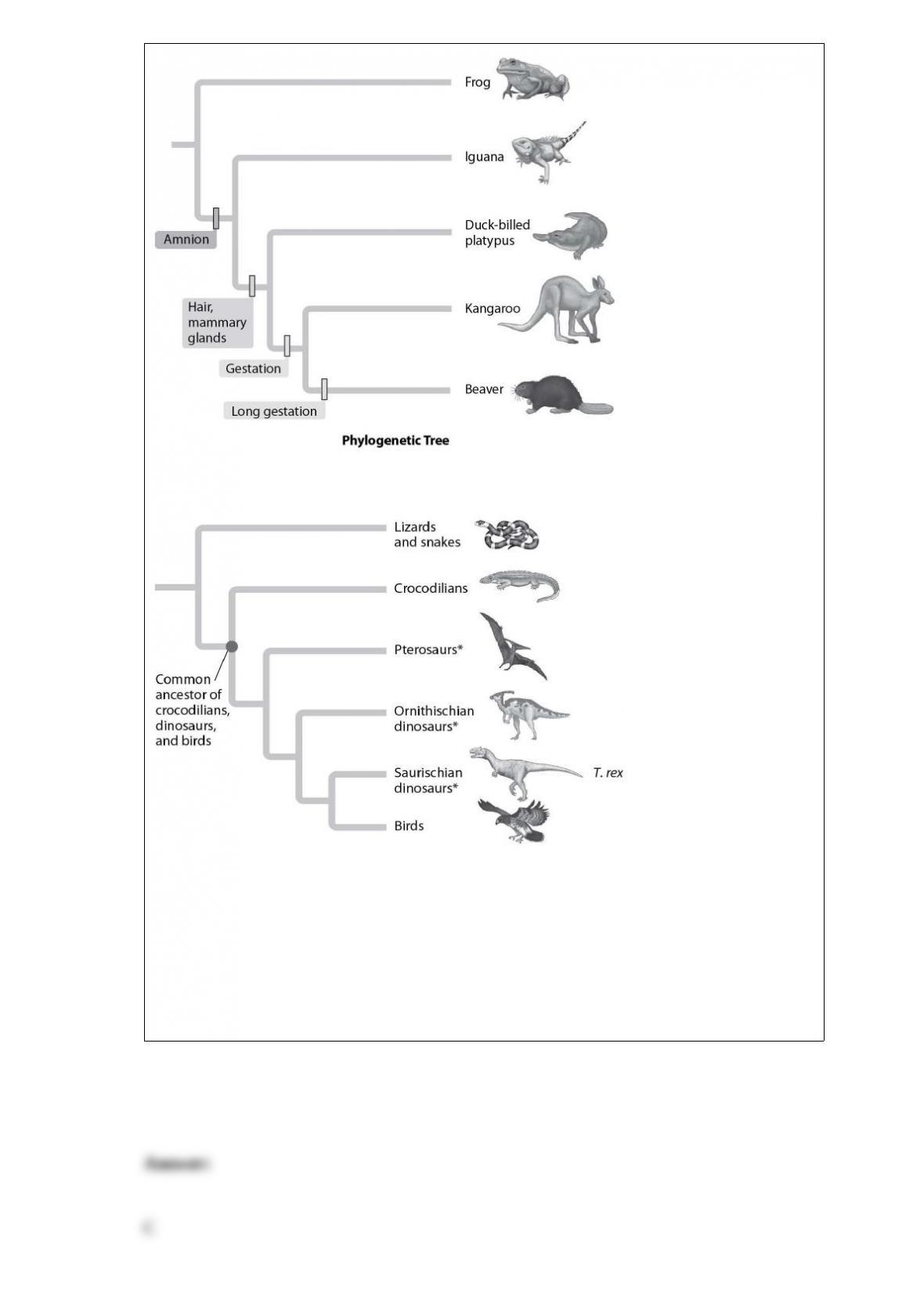
Below are phylogenetic trees of vertebrates (A) and reptiles (B). Using the data in these
models, what might a Tyrannosaurus rex taste like?
(A)
(B)
A) beef steak
B) frog legs
C) chicken legs
D) pork chops
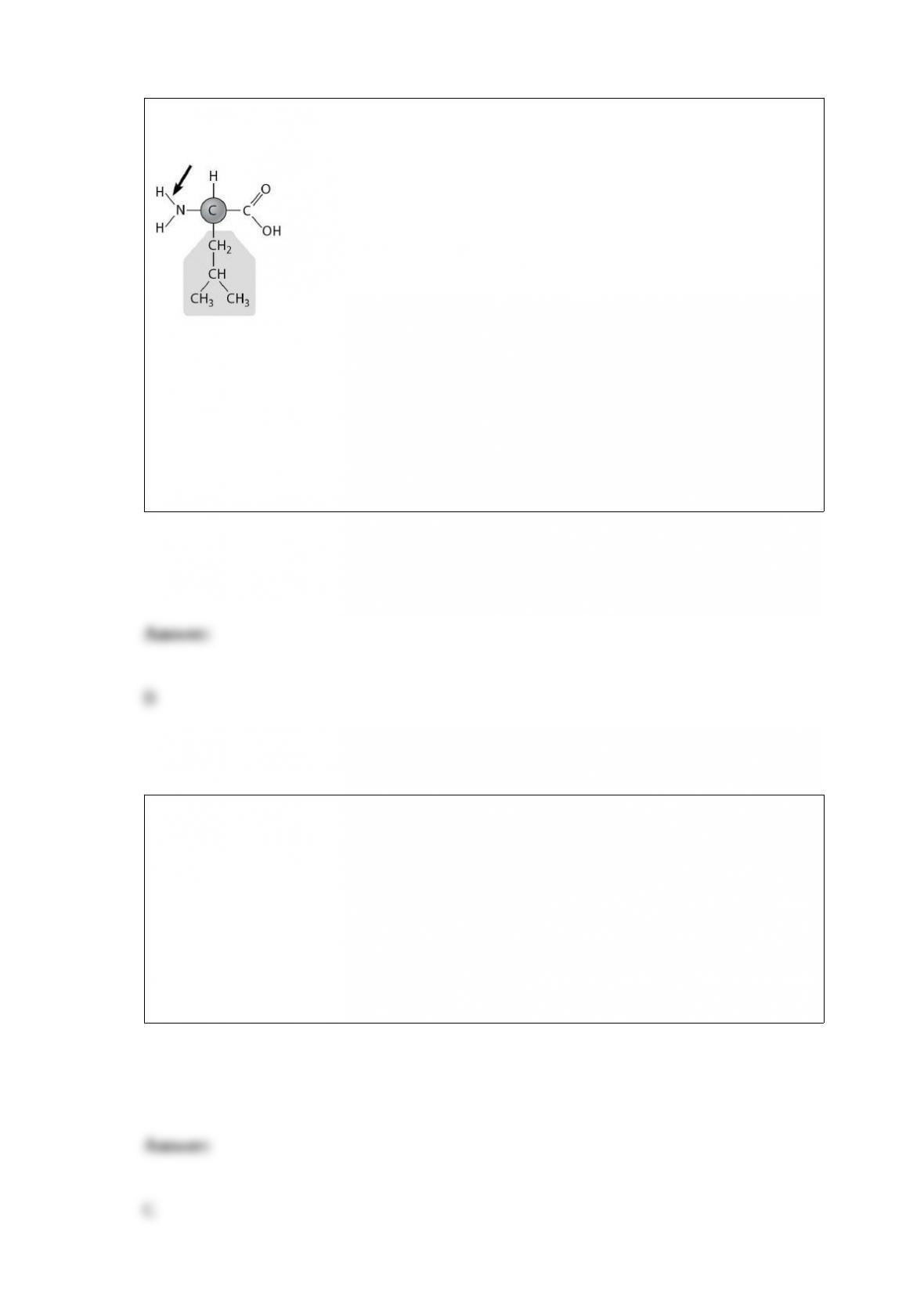
Below is the structure of leucine, an amino acid. What type of bond is the arrow
pointing to?
A) a nonpolar covalent bond
B) a polar covalent bond
C) an ionic bond
D) a hydrogen bond
Contractions in uterine smooth muscle during labor are initiated by
A) epinephrine.
B) estrogen.
C) oxytocin.
D) prolactin.