
Which of the following can be said about light in aquatic environments?
A) Water selectively reflects and absorbs certain wavelengths of light.
B) Longer wavelengths penetrate to greater depths.
C) Light penetration seldom limits the distribution of photosynthetic species.
D) Most photosynthetic organisms avoid the surface where the light is too intense.
Agrobacterium infects plants and causes them to form tumors. You are asked to
determine how long a plant must be exposed to these bacteria to become infected.
Which of the following experiments will provide the best data to address that question?
A) Determine the survival rate of Agrobacterium when exposed to different
concentrations of an antibiotic.
B) Measure the number of tumors formed on a plant when exposed to various
concentrations of Agrobacterium.
C) Measure the concentration of Agrobacterium in different soil environments where
the plants grow.
D) Measure the number of tumors formed on plants, which are exposed to
Agrobacterium for different lengths of time.

Statocysts contain cells that are _____.
A) mechanoreceptors used to detect orientation relative to gravity
B) chemoreceptors used in selecting migration routes
C) photoreceptors used in setting biological rhythms
D) thermoreceptors used in prey detection
If you gently bend your ear, and then let go, the shape of your ear will return because
the cartilage of your ear contains_____.
A) collagenous fibers
B) elastic fibers
C) reticular fibers
D) adipose tissue
Vinblastine, a drug that inhibits microtubule polymerization, is used to treat some forms
of cancer. Cancer cells given vinblastine would be unable to _____.
A) form cleavage furrows during cell division
B) migrate by amoeboid movement

C) separate chromosomes during cell division
D) maintain the shape of the nucleus
What role do chloride cells play in osmoregulation of marine fish with bony skeletons?
A) They actively transport chloride into the gills.
B) They mediate the movement of salt from seawater through their gills.
C) They are involved in excretion of excess salt.
D) They actively transport salt across the basolateral membrane of the rectal gland.
A significant contribution of intestinal bacteria to human nutrition is the benefit of
bacterial _____.
A) production of vitamins A and C
B) absorption of organic materials
C) production of vitamin K
D) recovery of water from fecal matter

What is metagenomics?
A) genomics as applied to a species that most typifies the average phenotype of its
genus
B) the sequencing of one or two representative genes from several species
C) the sequencing of only the most highly conserved genes in a lineage
D) sequencing DNA from a group of species from the same ecosystem
Kinetochore microtubules assist in the process of splitting centromeres by _____.
A) using motor proteins to split the centromere at specific arginine residues
B) creating tension by pulling toward opposite poles
C) sliding past each other like actin filaments
D) phosphorylating the centromere, thereby changing its conformation

When 10,000 molecules of ATP are hydrolyzed to ADP and i in a test tube, about half
as much heat is liberated as when a cell hydrolyzes the same amount of ATP. Which of
the following is the best explanation for this observation?
A) Cells are open systems, but a test tube is an isolated system.
B) Cells are less efficient at heat production than nonliving systems.
C) The reaction in cells must be catalyzed by enzymes, but the reaction in a test tube
does not need enzymes.
D) Reactant and product concentrations in the test tube are different from those in the
cell.
An injury to the occipital lobe will likely impair the function of the _____.
A) primary visual cortex
B) thalamus
C) sense of taste
D) sense of touch
The questions below refer to the following paragraph.
A sediment core is removed from the floor of an inland sea. The sea has been in
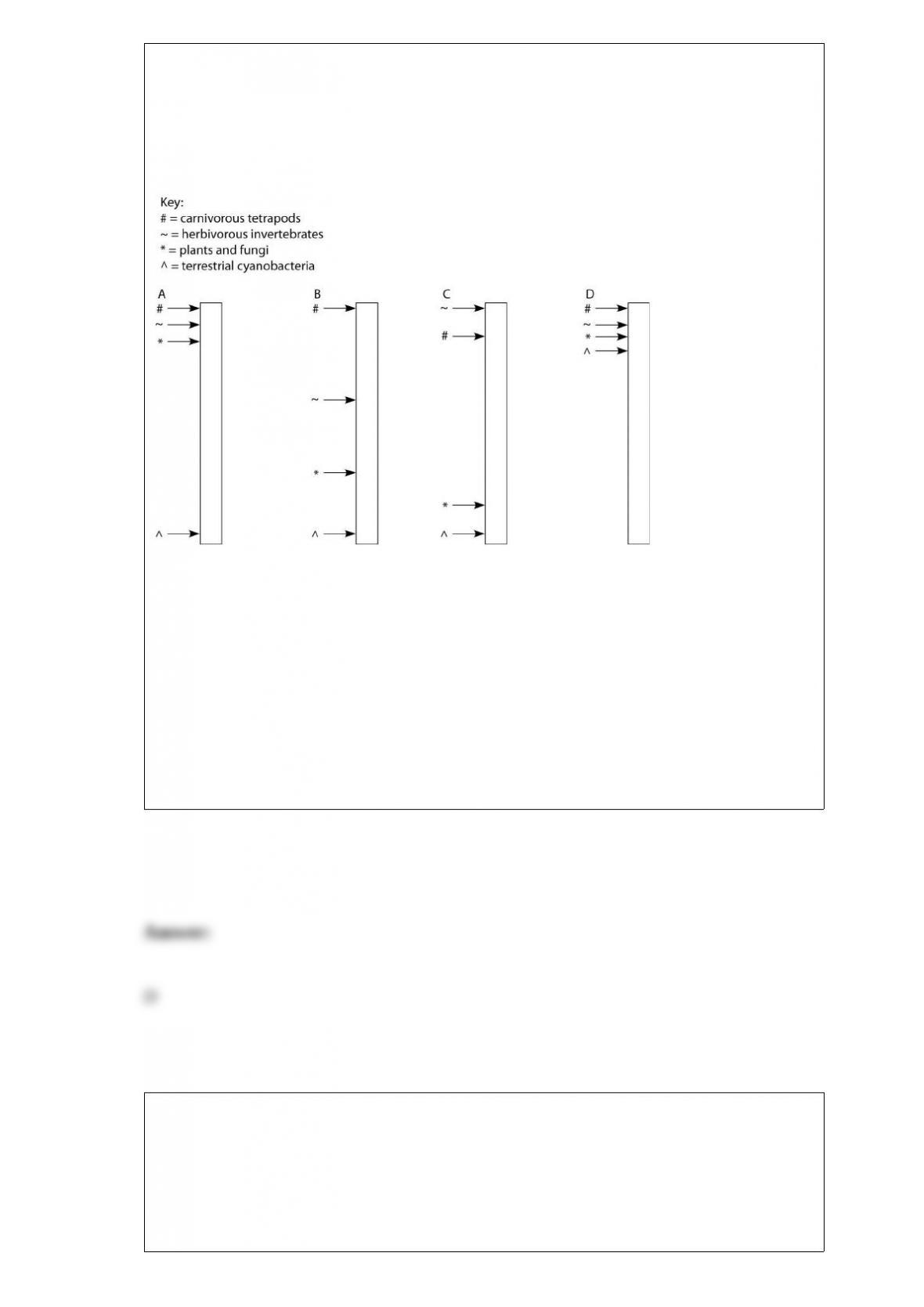
existence, off and on, throughout the entire time that terrestrial life has existed.
Researchers wish to locate and study the terrestrial organisms fossilized in this core.
The core is illustrated as a vertical column, with the top of the column representing the
most recent strata and the bottom representing the time when land was first colonized
by life.
Which factor most likely caused animals and plants in India to differ greatly from
species in nearby southeast Asia?
A) The climates of the two regions are similar.
B) India is in the process of separating from the rest of Asia.
C) Life in India was wiped out by ancient volcanic eruptions.
D) India was a separate continent until forty-five million years ago.
Use the following information to answer the question(s) below.
Researchers studying a small milkweed population note that some plants produce a
toxin and other plants do not. They identify the gene responsible for toxin production.
The dominant allele (T) codes for an enzyme that makes the toxin, and the recessive
allele (t) codes for a nonfunctional enzyme that cannot produce the toxin.

Heterozygotes produce an intermediate amount of toxin. The genotypes of all
individuals in the population are determined (see chart) and used to determine the actual
allele frequencies in the population.
Refer to the figure above. Is this population in Hardy-Weinberg equilibrium?
A) Yes.
B) No; there are more heterozygotes than expected.
C) No; there are more homozygotes than expected.
D) More information is needed to answer this question.
A necropsy (postmortem analysis) of a marine sea star that died after it was mistakenly
placed in fresh water would likely show that it died because _____.
A) it was stressed and needed more time to acclimate to the new conditions
B) it was so hypertonic to the fresh water that it could not osmoregulate
C) its contractile vacuoles ruptured
D) its cells dehydrated and lost the ability to metabolize

Use the following information to answer the question(s) below.
Paulinella chromatophora is one of the few cercozoans that is autotrophic, carrying out
aerobic photosynthesis with its two elongated “chromatophores.” The chromatophores
are contained within vesicles of the host cell, and each is derived from a
cyanobacterium, though not the same type of cyanobacterium that gave rise to the
chloroplasts of algae and plants.
P. chromatophora secretes around itself a test, or case, of plates made of silica. Which
of the following is another rhizarian that would be in competition with P.
chromatophora for the silica needed to make these plates, assuming limited quantities
of silica in the environment?
A) radiolarians
B) foraminiferans
C) dinoflagellates
D) diatoms
The free energy for the oxidation of glucose to CO2 and water is -686 kcal/mol and the
free energy for the reduction of NAD+ to NADH is +53 kcal/mol. Why are only two
molecules of NADH formed during glycolysis when it appears that as many as a dozen
could be formed?
A) Most of the free energy available from the oxidation of glucose is used in the
production of ATP in glycolysis.
B) Glycolysis is a very inefficient reaction, with much of the energy of glucose released
as heat.
C) Most of the free energy available from the oxidation of glucose remains in pyruvate,
one of the products of glycolysis.
D) There is no CO2 or water produced as products of glycolysis.

One of the complications of Alzheimer’s disease is an interference with learning and
memory. This disease would most likely involve _____.
A) changes in the concentration of ions in the extracellular fluid surrounding neurons
B) changes in myelination of axons
C) molecular and structural changes at synapses
D) structural changes to ion channels in axons
In prokaryotes new mutations accumulate quickly in populations, while in eukaryotes
new mutations accumulate much more slowly. The primary reasons for this are
A) Prokaryotes have short generation times and large population sizes.
B) Prokaryotes have random mutations while eukaryotes can target genes for mutations;
thus mutations may not accumulate as quickly in eukaryotes but they are more useful to
the organism.
C) The DNA in prokaryotes is not as stable as eukaryotic DNA and is thus more likely
to mutate.
D) Prokaryote mutations are less effective than eukaryote mutations in providing
variation for evolution.

Digestive secretions with a pH of 2 are characteristic of the _____.
A) small intestine
B) stomach
C) pancreas
D) liver
Use the following information to answer the question(s) below.
Trichoplax adhaerens (Tp) is the only living species in the phylum Placozoa.
Individuals are about 1 mm wide and only 27 μm high, are irregularly shaped, and
consist of a total of about 2000 cells, which are diploid (2n = 12). There are four types
of cells, none of which are nerve or muscle cells, and none of which have cell walls.
They move using cilia, and any “edge” can lead. Tp feeds on marine microbes, mostly
unicellular green algae, by crawling atop the algae and trapping it between its ventral
surface and the substrate. Enzymes are then secreted onto the algae, and the resulting
nutrients are absorbed. Tp sperm cells have never been observed, nor have embryos
past the 64-cell (blastula) stage.
Which of the following Tp traits is different from all other known animals?
A) Tp is multicellular.
B) Tp lacks muscle and nerve cells.
C) Tp has cilia.
D) Tp lacks cell walls.

Hormones secreted by the posterior pituitary gland are made in the _____.
A) cerebrum
B) cerebellum
C) thalamus
D) hypothalamus
Hair cells in the vertebrate ear are responsible for transducing sound pressure waves.
Ion channels in the hair cell membrane open when _____.
A) a chemical ligand binds to the ion channel
B) light is absorbed by a molecule in the membrane
C) the cell membrane reaches a threshold voltage
D) the membrane is distorted mechanically
Ecosystem services include processes that increase the quality of the abiotic
environment. Which of the following processes would fall under this category?
I) Keystone predators have a marked effect on species diversity.
II) Green plants produce the oxygen we breathe.
III) The presence of land plants builds soil.
IV) The presence of diverse wetlands helps in flood control.
A) only I and III
B) only II and IV
C) only I, II, and IV
D) only II, III, and IV
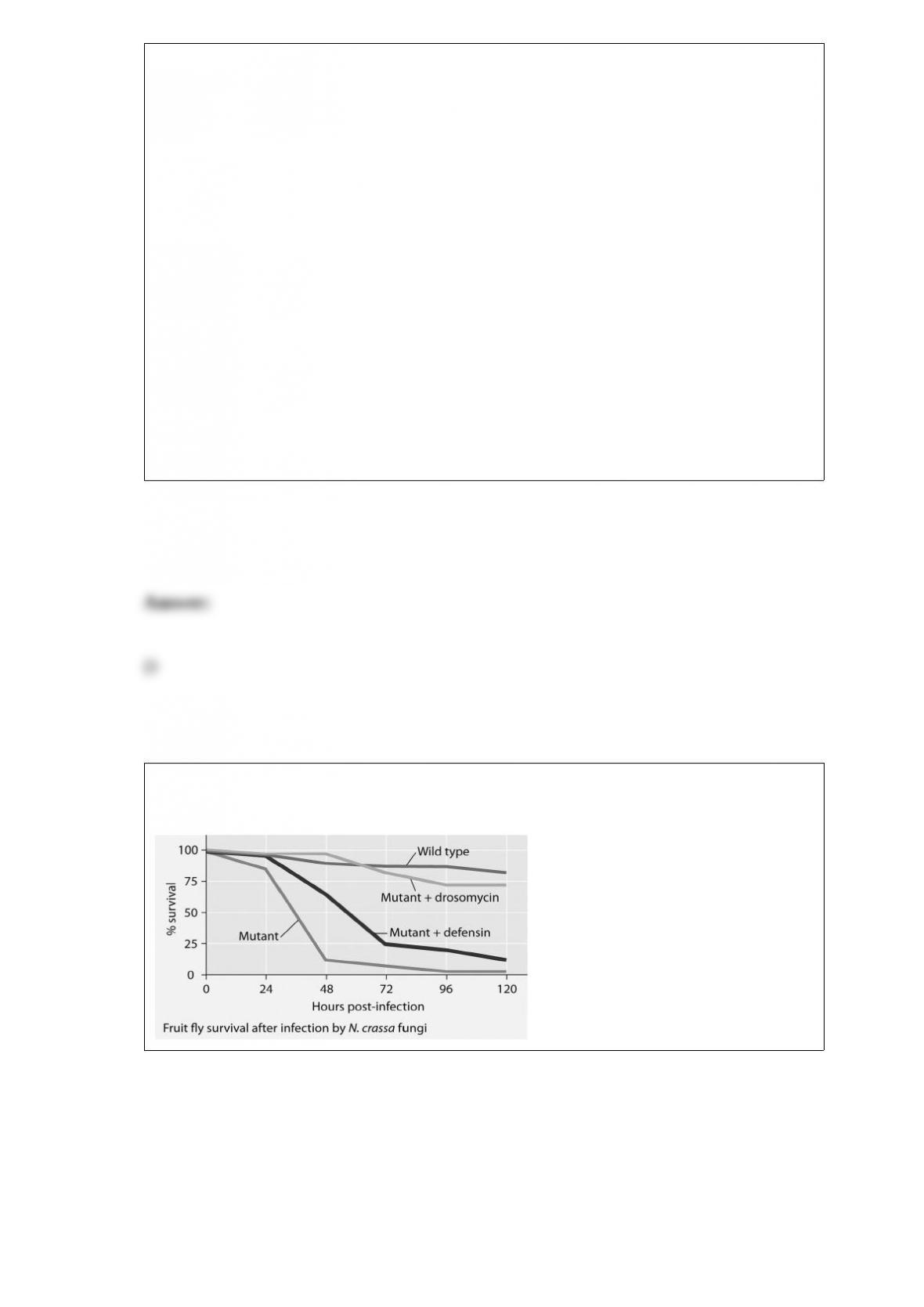
Mutant fruit flies that make only one antimicrobial peptide were tested for survival after
infection with Neurospora crassa fungi or with Micrococcus luteus bacteria.

The results shown in the graphs support the hypothesis that _____.
A) adding the defensin gene to such mutants protects them from death by fungal
infection
B) adding the drosomycin gene to such mutants protects them from death by fungal
infection
C) wild-type flies with the full set of genes for antimicrobial peptides are highly
susceptible to these infective agents
D) the presence of any single antimicrobial peptide protects against both infective
agents
For a plant to initiate chemical responses to herbivory, before it is directly affected by
herbivores,_____.
A) a plant must have already flowered at least once
B) volatile ‘signal” compounds must be perceived
C) gene-for-gene intraspecific recognition must occur
D) phytoalexins must be released

Which of these statements accurately describes a similarity between sharks and
ray-finned fishes?
A) They are equally able to exchange gases with the environment while stationary.
B) They are highly maneuverable due to their flexibility.
C) They have a lateral line that is sensitive to vibrations.
D) A swim bladder helps control buoyancy.
Use the following information to answer the question(s) below.
Big Bend National Park in Texas is mostly Chihuahuan desert, where rainfall averages
about 10 inches per year. Yet, it is not uncommon when hiking in this bone-dry desert to
encounter mosses and ferns. One such plant is called “flower of stone.” It is not a
flowering plant, nor does it produce seeds. Under arid conditions, its leaflike structures
curl up. However, when it rains, it unfurls its leaves, which form a bright green rosette
on the desert floor. Consequently, it is sometimes called the “resurrection plant.” At first
glance, it could be a fern, a true moss, or a spike moss.
Which of the following features is most important for true mosses and ferns to
reproduce in the desert?
A) that the sporophytes occupy only permanently shady, north-facing habitats
B) that the sporophytes hug the ground, growing no taller than a couple of inches
C) either that their gametophytes grow close together, or that they be hermaphroditic
D) that the sporophytes have highly lignified vascular tissues

DNA is synthesized through a process known as _____.
A) semiconservative replication
B) conservative replication
C) translation
D) transcription
The fluid with the highest osmolarity is _____.
A) distilled water
B) plasma in birds
C) plasma in mammals
D) seawater in a tidal pool

Movement of the chromosomes during anaphase would be most affected by a drug that
prevents _____.
A) nuclear envelope breakdown
B) elongation of microtubules
C) shortening of microtubules
D) formation of a cleavage furrow
In terms of alternation of generations, the internal parts of the pollen grains of
seed-producing plants are most similar to a _____.
A) moss sporophyte
B) moss gametophyte bearing both male and female gametangia
C) fern sporophyte
D) fern gametophyte bearing only antheridia
Adult male humans generally have deeper voices than do adult female humans, which
is the direct result of higher levels of testosterone causing growth of the larynx. If the
fossil records of apes and humans alike show a trend toward decreasing larynx size in
adult females and increasing larynx size in adult males, then _____.

A) sexual dimorphism was evolving over time in these species
B) intrasexual selection seems to have occurred in both species
C) stabilizing selection was occurring in these species concerning larynx size
D) selection was acting more directly upon genotype than upon phenotype
A hypothetical island lies far from any other landmasses. There are many different types
of plants, but only one animal, a beetle, that can fly or walk from plant to plant and
feeds by chewing leaves. Given that the beetle is not exploiting all of the resources on
the island, which morphological change would be most likely to trigger an adaptive
radiation of the beetles?
A) a change in wing shape that improves flight speed
B) an additional segment on a pair of legs
C) a mouthpart that can pierce fruits and seeds
Which of the following root tissues gives rise to lateral roots?
A) endodermis
B) phloem
C) epidermis

D) pericycle