
In contrast with euchromatin, heterochromatin contains more genes and is earlier
replicating.
Transcription factors are proteins with at least two functional domains”one that binds to
DNA and one that binds to RNA polymerase or to other transcription factors.
When considering the structure of DNA, we would say that complementary strands are
antiparallel.
If two gene loci are on nonhomologous chromosomes, genes at these loci are expected
to assort independently.

When referring to tumor-suppressor genes and cancer, loss of heterozygosity is likely to
suppress cancer formation.
In large random mating populations, random genetic drift is usually a significant factor
in changing gene frequencies.
The term expressivity defines the percentage of individuals who show at least some
degree of expression of a mutant genotype.

Alternative RNA processing can result in different mRNAs that start with different
exons.
DNA strand replication begins with an RNA primer.
The ribonucleic acid components known to exist in eukaryotic ribosomes are the
following: 5.8S, 18S, 28S, and 5S.
The enzyme permease cleaves the linkage between glucose and galactose residues in
lactose.

The multiple factor hypothesis suggests that many factors or genes contribute to the
phenotype in a cumulative or quantitative manner.
Expressivity is the term used to describe the balanced genetic output from a hemizygous
condition.
Bacterial genes have introns, and eukaryotic genes lack introns.

Individuals with familial Down syndrome are trisomic and have 47 chromosomes.
Sickle-cell anemia is caused by the absence of the alpha chain of hemoglobin.
Mitochondrial ribosomes are responsible for determining the learning and memory
development in Drosophila.
“Gain of function” mutations are generally dominant since one copy in a diploid
organism is sufficient to alter the normal phenotype.

Penetrance specifically refers to the expression of lethal genes in heterozygotes.
Sex-limited inheritance is the same as sex-linked inheritance.
A nucleosome is a structure associated with the nuclear membrane. It helps maintain a
stable relationship between the extracellular matrix and the membrane itself.
An expected meiotic pairing configuration in a triploid would be a trivalent.

When a metabolic block occurs in a biochemical pathway, it is common for amount of
the substance immediately prior to that block to increase.
Telomerase is an enzyme involved in the replication of the ends of eukaryotic
chromosomes.
Mendel predicted that some genes will be carried in the same chromosome.

The terms proteomics and genomics mean essentially the same thing.
Normally in humans, all the sons of a male showing a sex-linked phenotype will inherit
the trait.
A 5″-cap describes the addition of a base, usually thymine, to the 5″ end of a completed
peptide.
A typical XX human female has one Barr body.

It appears as if the direction of shell coiling in Lymnaea peregra is influenced by the
orientation of the first cleavage division.
An upstream activator sequence (UAS) can function at variable distances and in either
orientation. However, it differs from an enhancer in that it cannot function downstream
of the transcription starting point.
Deoxyribonuclease is an enzyme that adds 3″-hydroxyl groups to RNA.

In mice, there is a set of multiple alleles of a gene for coat color. Four of those alleles
are as follows:
C = full color (wild)
cch = chinchilla
cd= dilution
c = albino
Given that the gene locus is not sex-linked and that each allele is dominant to those
lower in the list, diagram the crosses indicated below and give the phenotypic ratios
expected from each.
a) wild (heterozygous for dilution) x chinchilla (heterozygous for albino)
b) chinchilla (heterozygous for albino) x albino
Transduction is a form of recombination in bacteria that involves ________.
A) 5-bromouracil
B) plasmids
C) bacteriophages
D) fertility factors
E) physical contact between the bacteria involved

What is the initiator triplet in both prokaryotes and eukaryotes? What amino acid is
recruited by this triplet?
A) UAA; no amino acid called in
B) UAA or UGA; arginine
C) AUG; arginine
D) AUG; methionine
E) UAA, methionine
Compared with prokaryotic chromosomes, eukaryotic chromosomes are ________.
A) large, mainly organized in single gene transcription units without introns
B) small, mainly organized in single gene transcription units with introns
C) large, mainly organized in polygenic transcription units without introns
D) small, mainly organized in polygenic transcription units without introns
E) large, linear, less densely packed with protein-coding genes, mainly organized in
single gene units with introns

Approximately one in5000 humans either have a mitochondrial DNA disorder or are at
risk for developing such a disorder. What future approach involving nuclear
transplantation might be available to treat mtDNA-based human disorders?
A) nuclear disintegration
B) mitochondrial swapping
C) nuclear activation
D) mitochondrial activation
E) mitochondrial suppression
Which of the following groups of scientists were influential around the year 1900 in
setting the stage for our present understanding of transmission genetics?
A) Beadle, Tatum, Lederberg
B) Watson, Crick, Wilkins, Franklin
C) de Vries, Correns, Tschermak, Sutton, Boveri
D) Darwin, Mendel, Lamarck
E) Hippocrates, Aristotle, Klreuter

Dentinogenesis imperfecta is a rare, autosomal, dominantly inherited disease of the
teeth that occurs in about one in 8000 people (Witkop 1957). The teeth are somewhat
brown in color, and the crowns wear down rapidly. Assume that a male with
dentinogenesis imperfecta and no family history of the disease marries a woman with
normal teeth. What is the probability that
a) their first child will have dentinogenesis imperfecta?
b) their first two children will have dentinogenesis imperfecta?
c) their first child will be a girl with dentinogenesis imperfecta?
Normal diploid somatic (body) cells of the mosquito Culex pipiens contain six
chromosomes. Assign the symbols AmAp, BmBp, and CmCp to the three homologous
chromosomal pairs. The “m” superscript indicates that the homolog is maternally
derived; the “p” indicates a paternally derived homolog. Assume that in the genus
Culex, the sex chromosomes are morphologically identical.
a) For each of the cell types given below, draw and label (with reference to the symbols
defined above) an expected chromosomal configuration.
Mitotic metaphase
Metaphase of meiosis I
Metaphase of meiosis II
b) The stage at which “sister chromatids go to opposite poles” immediately follows
which of the stages listed in (a)?
c) Assuming that all nuclear DNA is restricted to chromosomes and that the amount of
nuclear DNA essentially doubles during the S phase of interphase, how much nuclear
DNA would be present in each cell listed above? Note: Assume that the G1 nucleus of a
mosquito cell contains 3.0 x 10⁻¹² grams of DNA.
d) Given that the sex of Culex is determined by alleles of one gene, males heterozygous,
Mm, and females homozygous, mm, illustrate a labeled chromosomal configuration
(involving the symbols AmAp, BmBp, and CmCp and the M locus) in a primary
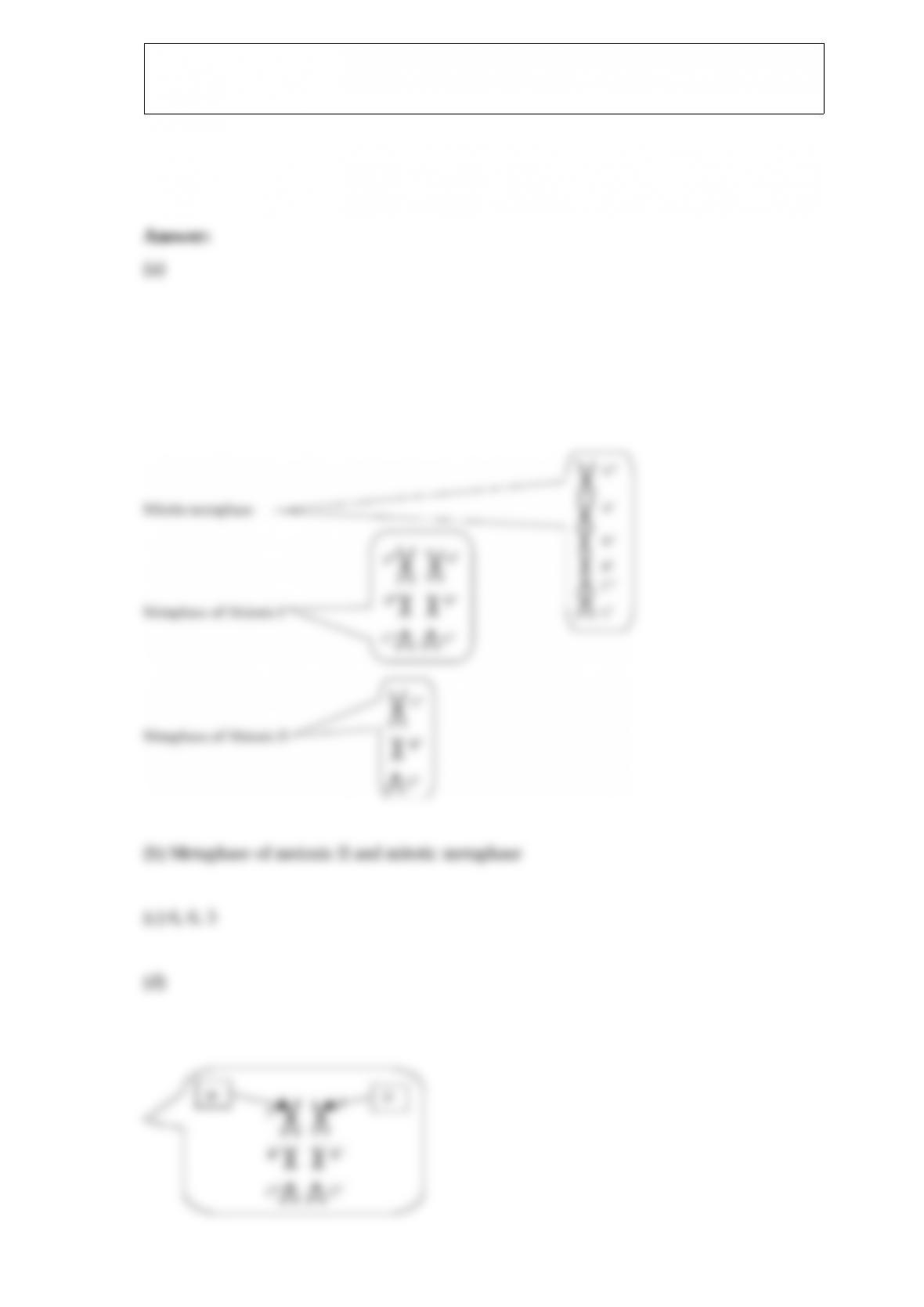
spermatocyte at metaphase. Assume that the M locus is on the AmAp chromosome and
that crossing over has not occurred between the M locus and the centromere.

Typically, bacterial DNA contains less repetitive DNA than eukaryotic DNA.
What two terms apply to the fusion of cultured human and mouse cells that produces
cell lines that are useful in assigning a gene to a particular human chromosome?
A) forward and reverse
B) lod score and pod score
C) heterokaryon and synkaryon
D) single and double
E) positive and negative
Which types of phenotypic ratios are likely to occur in crosses when dealing with two
gene pairs for which all the genotypic combinations are of equal viability?
A) 9:3:3:1
B) 1:2:1, 3:1
C) 6:6:2
D) 12:2:2

E) 2:3, 1:2
If one compares the base sequences of related genes from different species, one is likely
to find that corresponding ________ are usually conserved, but the sequences of
________ are much less well conserved.
A) exons; introns
B) introns; exons
C) introns; chaperons
D) chaperons; exons
E) introns; proteins
Three major types of RNAs are mRNA, rRNA, and tRNA. For each of the conditions
below predict the consequences in terms of the population of proteins being synthesized
in a particular cell. What qualitative and quantitative changes, if any, are expected in the
individual protein involved (if one is involved) and in the population of proteins
produced in that cell?
a) A frameshift mutation in mRNA. The condition is heterozygous in the involved cell.
b) A deletion (homozygous) that removes approximately half of the rRNA genes.

Transcription factors function to help move ribosomes along the mRNA.
A mutation in a gene often results in a reduction of the product of that gene. The term
for this type of mutation is ________.
A) codominance
B) incomplete dominance
C) gain of function
D) multiple allelism
E) loss of function or null (in the case of complete loss)

The condition that exists when an organism gains or loses one or more chromosomes
but not a complete haploid set is known as ________.
A) polyploidy
B) euploidy
C) aneuploidy
D) triploidy
E) trisomy
What is a major problem that arises in the study of the genetic basis of human
behavior?
A) Memories of individuals are unreliable.
B) People are too short lived.
C) Behaviors are difficult to define objectively.
D) The environment plays no role in behavioral expression.
E) The environment is the only factor that determines human behavior.
In which of the following biochemical reactions is it common to use ddNTPs
(dideoxyribonucleoside triphosphates)?
A) citric acid cycle
B) DNA sequencing
C) restriction digestion
D) electron transport
E) plasmolysis
Below are several phenomena relating to protein structure. Clearly describe each
phenomenon, the conditions under which each occurs, and the probable influence each
has on protein structure.
(a) hydrophobic interactions
(b) hydrogen bonds
(c) disulfide bridges

A situation in which there are more than two alternative forms of a given gene would be
called ________.
A) multiple alleles
B) alternation of generations
C) codominance
D) incomplete dominance
E) hemizygosity
Barbara McClintock discovered mobile elements in corn by analyzing the genetic
behavior of two elements, Ds and Ac. The interplay between these two elements has
become one of the most interesting stories of discovery in the field of genetics. How do
Ds and Ac interact?
A) Ds causes a deletion next to the insertion site of Ac.
B) Ac causes a deletion next to the insertion site of Ds.
C) While Ds moves only if Ac is present in the genome, Ac is capable of autonomous
movement.
D) The movement of Ac is dependent on two forms of Ds.
E) Both elements can move only within chromosome 9.
Three major types of RNAs are mRNA, rRNA, and tRNA. For each of the conditions
below, predict the consequences in terms of the population of proteins being
synthesized in a particular cell. What qualitative and quantitative changes, if any, are
expected in the individual protein involved (if one is involved) and in the population of
proteins in this cell?
(a) An acridine dye-induced mutation (adds or deletes single bases in DNA) leads to an
mRNA for one protein-producing gene. The condition is heterozygous in the involved
cell.
(b) A deletion (homozygous) that removes approximately half of the rRNA genes.
Viral chromosomes exist in a variety of conformations and can be made up of
________.
A) protein- or lipid-coding sequences
B) DNA only
C) DNA or RNA
D) RNA only
E) DNA, RNA, or protein

What are the two major components of the Tobacco Mosaic Virus?
A) RNA and DNA
B) DNA and protein
C) RNA and protein
D) lipids and nucleic acids
E) carbohydrates and nucleic acids
Refer to the accompanying diagram of a generalized tetranucleotide to answer questions
(a) through (e).
(a) Is this a DNA or an RNA molecule?
(b) Place an “X” (in one of the circles in the diagram) at the 3″ end of this
tetranucleotide.
(c) Given that the DNA strand, which served as a template for the synthesis of this
tetranucleotide, was composed of the bases 5″ A C A G 3″, fill in the parentheses (in the
diagram) with the expected bases.
(d) Suppose that one of the precursors for this tetranucleotide was a 32P-labeled guanine
nucleoside triphosphate (the innermost phosphate containing the radioactive
phosphorus). Circle the radioactive phosphorus atom as it exists in the tetranucleotide.
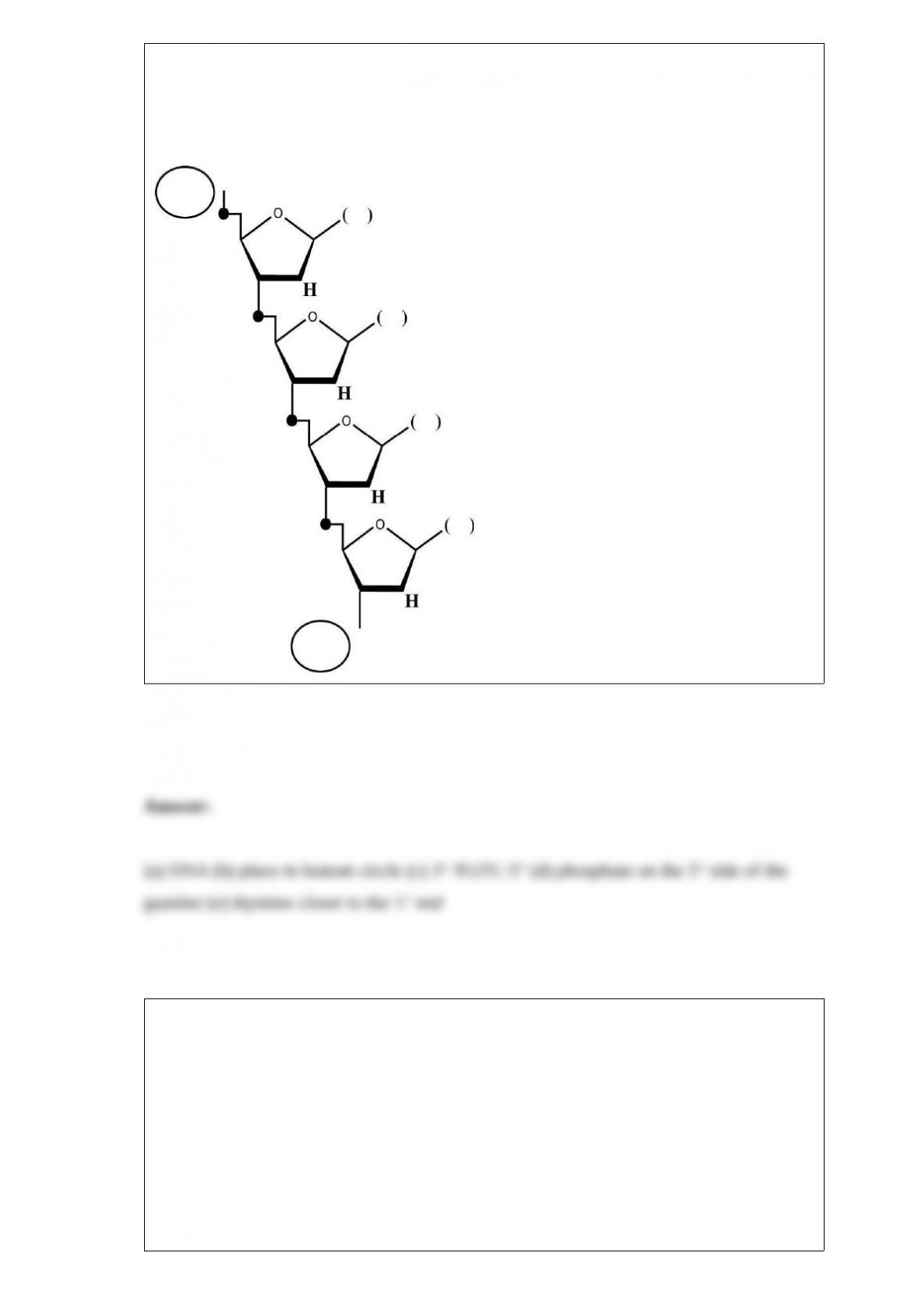
(e) Given that spleen diesterase (breaks between the phosphate and the 5″ carbon)
digests the pictured tetranucleotide, which base(s) among the breakdown products
would be expected to be attached to the 32P?
Klinefelter syndrome in humans, which leads to underdeveloped testes and sterility, is
caused by which chromosomal condition?
A) 47, XXY
B) 47, 21+
C) 45, X
D) 47, XYY

E) triploidy
Which of the following characteristics do SNPs have?
A) variable amino acid substitutions, highly heterogeneous
B) variable numbers of tandem repeats, highly uniform in the population
C) variable base sequences, variable in the population
D) various nucleotides transcribed repeatedly, homogeneous
E) small noteworthy transcribed regions, lethal genes
Assume that a given plasmid vector to be used in a cloning experiment contains 4000
base pairs of DNA. Assume also that the restriction endonuclease Cuj cuts this plasmid
at the following sites (starting from an arbitrary zero point): 1000, 1500, and 3000.
Given complete digestion of the plasmid with the endonuclease so that only linear
fragments are produced, what sizes of DNA are expected?

Through the study of mitochondrial disorders, scientists have suggested a link between
the decline of mitochondrial function and aging. What process appears to be involved in
this suspected phenomenon?
A) accumulation of sporadic mutations in the nuclear genome
B) decline of mutations in the nuclear genome
C) accumulation of mutations in the mtDNA
D) recombination of mtDNA and nuclear DNA
E) recombination among mtDNAs of different mitochondria
What are two typical testcross ratios?
Name two mammalian traits with relatively high heritability (h2) values and two with
relatively low h2 values.
Klinefelter and Turner syndromes have how many chromosomes, respectively?
Experiments involving nuclear transplantation in amphibians indicate that nuclei
derived from blastula are more likely to support development of complete and normal
adults compared with those derived from later stages of development. What do these
experiments tell us about the process of development?
How were insertion sequences (IS elements) first discovered?

Assume that a dihybrid cross (AaBb x AaBb) is made in which the gene loci are
autosomal, independently assorting, and incompletely dominant. What phenotypic ratio
would you expect from such a cross? Just provide the ratio, not the phenotypes.
In the context of molecular genetics, how does one reconcile the terms overlapping
genes and nonoverlapping code?
What are the name and formula for describing sample variability?

List at least three posttranslational modifications known to occur as a newly
synthesized protein matures.
Two lines of work indicated that crossing over actually involves breakage and reunion
of chromatid material. What organisms were involved, and who did the work?
What are the approximate positions of consensus sequences (modular elements) at the
5″ end of eukaryotic genes?

Which class of protein functions primarily by lowering the energy of activation during a
reaction?
Suppose that a given gene undergoes a mutation to a dominant allele such that 2 out of
100,000 offspring exhibit the new mutant phenotype. Assuming that these offspring are
heterozygous, what is the mutation rate for the gene?
If someone has a predisposition to cancer, what genetic circumstance likely exists?
Meselson and Stahl determined that DNA replication in E coli is semiconservative.
What additive did they initially supply to the medium in order to distinguish “new”
from “old” DNA?

Assume that a Chi-square test was conducted to test the goodness of fit to a 9:3:3:1
ratio and a Chi-square value of 10.62 was obtained. Should the null hypothesis be
accepted?
List three abnormalities involving numbers of X chromosomes.
What are histones, and how are they arranged in nucleosomes?
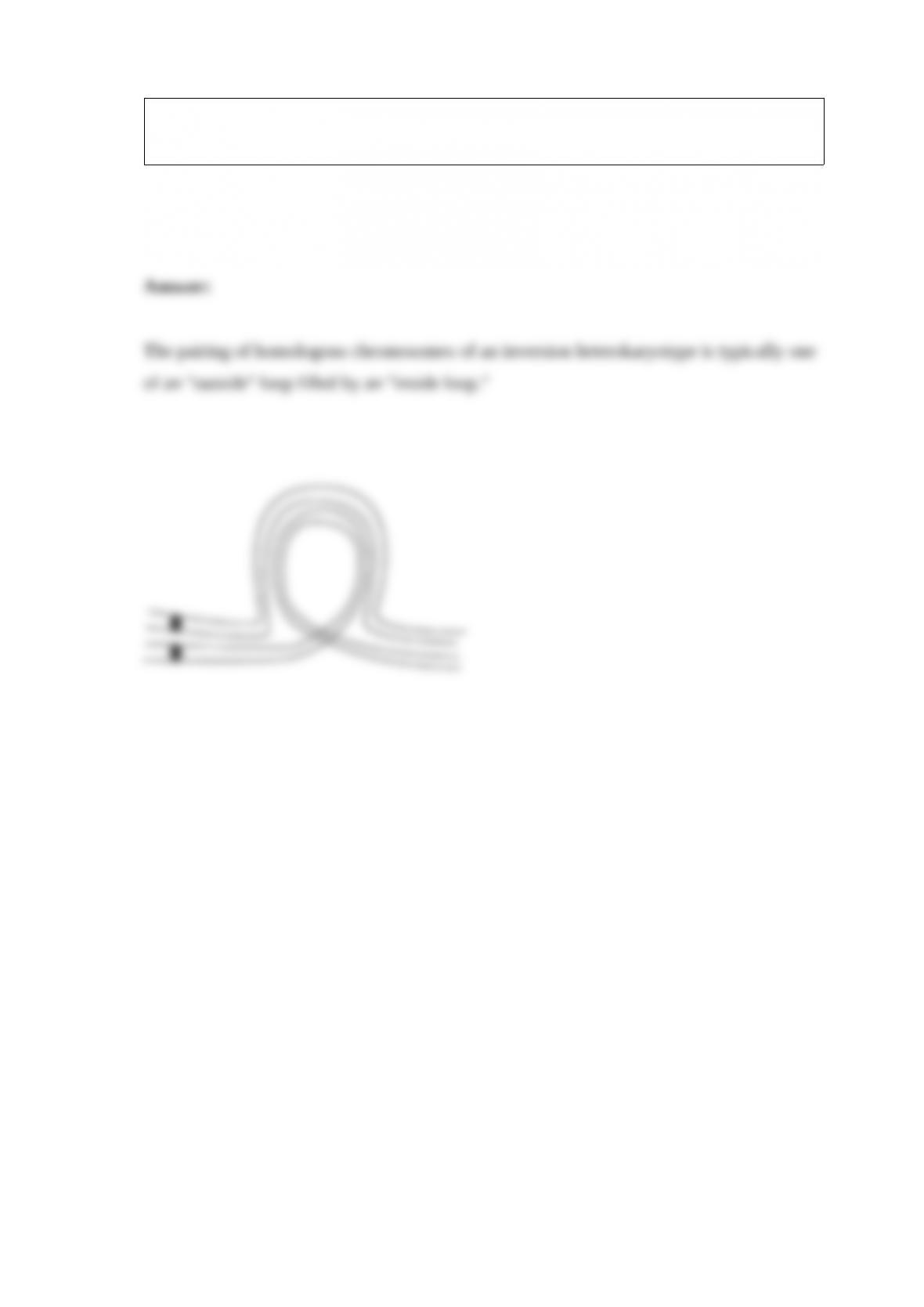
Clearly illustrate the pairing configuration of an inversion (paracentric)
heterokaryotype.