
Read the following scenario to answer the following question(s).
Endotoxins are commonly found in the air, both inside and outside our homes. These
“air endotoxins” can come from sources that include house dust mites, agricultural and
industrial dust, and dust from indoor pets. Air endotoxins are typically found in low
amounts, but production of them can increase dramatically under specific
environmental conditions such as dampness, mold, and sewage. Many scientific studies
have been conducted investigating possible links between indoor endotoxin levels and
asthma, chronic bronchitis, and other upper respiratory diseases. Interestingly, some
studies have found positive correlations between indoor endotoxin exposure and
severity of some of these diseases while other studies have suggested that some air
endotoxin exposure can actually decrease the risk of developing asthma in children.
Additionally, data suggests that industrial workers who are exposed to endotoxins in the
air can develop irreversible lung damage.
In 2005, Hurricane Katrina devastated the eastern coastline of the United States. The
state of Louisiana, and in particular the city of New Orleans, experienced tragic loss of
human life and homes due to the failure of the levee system. Intense flooding destroyed
homes and created severe exposure to wet, moldy surfaces. At that time there were no
regulations in existence on the amount of exposure that individuals should have to air
endotoxins. Scientists from the Natural Resources Defense Council who wanted to
determine if endotoxin levels had risen in New Orleans, conducted tests across 12
outdoor areas, 9 of which had been significantly flooded while the other 3 were less
affected. Two indoor areas were also sampled for endotoxin levels. No significant
differences were found in endotoxin levels between the flooded and non-flooded areas
or between the indoor and outdoor areas. However, a limited number of samples were
collected, and they were taken after a recent dry spell. Endotoxin levels at all sites were
found to be higher than national average levels but were lower than levels typically
associated with long-term changes in lung function.
What is an implication of the fact that tests were conducted after a period of dry
weather?
A) Dry weather creates harsher sampling conditions for scientists.
B) If more periods of rainfall occur after the testing, bacteria that secrete endotoxins
may increase, thereby increasing endotoxin levels.
C) Dry weather increases the amount of carbon available for the endotoxin bacteria to
use for organic compound production.
D) The endotoxin bacteria are better able to be used for bioremediation efforts in dry
weather than in wet weather.
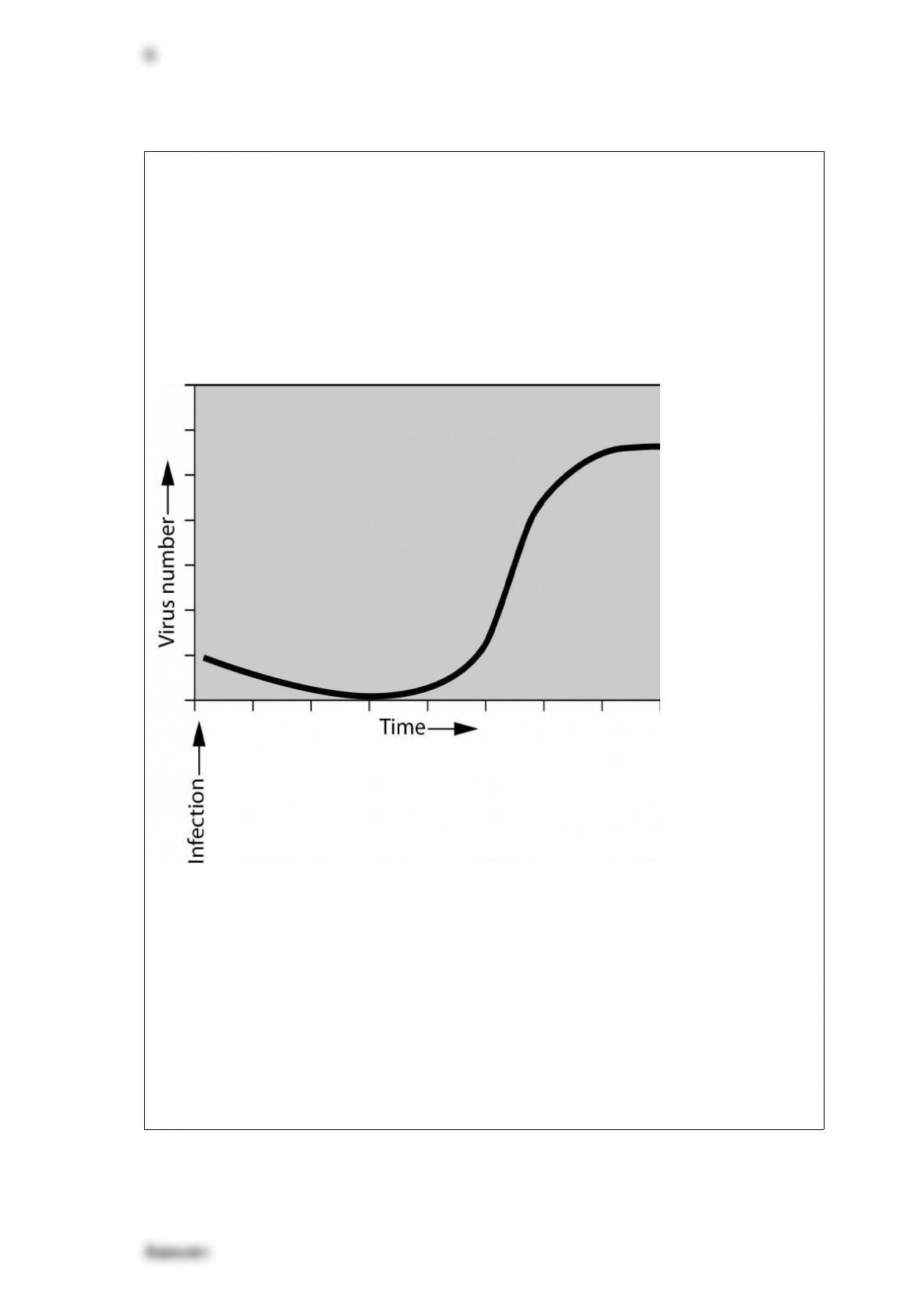
Please read the following scenario to answer the following questions
If you were asked to study the pattern of bacterial growth (increase in numbers over
time) during an infection, you would find that numbers of bacteria increase
exponentially up to a certain point. Assume that you have been asked to interpret the
growth of bacteriophages. You infect the host bacteria and measure the increase of
phages over a defined period of time. You plot the results and get the graph shown here.
Once viruses are detected, the number of viruses increases rapidly. This is because
________.
A) lysogeny produces large numbers of bacteriophages
B) DNA viruses reproduce more rapidly than RNA viruses
C) the host cell speeds the release process
D) the viruses lyse the hosts to release mature viruses quickly in a short amount of time

What structure do lobsters use for gas exchange?
A) gills
B) lungs
C) skin
D) tracheae
Thymine and cytosine differ from adenine and guanine in that ________.
A) thymine and cytosine are single-ring structures, whereas adenine and guanine are
double-ring structures
B) thymine and cytosine are only found in DNA, whereas adenine and guanine are
found in both DNA and RNA
C) thymine and cytosine are only found in DNA, whereas adenine and guanine are only
found in RNA
D) thymine and cytosine are larger nitrogenous bases

Please use the following information to answer the following questions.
You work for a company selling tropical rain forest plants commonly found in the
understory of the forest. These plants are shade tolerant and can be grown indoors
because they require low light. Your employer wants you to find out what is the best
type of light to maximize growth of these understory plants. Using a full spectrum of
natural light would cause these plants to die because they are a shade-tolerant plant
species.
From your biology class, you recall that the light-dependent reactions of photosynthesis
involve pigment molecules that absorb light of specific wavelengths. You also
remember the experiments done by the German biologist Theodor Engelmann, in which
he separated light using a prism into different wavelengths and then determined which
wavelengths were best for promoting photosynthesis in the algae species he was
examining. Your goal is to determine which wavelengths (colors) of light are best for
promoting photosynthesis to enhance growth in your species of plant. To achieve this,
you grew your plants under different wavelengths of light and measured their growth
rates. The wavelengths were measured in nanometers (nm), and the growth rate was
measured in millimeters per day (mm/day). The data you collected are as follows:
Make a bar graph plotting growth rates on the y-axis and wavelengths of light on the
x-axis. Referring to your graph, answer the following questions:
Which wavelength is best for your plants’ growth?
A) 650 nm
B) 550 nm

C) 500 nm
D) 400 nm
A hormone that will be secreted from a cell is manufactured by ribosomes ________.
A) attached to the endoplasmic reticulum
B) attached to the Golgi apparatus
C) attached to the plasma membrane
D) inside the nucleus
Which statement about antigen recognition in B and T cells is TRUE?
A) B cell antigen receptors can bind to intact freely circulating antigens that are bound
to self proteins.
B) T cell antigen receptors can bind to intact antigens that are bound to self proteins.
C) B cell antigen receptors can bind to intact antigens that are on pathogen surfaces.
D) T cell antigen receptors can bind to intact freely circulating antigens.
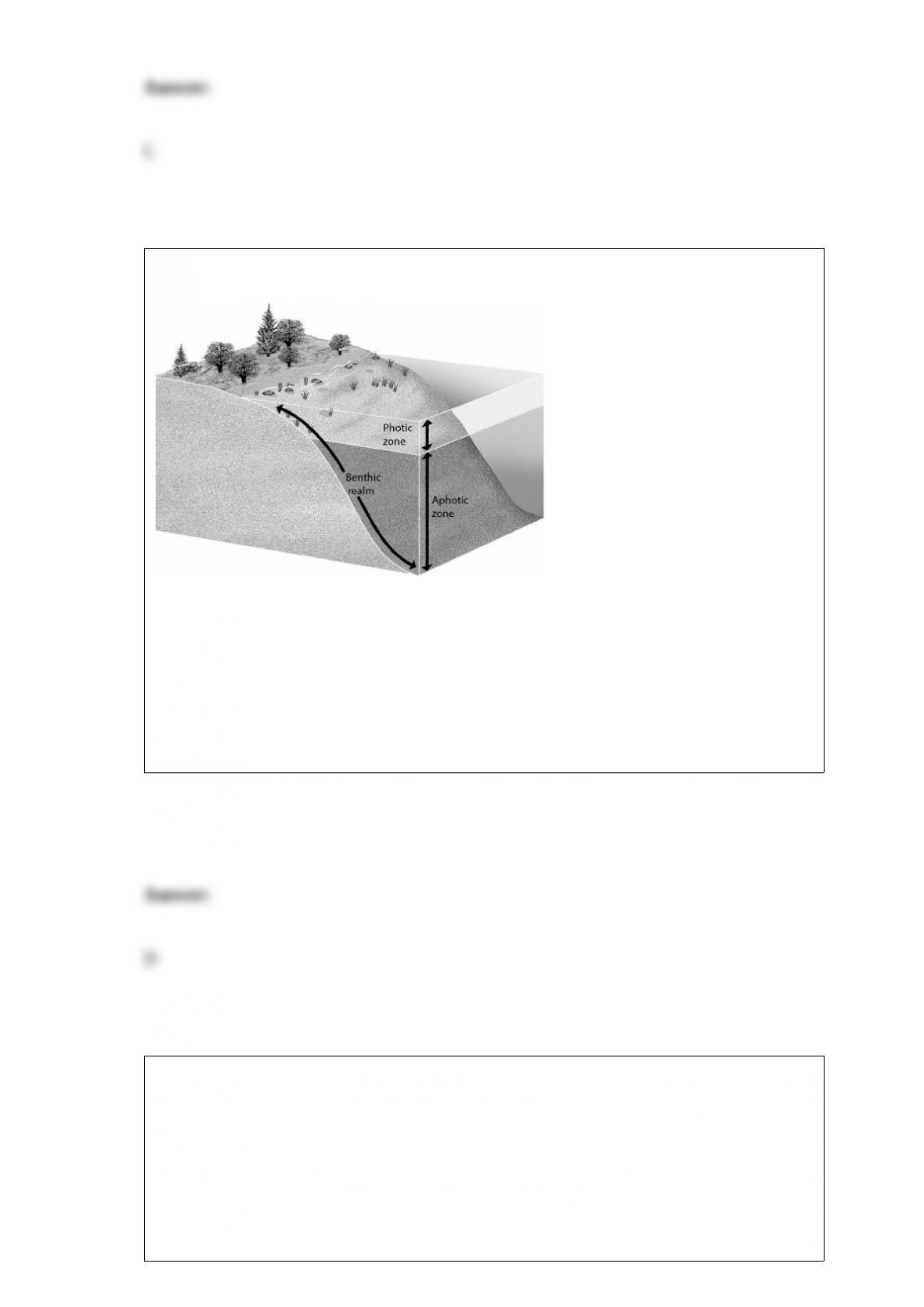
Examine the figure below. Phytoplankton live in the ________.
A) photic zone and aphotic zone
B) aphotic zone
C) benthic realm
D) photic zone
Oats are eaten by humans as oatmeal or rolled oats, and as feed for livestock such as
cattle. In order for an oat plant to make the part we eat (the seed), it must flower and be
pollinated. Typically, oat plants flower when days are lengthening (i.e., late spring to
early summer). What is the best classification for oat plants?
A) long night
B) short night

C) night neutral
D) short day
By definition, what type of fatty acid has double bonds?
A) steroid
B) triglyceride
C) unsaturated
D) saturated
What does evolutionary fitness measure?
A) physical health
B) longevity
C) relative reproductive success
D) population size

The major result of the inflammatory response is to ________.
A) initiate the production of antibodies
B) disinfect and clean damaged tissues
C) initiate the release of defensive proteins
D) initiate the production of natural killer cells
Please read the following scenario to answer the following questions.
Michigan’s Isle Royale is an island located in Lake Superior that is 45 miles long and 9
miles wide. Ecologists estimate that the moose population on the island has been there
since around 1900. The wolf population on the island, on the other hand, has been there
only since the winter of 1949. Weather conditions had to be calm and cold enough for
the lake to freeze and the first wolves to make the passage over to the island. When the
wolves arrived, they were greeted with a large moose population that had no predators.
The moose population was at a dangerously high level, but was kept in check by the
arrival of the wolves. This “harmonious” pattern continued for at least 20 years.
In 1982, the wolf population suddenly crashed. The problem was a new canine virus.
This virus surfaced around the world in 1978 and spread rapidly in about 6 months.
Infected animals can survive, but they have to be treated immediately. Ecologists
hypothesized that the virus arrived on the island carried on the shoe of a human traveler.
The wolf population decreased from 50 to 14 individuals in a year. While the wolf
population dropped, the moose population increased. However, the winter of 1996 was
extremely harsh and the moose population experienced a major crash. More than 500
animals died during the winter months, reducing the population to less than 800
animals.
The harsh winter that led to the death of many moose in 1996 is an example of
________.
A) a density-dependent factor
B) biological control
C) a density-independent factor
D) a trigger for logistic growth
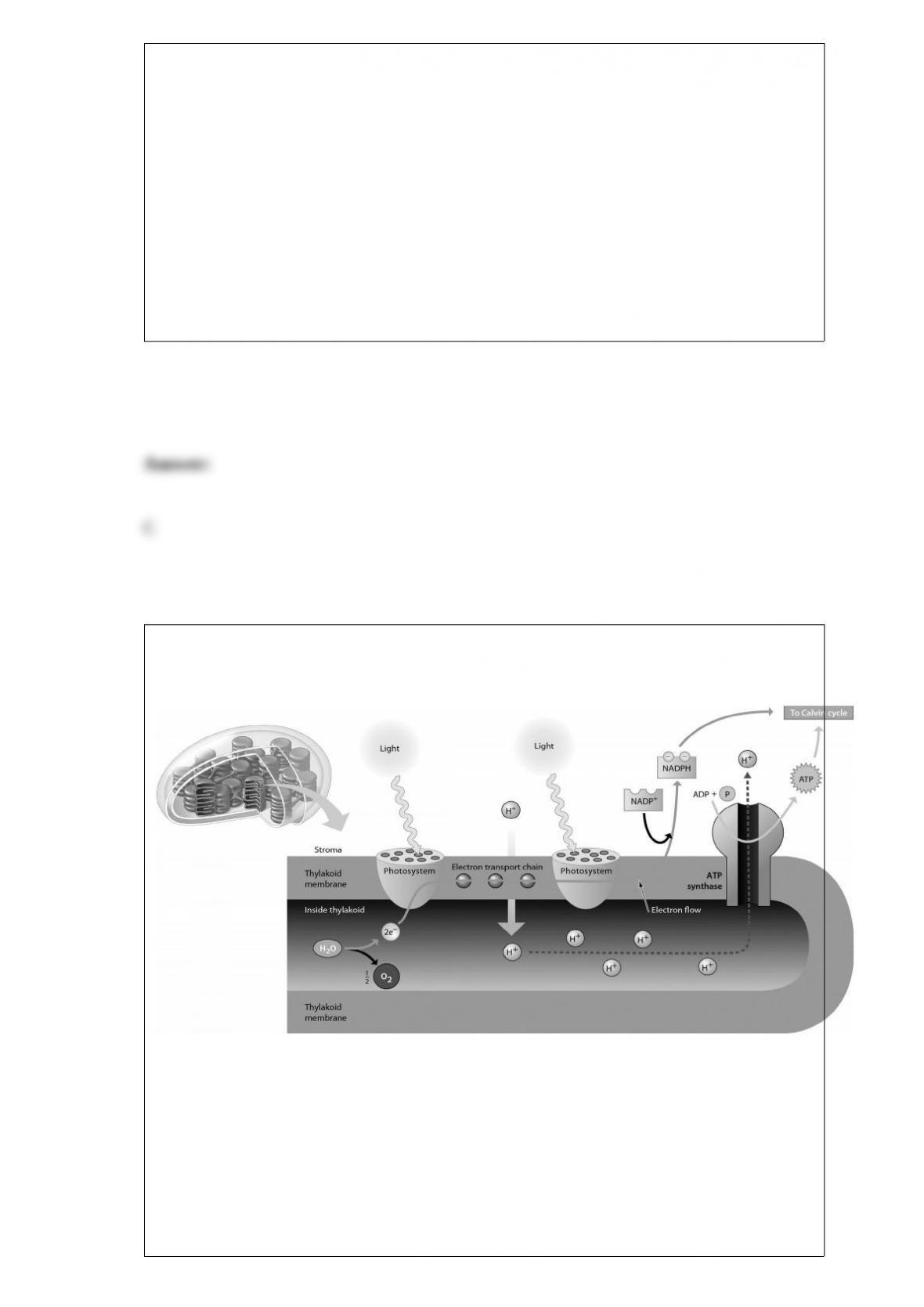
Please refer to the following art to answer the following questions.
Which of the following BEST describes the direct mechanism of ATP production during
photosynthesis?
A) use of the energy generated as hydrogen ions (H+) move up a proton gradient; this
energy is used to make ATP
B) use of the energy released as excited electrons are passed from one molecule to
another in the electron transport system; the energy is converted to the chemical bond

energy of ATP
C) use of the energy stored in excited electrons; as the electrons move from the excited
state to the ground state, the energy released is converted to the energy stored in the
third phosphate bond in ATP
D) use of the energy stored in hydrogen ion (H+) gradients; the potential energy of the
proton gradient is released as the protons move down their gradient through special
membrane protein channels; this energy is converted to chemical bond energy in the
ATP molecule
Which one of the following is the earliest event in the process of fertilization?
A) Sperm contact the jelly coat around the egg.
B) The sperm head plasma membrane fuses with the egg plasma membrane.
C) Enzymes from the acrosome are released.
D) The sperm nucleus enters the cytoplasm of the egg.
The RNA that is translated into a polypeptide is ________ RNA.
A) viral
B) ribosomal

C) transfer
D) messenger
A dihybrid cross produces 30 recombinant offspring out of a total of 1,000 offspring.
What is the recombination frequency of the two gene pairs?
A) 6%
B) 3%
C) 30%
D) 1.5%
Which domain(s) consist(s) of prokaryotic cells?
A) Bacteria only
B) Eukarya only
C) Archaea and Eukarya
D) Bacteria and Archaea

The biological species concept cannot be applied to fossils. Which alternate approach to
identifying species would be most useful for classifying fossil organisms?
A) an approach based on use of reproductive barriers
B) an approach based on genetic history
C) an approach based on measurable physical traits
D) an approach based on molecular biology
The primary goal of conservation biology is to ________.
A) catalog species
B) maximize the land set aside for wildlife
C) integrate human culture back into nature
D) counter the loss of biodiversity

What is the smallest number of nucleotides that must be added or subtracted to change
the triplet grouping of the genetic message?
A) one
B) two
C) three
D) four
Small fishes that eat zooplankton are ________.
A) primary consumers
B) producers
C) tertiary consumers
D) secondary consumers
Which of the following nutrients begins undergoing chemical digestion in the mouth?
A) amino acids
B) protein
C) starch
D) glucose
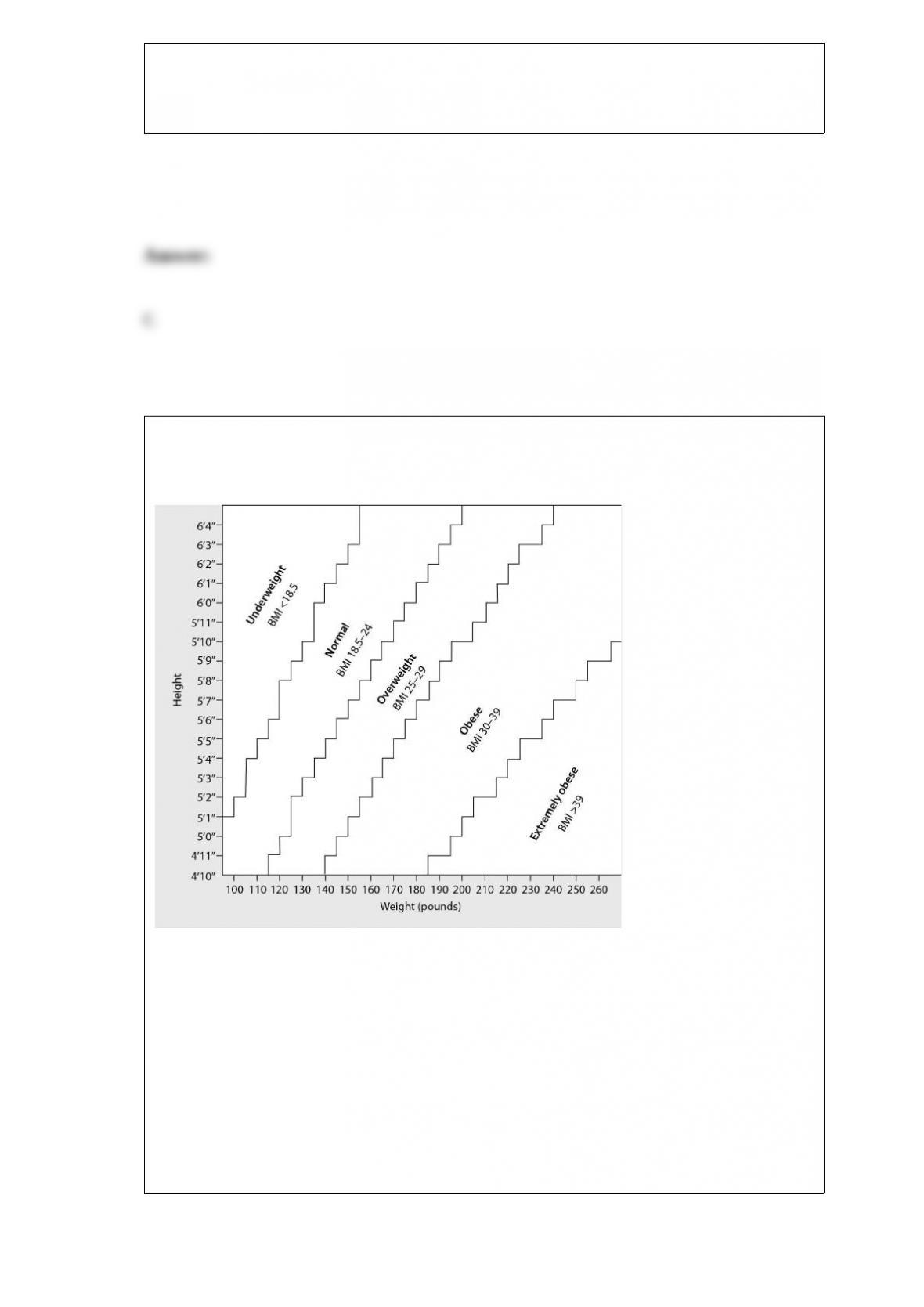
Please refer to the following art to answer the following questions.
Which of the following people is shifting from an unhealthy category to a healthy
category?
A) A 120 lb, 5’5″ male loses 15 lbs.
B) A 160 lb, 5’10” female loses 5 lbs.
C) A 180 lb, 5’10” male loses 20 lbs.
D) A 130 lb, 5’0″ female gains 10 lbs.

Read the following scenario to answer the following questions.
The North American beaver is a large rodent that builds dams to convert freshwater
streams into ponds. Beavers build their dams out of trees, which they cut down using
their front teeth. Beavers also eat the leaves and bark of trees, as well as the starchy
roots of water lilies.
Beavers dams are sturdy, because the part of a tree that provides structural support
when the tree is alive lends its strength to the dam, even after the tree is dead. What part
of a tree provides this structural support?
A) heartwood
B) bark
C) collenchyma
D) parenchyma
Which of these is generally considered a benefit of synthetic hormones?
A) effects on kidney and liver
B) cardiovascular effects
C) increased hostility
D) mimicking estrogen

What is the first level of control of eukaryotic gene transcription?
A) RNA splicing
B) attachment of RNA polymerase to the promoter
C) DNA packing and unpacking
D) the binding and unbinding of transcription factors to enhancer sequences
Most of the temperate grassland in North America has been converted to ________.
A) cities
B) farmland
C) national parks
D) small neighborhoods

HIV (human immunodeficiency virus) must use its own ________ to reproduce.
A) DNA polymerase
B) reverse transcriptase
C) RNA polymerase
D) tRNA
The buildup of plaque in the walls of arteries results in ________.
A) leukemia
B) atherosclerosis
C) anemia
D) low blood pressure
Which of the following is a way that a molecule releases energy gained by absorption
of a photon?
A) heat

B) fluorescence
C) light
D) all of the above
Which one of the following is a characteristic of open circulatory systems but NOT
closed circulatory systems?
A) a heart
B) a vascular system
C) blood
D) open-ended blood vessels
Which of these is a type of posttranscriptional regulation of gene expression?
A) inactivation of tRNA
B) alteration of DNA nucleotide sequences
C) breakdown of proteins
D) binding of transcription factors to enhancers

Which of the following results from cleavage?
A) formation of the nervous system
B) formation of the notochord
C) formation of more cells
D) segmentation