
After reading the paragraphs below, answer the questions that follow.
Bipedalism is one of the most important characteristics of hominin evolution. The
appearance of bipedalism led to anatomical changes that are considered to be
distinguishing characteristics of hominin fossils. The evidence for bipedalism is
supported by fossil evidence from more than 4 million years ago and
3.6-million-year-old footprints in volcanic ash.
Recently, however, scientists have focused on the link between tooth structure and diet
in the evolution of the early hominins, specifically in Australopithecus species. Detailed
studies of hominin dental features have provided evidence of an important dietary shift
that led to adaptive radiation within this genus. Most of the evidence comes from
analyses of tooth size and shape, microscopic wear patterns on teeth, and jaw structure.
The evidence suggests that fibrous plant materials became more important through the
Pliocene, perhaps as critical components in the diet of some species.
Evidence from fossil dentition suggests that Australopithecus species
A) evolved specifically to eat meat.
B) experienced a decrease in both tooth size and brain size.
C) were direct ancestors of modern humans.
D) were adapted to function successfully in a wide range of habitats.
A diet high in animal products and hydrogenated vegetable margarine may increase the
risk for atherosclerosis. This is because
A) most animal fats are unsaturated and most hydrogenated vegetable margarines
contain high levels of steroids.
B) most hydrogenated vegetable margarines are hydrogenated oils and most animal
products contain high levels of phospholipids.
C) most animal fats are used for energy storage and most hydrogenated vegetable
margarines contain high levels of unsaturated fats.

D) most animal fats are saturated and many hydrogenated vegetable margarines contain
high levels of trans fats.
The overall equation for the cellular respiration of glucose is
A) C5H12O6 + 6 O2 → 5 CO2 + 6 H2O + energy.
B) 5 CO2 + 6 H2O → C5H12O6 + 6 O2 + energy.
C) C6H12O6 + 6 O2 → 6 CO2 + 6 H2O + energy.
D) C6H12O6 + energy → 6 CO2+ 6 H2O + 6 O2.
Molecular data can be used to assess relationships among the major groups of living
organisms whose common ancestors lived millions or billions of years ago. Similar
techniques can be used to assess relationships among populations within a species. How
can molecular techniques be useful for such varied comparisons?
A) Studying the relationships among different populations of a single species can be
just as effective as studying the relationships of major biological groups if you look at a
lot more genes.
B) The same data can be used for any comparison with equal efficiency.
C) Faster-evolving gene sequences provide better data for comparisons among close
relatives, whereas very slowly evolving sequences work best for distantly related taxa.

D) The relationships between very different groups such as bacteria and whales are
assessed using mtDNA sequences, whereas rRNA sequences are used for very closely
related groups.
The insect body plan includes many groups of serially repeated units. For example,
there are typically three pairs of legs, one on each of the three segments of the thorax.
Which of the following options best describes how these pairs of legs develop and
evolve?
A) A single gene controls the development of all six legs. Thus within a species, all
three pairs of legs are identical.
B) The leg pairs all influence each other during development. Gene products move by
diffusion from one segment to the other. Therefore, it is impossible to alter the
development and form of one pair of legs without causing similar changes in the other
two pairs of legs.
C) The body parts develop in a modular fashion. Therefore, a genetic change could alter
the development of one pair of limbs without noticeably changing the rest of the insect’s
body plan.
D) The leg pairs grow under the control of an ancient set of highly conserved genes.
Therefore, all insects have more or less identical legs. Other parts of the insect body
plan can evolve somewhat more freely.
The tracheal system of an insect is most like which of the following?

A) the exhaust system of an automobile
B) the electrical wiring in a home
C) the air duct system in a building
D) leaves on a tree
Which of the following statements regarding the oxygen atom of a water molecule is
true?
A) Oxygen is more positively charged than the hydrogen atoms.
B) Oxygen attracts electrons less strongly than the hydrogen atoms.
C) Oxygen is more electronegative than the hydrogen atoms.
D) Oxygen is attracted to the negatively charged atoms of other molecules.
Which of the following statements regarding active transport is false?
A) Active transport uses ATP as an energy source.
B) Active transport can move a solute against its concentration gradient.
C) Active transport requires the cell to expend energy.

D) Active transport is driven by the concentration gradient.
Which of the following mechanisms helps keep the stomach lining in place despite the
destructive force of gastric juice?
A) digestion of protein by pepsin
B) secretion of acid-neutralizing compounds
C) generation through mitosis of new cells to replace the stomach lining
D) protection of the cells of the stomach-lining by parietal cells
A person who has blurred vision caused by a misshapen lens or cornea has
A) myopia.
B) astigmatism.
C) presbyopia.
D) night blindness.
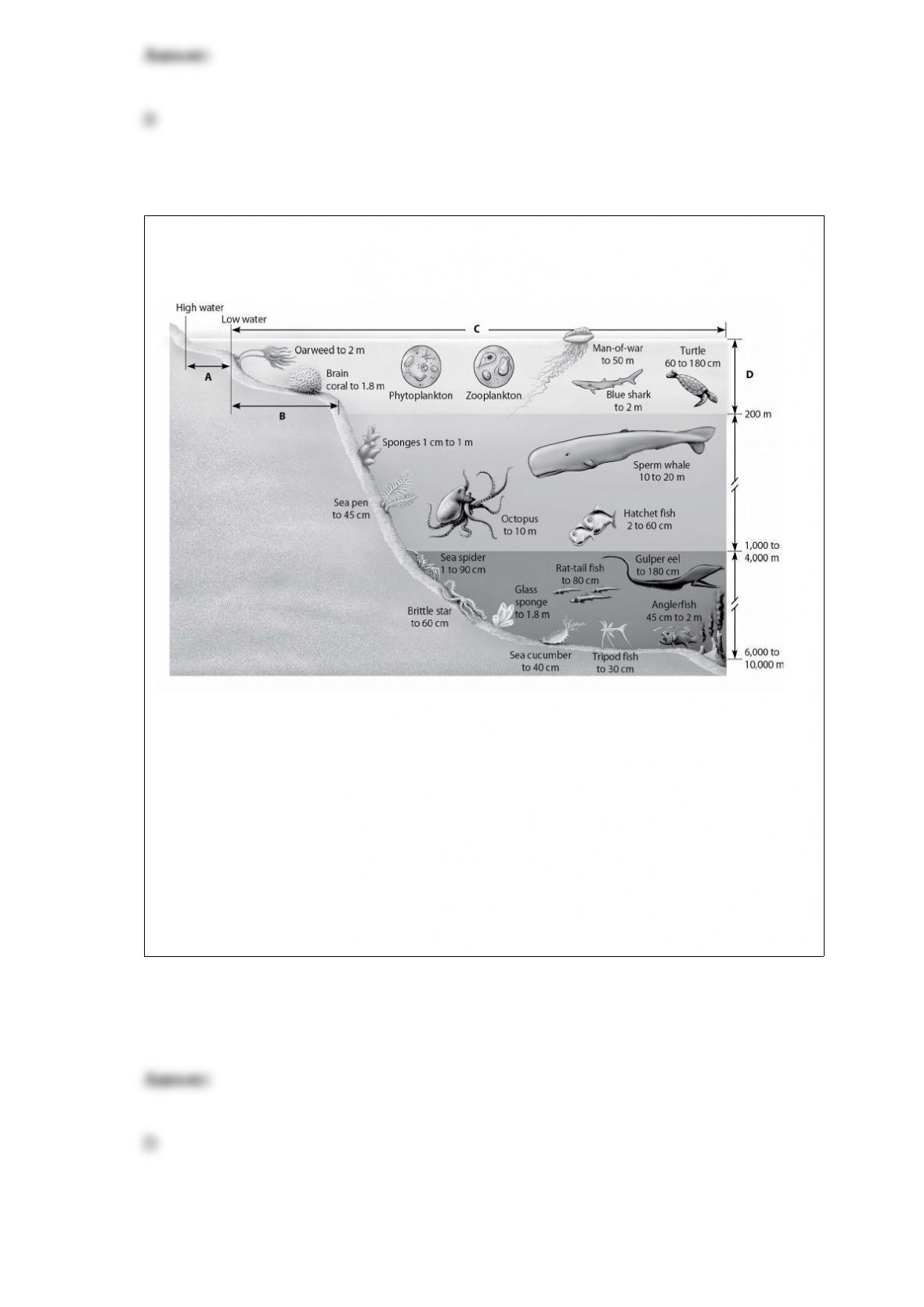
In which of the zones shown in this depiction of an aquatic biome does photosynthesis
occur?
A) zone A
B) zone B
C) zone C
D) zone D

The hydrogen atoms of a water molecule are bonded to the oxygen atom by ________
bonds, whereas neighboring water molecules are held together by ________ bonds.
A) hydrogen; polar covalent
B) polar covalent; hydrogen
C) ionic; covalent
D) polar covalent; ionic
Some butterflies can ingest toxic chemicals from the milkweed plants they feed on and
then can store those chemicals in their body. Because toxins stored in the butterflies are
toxic to birds, the birds avoid eating the butterflies. Which of the following is the best
explanation for this situation?
A) Butterflies that stored the chemicals were never eaten by predators, so those
butterflies survived.
B) Butterflies developed a mutation that led them to be able to store the chemical
because they needed to avoid being eaten.
C) Milkweed plants wanted the butterflies to ingest the chemical so they would no
longer feed on the plant, but the butterflies fooled the milkweed by storing the toxic
chemicals.
D) Any butterfly allele that allowed milkweed toxin storage would be likely to persist
because butterflies that had it were more likely to survive.
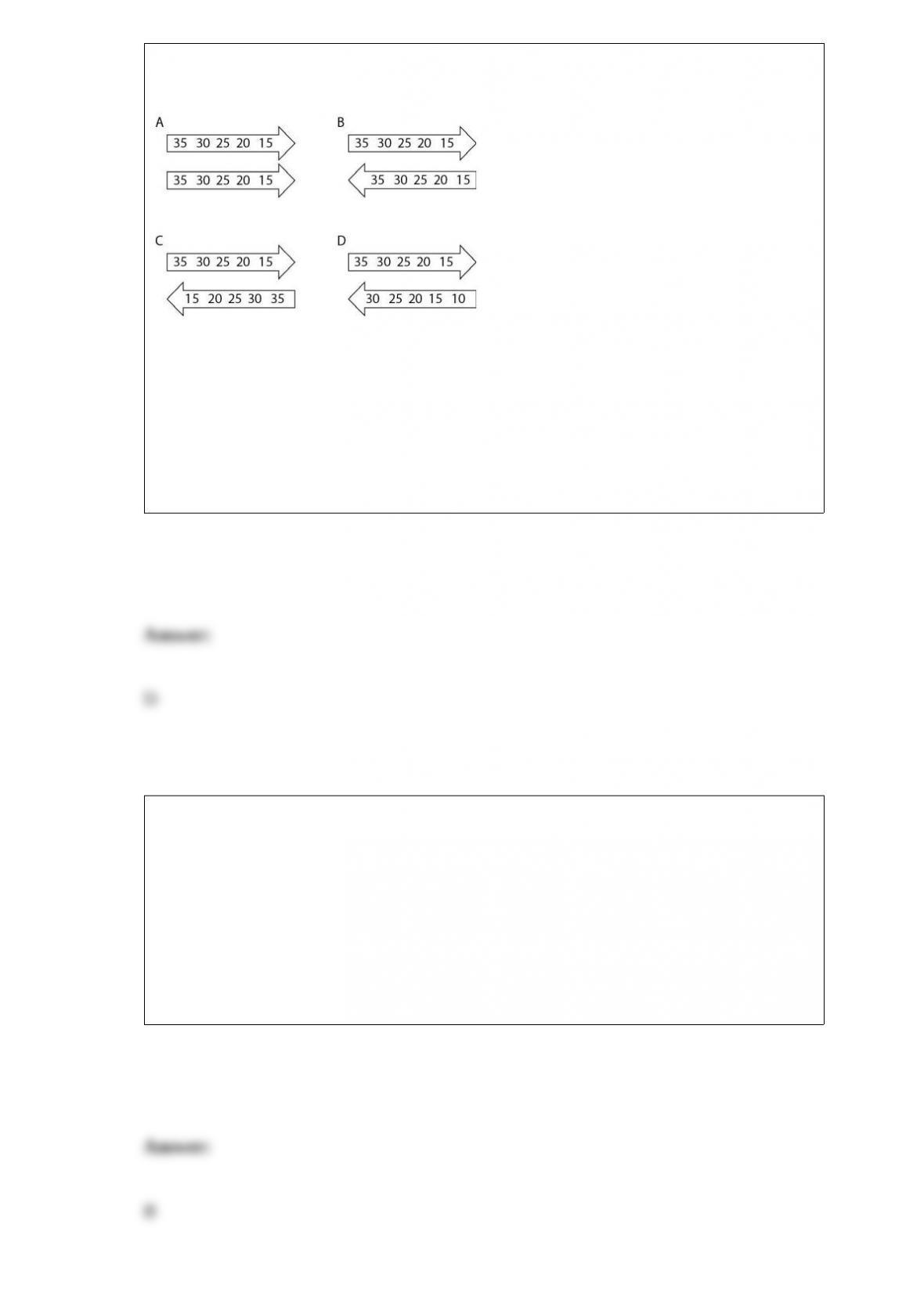
Which of the figures below represents countercurrent exchange? The arrows indicate
direction of flow, and the numbers indicate temperatures in degrees Celsius.
A) figure A
B) figure B
C) figure C
D) figure D
What are the macronutrients present in most commercial fertilizers?
A) C, H, and N
B) N, P, and K
C) C, N, and P
D) N, C, and K

DNP is a chemical that has been used by people to lose weight. However, it is a
dangerous option and has caused several people to die. DNP works in a fashion similar
to that of brown fat. Based on this information, how would DNP cause weight loss and
death?
A) DNP must prevent food from being consumed aerobically, so cells instead perform
fermentation, and lactate buildup is deadly.
B) DNP must increase the rate of substrate-level phosphorylation, causing NADH to be
produced more quickly than it can be used by the electron transport chain.
C) DNP must block cells from using fats and proteins to make ATP.
D) DNP must increase metabolism of food by producing heat instead of ATP.
What is one main effect of auxins on plant growth?
A) They reduce growth by inhibiting cell division.
B) They increase growth by promoting cell elongation.
C) They increase growth by increasing the rate of photosynthesis.
D) Auxins have no effect on plant growth.

While walking in your basement, you hear a crunching noise and notice that you have
stepped on an organism. You look closely and see part of a segmented body and a few
jointed appendages. What phylum does this animal represent?
A) Echinodermata
B) Annelida
C) Arthropoda
D) Chordata
Offering nutritious lunches in public schools is a popular health topic. School lunches
have had to meet new nutrition standards since the fall of 2012. In 2013, the USDA
(United States Department of Agriculture) reviewed data from the 2005 School
Nutrition and Dietary Assessment to investigate whether students in schools that were
already following the new standards (school group A) and that therefore offered more
fruits and vegetables than other schools (school group B) actually ate more of them.
You will be presented with some of the overall findings of the review and will then be
asked questions related to these conclusions.
Finding #1: If schools offered greater amounts of fruits and vegetables, then more
students ate them. However, many students in both schools did not did not eat any fruits
and vegetables. This suggests that
A) offering more fruits and vegetables increases the chances that students will eat them,
but simply offering more may not be the only solution to bettering child lunch nutrition.
B) a lower amount of fruits and vegetables should be offered to students in both school
group A and school group B.
C) offering more fruits and vegetables decreases the chances that students in school
group B will eat them but increases the chances that students in school group A will eat
them.
D) offering more fruits and vegetables increases the chances that students will eat them,
but only if they have all essential vitamins and minerals.

The cells that store starch in dicot roots are located between the
A) xylem and the phloem.
B) epidermis and the root hairs.
C) epidermis and the vascular cylinder.
D) epidermis and the cortex.
In many grocery stores, fresh fruits are sold in plastic bags dotted with holes so that
they will not overripen. The main function of the holes is to
A) permit the fruit to drain after being washed.
B) facilitate diffusion of ethylene away from the fruit.
C) prevent buildup of CO2.
D) facilitate diffusion of O2 to the fruit.

Which of the following is characteristic of all vertebrates?
A) a skull and a backbone consisting of vertebrae
B) a calcified (hard) skeleton and four legs
C) a hinged jaw
D) lungs or lung derivatives
You inflate a balloon and let it go. It shoots away as air exits forcefully through the
balloon’s narrow opening. This most closely resembles the mode of movement seen in
A) sea anemones.
B) snails.
C) squid.
D) nematodes.
The semicircular canals

A) are arranged in three perpendicular planes.
B) contain a thin basilar membrane.
C) are lined by long rows of hair cells along their entire length.
D) transmit vibrations from the oval window to the saccule.
The pronghorn antelope of the United States and the saiga antelope of the central Asian
steppes live in similar habitats and have similar adaptations. Which of the following
features would you be surprised to find in a saiga antelope?
A) camouflaging coloration
B) teeth adapted to grinding tough forage
C) a warmly insulating winter coat
D) a digestive tract without cellulose-digesting bacteria
Kingdom Fungi includes species
A) such as mushrooms and plants.
B) that obtain food by ingestion.

C) that use photosynthesis to obtain food.
D) that obtain food by decomposing dead organisms and absorbing the nutrients.
The expression of the tryptophan operon is controlled by
A) a repressor that is active when it is alone.
B) a repressor that is inactive when it binds to lactose.
C) a repressor that is active when it binds to tryptophan.
D) an activator that turns the operon on by binding to DNA.
The secretory parietal cells of the stomach are responsible for producing
A) mucus.
B) pepsin.
C) hydrochloric acid.
D) lactic acid.

A hypothetical community on a barren mid-Atlantic island consists of two fish-eating
seabirds (the booby and the noddy), the fungi and microorganisms that live on the birds’
dung, a tick that feeds on these two birds, a cactus, a moth that feeds on cast-off
feathers, a beetle that lives on dung organisms, and spiders that eat the other arthropods.
There are no other plants and no lichens. Which of the following choices incorrectly
pairs a member of this assemblage with its position in the trophic structure?
A) fungidetritivores
B) boobyprimary consumer
C) mothdetritivore
D) cactusproducer
A bilaterally symmetrical, wormlike animal that has a complete digestive tract and a
cuticle could be a member of which of the following phyla?
A) Cnidaria
B) Annelida
C) Nematoda
D) Chordata
Which of the following would be the most likely outcome if androgen receptors on cells
in the hypothalamus and anterior pituitary suddenly could not bind androgen?
A) Sperm production would increase.
B) Sperm production would decrease.
C) FSH production would decrease.
D) HCG production would increase.
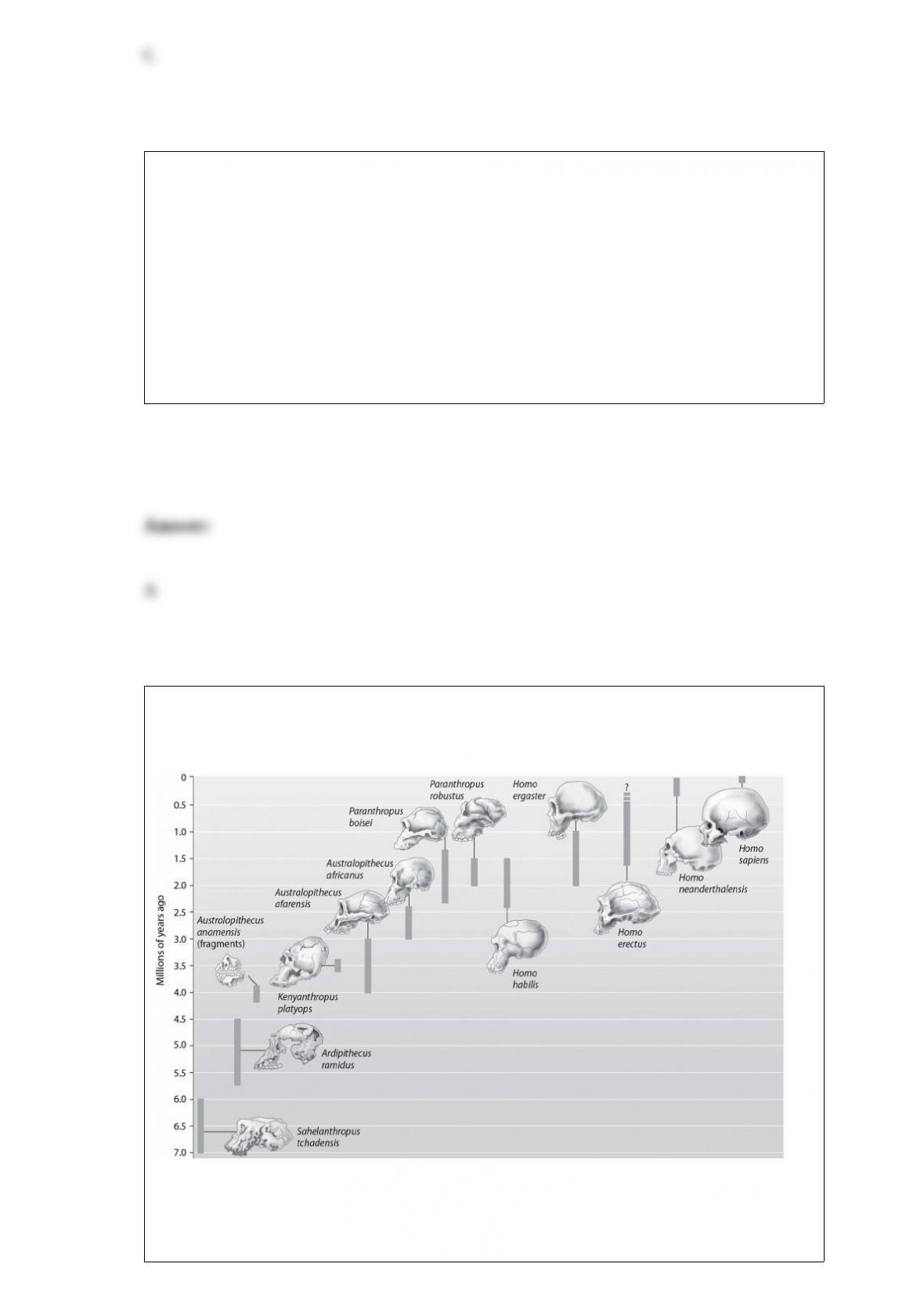
Refer to the figure above. Suppose a fossil was found and identified to be a species of
approximately 3.5 million years old. This fossil could be a representative of which
species?

A) Australopithecus afarensis or Australopithecus anamensis
B) Kenyanthropus platyops or Australopithecus africanus
C) Kenyanthropus platyops or Australopithecus afarensis
D) Australopithecus afarensis or Australopithecus africanus
During production of urine, a major function of the kidney is
A) water conservation.
B) amino acid production.
C) detoxification.
D) uric acid production.