
When the air in a testing chamber is specially mixed so that its oxygen content is 10
percent and its overall air pressure is 400 mm Hg, then is _____.
A) 400 mm Hg
B) 82 mm Hg
C) 40 mm Hg
D) 4 mm Hg
Which of the following represents an idea that Darwin learned from the writings of
Thomas Malthus?
A) Technological innovation in agricultural practices will permit exponential growth of
the human population into the foreseeable future.
B) Populations tend to increase at a faster rate than their food supply normally allows.
C) Earth changed over the years through a series of catastrophic upheavals.
D) The environment is responsible for natural selection.
In which feature(s) should one be able to locate a complete chromosome of this
bacterium?
1. nucleolus

2. prophage
3. endospore
4. nucleoid
A) 4 only
B) 1 and 3
C) 2 and 3
D) 3 and 4
Imagine that you are managing a large game ranch. You know from historical accounts
that a species of deer used to live there, but they have been extirpated. After doing some
research to determine what might be an appropriately sized founding population, you
reintroduce them. You then watch the population increase for several generations, and
graph the number of individuals (vertical axis) against the number of generations
(horizontal axis). With no natural predators impacting the population, the graph will
likely appear as _____.
A) a diagonal line, getting higher with each generation
B) an “S” that ends with a vertical line
C) an upside-down “U”
D) a “J,” increasing with each generation

Protein phosphorylation is commonly involved with all of the following
EXCEPT_____.
A) regulation of transcription by extracellular signaling molecules
B) enzyme activation
C) activation of G protein-coupled receptors
D) activation of protein kinase molecules
Which of the following is a reasonable explanation for why unsaturated fatty acids help
keep a membrane more fluid at lower temperatures?
A) The double bonds form kinks in the fatty acid tails, preventing adjacent lipids from
packing tightly.
B) Unsaturated fatty acids have a higher cholesterol content and, therefore, more
cholesterol in membranes.
C) Unsaturated fatty acids are more polar than saturated fatty acids.
D) The double bonds block interaction among the hydrophilic head groups of the lipids.
You own three hundred acres of patchy temperate forest. Which one of the following

actions would increase the net primary productivity of the area the most?
A) adding fertilizer to the entire area
B) introducing one hundred rabbits into the area
C) planting five hundred new trees
D) relocating all of the deer found in the area
In a well-fed human eating a Western diet, the richest source of stored chemical energy
in the body is _____.
A) fat in adipose tissue
B) glucose in the blood
C) protein in muscle cells
D) glycogen in muscle cells

A space probe returns with a culture of a microorganism found on a distant planet.
Analysis shows that it is a carbon-based life-form that has DNA. You grow the cells in
15N medium for several generations and then transfer them to 14N medium. Which
pattern in the figure above would you expect if the DNA was replicated in a
conservative manner?
A) A
B) B
C) C
D) D
Among plants known as legumes (beans, peas, alfalfa, clover, for example) the seeds
are contained in a fruit that is itself called a legume, better known as a pod. Upon
opening such pods, it is commonly observed that some ovules have become mature
seeds, whereas other ovules have not. Thus, which of the following statements is (are)
true?
1. The flowers that gave rise to such pods were not pollinated.
2. Pollen tubes did not enter all of the ovules in such pods.
3. There was apparently not enough endosperm to distribute to all of the ovules in such
pods.
4. The ovules that failed to develop into seeds were derived from sterile floral parts.
5. Fruit can develop, even if all ovules within have not been fertilized.

A) 1 only
B) 1 and 5
C) 2 and 5
D) 3 and 5
There is some evidence that reptiles called cynodonts may have had whisker-like hairs
around their mouths. If true, then hair is a shared _____.
A) derived character of mammals, even if cynodonts continue to be classified as reptiles
B) derived character of the amniote clade and not of the mammal clade
C) ancestral character of the amniote clade, but only if cynodonts are reclassified as
mammals
D) derived character of mammals, but only if cynodonts are reclassified as mammals
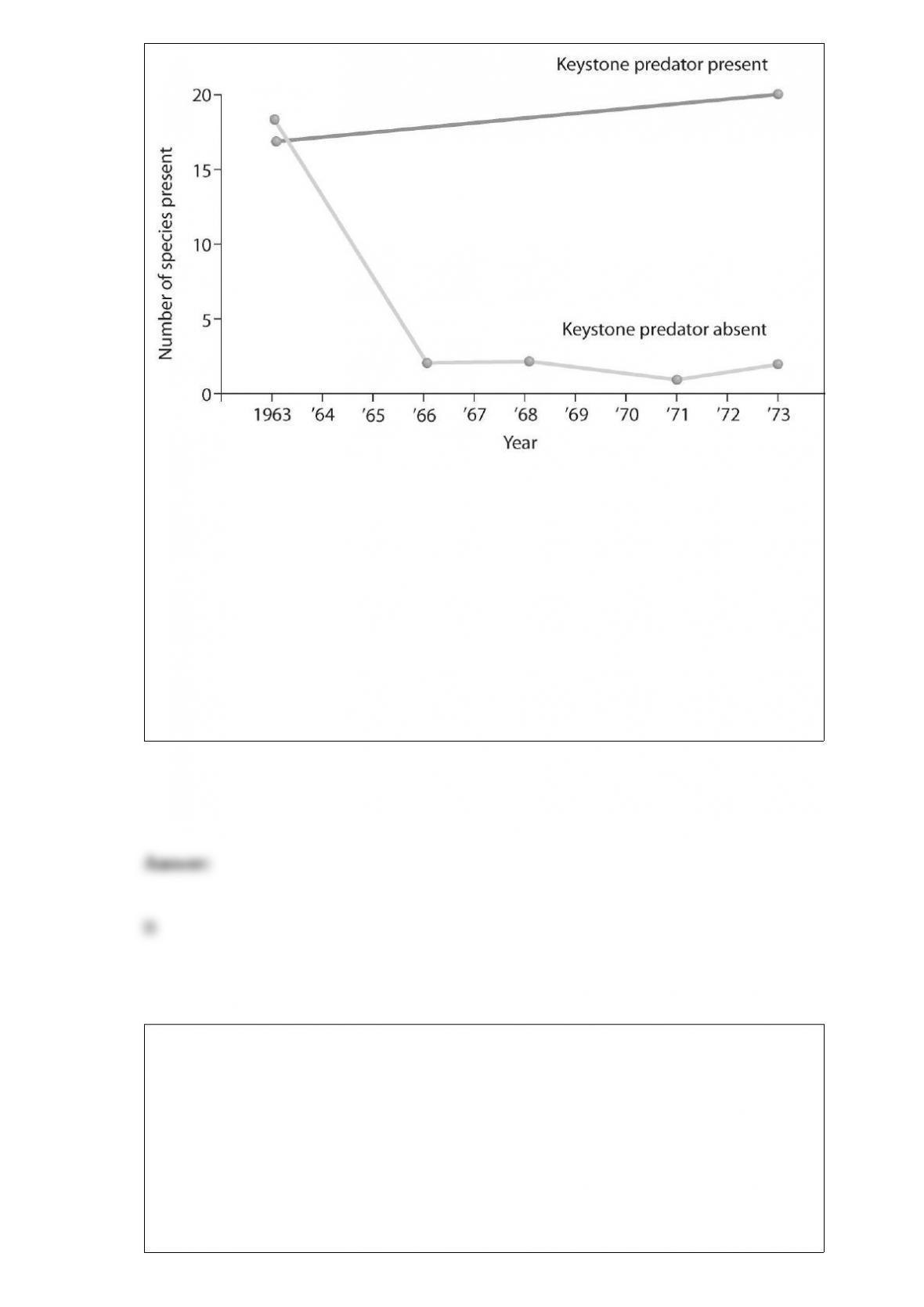
What does the graph in the figure above tell you about the definition of a keystone
species?
A) A keystone species has little interaction with other species in an environment.
B) Removing a keystone species from the community drastically reduces diversity.
C) Adding a keystone species to the community will make it more diverse.
D) Removing a keystone species from the community will eventually allow for the
invasion of a new species.
Use the following information to answer the question(s) below.
Paulinella chromatophora is one of the few cercozoans that is autotrophic, carrying out
aerobic photosynthesis with its two elongated “chromatophores.” The chromatophores
are contained within vesicles of the host cell, and each is derived from a
cyanobacterium, though not the same type of cyanobacterium that gave rise to the
chloroplasts of algae and plants.
Green algae differ from land plants in that many green algae _____.

A) are unicellular
B) have plastids
C) have alternation of generations
D) have cell walls containing cellulose
Darwin’s finches, collected from the Galpagos Islands, illustrate which of the
following?
A) mutation frequency
B) ancestors from different regions
C) adaptive radiation
D) vestigial anatomical structures
E) the accuracy of the fossil record
Researchers tested nitrogen loss from soil where the moss Dawsonia was growing, and
compared it to soil from which Dawsonia had been removed. The data are presented
below.
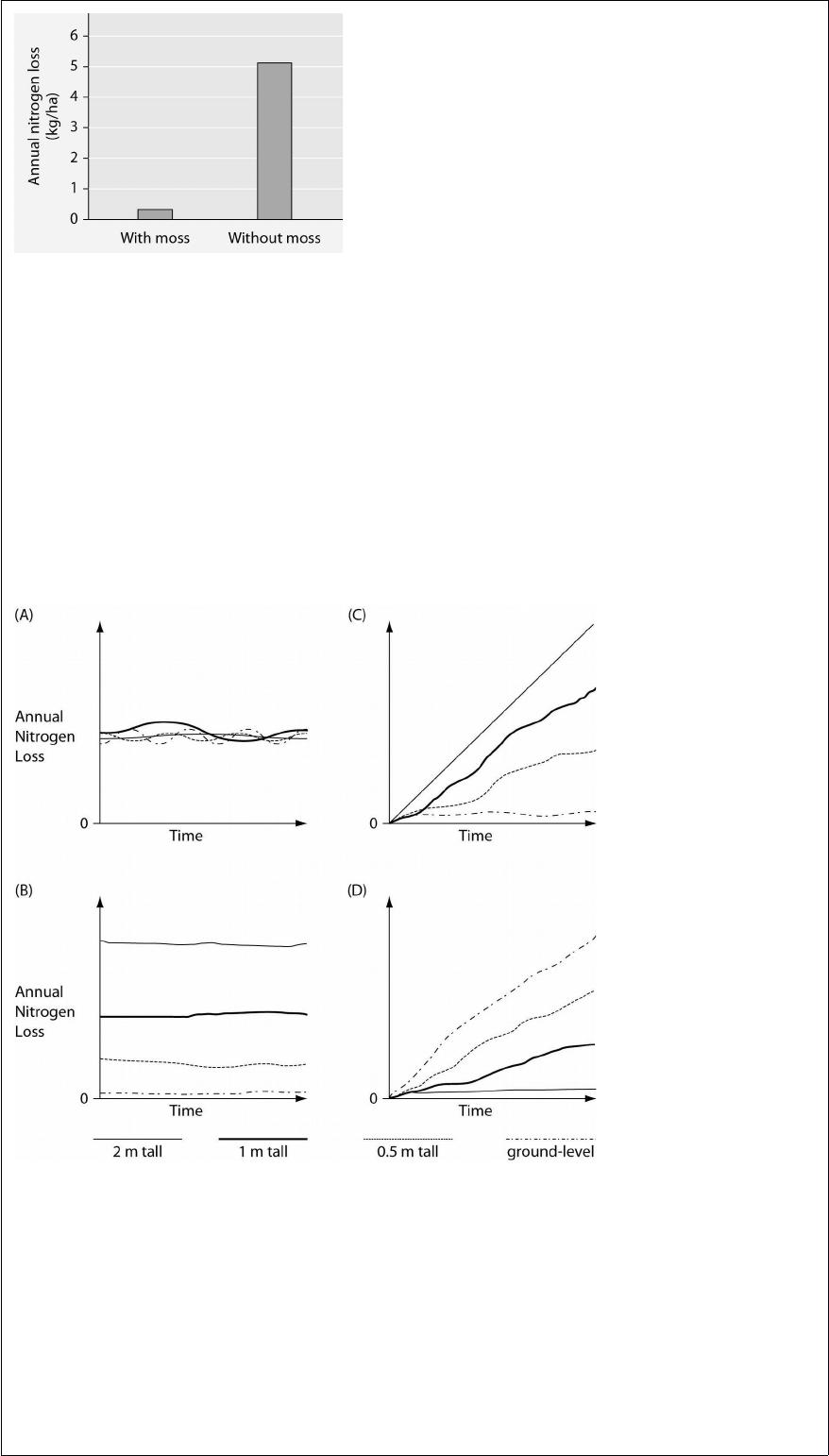
Researchers decided to test the hypothesis that if the 1-meter-tall Dawsonia
gametophyte-sporophyte plants had acted as a physical buffer, then they would have
reduced water’s ability to erode the soil and carry away its nitrogen. They began with
four equal-sized areas where Dawsonia mosses grew to a height of 1 m above the soil
surface. One of the four areas was not modified. In the second area, the mosses were
trimmed to a height of 0.5 m above the soil surface. In the third area, the mosses were
trimmed to a height of 0.25 m above the soil surface. In the fourth area, the mosses
were trimmed all the way to the ground, leaving only the rhizoids. Water, simulating
rainfall, was then added in a controlled fashion to all plots over the course of one year.
The figure below presents four graphs that depict potential results of this experiment.
In the figure above, which graph of soil nitrogen loss over time most strongly supports
the hypothesis that if the 1-m tall Dawsonia gametophyte-sporophyte plants had acted
as a physical buffer, then they would have reduced water’s ability to erode the soil and
carry away its nitrogen?
A) A
B) B

C) C
D) D
To become bound to hemoglobin for transport in a mammal, atmospheric molecules of
oxygen must cross _____.
A) one membranethat of the lining in the lungsand then bind directly to hemoglobin, a
protein dissolved in the plasma of the blood
B) two membranesin and out of the cell lining the lungand then bind directly to
hemoglobin, a protein dissolved in the plasma of the blood
C) four membranesin and out of the cell lining the lung, in and out of the endothelial
cell lining an alveolar capillaryand then bind directly to hemoglobin, a protein dissolved
in the plasma of the blood
D) five membranesin and out of the cell lining the lung, in and out of the endothelial
cell lining an alveolar capillary, and into the red blood cellto bind with hemoglobin
Macroevolution is _____.
A) the same as microevolution, but includes the origin of new species
B) evolution above the species level
C) defined as the evolution of microscopic organisms into organisms that can be seen

with the naked eye
D) defined as a change in allele or gene frequency over the course of many generations
There is still some controversy among biologists about whether Neanderthals should be
placed within the same species as modern humans or into a separate species of their
own. Most DNA sequence data analyzed so far indicate that there was probably little or
no gene flow between Neanderthals and Homo sapiens. Which species concept is most
applicable in this example?
A) phylogenetic
B) ecological
C) morphological
D) biological
A couple has a child with Down syndrome. The mother is 39 years old at the time of
delivery. Which of the following is the most probable cause of the child’s condition?
A) The woman inherited this tendency from her parents.
B) The mother had a chromosomal duplication.
C) One member of the couple underwent nondisjunction in somatic cell production.

D) The mother most likely underwent nondisjunction during gamete production.
Use the following information to answer the question(s) below.
Canadian and Swiss researchers wanted to know if the diversity of arbuscular
mycorrhizal fungi (AMF) was important to the productivity of grasslands (M.G.A. van
der Heijden, J. N. Klironomos, M. Ursic, P. Moutoglis, R. Streitwolf-Engel, T. Boler, A.
Wiemken, and I. R. Sanders. 1998. Mycorrhizal fungal diversity determines plant
biodiversity, ecosystem variability and productivity. Nature 396:69-72). Specifically,
they wanted to know if it mattered which specific AMF species were present, or just
that some type of AMF was present. They grew various plants in combination with one
of four AMF species (A, B, C, & D), no AMF species (O), or all four AMF species
together (A+B+C+D); and they measured plant growth under each set of conditions. All
plant species were grown in each plot, so they always competed with each other with
the only difference being which AMF species were present.
On the graphs below, the x-axis labels indicate the number and identity of AMF species
(bar 0 = no fungi; bars A-D = individual AMF species; bar A+B+C+D = all AMF
species together). The y-axis indicates the amount (grams) of plant biomass for the
species shown in italics above each graph. Graph (e) is the total biomass (grams) of all
11 plant species combined; graph (f) is the biomass of Bromus erectus plants only,
separated from the total.
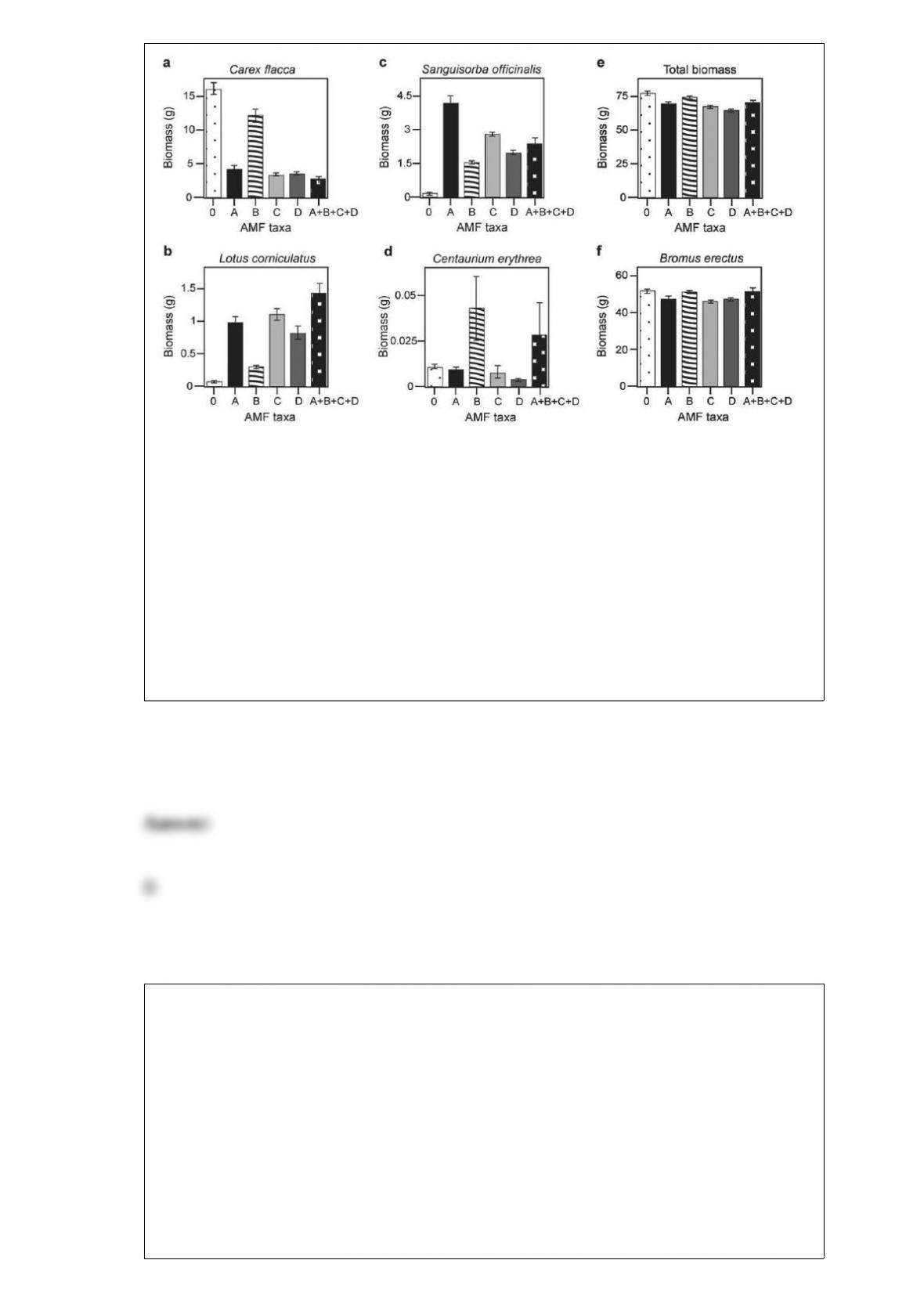
What is the major difference between Bromus erectus (graph f) and the other plant
species (graphs a-d) included in the study?
A) Bromus erectus grows best with a diversity of fungal partners.
B) Bromus erectus is unaffected by AMF diversity.
C) Bromus erectus does not form mycorrhizal associations.
D) Bromus erectus produces very little biomass regardless of AMF.
While hiking in a forest, you notice an unusual plant growing on the branches of a tree.
What will help you to determine if this plant is epiphytic or parasitic?
A) If the plant is green, it is epiphytic; if not, then it is parasitic.
B) The root of an epiphytic plant will be in the soil, but a parasitic plant will grow from
the trunk of a tree.
C) The roots of a parasitic plant will penetrate under the bark into the tree xylem, and
the roots of epiphytic plant will not.
D) The epiphytic plant will have large water collecting leaves, and the parasitic plant
will not.
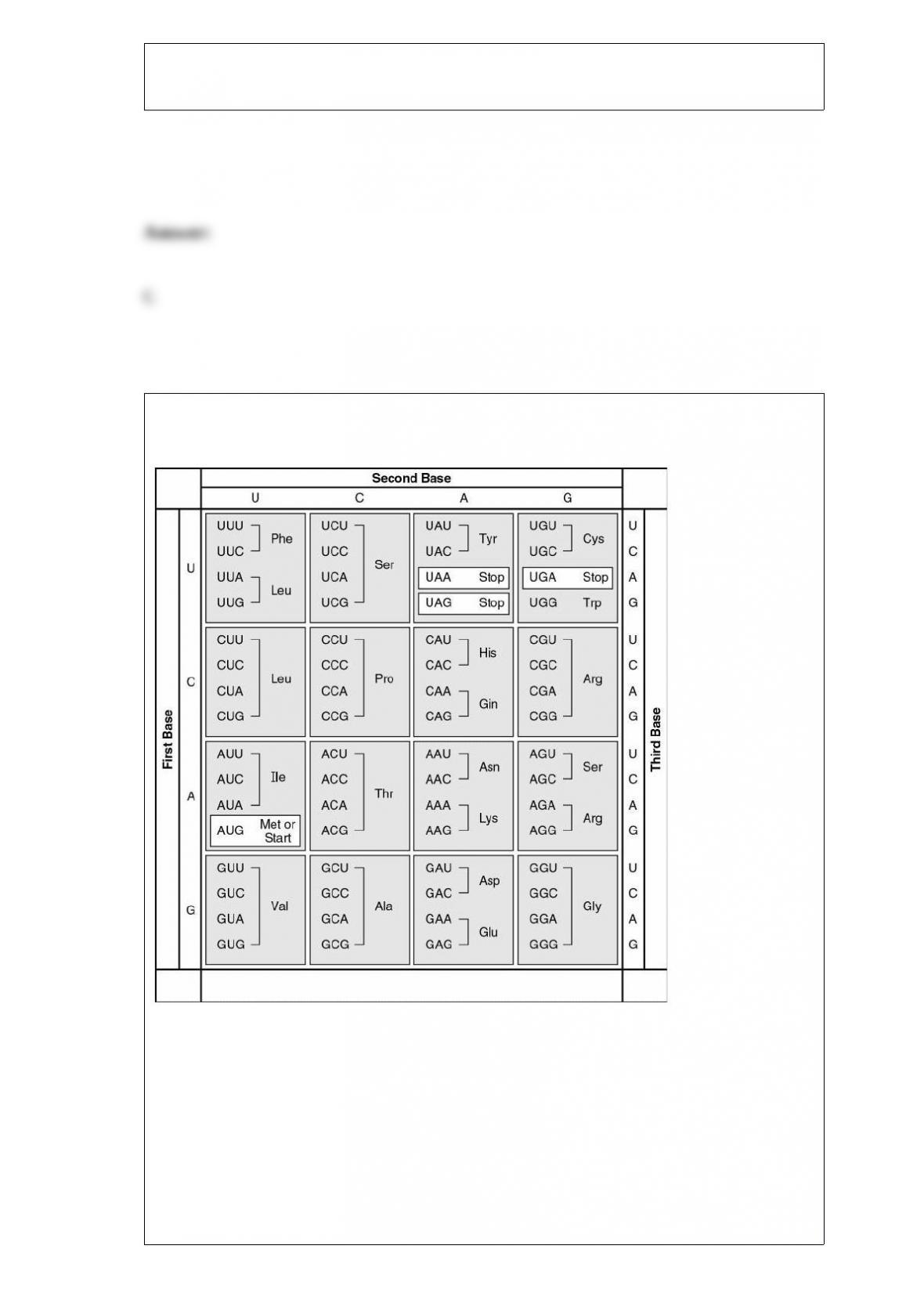
The following questions refer to this table of codons.
Refer to the figure above. What would the anticodon be for a tRNA that transports
phenylalanine to a ribosome?
A) UUU
B) AAA
C) TTT

D) CCC
Which mechanism of water transport in xylem can contribute to recovery from
cavitation?
A) cohesion-tension
B) capillarity
C) pressure flow
D) root pressure
Which of the following is a true statement about plant reproduction?
A) Embryophytes are small plants in an early developmental stage.
B) Male and female bryophytes each produce a type of gametangia.
C) Eggs and sperm of most land plants swim toward one another.
D) Bryophytes are limited to asexual reproduction.
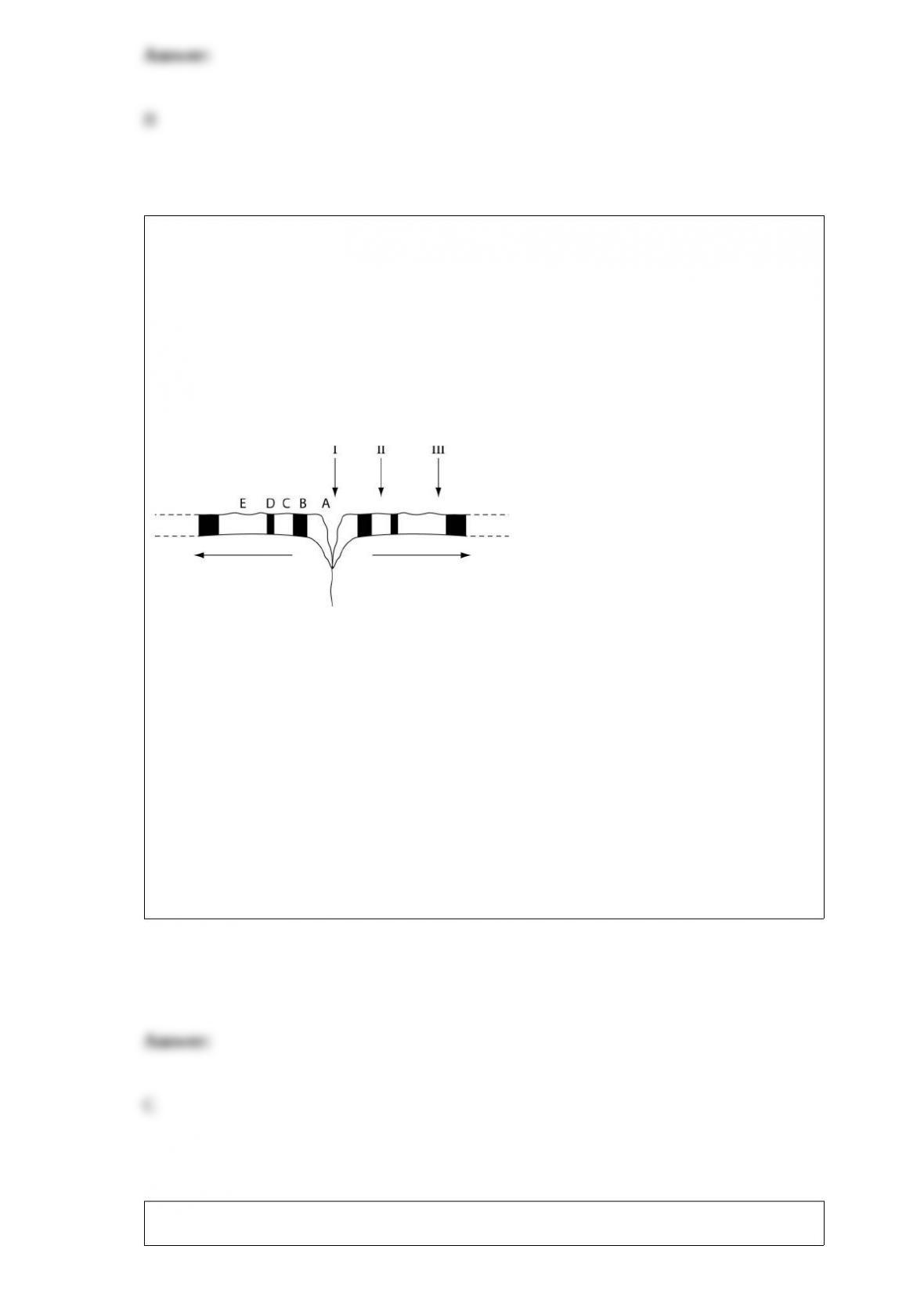
The questions below refer to the following description and figure.
The figure below represents a cross section of the sea floor through a mid-ocean rift
valley, with alternating patches of black and white indicating sea floor with reversed
magnetic polarities. At the arrow labeled “I” (the rift valley), the igneous rock of the sea
floor is so young that it can be accurately dated using carbon-14 dating. At the arrow
labeled “III,” however, the igneous rock is about one million years old, and
potassium-40 dating is typically used to date such rocks. Note: The horizontal arrows
indicate the direction of sea-floor spreading, away from the rift valley.
Assuming that the rate of sea-floor spreading was constant during the one-million-year
period depicted above, what should be the approximate age of marine fossils found in
undisturbed sedimentary rock immediately overlying the igneous rock at the arrow
labeled “II”?
A) 10,000 years
B) 250,000 years
C) 500,000 years
D) 1,000,000 years
You have before you a living organism, which you examine carefully. Which of the

following should convince you that the organism is acoelomate?
A) It is triploblastic.
B) It has bilateral symmetry.
C) It possesses sensory structures at its anterior end.
D) Muscular activity of its digestive system distorts the body wall.
A plant that grows one year, dies back, and then grows again the following year,
produces flowers and then dies would be considered _____.
A) annual
B) biennial
C) perennial
D) not very fit
Use the following description to answer the question(s) below.
A biology student hiking in a forest happens upon an erect, 15-cm-tall plant that bears
microphylls and a strobilus at its tallest point. When disturbed, the cone emits a dense
cloud of brownish dust. A pocket magnifying glass reveals the dust to be composed of
tiny spheres with a high oil content.

This student has probably found a(n) _____.
A) bryophyte sporophyte
B) fern sporophyte
C) horsetail gametophyte
D) lycophyte sporophyte
Which of the following is most true of sexual reproduction?
A) Only half of the offspring from sexually reproducing females are also females.
B) Asexual reproduction produces offspring of greater genetic variety.
C) Sexual reproduction is completed more rapidly than asexual reproduction.
D) Asexual reproduction is better suited to environments with extremely varying
conditions.
Testosterone functions inside a cell by _____.
A) acting as a signal receptor that activates tyrosine kinases
B) binding with a receptor protein that enters the nucleus and activates specific genes

C) acting as a steroid signal receptor that activates ion channel proteins
D) coordinating a phosphorylation cascade that increases spermatogenesis