
The forecasting time horizon and the forecasting techniques used tend to vary over the
life cycle of a product.
An enlarged job has more responsibility than the same job enriched.
Conforming to standards is the focus of the product-based definition of quality.
Line employees need the knowledge of TQM tools.

A scheduler may find that freezing the portion of the schedule closest to the due dates
allows the production system to function and the schedule to be met.
Aggregate planning for fast food restaurants is very similar to aggregate planning in
manufacturing, but with much smaller units of time.
Job rotation is an example of job enlargement.
The number-one reason driving outsourcing for many firms is to focus on core
competencies.

A p-chart is appropriate to plot the number of typographic errors per page of text.
PERT, but not CPM, has the ability to consider the precedence relationships in a
project.
ASRS stands for
A) automated storage and retrieval system
B) automated storage and recovery system
C) automated scan and recognize system
D) automated scan and retail system
E) none of the above
Which of the following statements is most accurate?

A) Nearly all outsourcing relationships do not last beyond two years.
B) Nearly all U.S. firms that outsourced processes to India have backsourced them.
C) Approximately half of all outsourcing agreements fail.
D) Outsourcing is a relatively risk-free activity.
E) More than 90% of outsourcing agreements succeed.
One of the advantages of simulation is that
A) real-world complications can be included that most OM models cannot permit
B) it always generates a more accurate solution than a mathematical solution
C) it is a trial-and-error approach that may produce different solutions in repeated runs
D) model development is less time consuming than for mathematical models
E) model solutions are transferable to a wide variety of problems
Forecasts
A) become more accurate with longer time horizons
B) are rarely perfect
C) are more accurate for individual items than for groups of items

D) all of the above
E) none of the above
If two variables were perfectly correlated, the correlation coefficient r would equal
A) 0
B) -1
C) 1
D) B or C
E) none of the above
Which of the following is true regarding work sampling?
A) The technique was developed in the 1890s.
B) It can be used to estimate the percentage of time workers spend in unavoidable
delays.
C) The method was developed by Frank Gilbreth.
D) The method makes extensive use of rest allowances.
E) All of the above are false.

The p-chart tells us whether there has been a
A) gain or loss in dispersion
B) change in the percent defective in a sample
C) change in the central tendency of the process output
D) change in the number of defects in a sample
E) none of the above
Geographic Information Systems can assist the location decision by
A) automating center-of-gravity problems
B) computerizing factor rating analysis
C) combining geography with demographic analysis
D) updating transportation method solutions
E) giving good Internet placement for virtual storefronts

The sequence of decisions that affect scheduling is
A) short term–>intermediate term–>long term
B) capacity planning–>aggregate planning–>master schedule–>short-term schedules
C) strategic decisions–>tactical decisions–>operational decisions
D) forward decisions–>current decisions–>backward decisions
E) none of the above
Which of the following statements best compares modular bills and phantom bills?
A) Both pertain to assemblies that are not inventoried.
B) There is no difference between the two.
C) Both pertain to assemblies that are inventoried.
D) Modular bills are used for assemblies that are not inventoried, unlike phantom bills.
E) Modular bills represent subassemblies that actually exist and are inventoried, while
phantom bills represent subassemblies that exist only temporarily and are not
inventoried.
A cleaning company uses $10 of chemicals, $40 of labor, and $5 of misc. expenses for
each house it cleans. After some quality complaints, the company has decided to
increase its use of chemicals by 50%. By what % has multifactor productivity fallen?
A) 0%
B) 8.3%
C) 25%
D) 50%
E) none of the above or unable to determine
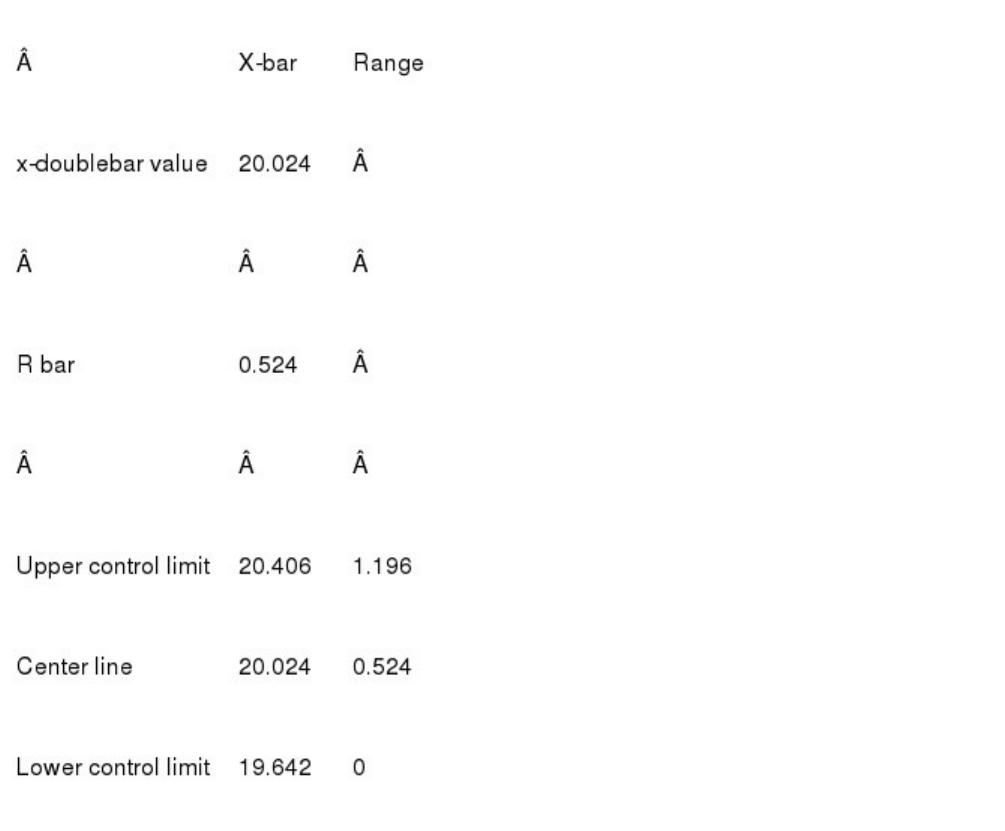
Ten samples of size four were taken from a process, and their weights measured. The
sample averages and sample ranges are in the following table. Construct and plot an
x-bar and R-chart using this data. Is the process in control?

A transportation problem has 8 origins and 6 destinations. The optimal solution of this
problem will fill no more than __________ cells with quantities to be shipped.
A) 2
B) 13
C) 14
D) 48
E) cannot be calculated without knowing the supply and demand totals

Which one of the following is an example of JIT being used for competitive advantage?
A) Jones Company has decreased the number of job classifications to just a few.
B) Lafourche Metals increases the number of its suppliers to be less dependent on just a
few.
C) Houma Fabricators is proud to announce that incoming goods are inspected.
D) Acme Company tells its maintenance department to intervene only if a machine
breaks down.
E) Caro Specialty Metals, Inc. has built a new, huge warehouse to store inventory.
The fact that human activities typically improve when they are done on a repetitive
basis is described by a
A) normal distribution curve
B) binomial distribution curve
C) learning curve
D) Poisson distribution curve
E) repetition curve
A bill of material must be updated with the corrected dimensions of a part. The
document that details this change is a(n)
A) modular bill

B) engineering change notice
C) resource requirements profile
D) lead time-offset product structure document
E) planning bill
Which of the following examples involves customer participation in the design of the
service?
A) investing in a mutual fund
B) getting a chest x-ray at the hospital
C) providing the stockbroker with the desired distribution of the portfolio
D) seeing a movie at the theater
E) eating at a fast-food restaurant
One of Britain’s largest children’s hospitals working with Ferrari Racing is an example
of
A) internal benchmarking
B) external benchmarking
C) Taguchi concepts
D) employee empowerment
E) corporate responsibility
__________ is a standardized data-transmittal format for computerized
communications between organizations.
The numbers used to represent each possible value or outcome in a computer simulation
are referred to as __________ .
How do service facility location decisions differ from industrial location decisions in
terms of the techniques used to analyze them?
In the logarithmic approach to learning curve calculations, you have used the formula
TN = T1. (N). For a problem with a 92 percent learning rate, what is ?
__________ involves the ability to respond with little penalty in time, cost, or customer
value.