
Electric generator companies did not raise their prices when there was a huge demand
for their products, due to a power shortage. The companies decided against a price rise
because they were
A. concerned about being sued by consumer activists.
B. concerned about political backlash.
C. concerned about peoples’ welfare.
D. concerned about reputation and future demand.
In a purely competitive market, a company views its demand curve as
A. completely price insensitive.
B. horizontal (flat).
C. vertical.
D. convex.
Which of the following is an example of excessive influencing activities?
A. Informing the manufacturing division of defects in a shipment
B. Estimating the elasticity of demand for your firm’s product
C. Cancelling a meeting with a client to play golf with your superiors
D. Taking clients out for dinner

Full-cost transfer-pricing frequently:
A. understates the opportunity costs of external transfers.
B. overstates the opportunity costs of external transfers.
C. understates the opportunity costs of internal transfers.
D. overstates the opportunity costs of internal transfers.
Which of the following types of shareholders can be categorized under institutional
investors?
A. Traders
B. Inventory suppliers
C. Insurance companies
D. Blockholders
Which of the following is an advantage of carrying out economic transactions through
firms?
A. The number of transactions carried out by a firm is fewer than that carried out in a
market, thereby reducing the contracting cost.
B. Firms lack knowledge about the products they produce and distribute in a market.
C. Transactions made by or with a firm involve no opportunity cost.
D. The number of transactions carried out by a firm is more than that carried out in a
market, thereby reducing the contracting cost.
Which of the following is a possible criticism of the happy-is-productive model?

A. The roles attributed to managers under this model represented a new brand of
elitism.
B. The economic interests of employees were inappropriately emphasized under this
model.
C. The model is based on the assumption that firms operate in a market where there is
fierce competition among firms.
D. The model proves to be expensive for a firm to execute.
J.C. Penney found that its headquarters staff did not understand regional fashion trends.
Consequently, the company invested in TV communications technology that allowed
New York buyers to communicate with local store managers. This communication was
meant to:
A. effectively use local general knowledge.
B. encourage knowledge transfer from corporate headquarters to local stores.
C. encourage risk taking by local stores.
D. effectively use local specific knowledge.
Sealed bid construction contracts are examples of market games that are
A. simultaneous and nonrepeated.
B. simultaneous and repeated.
C. sequential and nonrepeated.
D. sequential and repeated.

Manufacturers of printers and computers set prices independently. This means that they
A. use capital-intensive means of production.
B. use division of labor and specialization in production.
C. do not consider the effect of the prices on the demand for the products.
D. do not consider the negative effect that the high prices have on each other’s profit.
Which one of the following is not a method used to set transfer prices?
A. Market price method
B. Marginal production cost method
C. Negotiated pricing method
D. Opportunity cost method
The subjective evaluation method that requires the evaluator to rank the employees on a
number of different performance factors using a five point scale is called a(n):
A. 360-degree performance system.
B. internal benchmarking system.
C. goal-based rating system.
D. standard rating scale system.
Duds is a new laundry detergent trying to break into the market. What might be its big
problem?
A. The cost it incurs in getting all its employees insured

B. Entry costs in terms of getting shelf space in the retail stores
C. Its employment policy
D. Its outsourcing policy
Bob owns an auto parts firm. He uses a combination of steel and aluminum to produce
his auto parts. All of the following combinations will finish the task on time. Steel costs
$15 per unit and the aluminum costs $50 per unit. What combination of steel and
aluminum should he use?
A. 10 units of steel and 10 units of aluminum
B. 12 units of steel and 8 units of aluminum
C. 15 units of steel and 7 units of aluminum
D. 20 units of steel and 6 units of aluminum
Which of these is true of shareholders?
A. They are the ultimate owners and have major decision authority in the management
of the firm.
B. They are not the ultimate owners, yet have major decision authority in the
management of the firm.
C. They are not the ultimate owners and have no decision authority in the management
of the firm.
D. They are the ultimate owners but have no major decision authority in the
management of the firm.

Adverse selection in bargaining arises from:
A. signaling private information to other parties.
B. self-selection based on private information.
C. implicit contracts between the principal and the agent.
D. asymmetric information held by the principal or the agent.
The shutdown condition—the point where the company finds it no longer viable to
produce and sell a product—for a competitive firm, in the short run, is where price is
A. less than marginal revenue.
B. less than short-run average total cost.
C. greater than marginal revenue.
D. less than average variable cost.
Which of the following is not a benefit of the M form of an organization?
A. Improved coordination among functional specialists
B. Use of local product or geographic information
C. Focus across the entire product line
D. Improved use of senior management’s time
Diminishing marginal returns occur when
A. one input is increased and the others are held constant.
B. all inputs are increased.
C. one input is decreased while the other is increased.

D. all inputs are decreased.
Dan Unowsky, director of remanufacturing for the Southern division of Enhanced
Computers, finds that communication with marketing is very difficult. This is a ______
of separating marketing from production.
A. benefit
B. cost
C. necessary component
D. potential opportunity
Repeated market interaction, particularly when there is no end to the interaction in
sight, can
A. change the dominant strategic equilibrium.
B. not change the dominant strategic equilibrium.
C. only change the equilibrium if the first mover changes.
D. result in a mixed, secure strategy.
The extra wage that is paid to an individual to attract him/her to a less desirable job is
called:
A. the benchmark competitive wage.
B. the general training human capital difference.
C. the specific training human capital difference.
D. a compensating wage differential.

Team production is a limiting factor as a solution to incentive problems because:
A. the entire team may be inefficient.
B. some team members may choose to shirk and let the rest carry the load.
C. some team members never get along.
D. some team members may perceive the team leader to be a role model.
Related diversification occurs when
A. a business serves itself first before serving others.
B. a business serves others first before serving itself.
C. a business serves itself and allows others to serve it.
D. a business serves itself and many other common businesses.
The BankInc case shows the potential of shifting from ______ tasks to ______ task
assignments.
A. broad; specialized
B. specialized; broad
C. functional; geographic
D. broad; functional
Which one of the following is a source of conflict between owners and managers?
A. A manager’s effort leaves the firm’s value and the manager’s utility unchanged.
B. A manager’s effort decreases the firm’s value and the manager’s utility.
C. A manager’s effort increases the firm’s value but decreases the manager’s utility.
D. A manager’s effort increases the firm’s value and the manager’s utility.
FancyFoods belongs to the Restaurant Trade Association. One of the services that the
trade association provides is monthly data on total regional sales of restaurants. In
designing a bonus system for employees, this service:
A. would not be useful because it is too expensive.
B. would not provide useful information for performance-based contracts.
C. may provide low-cost information for performance contracts.
D. may deceive the owners from knowing what is actually happening in the region.
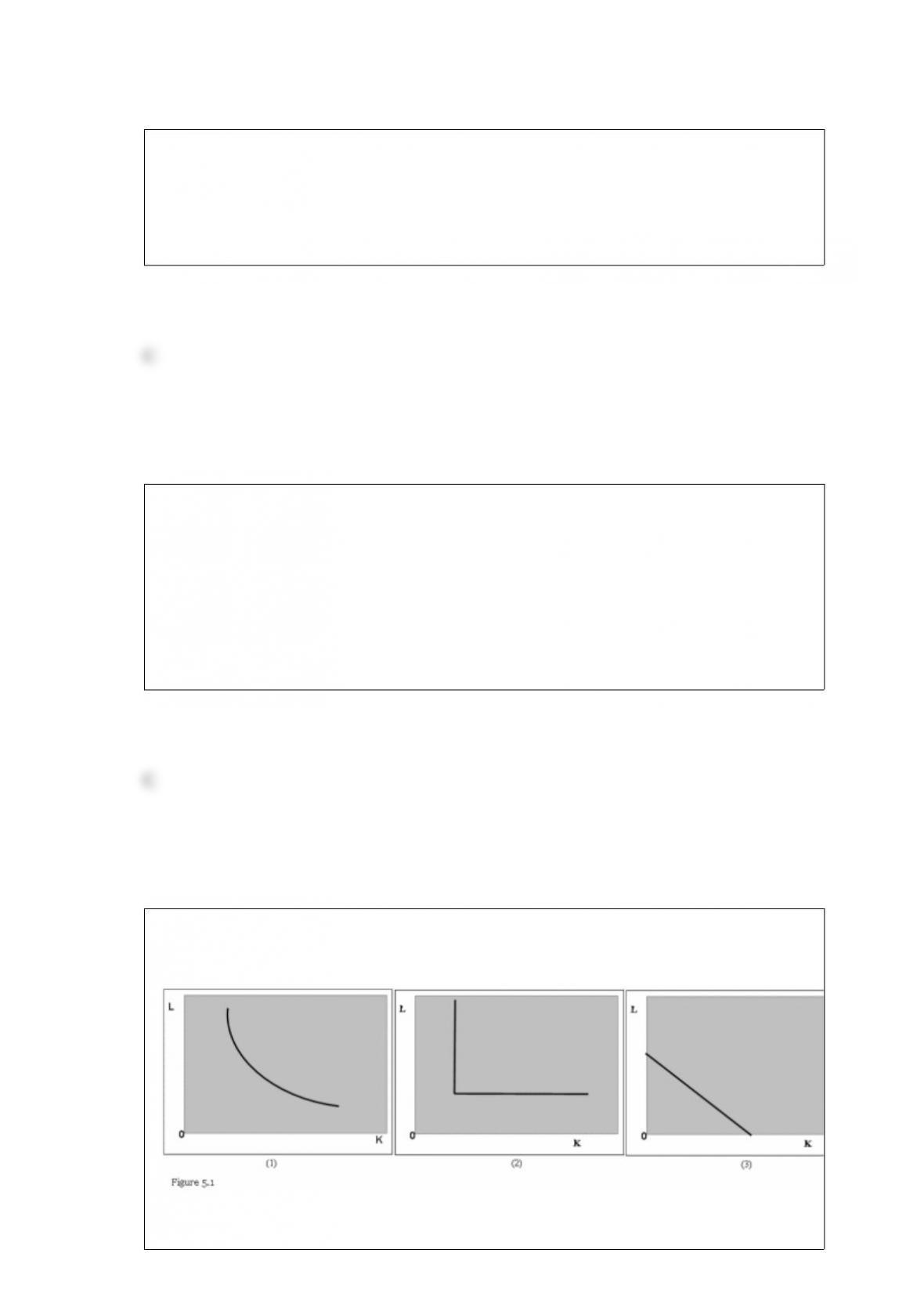
Refer to Figure 5.1. Observe the three isoquants depicted and determine which of the
following statements is true.
A. K and L are substitutes in each of the three cases.
B. K and L are substitutes in cases (1) and (2).

C. K and L are substitutes in cases (2) and (3).
D. K and L are substitutes in cases (1) and (3).
Identify the correct statement related to objective and subjective performance measures.
A. Subjective measures are used in explicit formal contracts.
B. Subjective measures induce dysfunctional behaviors while objective measures do
not.
C. Objective measures are more accurate than subjective measures.
D. Objective measures can create incentives for gaming.
The firm or corporation is the focal point for:
A. a set of contracts.
B. the interaction of demand and supply.
C. dealing with asymmetric information.
D. value minimization.
Which one of the following is a source of organizational power?
A. Vision setting
B. Having an appetite for risk
C. Work experience
D. Having close friends and allies

A demand function depicts how consumer demand for a product varies with
A. income.
B. the cost of raw materials.
C. the price of oil.
D. quantity of goods available in the market.
In terms of using accounting data to build an effective management control system,
what is the nirvana fallacy?
A. It is the tendency to use market-based transfer prices.
B. It is the system of using accounting data for both decision management and decision
control.
C. It is the tendency to use cost centers rather than profit centers as the core of business
structure.
D. It is the belief that a perfect control system can be invented that will stop all fraud.
State and federal regulators retain the authority to set or approve public utilities’ prices.
An important prerequisite for this role is to know the utility’s:
A. price elasticity of supply.
B. true cost function.
C. income elasticity of demand.
D. price in other economies.

The two defects of cafeteria benefit plans are:
A. the high cost of administration and wrong employee decisions.
B. the high cost of administration and adverse selection.
C. employee decision making and adverse selection.
D. employee decision making and free riding.