
All the following are means to manage capacity by changingorstimulating demand
EXCEPT:
a. varying price of goods or services.
b. adding peripheral goods and/or services.
c. providing reservations.
d. shifting work to slack periods.
Answer:
A fixed-period (FPS) inventory system:
a. orders a fixed-period quantity when the inventory position reaches or drops below the
reorder point (r).
b. chooses a replenishment level (M) which includes the demand during the review
period and lead time, plus any safety stock.
c. maintains a constant order quantity every review period.
d. assumes that the demand for an item is constant and continuous, and that the items
are withdrawn at a constant rate.
Answer:
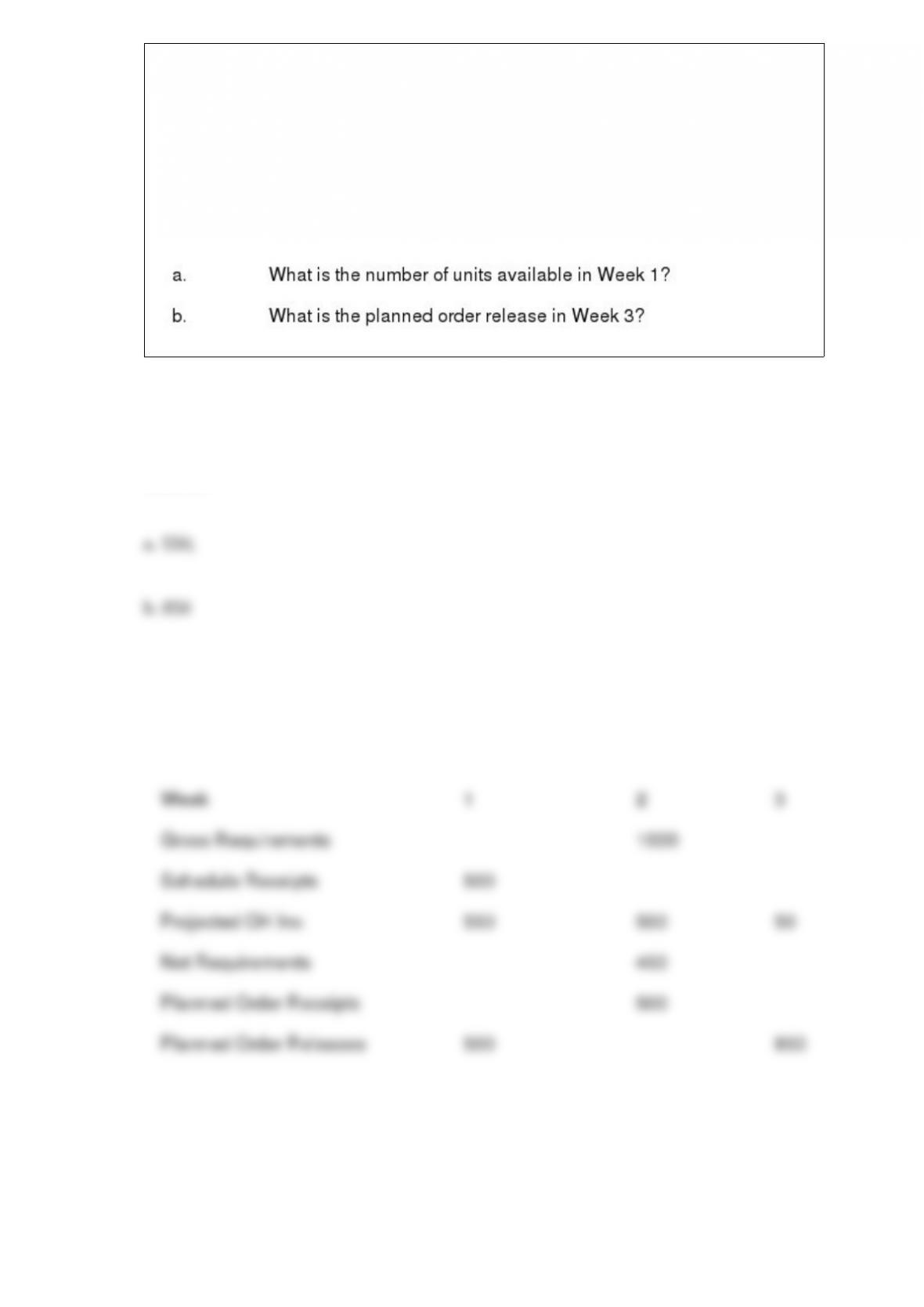
A company that makes inkjet printers is trying to determine a MRP schedule for the
print cartridges it needs in its newest model of printer. They have gross requirements of
1000 units in week 2 and 900 units in week 4. The minimum lot size is 500 units and
the lead time is 1 week. They currently have 300 units on hand that includes a safety
stock of 150 and another 100 units already allocated. They have 500 units scheduled for
receipt in week 1.
Answer:
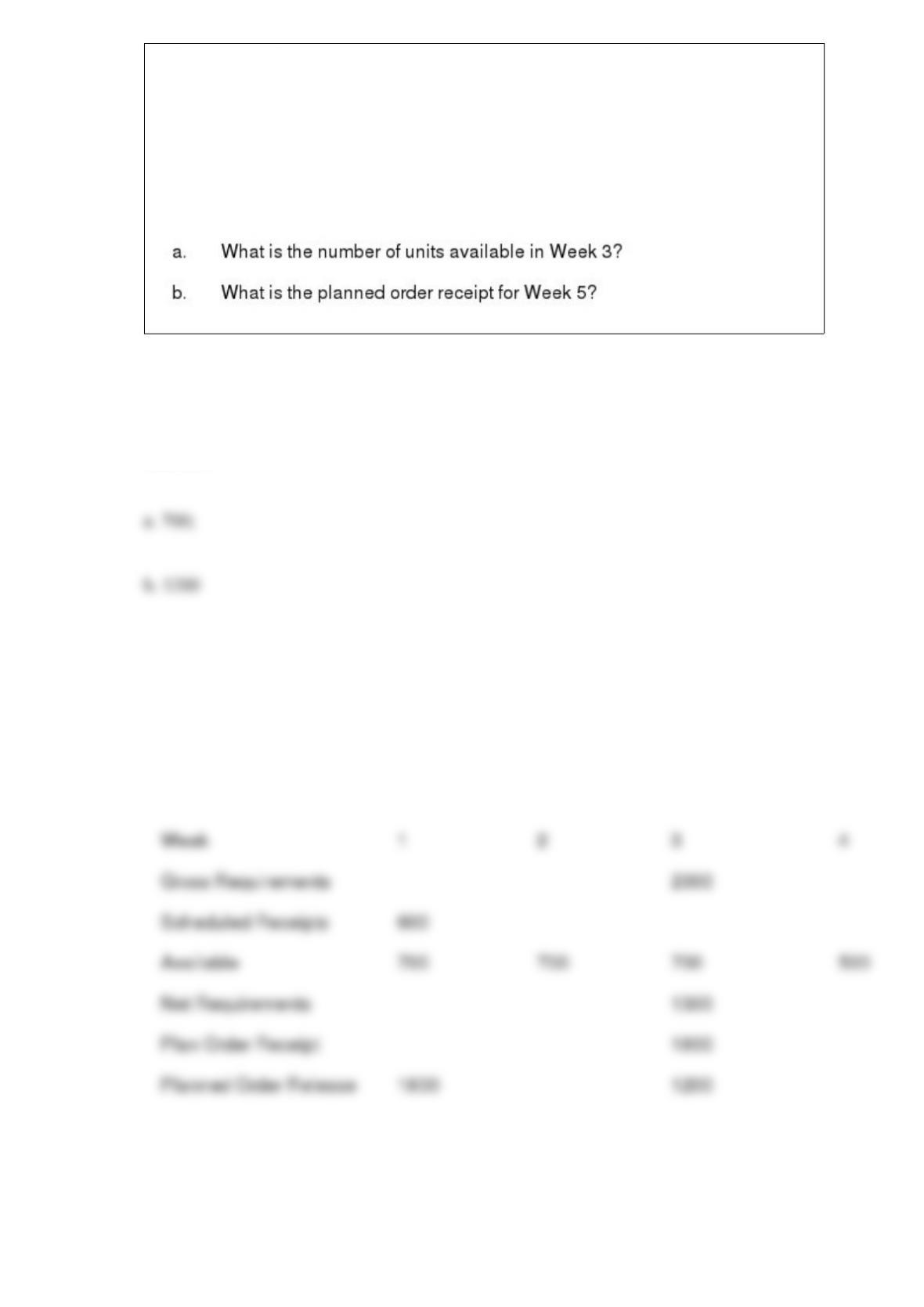
An electronics company wants to develop an MRP schedule for one of its key
components, a specialized chip. The lot size is 600, the lead time is 2 weeks, there are
900 units on hand with 300 of those as safety stock and 500 already allocated. There are
gross requirements for 2000 units in Week 3 and 1500 units in Week 5. There are 600
units scheduled to be received in Week 1.
Answer:
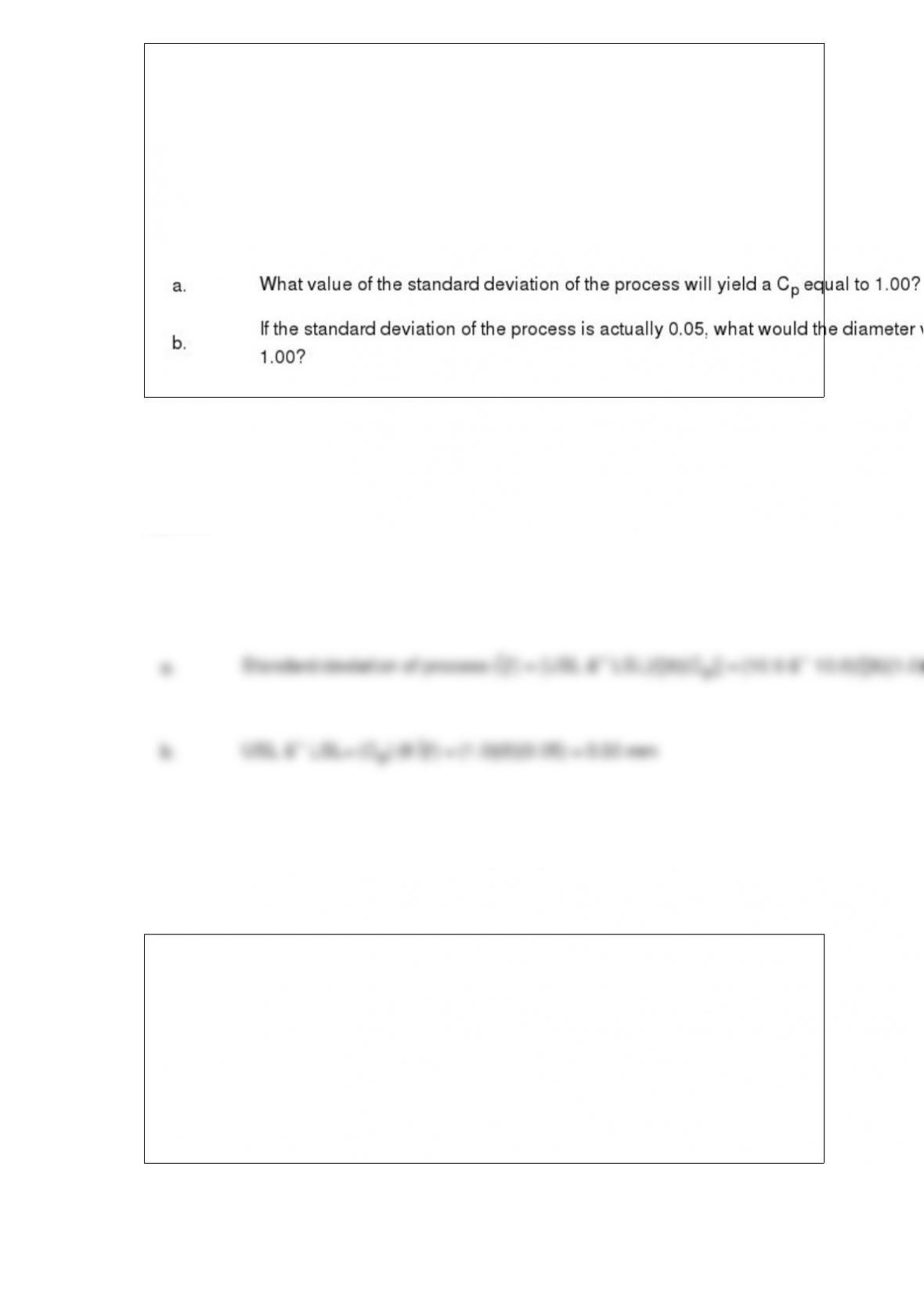
A company that manufactures arrows for sale in archery stores is developing a new
arrow with enhanced flight characteristics. From customer surveys, the company has
determined that the diameter of the arrow should be between 10.0 and 10.6 mm. They
want to ensure the process they develop to produce the arrows will meet customer
expectations; that is, the process capability index (Cp) will be greater than or equal to
1.00.
Answer:
Which of the following steps is NOT the same for both goods and services?
a. Detailed goods, services, and process design
b. Customer benefit package design and configuration
c. Market introduction/deployment
d. Marketplace evaluation
Answer:
In SERVQUAL, the instrument for measuring service quality, the concept of assurance
is associated with _____.
a. the ability to convey trust and confidence
b. individualized (customized) attention
c. providing consistent service
d. performing a service fast
Answer:
Which of the following is NOT considered part of total quality?
a. A focus on customers and stakeholders
b. A process focus
c. Participation and team work
d. Vendor-managed inventory (VMI)
Answer:
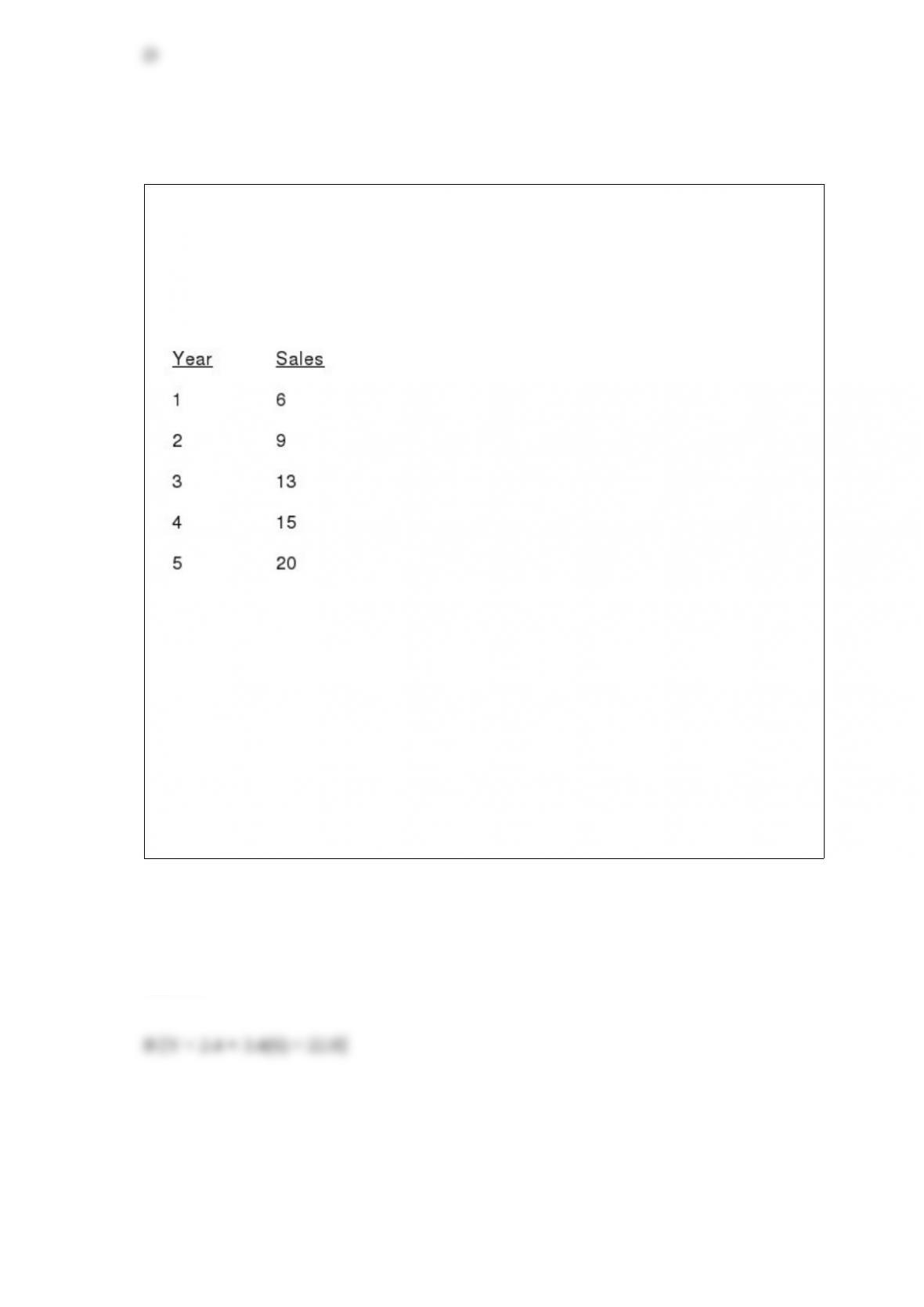
A Taiwan electronics company exports personal computers (PCs) to the U.S. Their PC
sales (in thousands) over the past five years are given below in Table 6.
Table 6
Using the data in Table 6 the forecast for sales in year 6 using the simple regression
equation is:
a. less than 20.
b. more than 20 but less than or equal to 25.
c. more than 25 but less than or equal to 30.
d. more than 30 but less than or equal to 35.
Answer:
Which of the following is NOT a correct statement about bottleneck resources?
a. Work at all times to maximize throughput and resource utilization.
b. An hour lost is an hour lost for the entire process or factory output.
c. Use small order sizes.
d. Work-in-process buffer inventory is placed in front of workstations to maximize
resource utilization.
Answer:
In a fixed-quantity system (FQS), as the reorder point increases:
a. the safety stock increases.
b. the safety stock decreases.
c. the number of orders increases.
d. the number of orders decreases.
Answer:
The determination of specific job tasks and responsibilities is called _____.
a. job design
b. ergonomics
c. job enlargement
d. job enrichment
Answer:
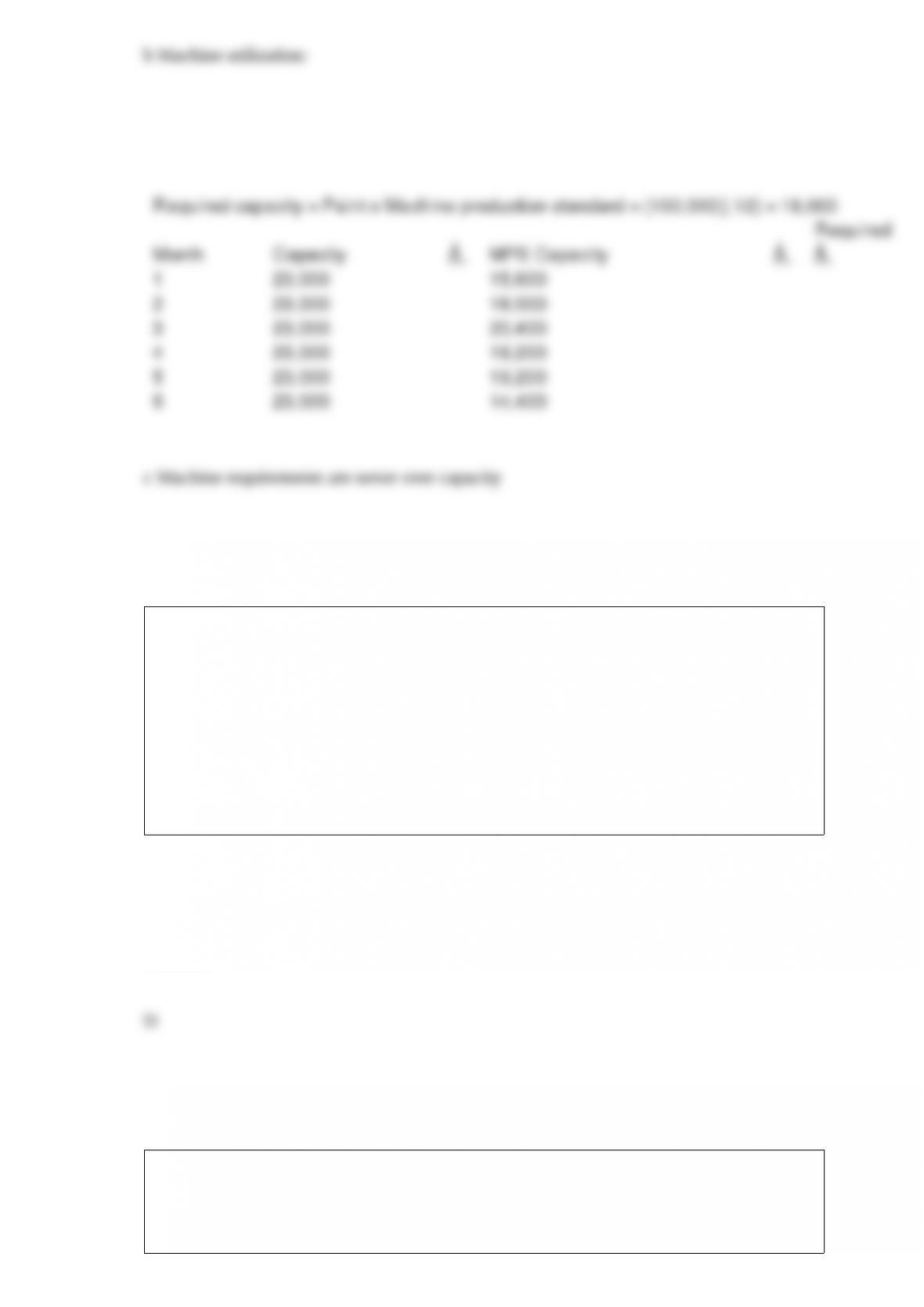
The Pacific Chemical Company produces high quality paint in Oregon for sale
throughout the western U.S. The company ships paint in gallon containers. The
production manager has developed the following master production schedule (MPS) for
the next six months (data is in thousands of gallons):
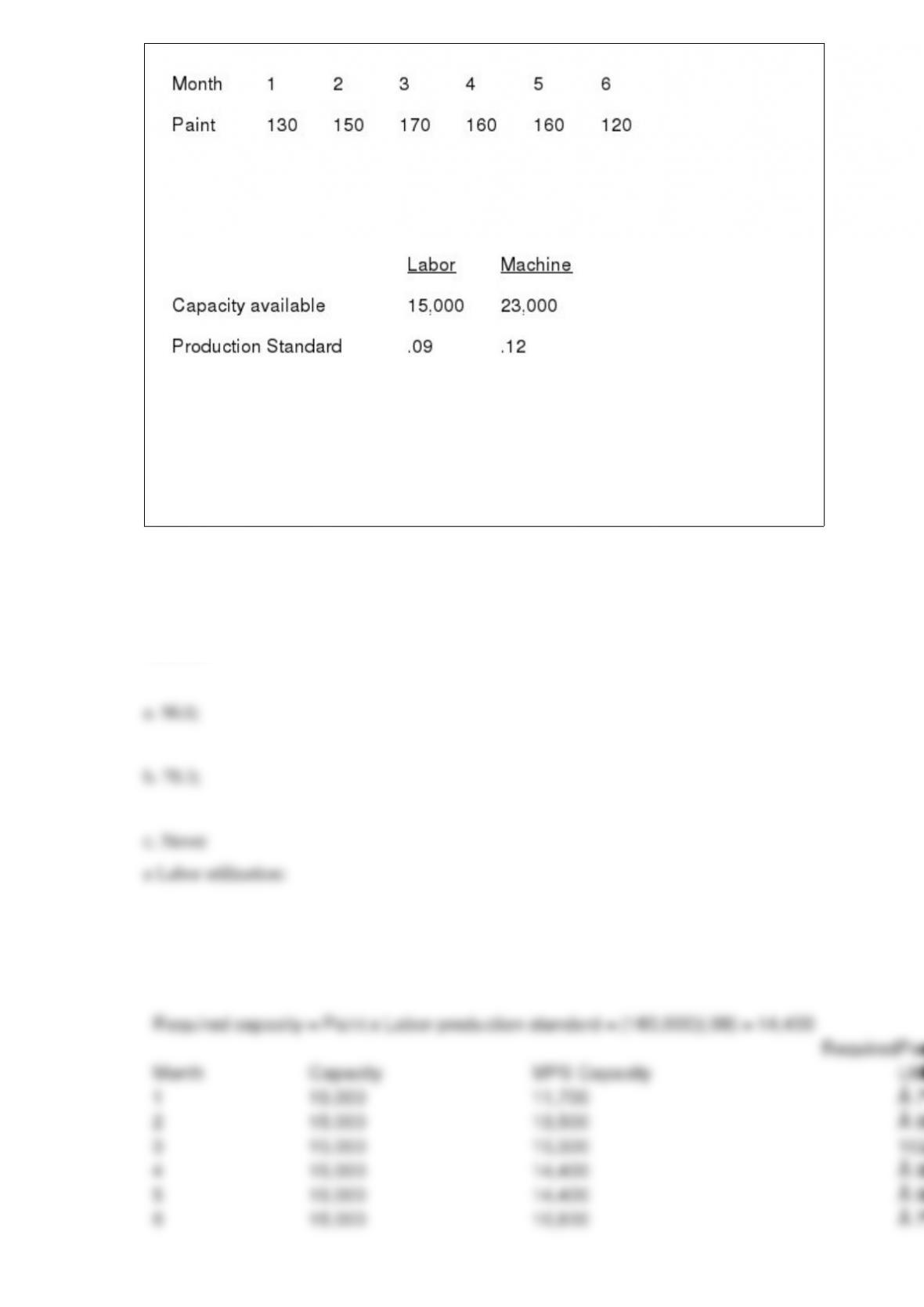
The company’s monthly labor and machine capacity available (in hours) and its
production standards (in hours per gallon) are:
a. What is the percentage utilization of the labor capacity in Week 4?
b. What is the percentage utilization of the machine capacity in Week 2?
c. In which weeks are the machine requirements over capacity?
Answer:
All of the following are simulation languages EXCEPT:
a. Arena.
b. GPSS (General Purpose Systems Simulator).
c. ProcessModel.
d. SystemModel.
Answer:
If Rm = increase in the total production level during month ‘m’ compared to month m1
and Dm = decrease in the total production level during month ‘m’ compared to month
m1, which of the following statements can be correct?
a. Rm = Dm = 0.
b. Both Rm and Dm are positive.
c. Both Rm and Dm are negative.
d. One variable can be positive and the other negative.
Answer:
Community General Hospital finds itself treating many bicycle accident victims. Data
from the last seven 24-hour period is shown below:
a.
What is the forecast for day 4 using a moving average model with AP = 3?
b. With an alpha value of 0.5 and a starting forecast in day 4 equal to the actual data,
what is the exponentially smoothed forecast for day 8?
c. What is the mean absolute deviation (MAD) for days 5 to 7 for an exponentially
smoothed forecasting model with an alpha value of 0.5 and a starting forecast in day 4
equal to the actual data?
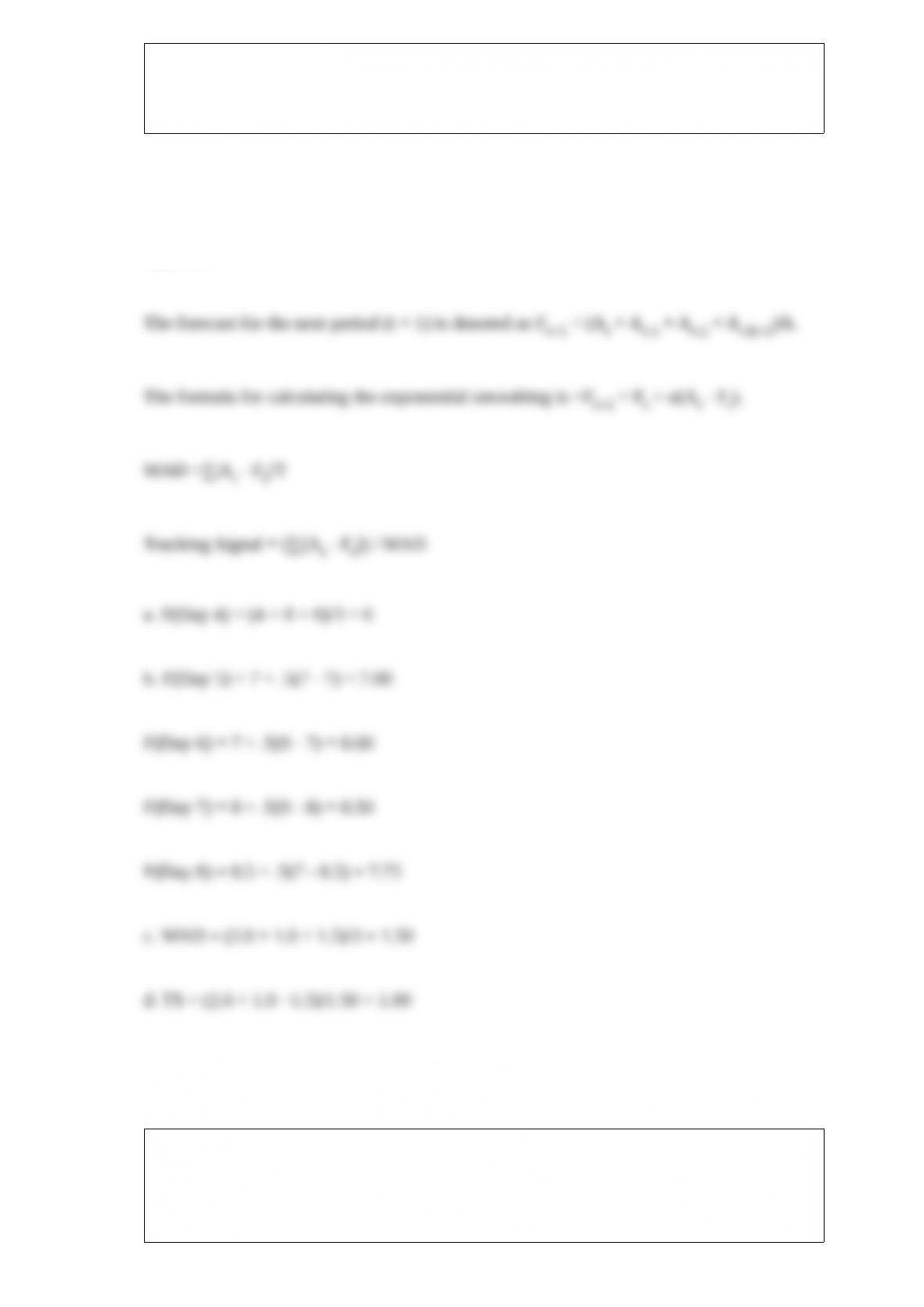
d. What is the tracking signal for days 5 to 7 for an exponentially smoothed forecasting
model with an alpha value of 0.5 and a starting forecast in day 4 equal to the actual
data?
Answer:
Jude is in charge of the advertising program for the Boston Red Sox baseball team
during their spring training in Fort Myers, Florida. He has defined the advertising
program as a project with the following characteristics. The goal is to fill all stadium
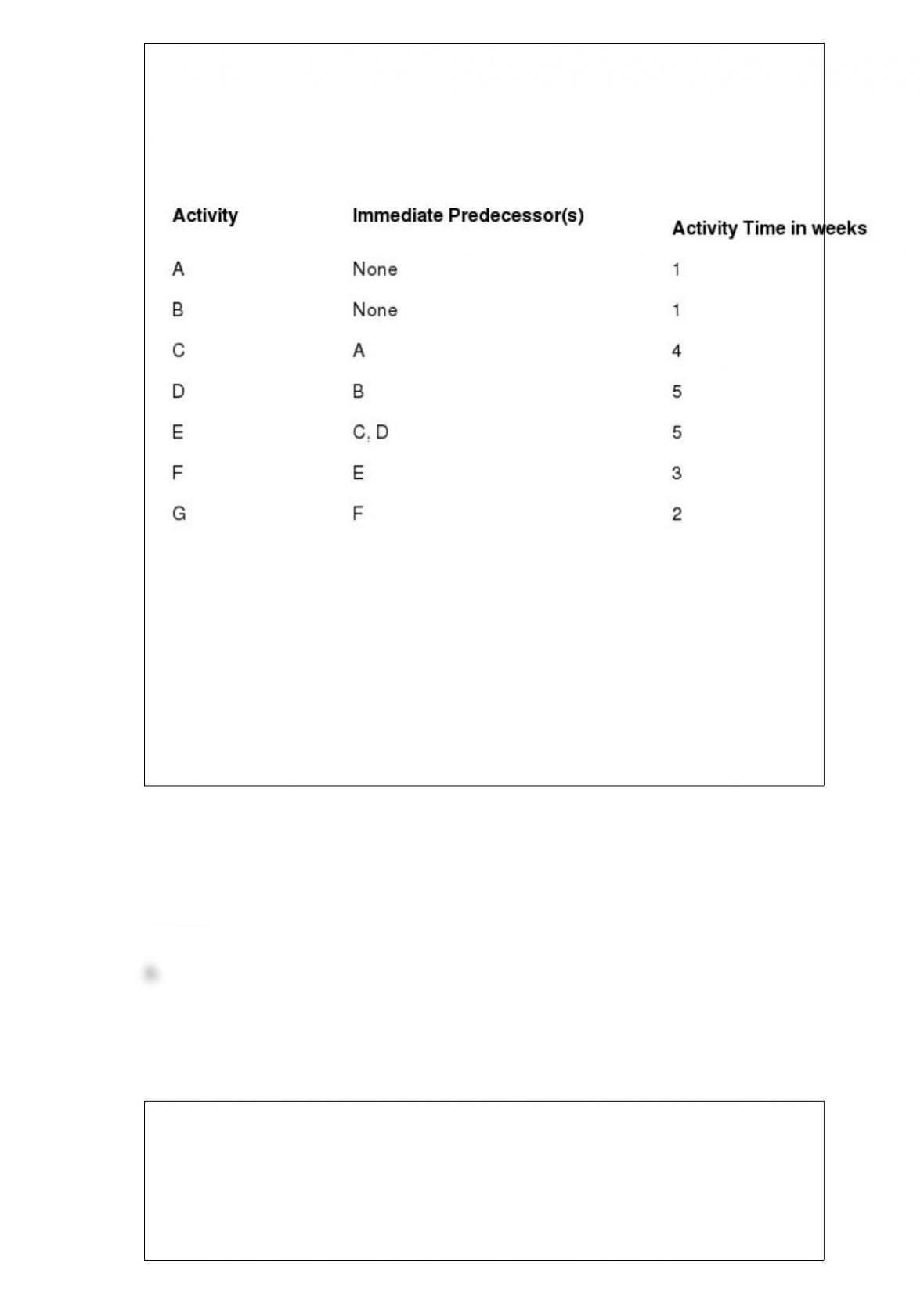
seats during the spring training season or he may not have this job next yearthe pressure
is on!
The largest amount of slack that any activity has in this project is:
a. 1 week.
b. 2 weeks.
c. 3 weeks.
d. 4 weeks.
Answer:
A firm produces two models of pagers, products A and B, on a produce-to-stock basis
and is trying to develop a master production schedule for its operation. Safety stock is
30 for product A and 20 for product B. Fixed lot sizes are 70 for product A and 40 for
product B. The beginning inventories are 30 for A and 30 for B. The demand for these
products comes from many different sources, but the total weekly demand for each of
the next six weeks is given as follows:
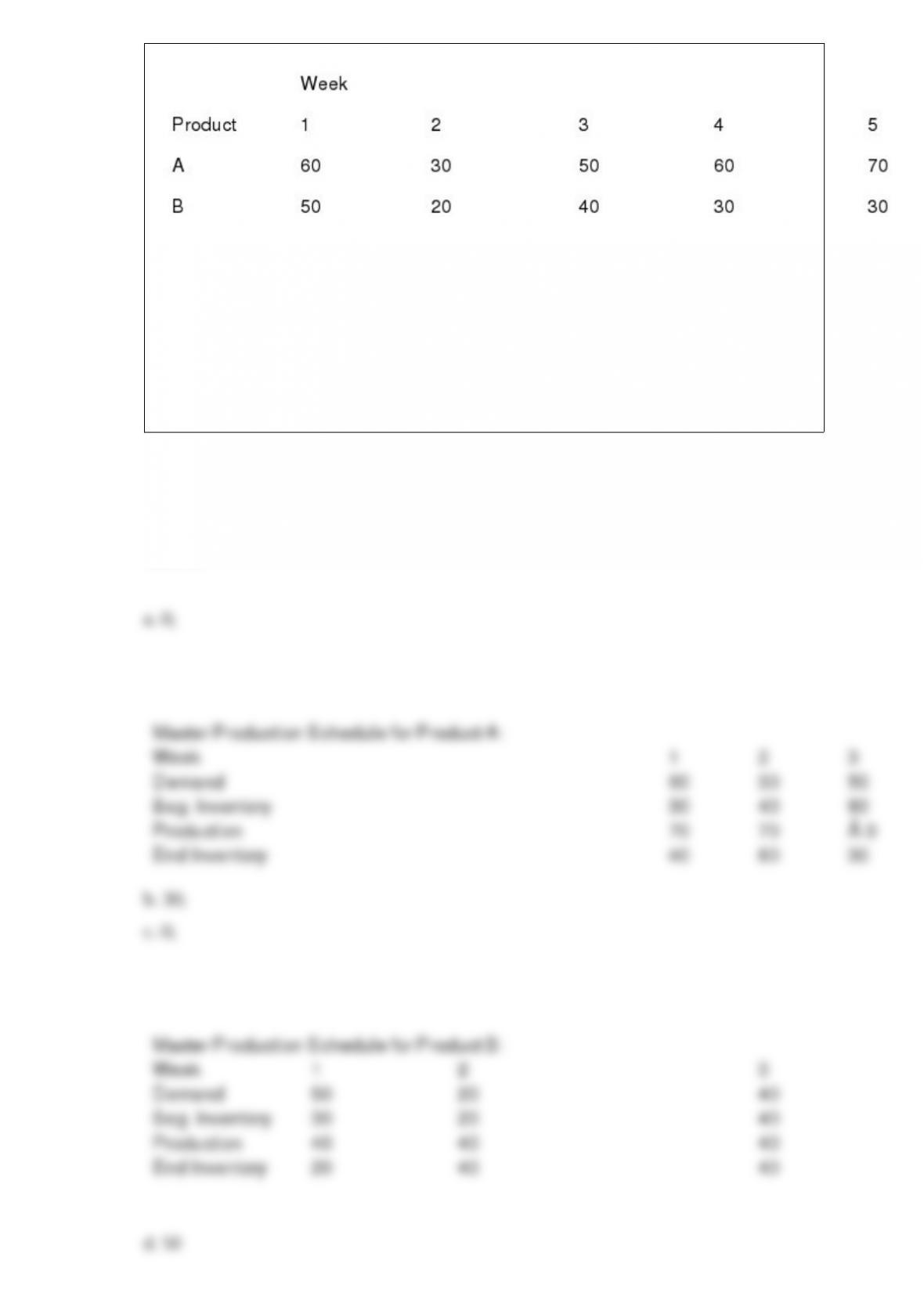
a. What is the production quantity for Product A for Week 3?
b. What is the ending inventory for Product A for Week 3?
c. What is the production quantity for Product B for Week 5?
d. What is the beginning inventory for Product B for Week 5?
Answer:
Which of the following type of process is most likely to be used by a manufacturing
firm that produces a standardized product, not made of discrete parts, with little to no
customization, and has a high volume of demand?
a. Project
b. Job shop
c. Flow shop
d. Continuous flow
Answer:
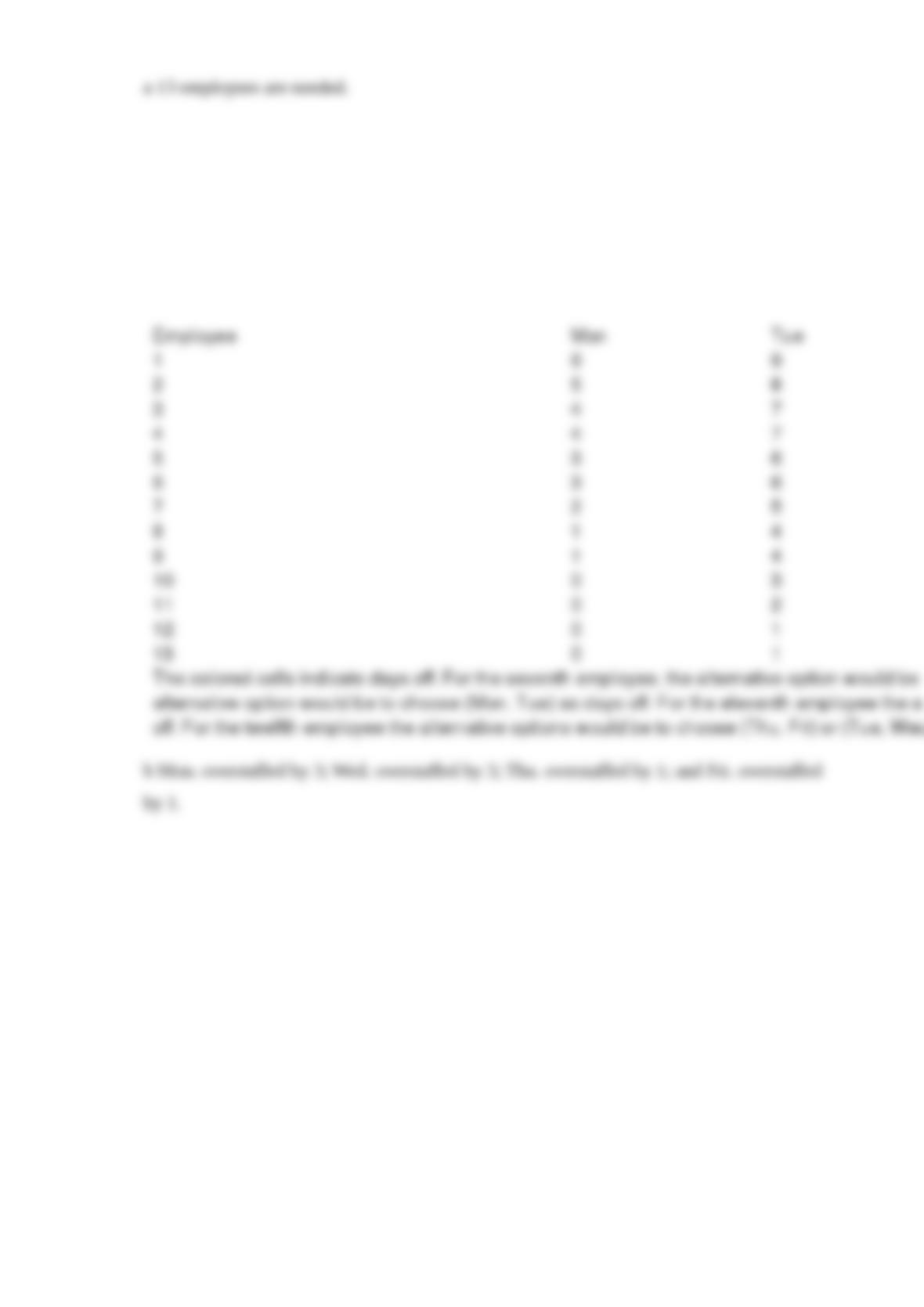
A young entrepreneur has just opened an electronics store. One of the many tasks that
she must address is work scheduling. She plans to stay open from 9 a.m. to 9 p.m.,
Monday through Saturday. She expects her employees to stock the shelves and also be
available for cashier check-out when needed. All employees are full time and work four
days with two consecutive days off each week. She estimates the number of employees
needed each day as follows:
Answer:
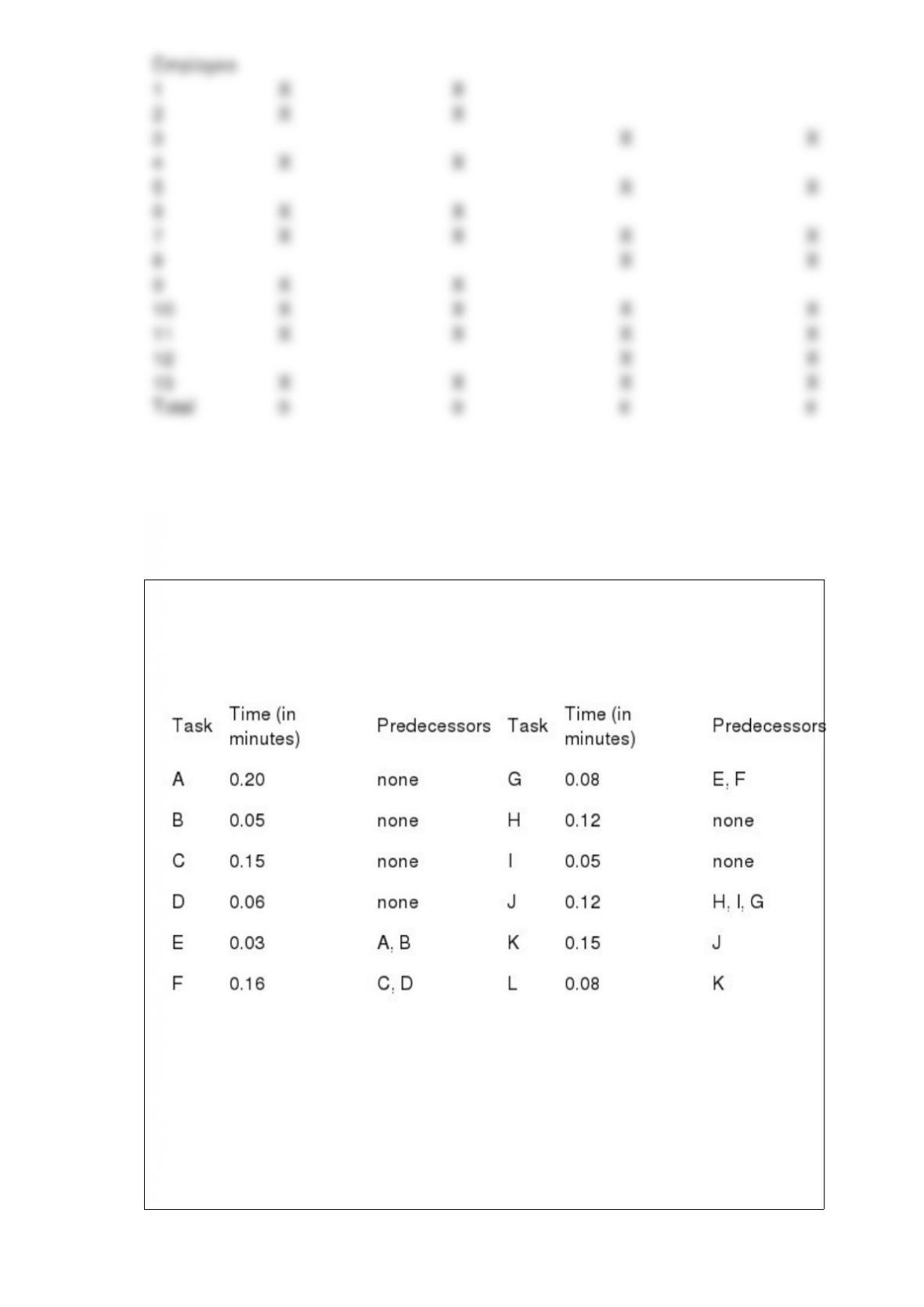
The twelve tasks necessary to assemble a food blender are listed below. The time to
perform each task and the tasks that must immediately precede are also listed. 200
blenders are needed per hour and 50 minutes per hour are productive:
a. Compute the cycle time per unit in minutes.
b. Compute the minimum number of workstations required.
c. Use the longest-task-time heuristic to balance the assembly line.
d. Compute the efficiency of your assembly line.
Answer:
Repeatable periods of ups and downs over short periods of time are called _____.
a. trends
b. seasonal patterns
c. cyclical patterns
d. irregular variations
Answer:
At the end of each month, a research and development team writes status reports for the
projects worked on during the month. The team leaders, Andrew and Julie, submit the
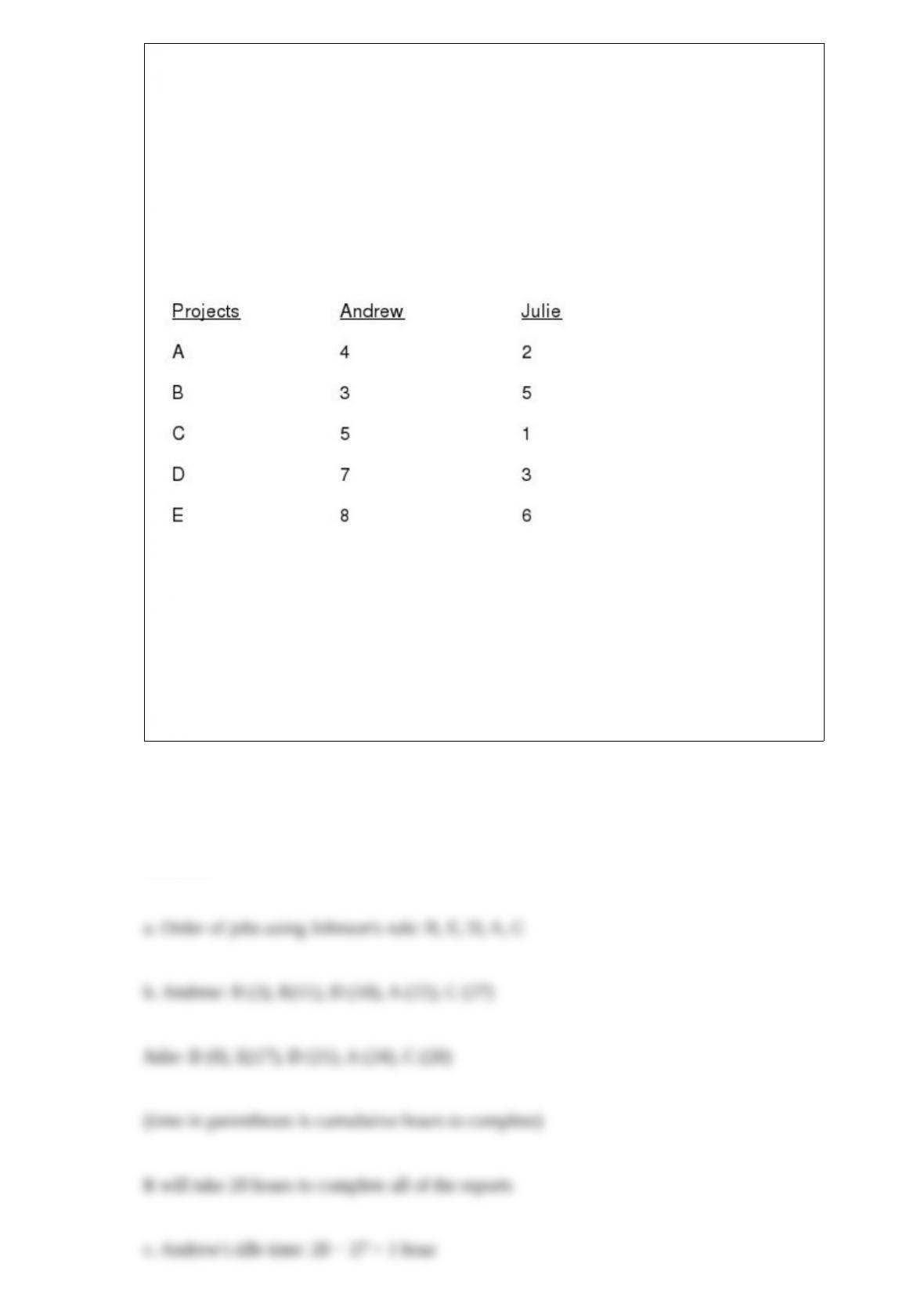
reports to the R&D director on the first Monday of each month. It is late Friday evening
and to their surprise, they discover that the month ends on Sunday, and the reports are
due on Monday morning. They decide to come to work early Saturday morning, so they
can finish the reports before Monday morning. They split the work as follows: Andrew
will write and edit the reports, while Julie collates data and draws all the necessary
graphs. Assume that Julie starts her work on a report as soon as Andrew is finished with
it and that Andrew works continuously. Times for the reports (in hours) are as follows:
a. What is the order of the projects using Johnson’s rule?
b. How many hours will it take them to finish all the reports?
c. How many hours is Andrew idle?
d. How many hours is Julie idle?
Answer:
Which of the following statements on organizational performance measures is FALSE?
a. The five dimensions to assess service quality are empathy, assurance, responsiveness,
reliability, and tangibles.
b. Learning refers to the ability to create new and unique goods and services that delight
customers and create competitive advantage.
c. The two types of performance measures related to time are the speed of doing
something and the variability of a process.
d. Flexibility is the ability to adapt quickly and effectively to changing requirements.
Answer:
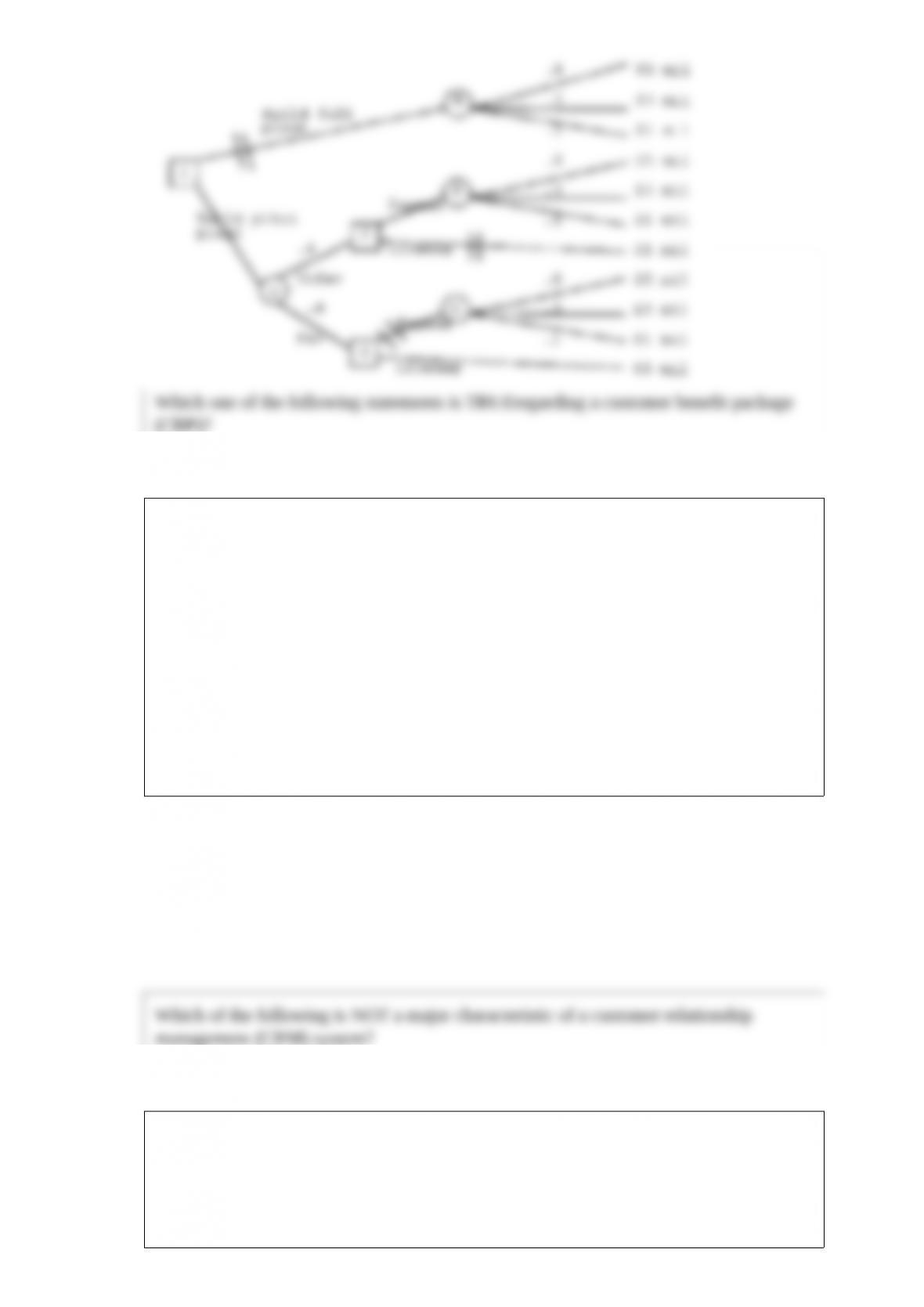
A chemical company is trying to decide whether to build a pilot plant now for a new
chemical process or to build the full plant now. If they build a pilot plant now, they
could expand it later to a full plant or license the plant to another company. It would
cost them $2 million to build the pilot plant and another $2 million later to expand it. If
they build the full plant now it would cost $3.5 million to construct. The returns they
expect to get from the full production plant depend upon the market.
They estimate there is a 60% chance the market will be robust, a 30% chance it will
remain stable, and a 10% chance it will become stagnant. The returns are estimated to
be $5 million if it is robust, $3 million if it is stable, and $1 million if it is stagnant.
Before they expand the pilot plant, they plan to conduct a comprehensive study. Based
on past experience, they expect the study to report a 60% chance of favorable outcome
for expansion and a 40% unfavorable chance. In either case, they should decide whether
to expand to a full plant or license the pilot plant. If the report is favorable and they
license it, they expect to get $3 million. However, if the report is unfavorable and they
license it, they will only get $1 million.
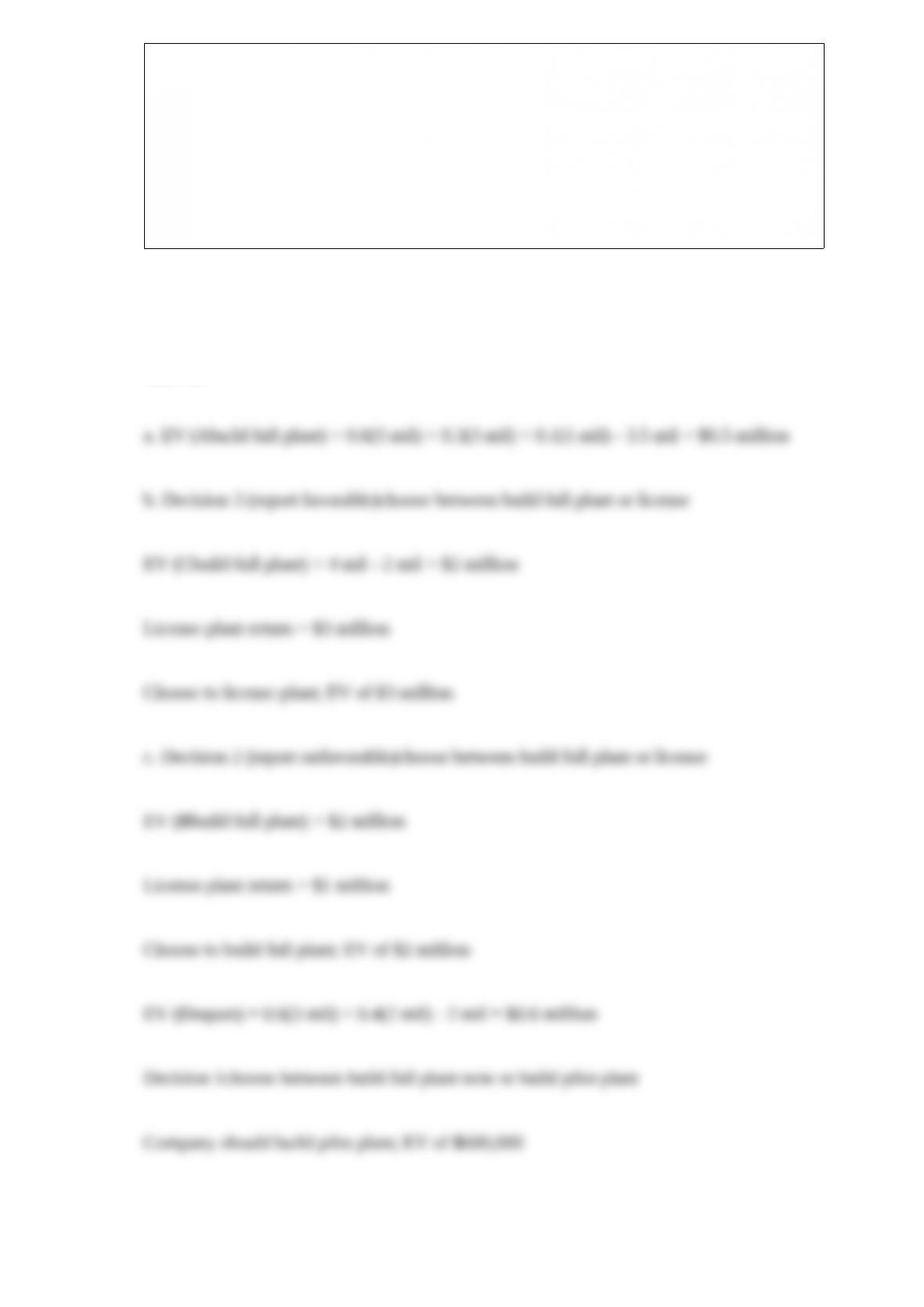
a. Using decision tree analysis, what is the expected value for building the full plant
now?
b. Using decision tree analysis, what is the value of the decision on expanding the pilot
plant assuming the report is favorable?
c. What should the company do, and what is the expected value of that decision?
Answer:
Which one of the following statements is TRUEregarding a customer benefit package
(CBP)?
a. A CBP consists of a primary good and a primary service coupled together.
b. A variant is a CBP feature that strictly adheres to the standard CBP.
c. The size of the circles in the CBP framework can signify the relative importance of
each good and service.
d. When defining a CBP, the features determined by management accurately describe
customers’ wants and needs.
Answer:
Which of the following is NOT a major characteristic of a customer relationship
management (CRM) system?
a. Predicts various Web characteristics that would be most attractive to customers
b. Identifies the possible fraudulent transactions
c. Monitors the quality levels of products
d. Forecasts customer retention
Answer:
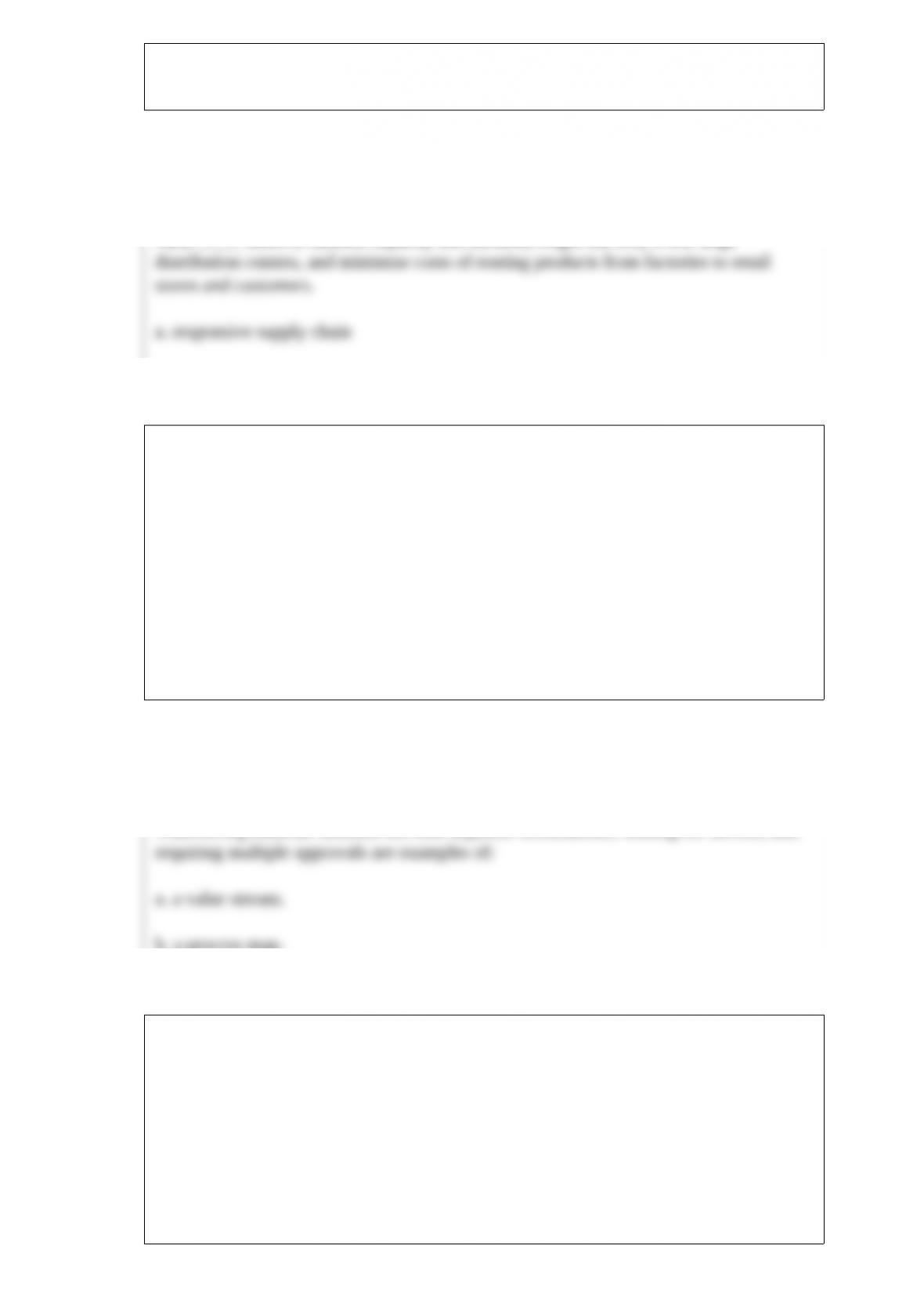
Shea is in charge of the “advertising program” for the Boston Red Sox baseball team
during their spring training in Fort Myers, Florida. She has defined the advertising
program as a project with the following characteristics. The goal is to fill all stadium
seats during the spring training season or she may not have the same job next yearthe
pressure is on!
The largest amount of slack that any activity has in this project is:
a. 1 week.
b. 2 weeks.
c. 3 weeks.
d. 4 weeks.
Answer:
A(n) _____ seeks to balance capacity and demand, might use only a few large
distribution centers, and minimize costs of routing products from factories to retail
stores and customers.
a. responsive supply chain
b. efficient supply chain
c. push system
d. pull system
Answer:
Transferring material between two non-adjacent workstations, waiting for service, and
requiring multiple approvals are examples of:
a. a value stream.
b. a process map.
c. non-value-added activities.
d. a service blueprint.
Answer:
An inventory item can be:
a. only a parent.
b. only a component.
c. both a parent and a component.
d. either a parent or a component, but not both.
Answer:
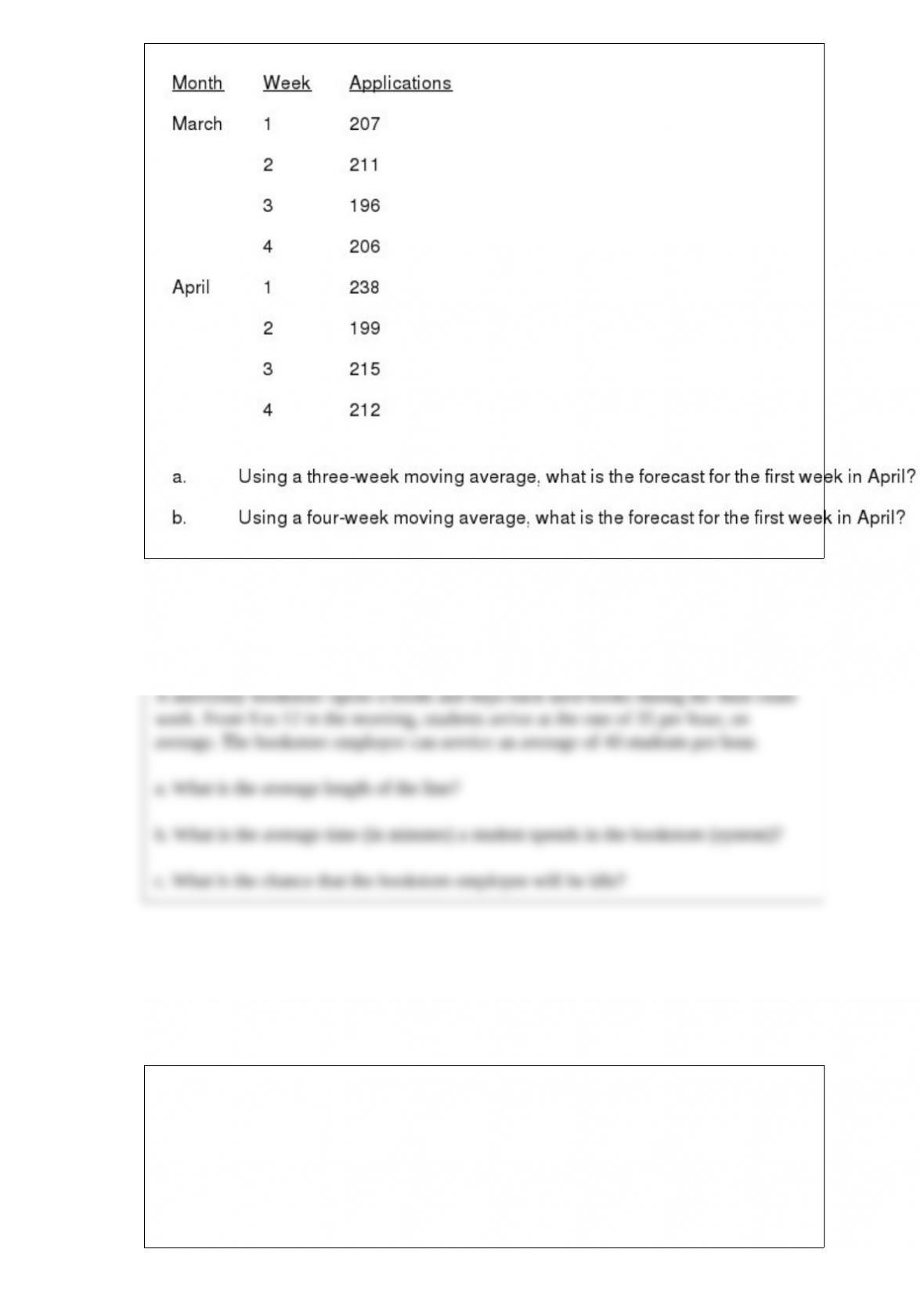
State Division of Motor Vehicles (DMV) statistics show the rate of new driver’s license
applications as shown below:
Answer:
A university bookstore opens a booth and buys back used books during the final exam
week. From 9 to 12 in the morning, students arrive at the rate of 35 per hour, on
average. The bookstore employee can service an average of 40 students per hour.
a. What is the average length of the line?
b. What is the average time (in minutes) a student spends in the bookstore (system)?
c. What is the chance that the bookstore employee will be idle?
Answer:
Answer:
Define a Kanban. Describe how it helps to execute a pull system.
Answer:
Enterprise resource planning systems are designed to build customer relationships and
loyalty.
Answer:
Which of the following statements is FALSE concerning the discussion of the Zappos
case study?
a. An example of a primary process at Zappos is “order entry.”
b. The value of a loyal customer is an important part of Zappos’ strategy because of its
emphasis on more repeat customers through word of mouth.
c. Zappos’ first core value is “Deliver WOW through service.”
d. Zappos’ call center is the gateway to its business and represents a support process.
Answer:
Predetermined time standards are advantageous since they avoid needing multiple
performance ratings.
Answer:
The number of Kanban cards is directly proportional to the amount of work-in-process
inventory.
Answer:
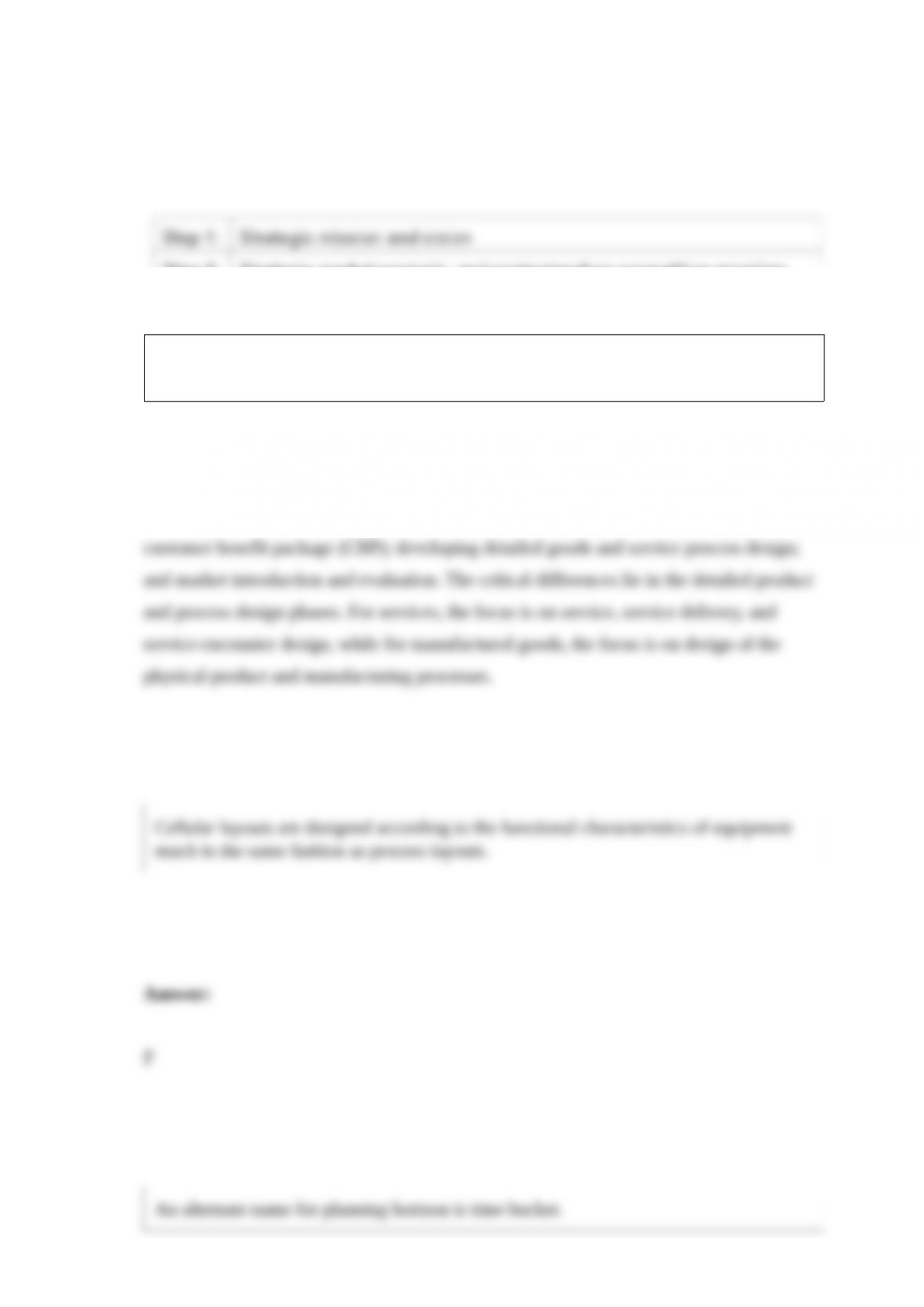
Summarize the process of designing goods and services, and explain where the process
differs between goods and services.
Answer:
Cellular layouts are designed according to the functional characteristics of equipment
much in the same fashion as process layouts.
Answer:
An alternate name for planning horizon is time bucket.
Answer:
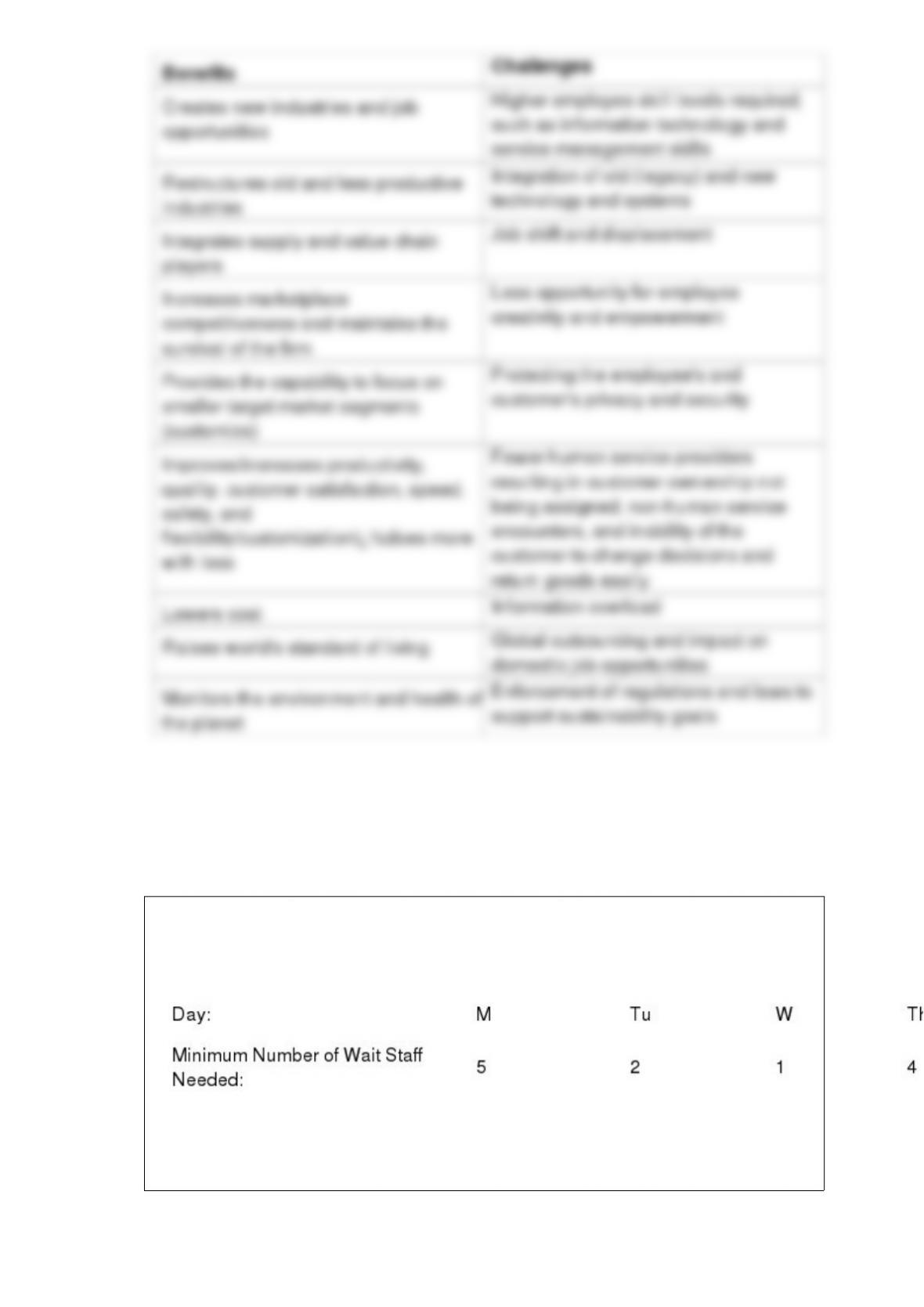
What are the benefits and challenges of technology?
Answer:
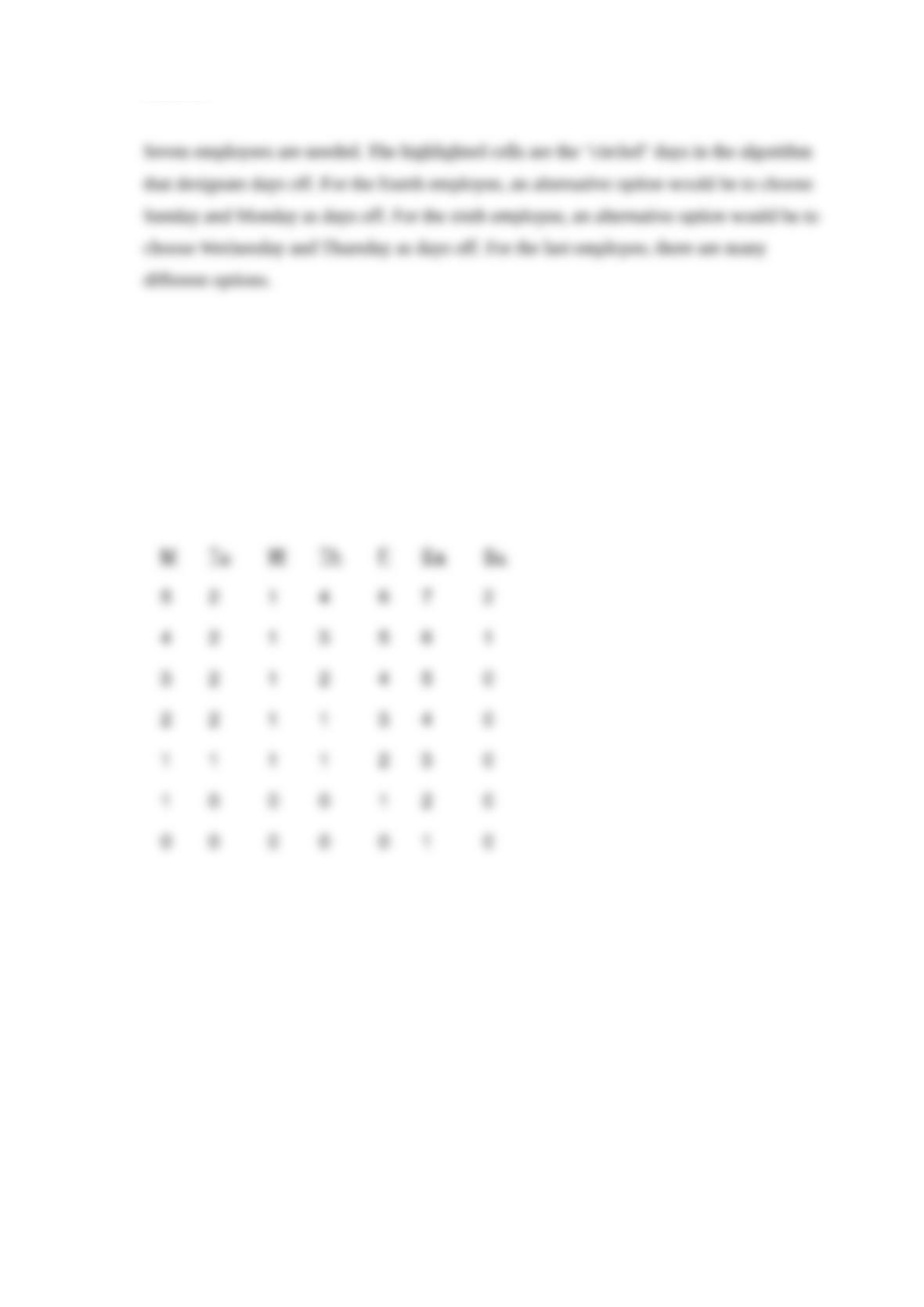
A restaurant needs the following number of wait staff to serve its evening guests.
How many employees are needed so that each has two consecutive days off? Construct
a work schedule for these employees.
Answer:
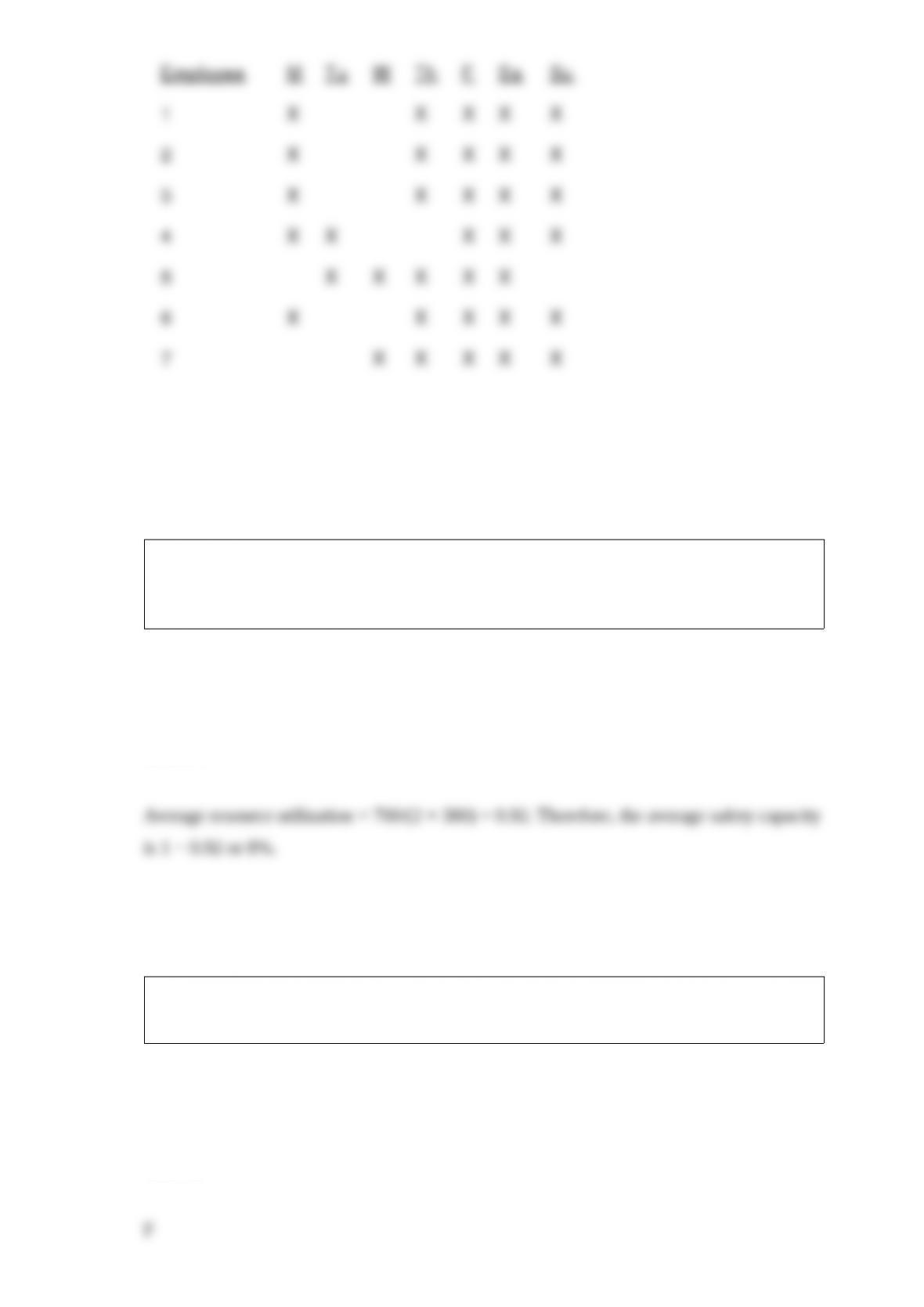
An assembly line normally operates two shifts a day, five days per week. The planned
capacity of the assembly line is 380 units/shift. Determine the average safety capacity if
700 items are assembled a day, on average.
Answer:
Process mapping is defined as the fundamental rethinking and radical redesign of
business processes.
Answer:
Quality has been a principal focus of operations management since the industrial
revolution.
Answer:
Explain the essence of a transportation problem.
Answer:
Answer:
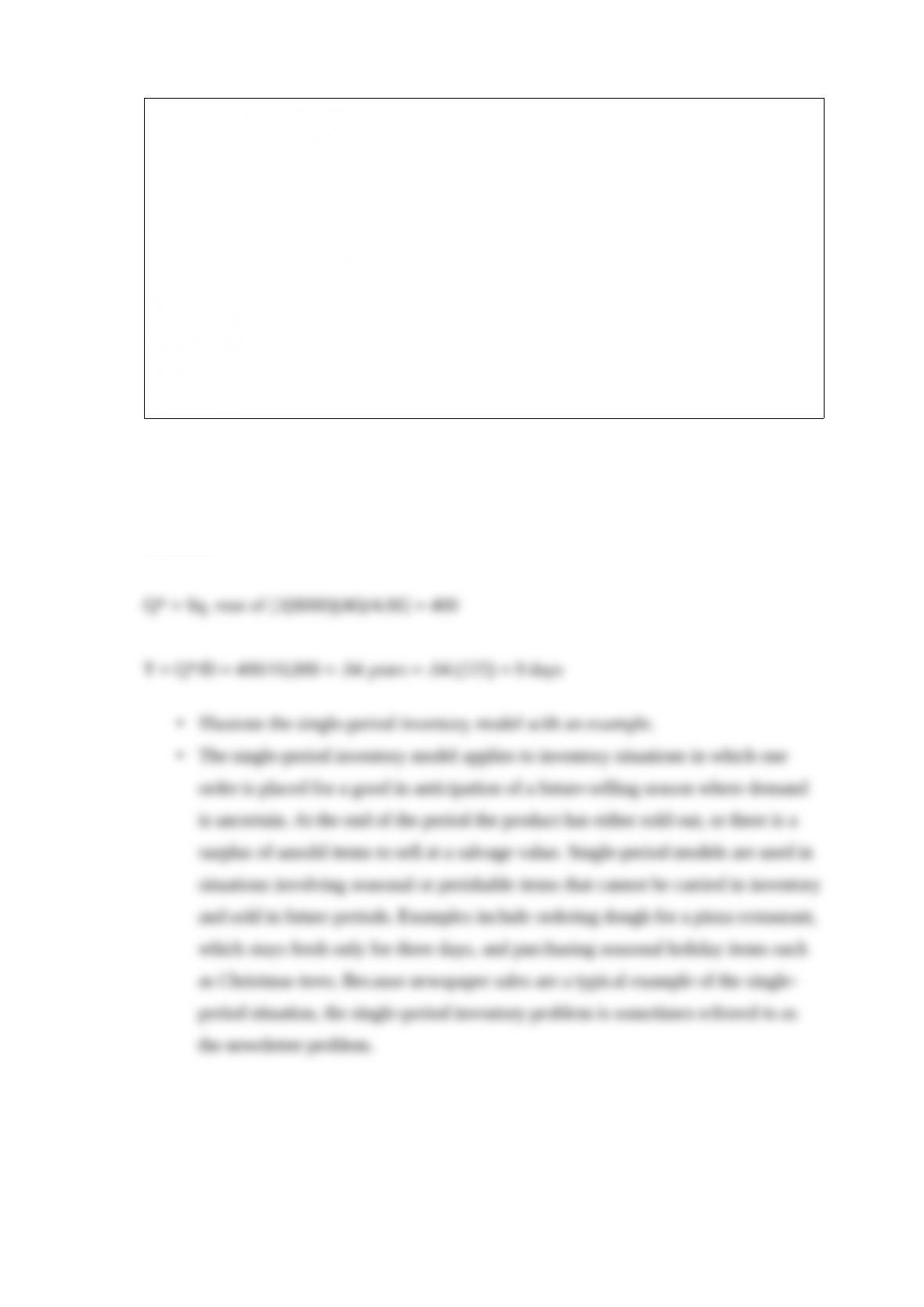
Heather, manager of a large medical supply house that operates 45 weeks per year and 5
days per week, has decided to implement a fixed-period inventory system for all class A
items. One such item has the following characteristics:
Demand = 8,000 units/year
Order cost = $40/order
Holding cost = $4/unit/year
If Heather wishes to minimize total cost (thereby approximating the economic order
quantity (EOQ)), what should be T, the number of workdays between orders (i.e.,
review period)?
Answer:
A fixed-position layout is based on the sequence of operations that is performed during
the manufacturing of a good or delivery of a service.
Answer:
Errors in service creation and delivery are sometimes called service upsets.
Answer:
Graeme manages a candy store in a high traffic shopping mall where he has collected
the following information:
•Weekly demand for small candy boxes = 90 boxes
•Cost to place one purchase order with the box supplier = $19.80
•Cost to hold one box for one year in inventory = $2.45
•Lead time = 2 weeks
•Weeks in a year = 52 weeks
The total order and inventory-holding cost is:
a. less than $300.
b. more than or equal to $300 but less than $400.
c. more than or equal to $400 but less than $500.
d. more than or equal to $600.
Answer: