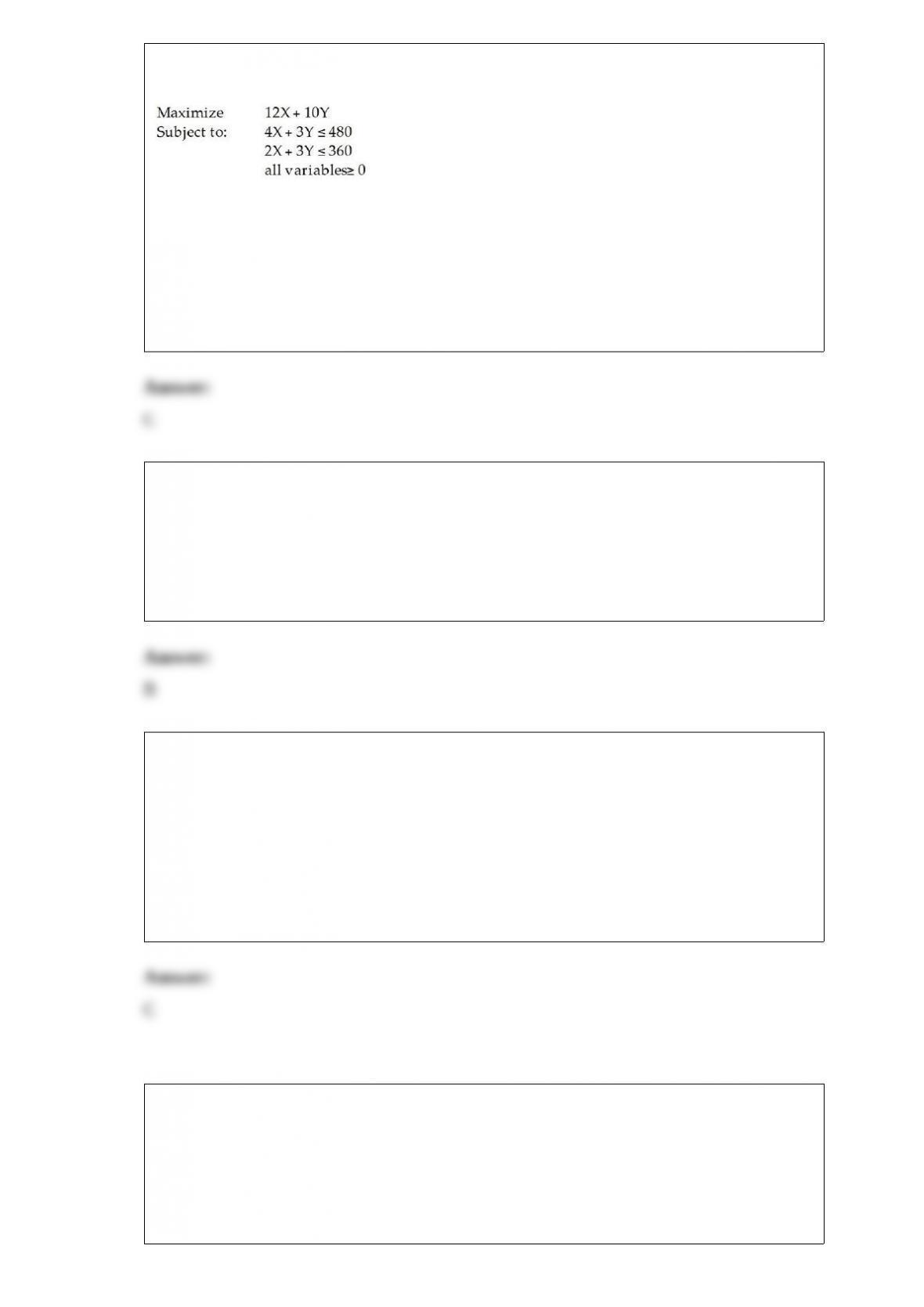
1) Consider the following linear programming problem:
The maximum possible value for the objective function is
A) 360.
B) 480.
C) 1520.
D) 1560.
E) None of the above
2) When does P(A|B) = P(A)?
A) when A and B are mutually exclusive
B) when A and B are statistically independent
C) when A and B are statistically dependent
D) when A and B are collectively exhaustive
E) when P(B) = 0
3) Which of the following represents the underlying linear model for hypothesis
testing?
A) Y = b0 + b1 X + ε
B) Y = b0 + b1 X
C) Y = β0 + β1 X + ε
D) Y = β0 + β1 X
E) None of the above
4) The three decision-making environments are decision making under
A) utility, risk, and certainty.
B) utility, risk, and uncertainty.
C) utility, certainty, and uncertainty.
D) utility, equity, and certainty.
E) risk, certainty, and uncertainty.
5) Consider the following constraints from a linear programming problem:
2X + Y =<200
X + 2Y =<200
X, Y >=0
If these are the only constraints, which of the following points (X,Y) cannot be the
optimal solution?
A) (0, 0)
B) (0, 100)
C) (65, 65)
D) (100, 0)
E) (66.67, 66.67)
6) An advantage of exponential smoothing over a simple moving average is that
exponential smoothing requires one to retain less data.
7) Table 8-1
A small furniture manufacturer produces tables and chairs. Each product must go
through three stages of the manufacturing process: assembly, finishing, and inspection.
Each table requires 3 hours of assembly, 2 hours of finishing, and 1 hour of inspection.
Each chair requires 2 hours of assembly, 2 hours of finishing, and 1 hour of inspection.
The profit per table is $120 while the profit per chair is $80. Currently, each week there
are 200 hours of assembly time available, 180 hours of finishing time, and 40 hours of
inspection time. Linear programming is to be used to develop a production schedule.
Define the variables as follows:
T = number of tables produced each week
C = number of chairs produced each week
According to Table 8-1, which describes a production problem, suppose it is decided
that the number of hours used in the assembly process must be at least 90 percent of the
number of hours used in the finishing department. How would this constraint be
written?
A) 3T + 2C >=162
B) 3T + 2C >=0.9(2T + 2C)
C) 3T + 2C =< 162
D) 3T + 2C =< 0.9(2T + 2C)
E) None of the above
8) In the long run, in Markov analysis,
A) all state probabilities will eventually become zeros or ones.
B) generally, the vector of state probabilities, when multiplied by the matrix of
transition probabilities, will yield the same vector of state probabilities.
C) the matrix of transition probabilities will change to an equilibrium state.
D) All of the above
E) None of the above
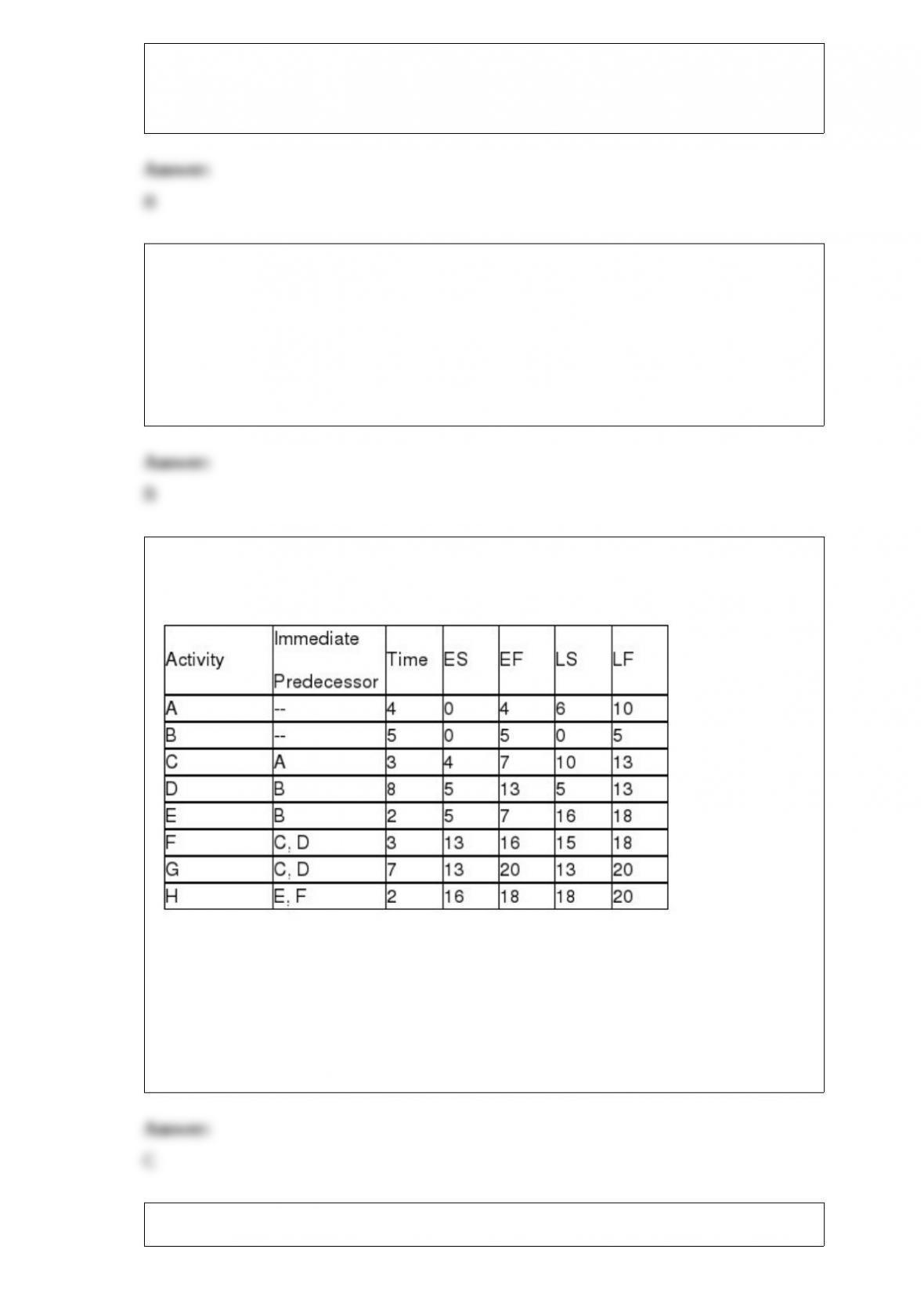
9) Table 11-5
How long could Table 11-5’s activity E be delayed without delaying the completion of
the project?
A) 7
B) 16
C) 11
D) 18
E) None of the above
10) Markov analysis is a technique that deals with the probabilities of future
occurrences by
A) using the simplex solution method.
B) analyzing currently known probabilities.
C) statistical sampling.
D) the minimal spanning tree.
E) None of the above
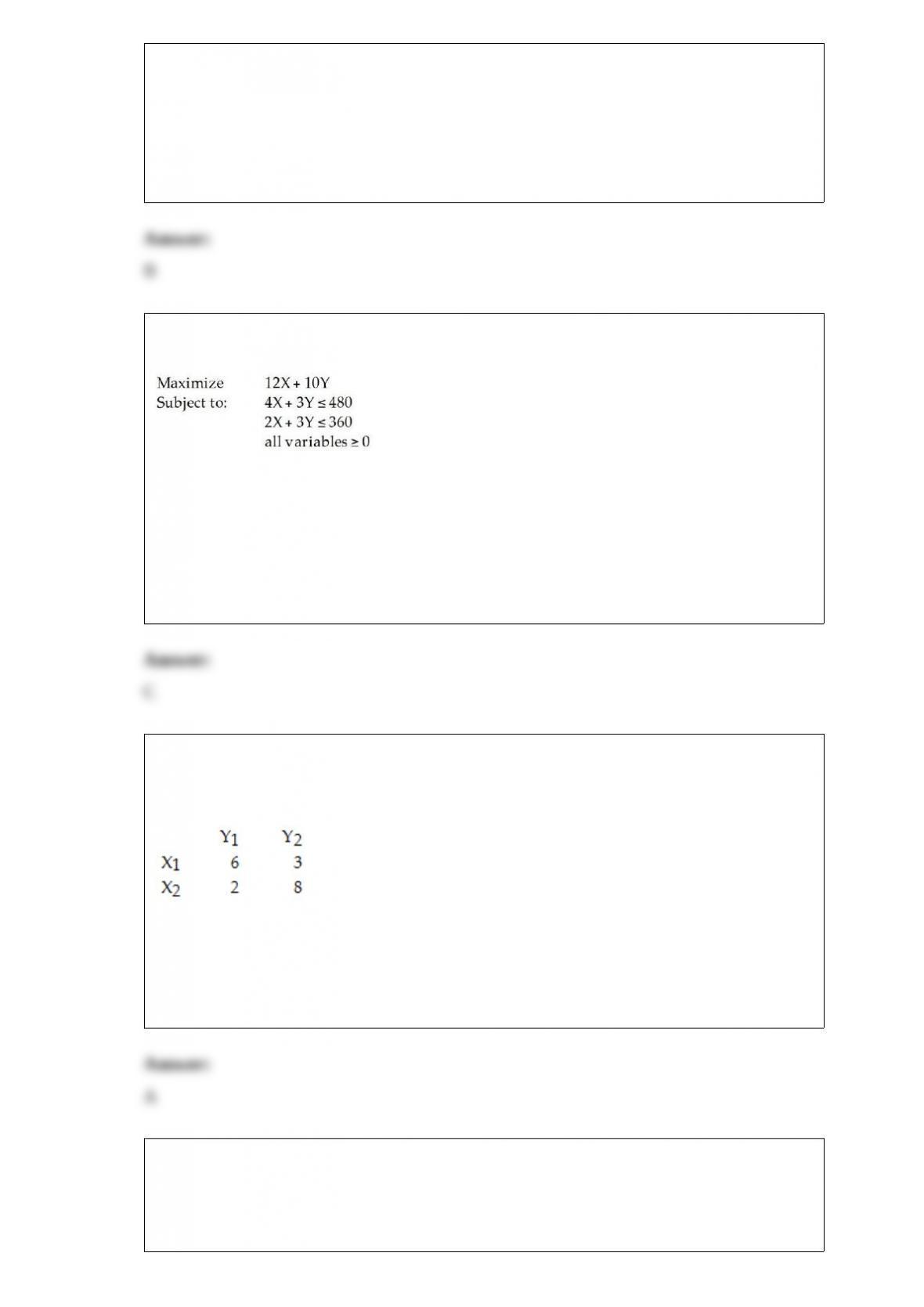
11) Consider the following linear programming problem:
Which of the following points (X,Y) is feasible?
A) (10,120)
B) (120,10)
C) (30,100)
D) (60,90)
E) None of the above
12) Considering the following two-person game, what percentage of the time should X
play strategy X2?
A) 1/3
B) 2/3
C) 4/9
D) 5/9
E) None of the above
13) Barbour Electric is considering the introduction of a new product. This product can
be produced in one of several ways: (a) using the present assembly line at a cost of $25
per unit, (b) using the current assembly line after it has been overhauled (at a cost of
$10,000) with a cost of $22 per unit; and (c) on an entirely new assembly line (costing
$30,000) designed especially for the new product with a per unit cost of $20. Barbour is
worried, however, about the impact of competition. If no competition occurs, they
expect to sell 15,000 units the first year. With competition, the number of units sold is
expected to drop to 9,000. At the moment, their best estimate is that there is a 40%
chance of competition. They have decided to make their decision based on the first year
sales.
(a) Develop the decision table (EMV).
(b) Develop a decision table (EOL).
(c) What should they do?
14) At equilibrium,
A) state probabilities for the next period equal the state probabilities for this period.
B) the state probabilities are all equal to each other.
C) the matrix of transition probabilities is symmetrical.
D) the vector of state probabilities is symmetrical.
E) the fundamental matrix is the same as the matrix of transition probabilities.
15) Table M8-1
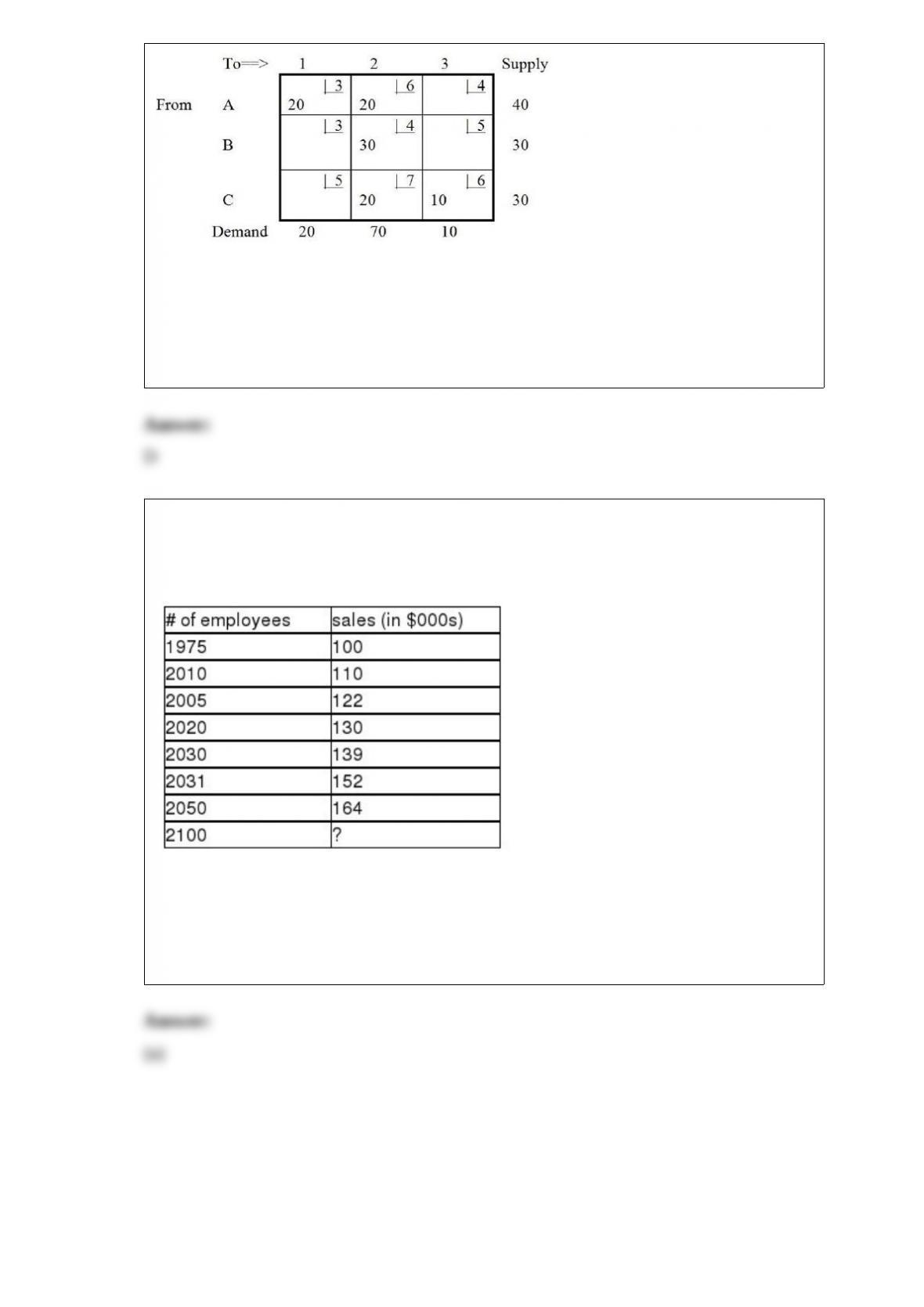
What is the total cost represented by the solution shown in Table M8-1?
A) 60
B) 2500
C) 2600
D) 500
E) None of the above
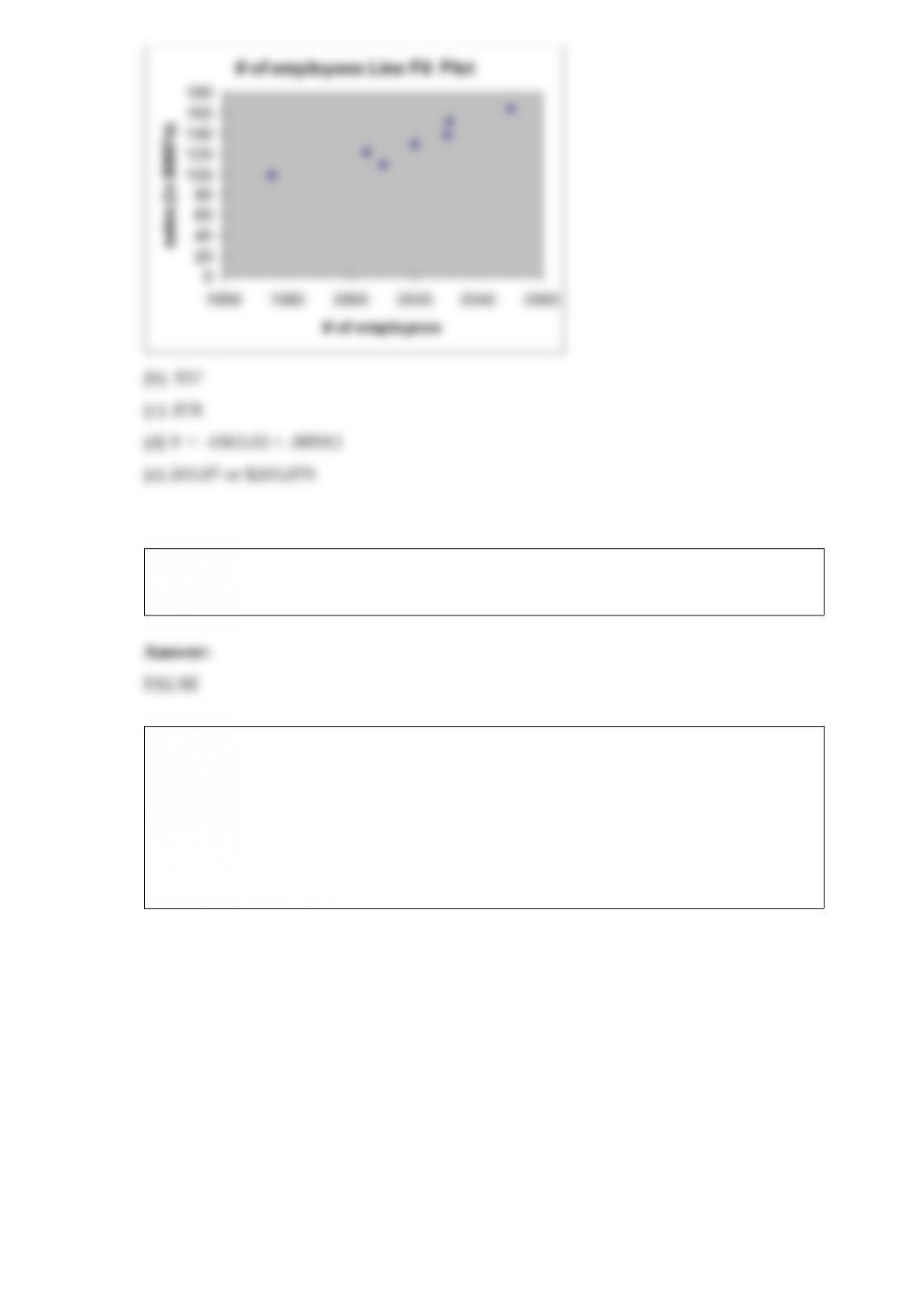
16) A large international sales organization has collected data on the number of
employees and the annual gross sales during the last 7 years.
(a) Develop a scatter diagram.
(b) Determine the correlation coefficient.
(c) Determine the coefficient of determination.
(d) Determine the least squares trend line.
(e) Determine the predicted value of sales for 2100 employees.
17) For two events A and B that are not mutually exclusive, the probability that either A
or B will occur is P(A) x P(B) – P(A and B).
18) Table 13-4
A pawn shop in Arlington, Texas, has a drive-through window to better serve
customers. The following tables provide information about the time between arrivals
and the service times required at the window on a particularly busy day of the week. All
times are in minutes.
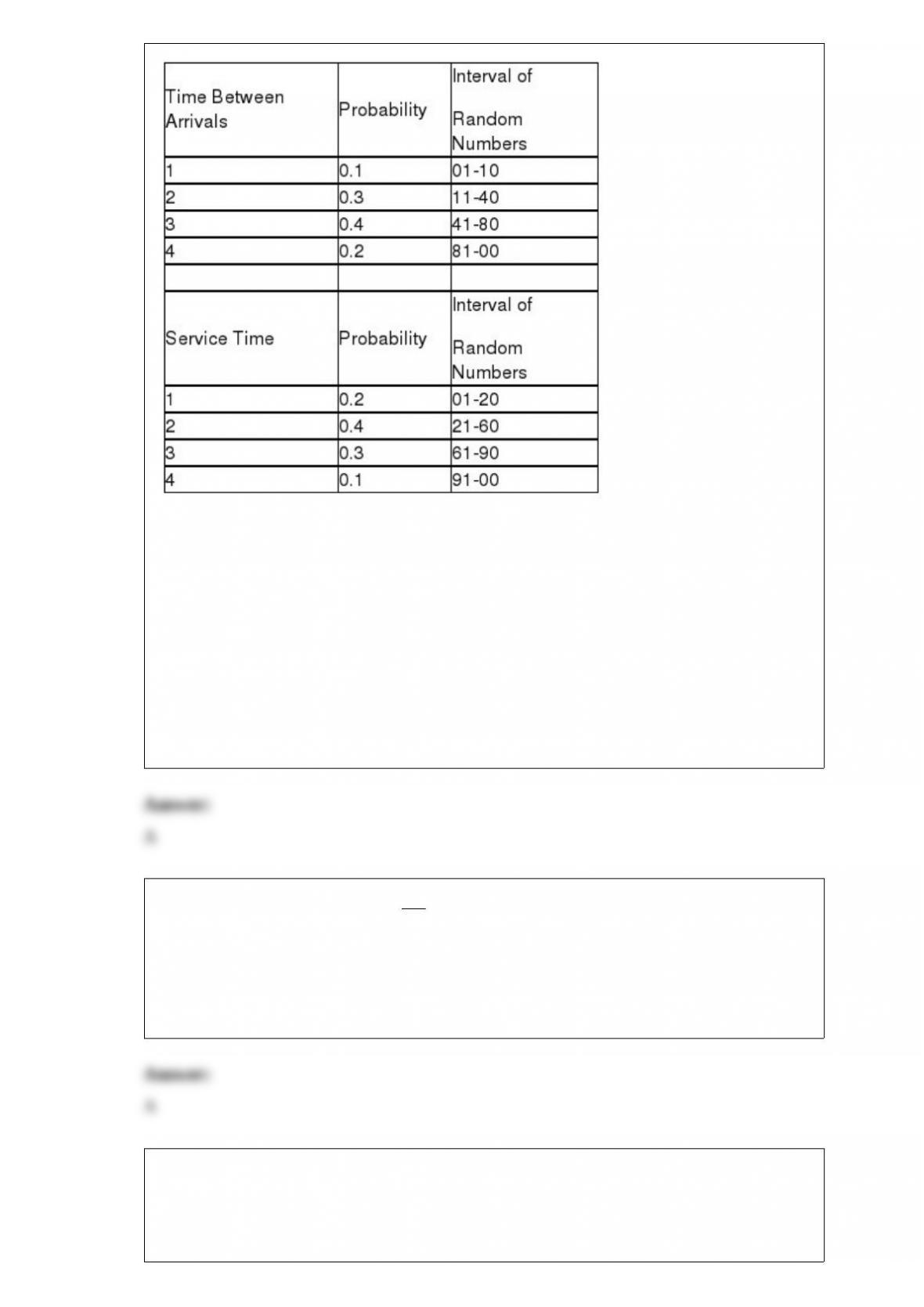
The first random number generated for arrivals is used to tell when the first customer
arrives after opening.
According to Table 13-4, the time between successive arrivals is 1, 2, 3, or 4 minutes. If
the store opens at 8:00 a.m., and random numbers are used to generate arrivals, what
time would the first customer arrive if the first random number were 02?
A) 8:01
B) 8:02
C) 8:03
D) 8:04
E) None of the above
19) Which of the following does not have an impact on EOQ?
A) safety stock
B) demand per unit time
C) order cost
D) holding cost
E) None of the above
20) Which of the following is a technique used to determine forecasting accuracy?
A) exponential smoothing
B) moving average
C) regression
D) Delphi method
E) mean absolute percent error