The simple method used for solving linear programming problems uses matrix algebra
to solve simultaneous equations.
A project’s duration can be reduced by crashing activities on the critical path.
Finished product is an example of a dependent demand item.
Shortage costs are easier to determine than carrying costs or ordering costs.
Product deterioration, spoilage, breakage, and obsolescence are examples of shortage
costs.
Decision analysis is a quantitative technique supporting decision-making with
uncertainty.
The scheduling function for mass production and job shop production are basically the
same.
The center-of-gravity technique outlines a method for identifying and weighing
important location factors.
Companies use outsourcing as a strategic move to transfer their core competencies to
their suppliers.
The optimal solution for a linear programming problem will always occur at an extreme
point.
A lot is rejected if the number of defective units found in a random sample exceeds a
predetermined acceptable number of defective units.
Push systems rely on predetermined production schedules often generated by
computerized systems.
Productivity is the most common measure of competitiveness.
The type of forecasting method selected depends on time frame, demand behavior and
causes of behavior.
Globalization requires that firms compete only on cost and not quality, speed or
flexibility.
A quantity discount is a price discount available if a predetermined number of units is
ordered.
Logistics includes distribution and transportation activities within a supply chain.
ISO 9000 certification is a major consideration for doing business within the United
States Europe Union.
Supplier reliability is often an important consideration in outsourcing decisions.
Consider an espresso stand with a single barista. Customers arrive at the stand at the
rate of 28 per hour according to a Poisson distribution. Service times are exponentially
distributed with a service rate of 35 customers per hour. The probability that there are
exactly 3 customers in the system is
a. 0.0000
b. 0.1024
c. 0.4096
d. 0.5120
The area that contains the values that satisfies all the constraints in a linear
programming problem is known as the _________________ space.
a. optimal solution
b. non-optimal solution
c. feasible solution
d. infeasible solution.
After a sufficient number of simulation runs, a steady state results when the variable
being investigated reaches an _________ result that remains constant.
a. optimal
b. average
c. expected
d. estimated
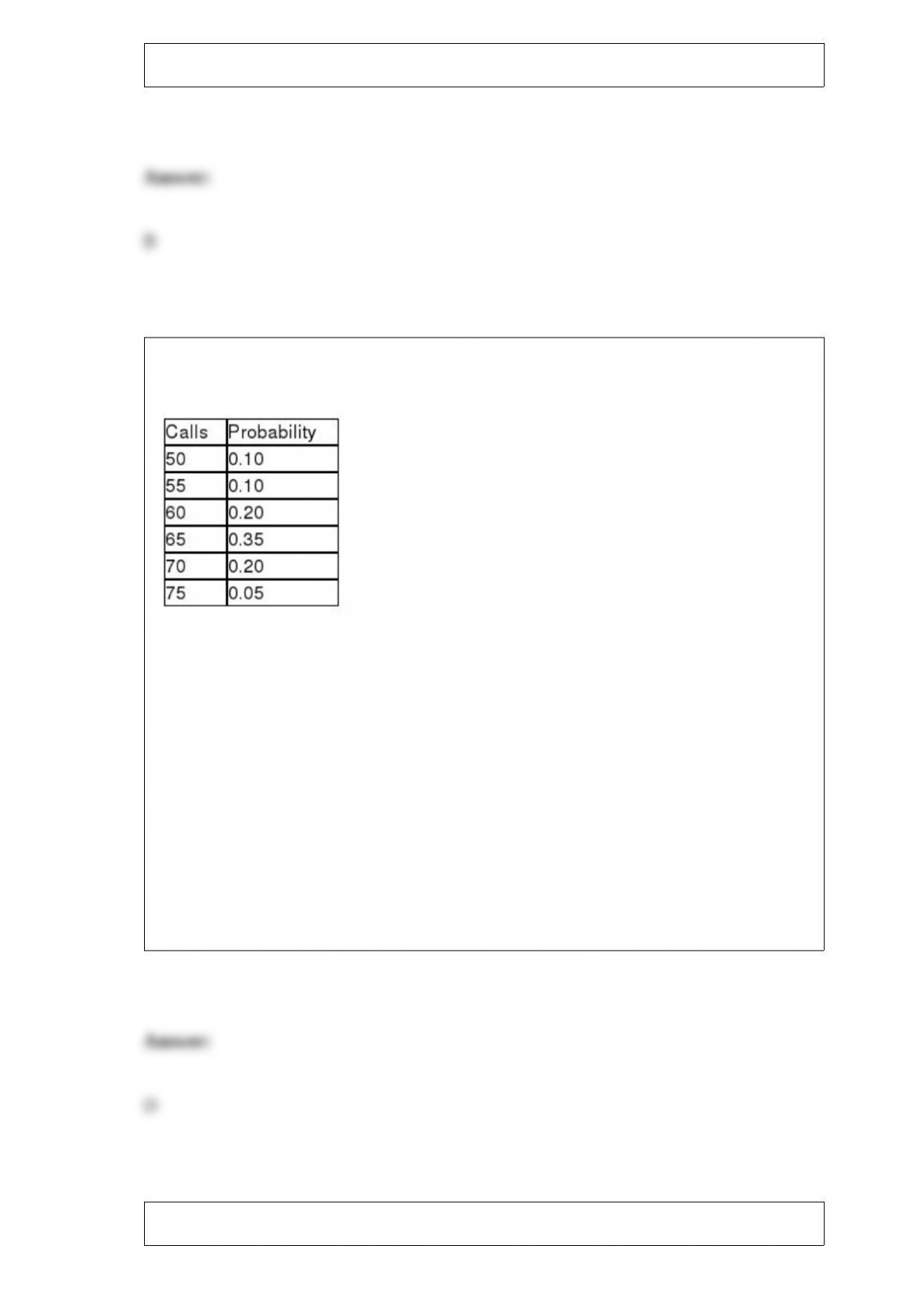
The number of daily calls received by a help desk between the hours of 9:00 a.m. to
10:00 a.m. can be described by the following probability distribution.
Use the following random numbers to simulate the number of calls to the help desk
between 9:00 and 10:00 a.m. for the next five days: 39, 55, 18, 16, 70.
If the first random number interval begins with 0, then the estimated total number of
calls received over the simulated five day period is
a. 375.
b. 350.
c. 325.
d. 300.
A structured process that translates the voice of the customer into technical design
requirements is known as
a. quality function deployment (QFD).
b. failure mode and effects analysis (FMEA).
c. concurrent design.
d. robust product design.
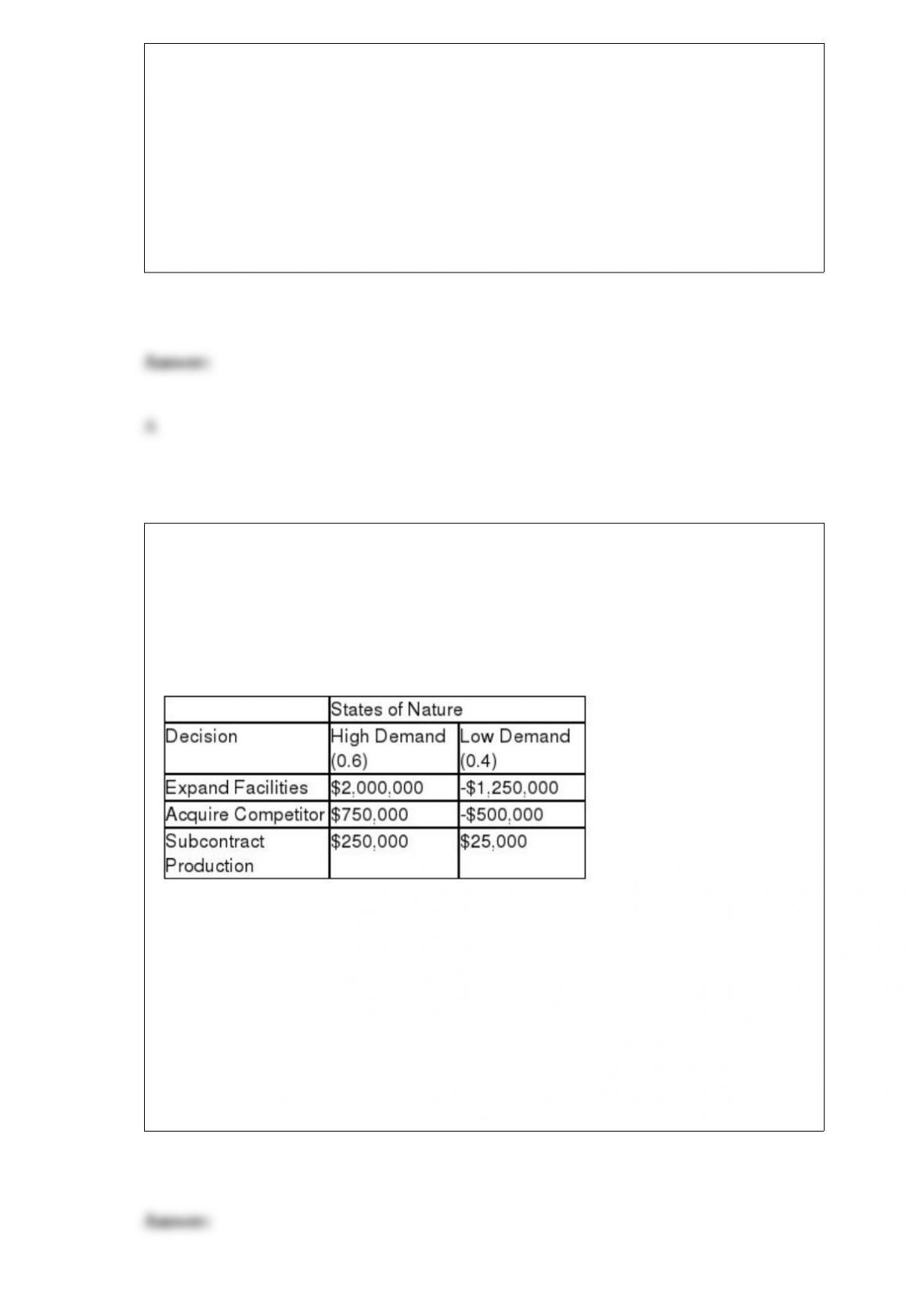
Kallie Inc., a small parts manufacturer, has just engineered a new product for the
automotive industry. In order to produce the part the company can expand existing
facilities, acquire a competitor, or subcontract production. The company believes the
product will either experience high market demand or low market demand, with
probabilities of 0.6 and 0.4, respectively. The following payoff table describes the
company’s decision situation.
The expected value for the subcontract production decision is
a. $250,000
b. $160,000
c. $700,000
d. $1,200,000
Association rule learning is a data mining technique that
a. discovers trends, predicts future events, and assesses possible course of action.
b. searches for relationships between variables.
c. identifies groups of data that fall naturally together.
d. None of these answer choices is correct.
The process of prioritizing jobs that have been assigned to a resource is called
a. loading.
b. monitoring.
c. sequencing.
d. input/output analysis.
The product-process matrix includes all the following process types except
a. mass production.
b. stable production.
c. continuous production.
d. batch production.
In a product layout, the process of assigning tasks to work stations is referred to as
_________ balancing.
a. station
b. product
c. line
d. work
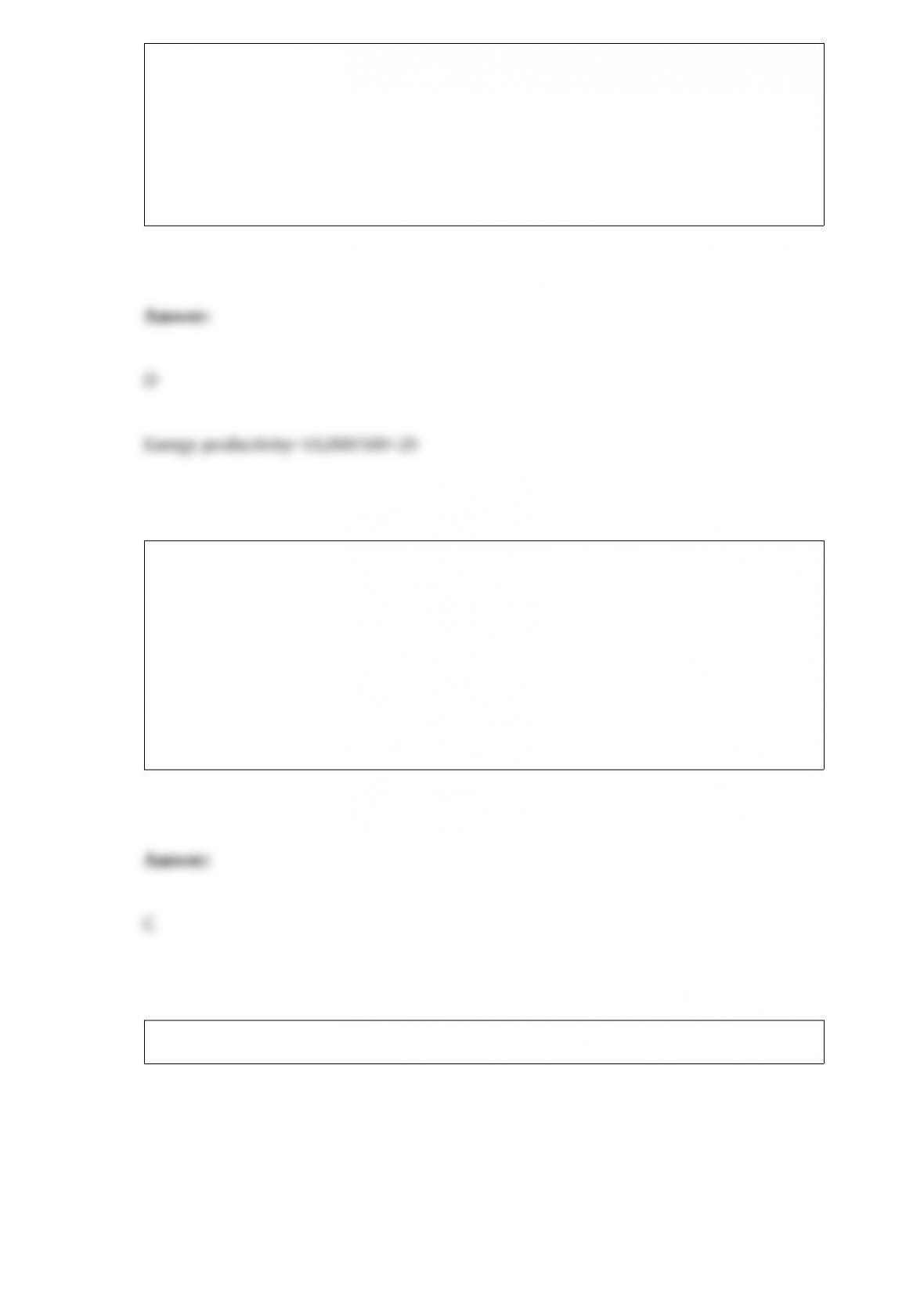
Snacknow, a food service firm, is calculating its monthly productivity report. From the
following data calculate the energy productivity.
a. 0.220
b. 2
c. 10
d. 20
The slack time for an activity can be computed as
a. latest start time (LS) ‘“ latest finish time (LF).
b. earliest start time (ES) + earliest finish time (EF).
c. latest start time (LS) ‘“ earliest start time (ES).
d. latest finish time (LF) + earliest finish time (EF).
Given the following MRP matrix for Item C:
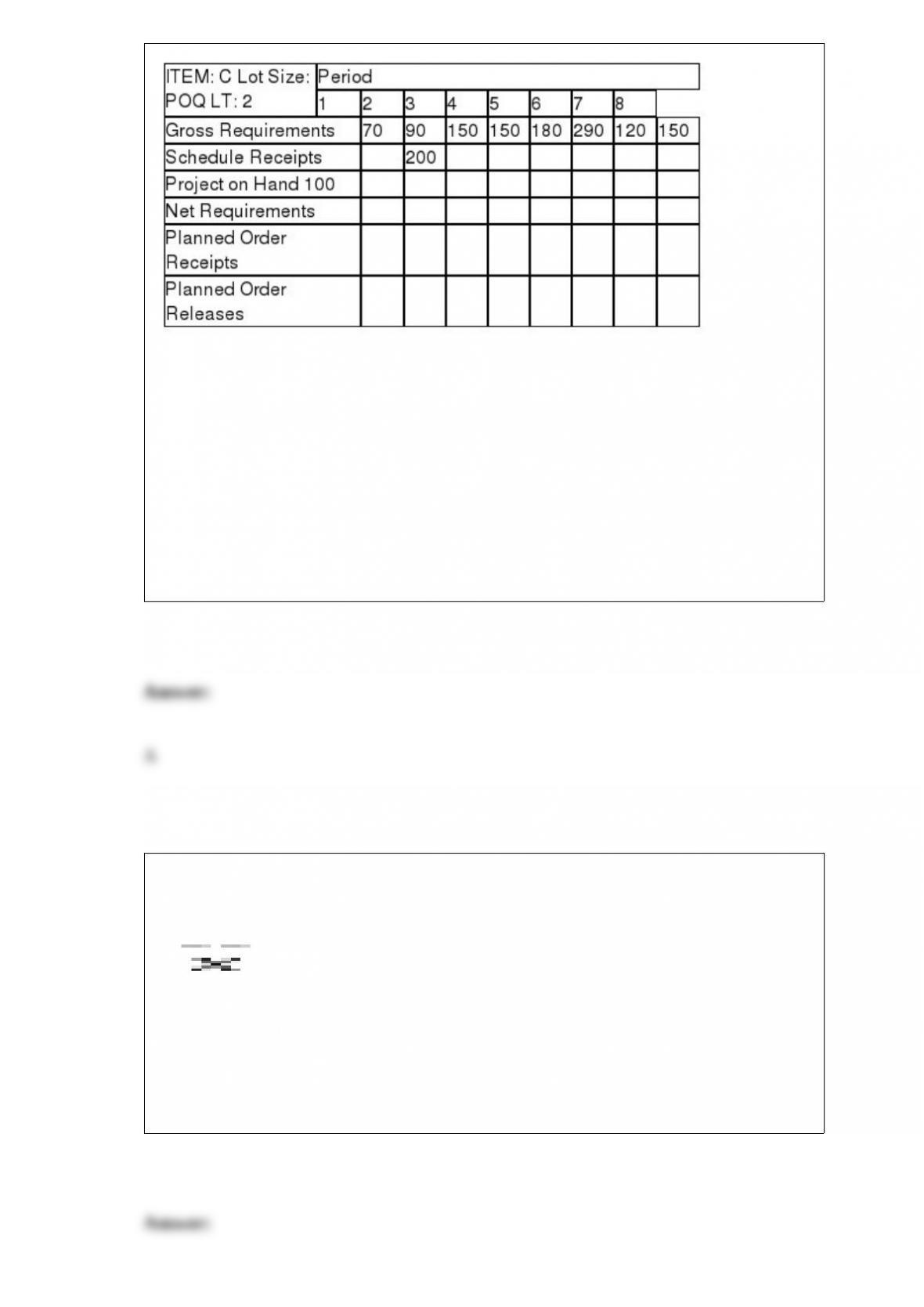
If each order cost $500 and the holding cost is $0.75 per item per period, the periodic
order quantity is
a. 3 periods of requirements
b. 2 periods of requirements
c. 1 period of requirements
d. 0 period of requirements
Which of the following control charts is based on the number of defects within a
sample?
a.
b. R
c. c
d. p
Moving production related operations from foreign countries back to domestic locations
is called
a. reverse globalization.
b. inverse trade agreements.
c. The Nationalization of trade movement.
d. None of these answer choices is correct.
Process flowcharts document
a. productive activities.
b. nonproductive activities.
c. Both productive and nonproductive activities.
d. None of these answers is correct.
Which of the following is not a characteristic of a service?
a. Tangible
b. Variable output
c. Difficult to emulate
d. Perishable
Annual demand for a product is 40,000 units. The product is used at a constant rate over
the 365 days the company is open every year. The annual holding cost for the product is
estimated to be $2.50 per unit and the cost of placing each order is $125.00. If the
company orders according to the economic order quantity (EOQ) formula, then its
average inventory level for this product is
a. 20,000 units.
b. 10,000 units.
c. 2,500 units.
d. 1,000 units.
A relationship between a firm and its supplier where the supplier agrees to meet the
firms’ quality standards and the firm enters into a long-term purchasing agreement with
the supplier is known as
a. Outsourcing.
b. vertical integration.
c. partnering.
d. conformance.