1) Any time that we have an isoprofit line that is parallel to a constraint, we have the
possibility of multiple solutions.
2) EVPI and minimum EOL are equivalent.
3) Qualitative models attempt to incorporate judgmental or subjective factors into the
forecasting model.
4) In the maximal-flow technique, a zero (0) means no flow or a one-way arc.
5) When two or more constraints conflict with one another, we have a condition called
unboundedness.
6) Dynamic programming can only be used to solve network-based problems.
7) An n x m determinant is the same as an n x m matrix.
8) Sensitivity analysis helps us estimate the effect of known and unknown errors in our
model.
9) A moving average forecasting method is a causal forecasting method.
10) Adaptive smoothing is analogous to exponential smoothing where the coefficients
and are periodically updated to improve the forecast.
11) Activity C of a project has a budgeted cost of $40,000 and is 20% complete. The
actual cost is $10,000.
(a) What is the value of work completed?
(b) What is the activity difference?
12) Table 12-5
According to the information provided in Table 12-5, which presents the solution for a
queuing problem with a constant service rate, on average, how much time is spent
waiting in line?
A) 1.607 minutes
B) 0.714 minute
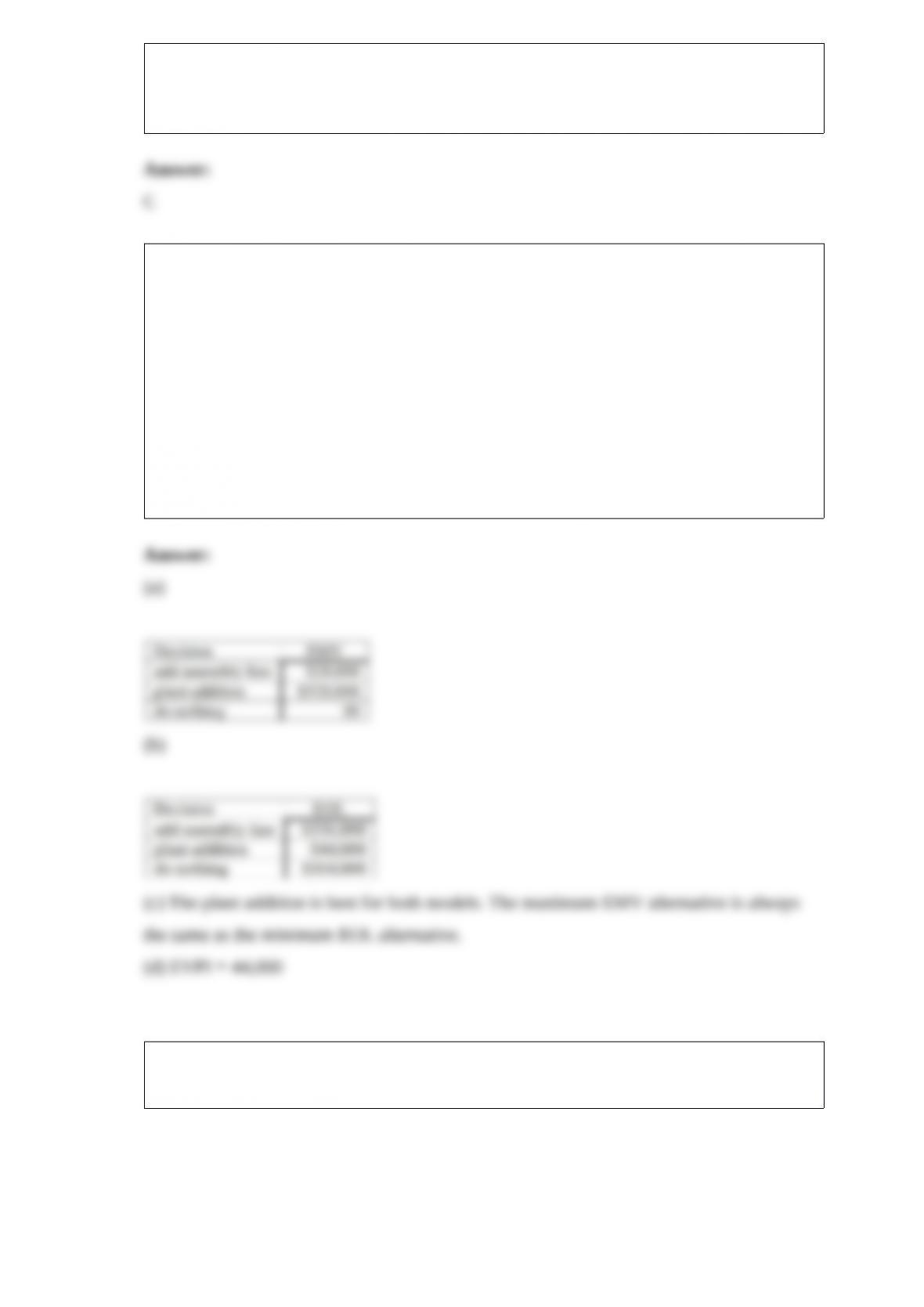
C) 0.179 minute
D) 0.893 minute
E) None of the above
13) The ABC Co. is considering a new consumer product. They believe there is a
probability of 0.4 that the XYZ Co. will come out with a competitive product. If ABC
adds an assembly line for the product and XYZ does not follow with a competitive
product, their expected profit is $40,000; if they add an assembly line and XYZ does
follow, they still expect a $10,000 profit. If ABC adds a new plant addition and XYZ
does not produce a competitive product, they expect a profit of $600,000; if XYZ does
compete for this market, ABC expects a loss of $100,000.
(a) Determine the EMV of each decision.
(b) Determine the EOL of each decision.
(c) Compare the results of (a) and (b).
(d) Calculate the EVPI.
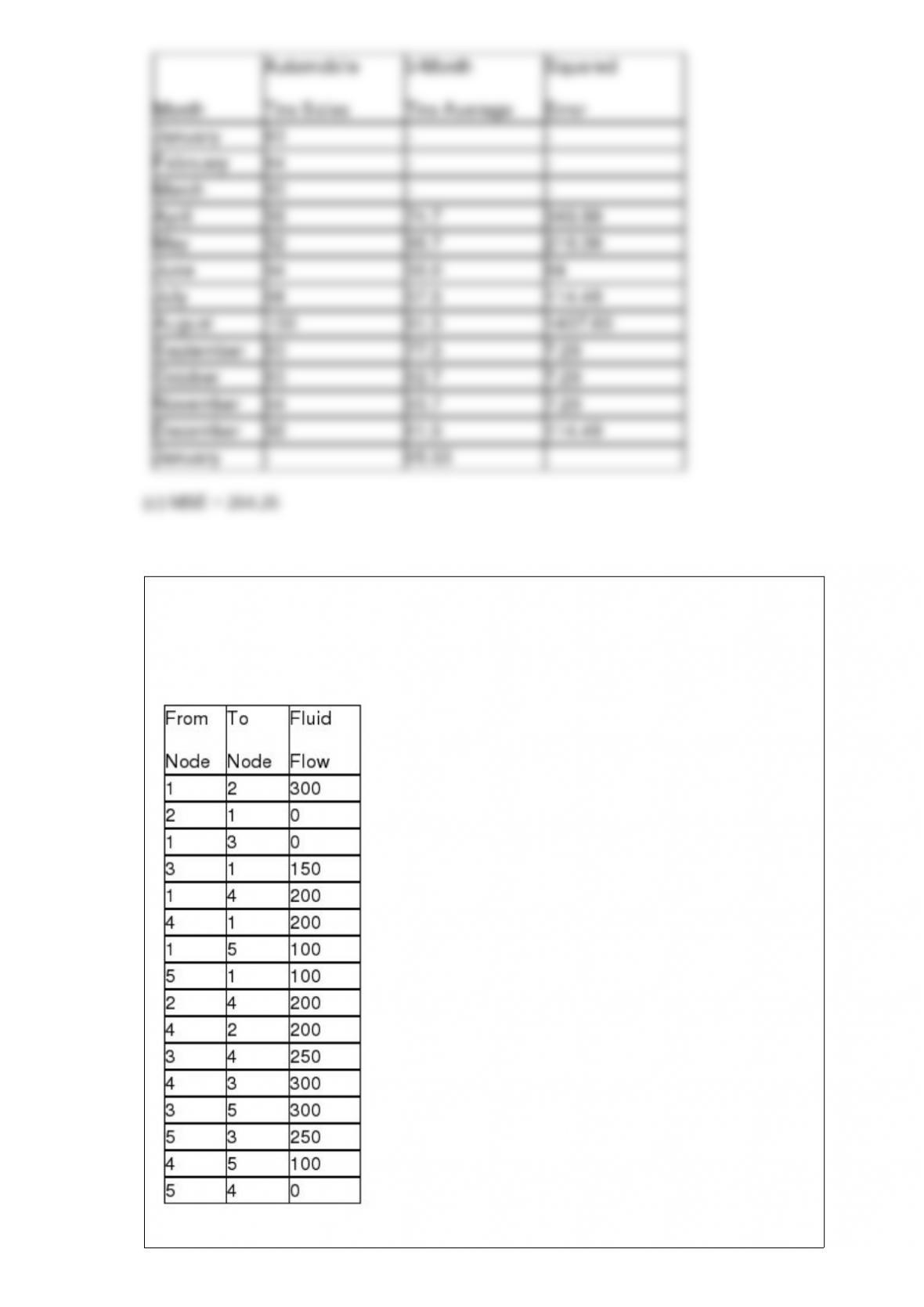
14) For the data below:
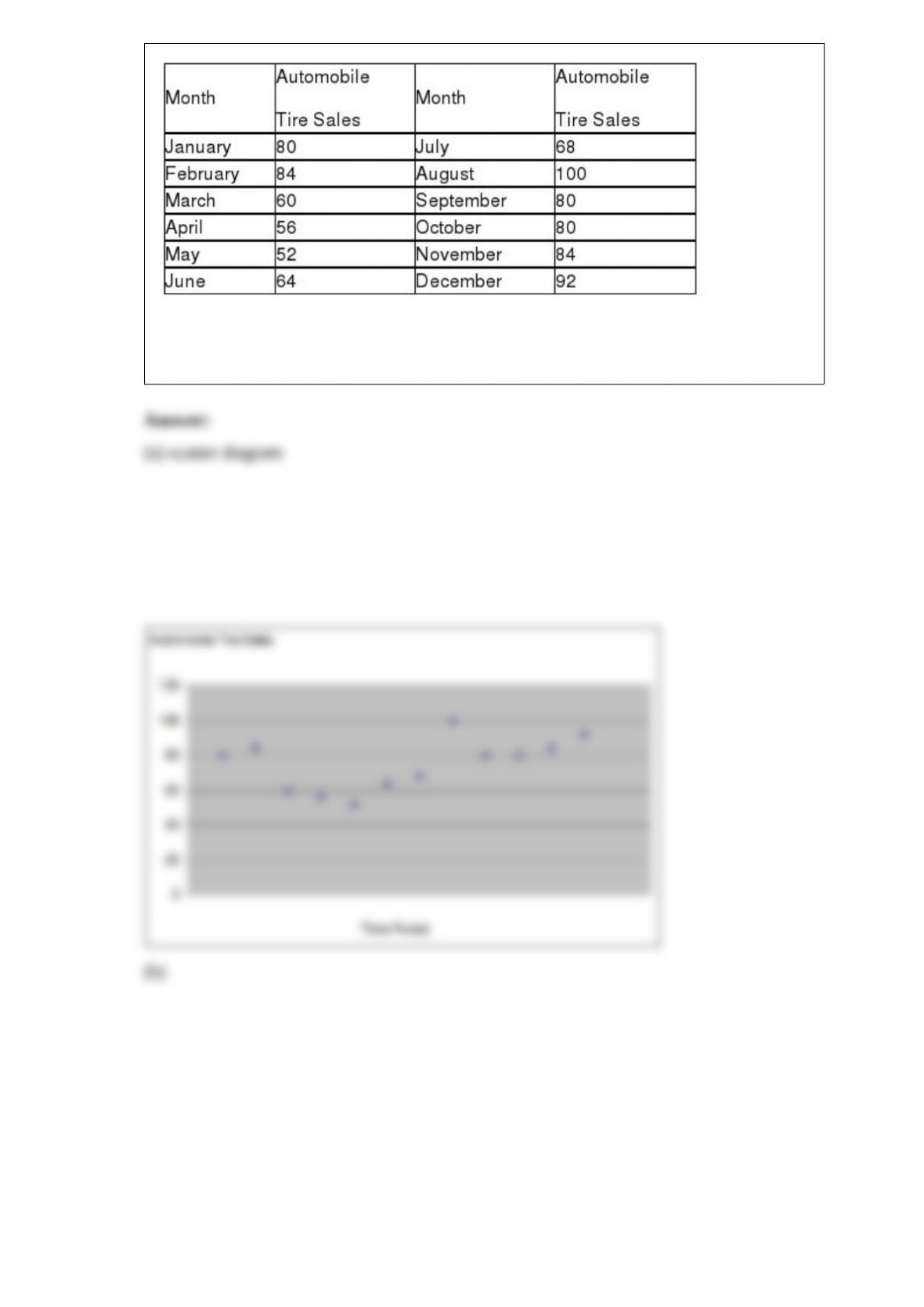
(a) Develop a scatter diagram.
(b) Compute a three-month moving average.
(c) Compute the MSE.
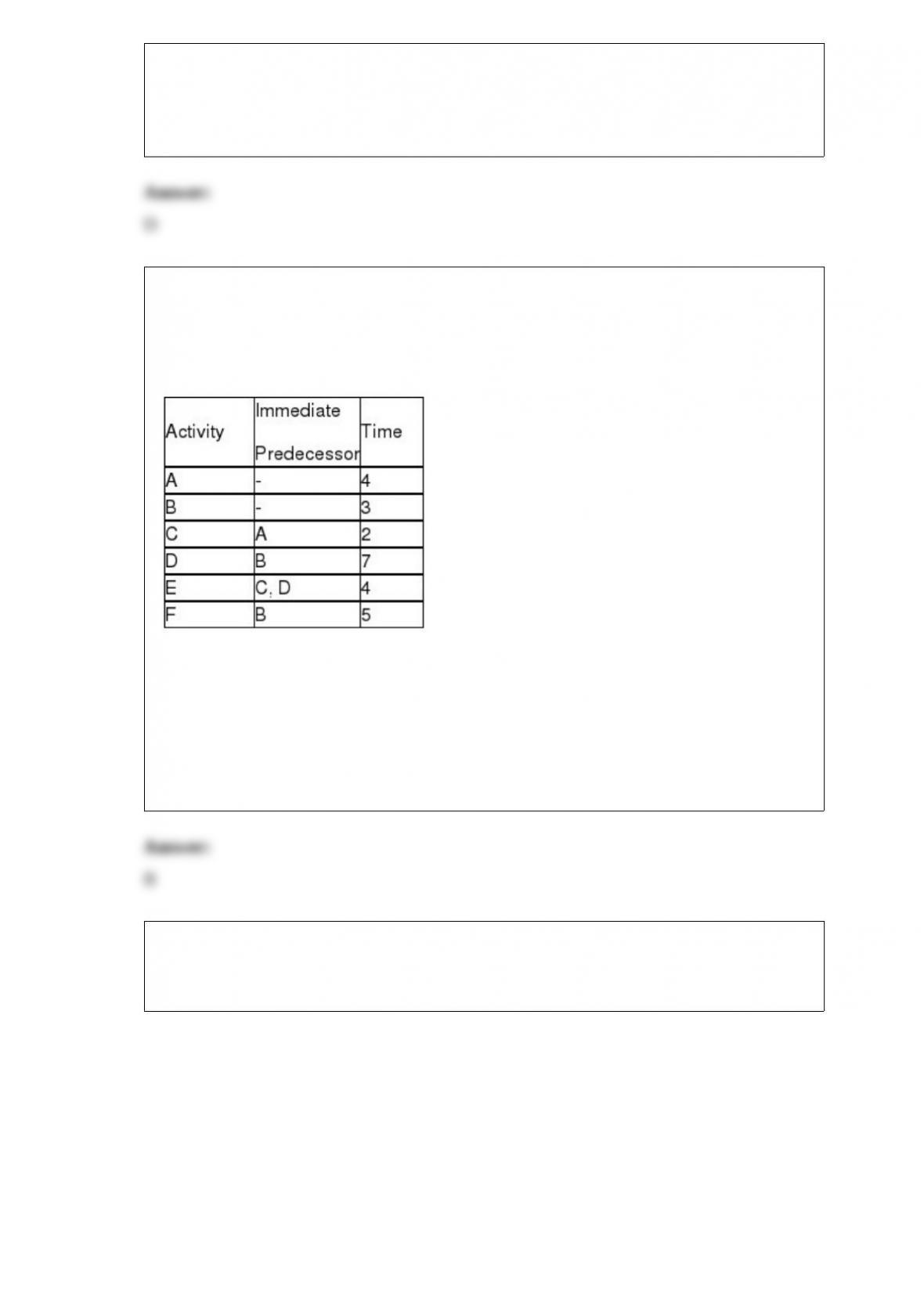
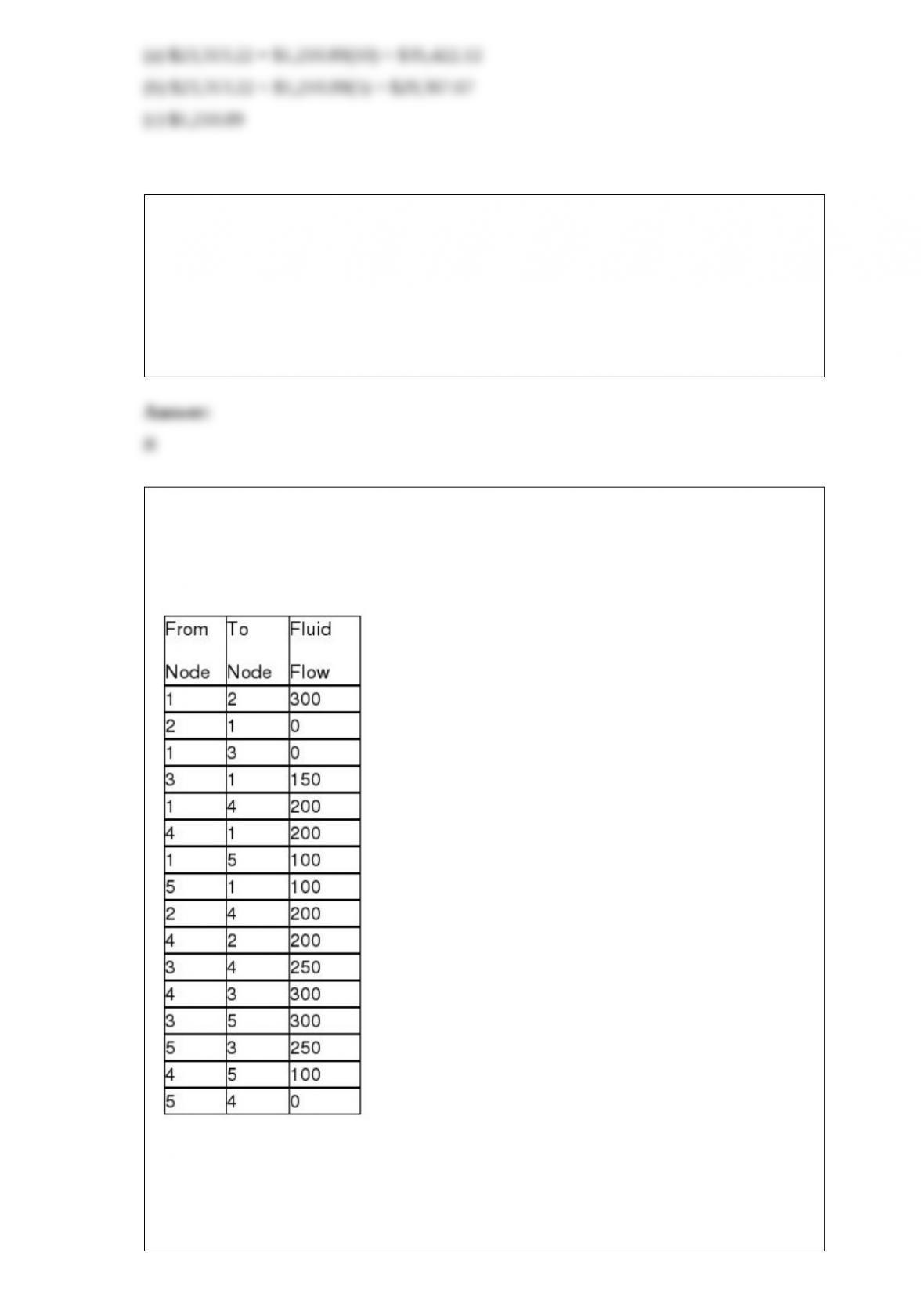
15) Pipeline fluid flows are indicated below. Determine the maximum flow from Node
1 to Node 5.
A) 300
B) 400
C) 600
D) 500
E) None of the above
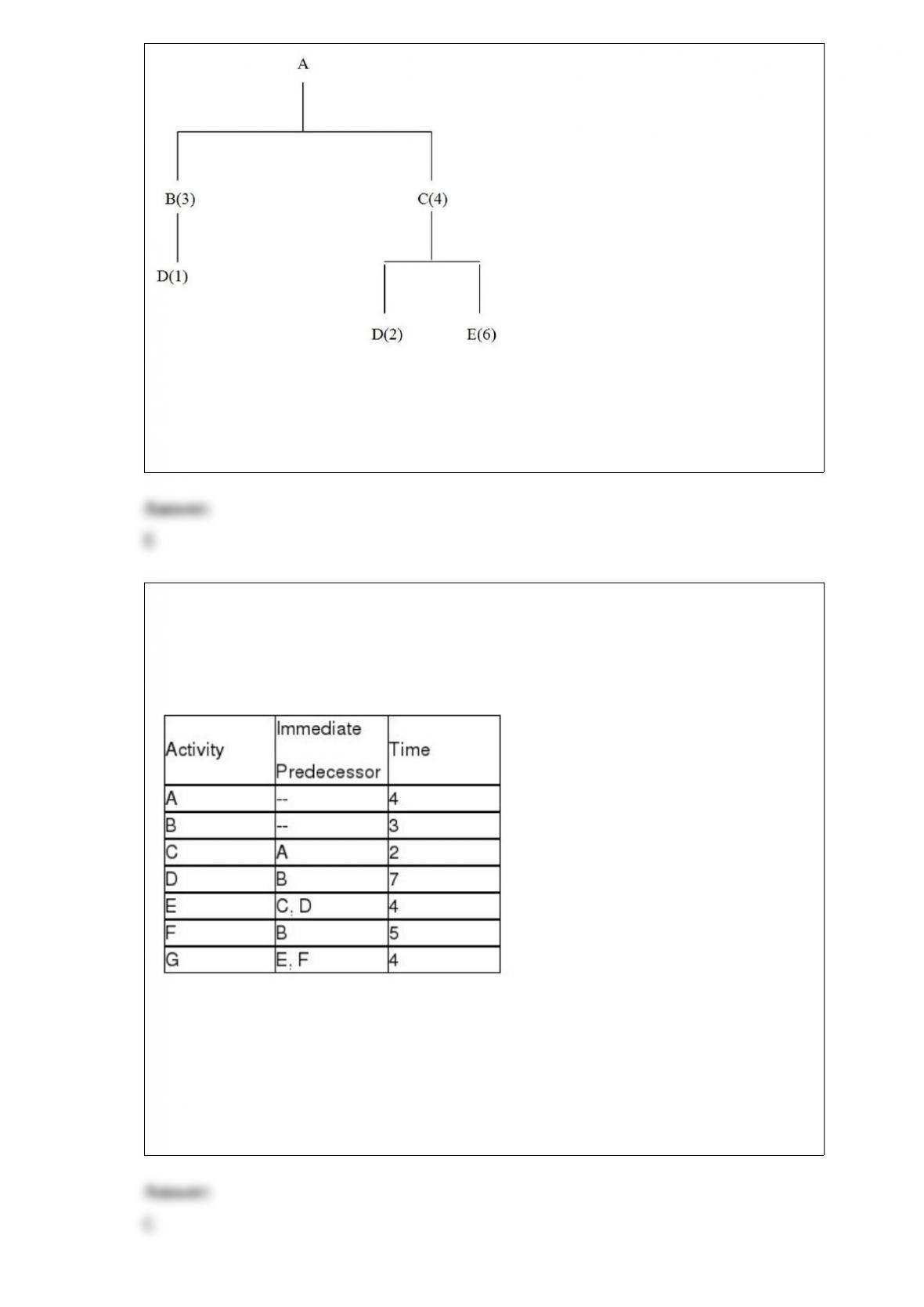
16) Table 11-1
The following represents a project with known activity times. All times are in weeks.
Using the data in Table 11-1, what is the minimum possible time required for
completing the project?
A) 8
B) 14
C) 25
D) 10
E) None of the above
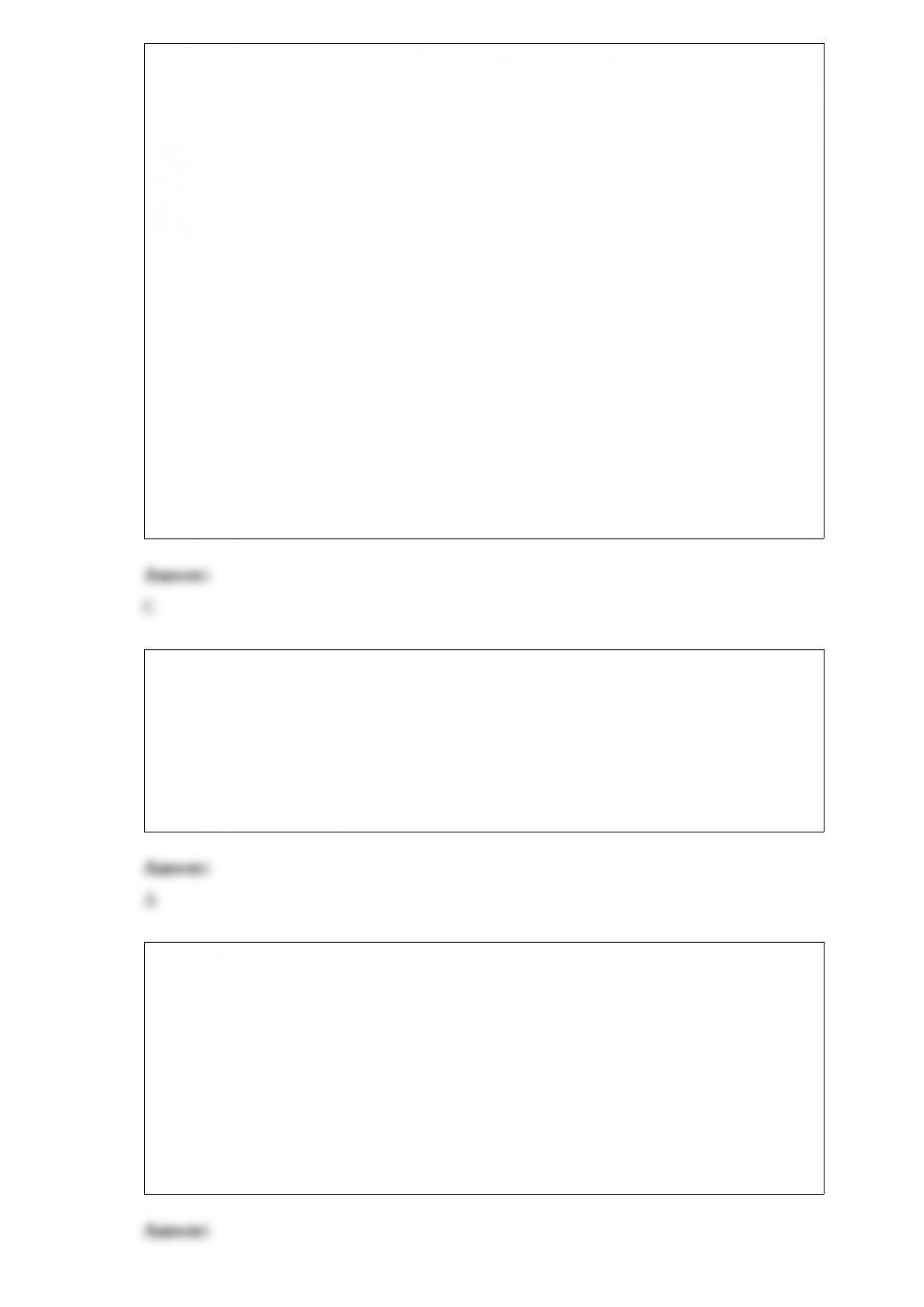
17) Consider the material structure tree for item A below. If 20 units of A are needed,
how many units of D are needed?
A) 11
B) 30
C) 160
D) 60
E) 220
18) Table 11-4
The following represents a project with known activity times. All times are in weeks.
Using the data in Table 11-4, determine the latest time activity A can be finished and not
delay any activity?
A) 4
B) 0
C) 8
D) 5
E) None of the above
19) ( Use all of the product B available.
Let X1 = number of Zigs, X2 = number of Zags.
d1
– = underachievement of Zig goal
d1
+ = overachievement of Zig goal
d2
– = underachievement of profit target
d2
+ = overachievement of profit target
d3
– = unused product B
d3
+ = additional amount of product B needed
In the goal programming problem described in Table 10-7, what is the optimal solution?
A) X1 = 75 + X2 = 91.67
B) X1 = 91.67 + X2 = 50
C) X1 = 50 + X2 = 75
D) X1 = 50 + X2 = 91.67
E) X1 = 75 + X2 = 50
20) When a constraint line bounding a feasible region has the same slope as an isoprofit
line,
A) there may be more than one optimum solution.
B) the problem involves redundancy.
C) an error has been made in the problem formulation.
D) a condition of infeasibility exists.
E) None of the above
21) A large school district is reevaluating its teachers’ salaries. They have decided to use
regression analysis to predict mean teachers’ salaries at each elementary school. The
researcher uses years of experience to predict salary. The resulting equation was:
Y = 23,313.22 + 1,210.89X, where Y = salary and X = years of experience
(a) If a teacher has 10 years of experience, what is the forecasted salary?
(b) If a teacher has 5 years of experience, what is the forecasted salary?
(c) Based on this equation, for every additional year of service, a teacher could expect
his or her salary to increase by how much?
22) Which of the following techniques can be used for moving from an initial feasible
solution to an optimal solution in a transportation problem?
A) Hungarian method
B) stepping-stone method
C) northwest corner rule
D) Vogel’s approximation method
E) All of the above
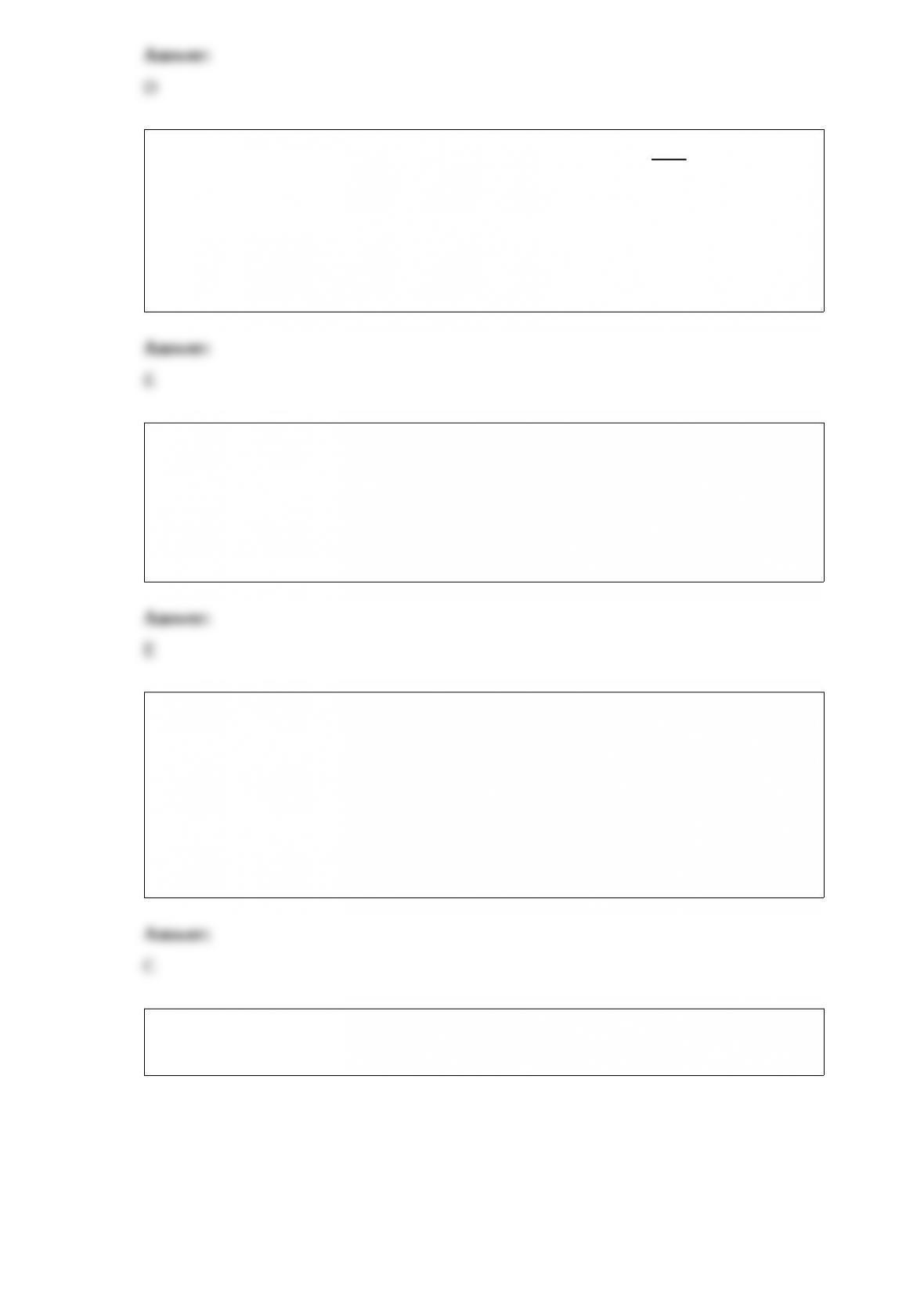
23) Pipeline fluid flows are indicated below. Determine the maximum flow from Node
1 to Node 5.
A) 300
B) 400
C) 600
D) 500
E) None of the above
24) Which of the following statements about the kanban system is false?
A) Kanban in Japanese means “card.”
B) In a dual card system, there is the C-kanban and P-kanban.
C) More than two containers can be used.
D) The kanban system is most commonly executed manually.
E) One typical kanban rule is that no containers are filled without the appropriate
C-kanban.
25) All the nodes must be connected in which of the following techniques?
A) minimal-flow
B) maximal-spanning tree
C) shortest-route
D) maximal-flow
E) minimal-spanning tree
26) In picking the smoothing constant for an exponential smoothing model, we should
look for a value that
A) produces a nice-looking curve.
B) equals the utility level that matches with our degree of risk aversion.
C) produces values which compare well with actual values based on a standard measure
of error.
D) causes the least computational effort.
E) None of the above
27) Customer arrivals adhere to the following probability distribution:
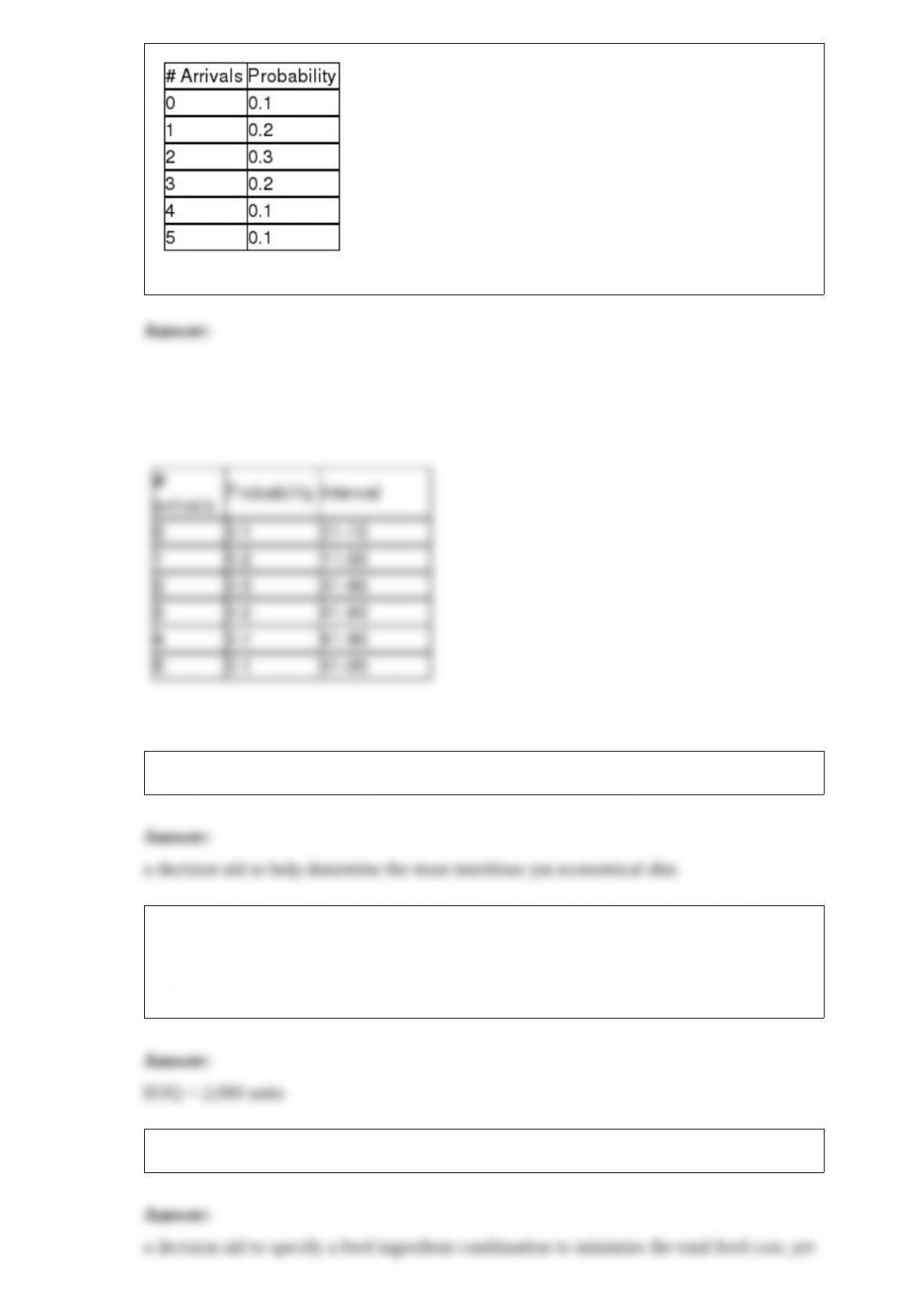
Create an appropriate table of interval of random numbers.
28) Describe a diet problem linear programming application.
29) East Valve Distributors distributes industrial valves and control devices. The
Eastern control device has an annual demand of 9,375 units and sells for $100 per unit.
The cost of ordering is $160 per order and the average carrying cost per unit per year is
$0.75. Determine the economic order quantity.
30) Describe the feed mix linear programming application.
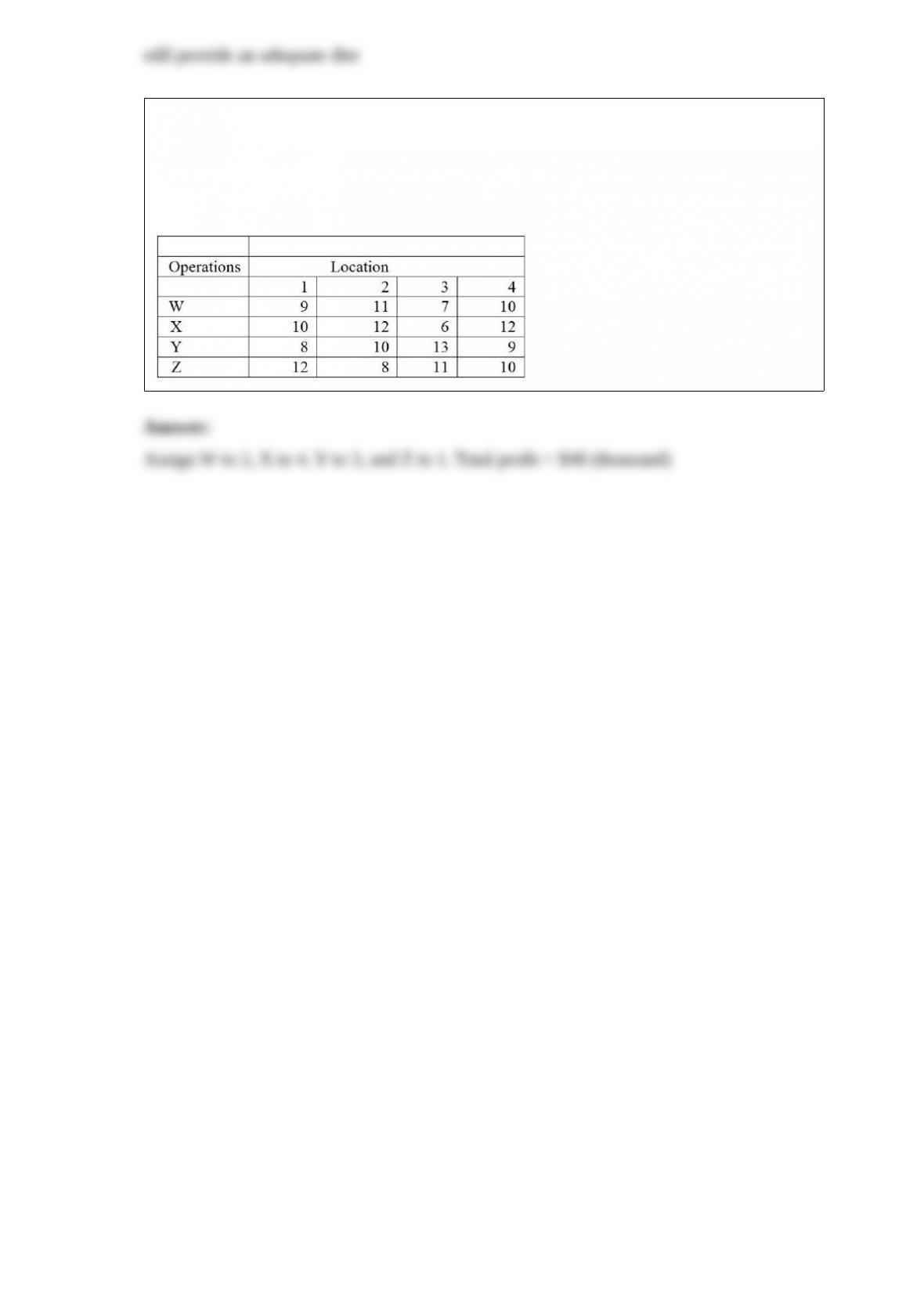
31) A certain firm has four different operations that must be assigned to four locations.
The profit (in thousands of dollars) associated with each operation at each location is
presented below. The firm’s vice president would like to assign the various operations
so that the total profit is maximized. Find the appropriate assignments.