Purchasing can be classified according to two broad categories: direct (manufacturing
inputs) and indirect (operating inputs).
When a control chart detects no special cause (nonrandom) variation in a process, the
upper and lower control limits are the same value.
Railroad access is frequently a factor in locating a manufacturing plant.
Minimizing material handling cost is an important objective for a process layout.
E-procurement is often used to purchase indirect products that support production.
The average, absolute difference between the forecast and demand is a popular measure
of forecast error.
The output of a manufacturing cell is changed by adding or removing workers.
The first-come, first-served (FCFS) sequencing rule should be only used when
operating at high levels of capacity.
Information concerning on-hand quantities, lot sizes, and lead time can be found in the
master production schedule (MPS).
The best process strategy is usually found on the diagonal of the product-process
matrix.
With the economic order quantity (EOQ) model, increasing the order quantity reduces
inventory carrying cost.
A supply chain is sometimes referred to as a demand-driven value chain.
In general, as the level of service improves, the cost of service increases.
Crashing activates with positive slack reduces a project’s duration.
(Use the following information for the next five problems.)
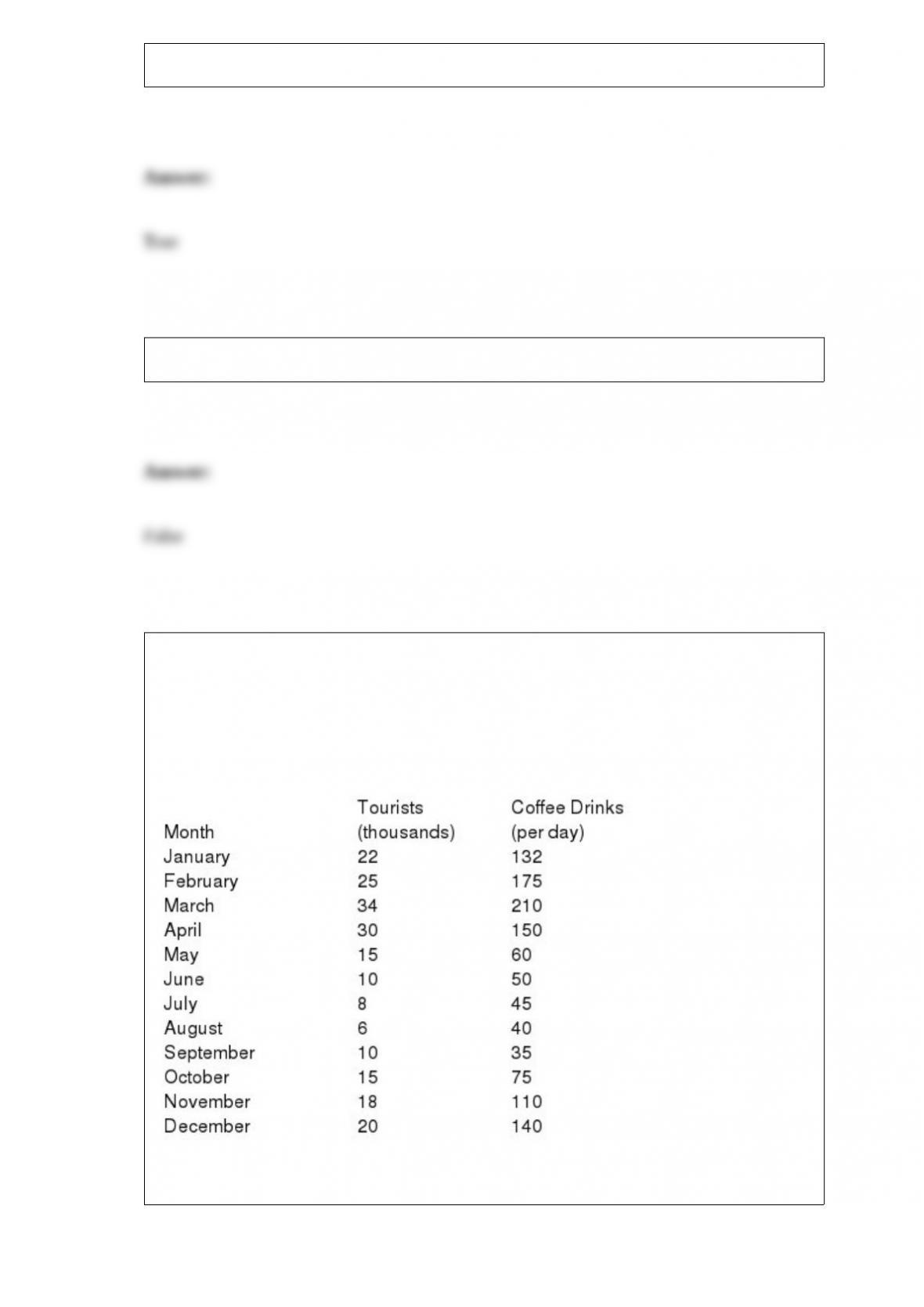
The owner of Koffi, the sole coffee house located in a resort area, wants to develop a
forecast based on the relationship between tourism and coffee drinks sold. He has
generated the following data over the past 12 months:
The data from using Data Analysis on Excel is as follows:
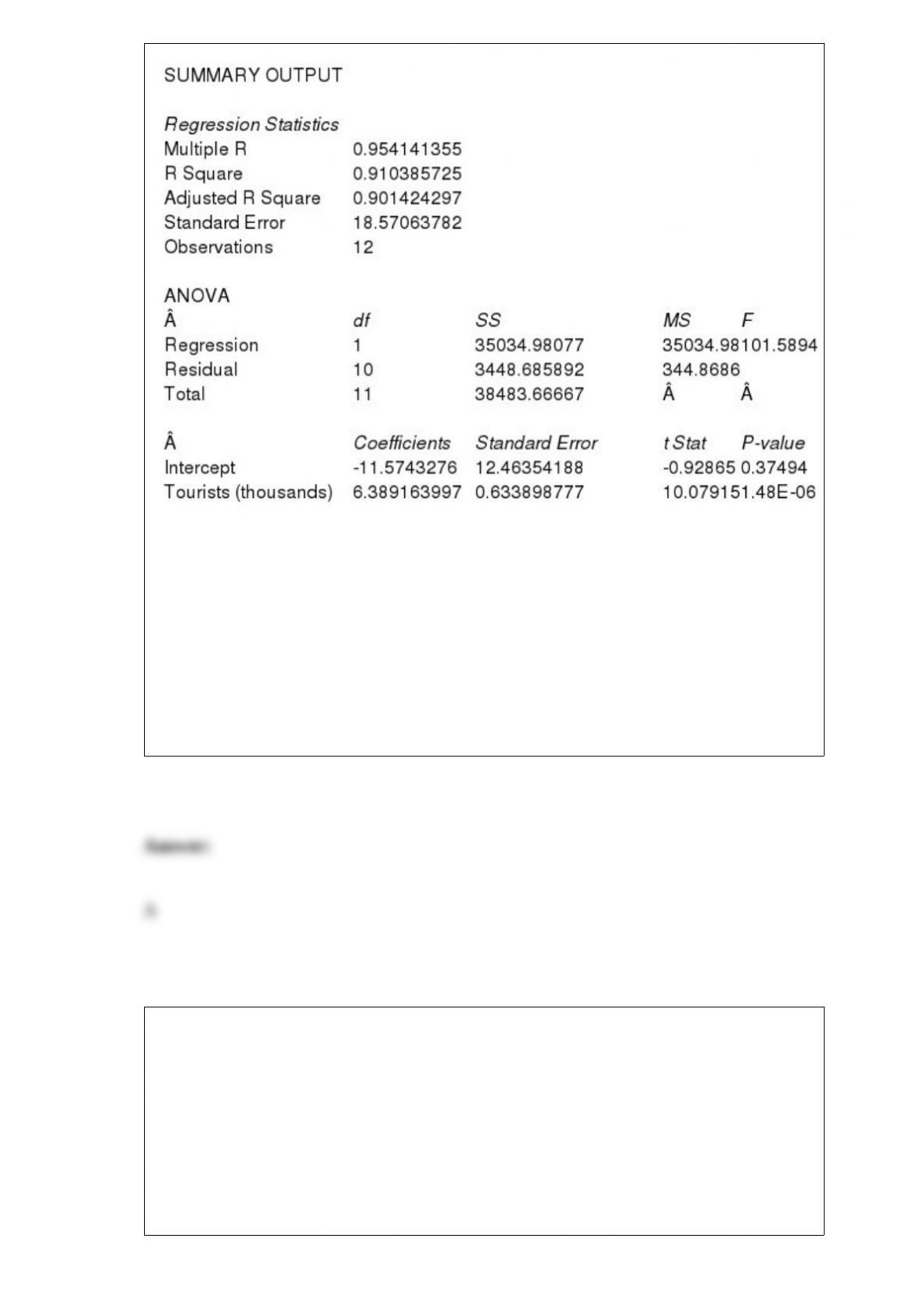
What is the approximate intercept, a?
a. -11.6
b. 11.6
c. 6.4
d. -6.4
The per-period average of cumulative error is called
a. cumulative forecast variation.
b. absolute error.
c. average error.
d. noise.
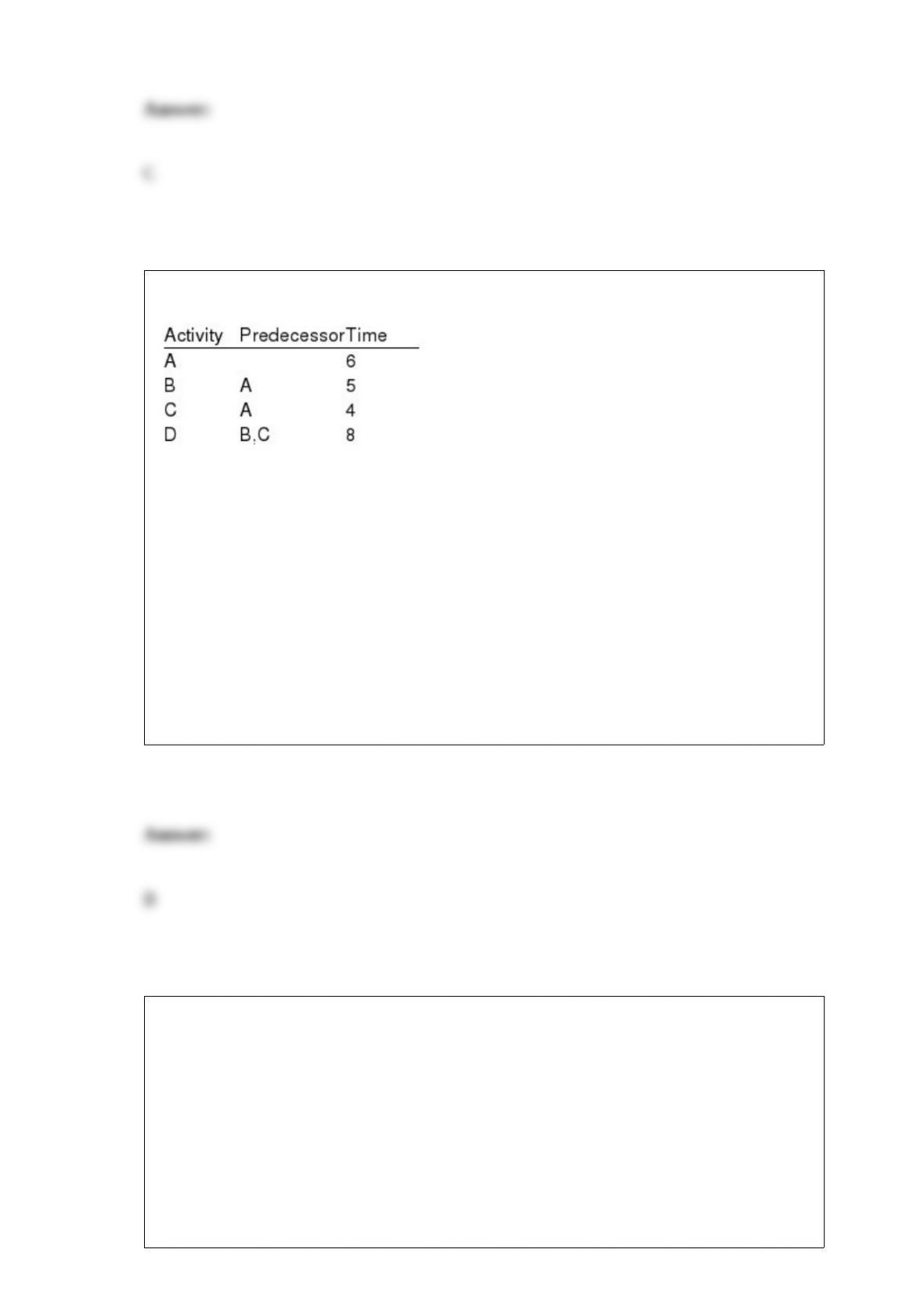
A project consists of the following four activities with activity times in days:
Table YY
The time to complete the entire project would be
a. 23 days.
b. 19 days.
c. 17 days.
d. 11 days.
If a firm can sell a product for $40each, then what is the volume needed to breakeven if
the fixed cost of production is $125,000 and labor and material costs are $30. per item?
a. 125,000
b. 12,500
c. 4,167
d. 3,250
Similar activities are grouped together in departments or work centers according to the
function with a __________ layout.
a. process
b. fixed-position
c. hybrid
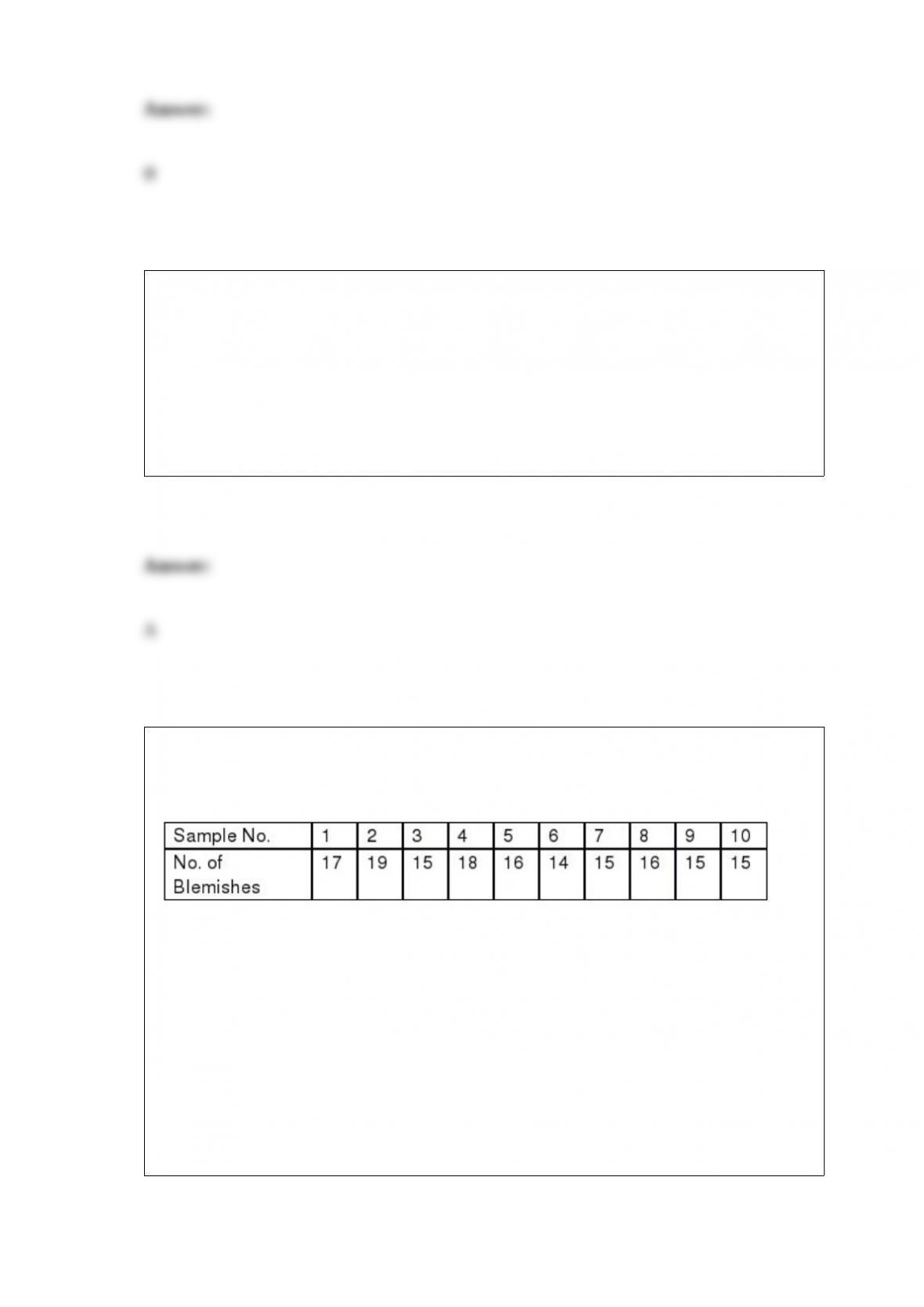
Marble Inc. makes countertops from a variety of high-end materials. To monitor the
quality of its production processes the company randomly selects one countertop and
counts the number of blemishes. The results for ten samples are shown below:
Given the sample information above, the UCL using sigma = 3 for this process would
be
a. 36
b. 32
c. 30
d. 28
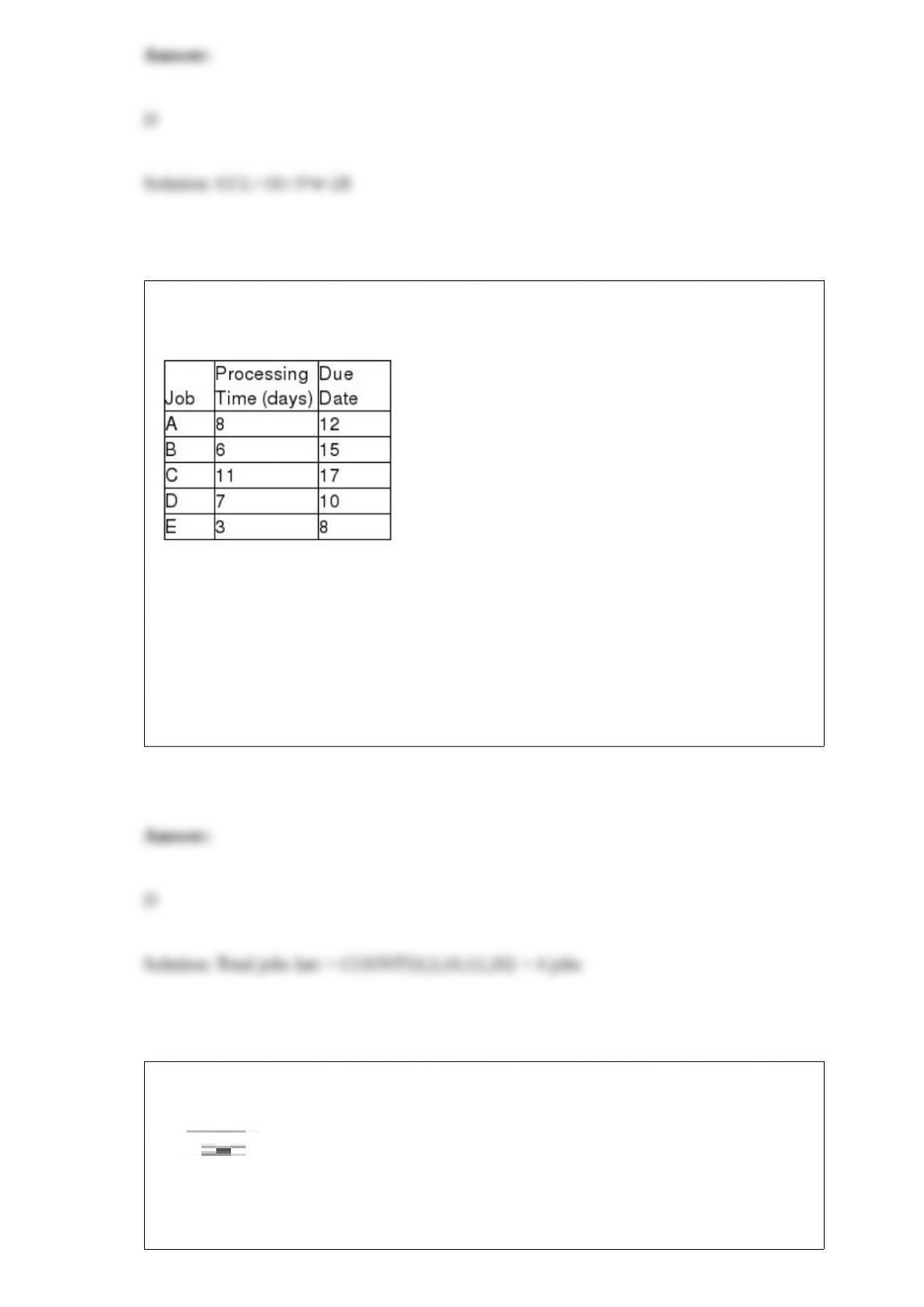
If the following jobs are sequenced according to the SLACK rule then the total number
of jobs that would be late is (assume zero for today’s date)
a. 1 jobs.
b. 2 jobs.
c. 3 jobs
d. 4 jobs
Which of the following control charts is used to control the variation between samples?
a. -chart
b. R-chart
c. c-chart
d. p-chart
A workstation’s output is 200 bottles of wine per hour. It takes 45 minutes to receive a
withdrawal kanban of corks from the previous workstation. The withdrawal kanban is
attached to a container holding 30 corks. The process uses a safety factor of 20 percent.
What is the number of withdrawal kanbans needed to support the bottling process?
a. 4
b. 5
c. 6
d. 3
TicToc produces product A and product B. These products have the following resource
requirements.
The firm has a weekly production budget of $3000 and a maximum of 1000 hours of
labor per week. Each A produced generates $35.00 in profit for the company. Each B
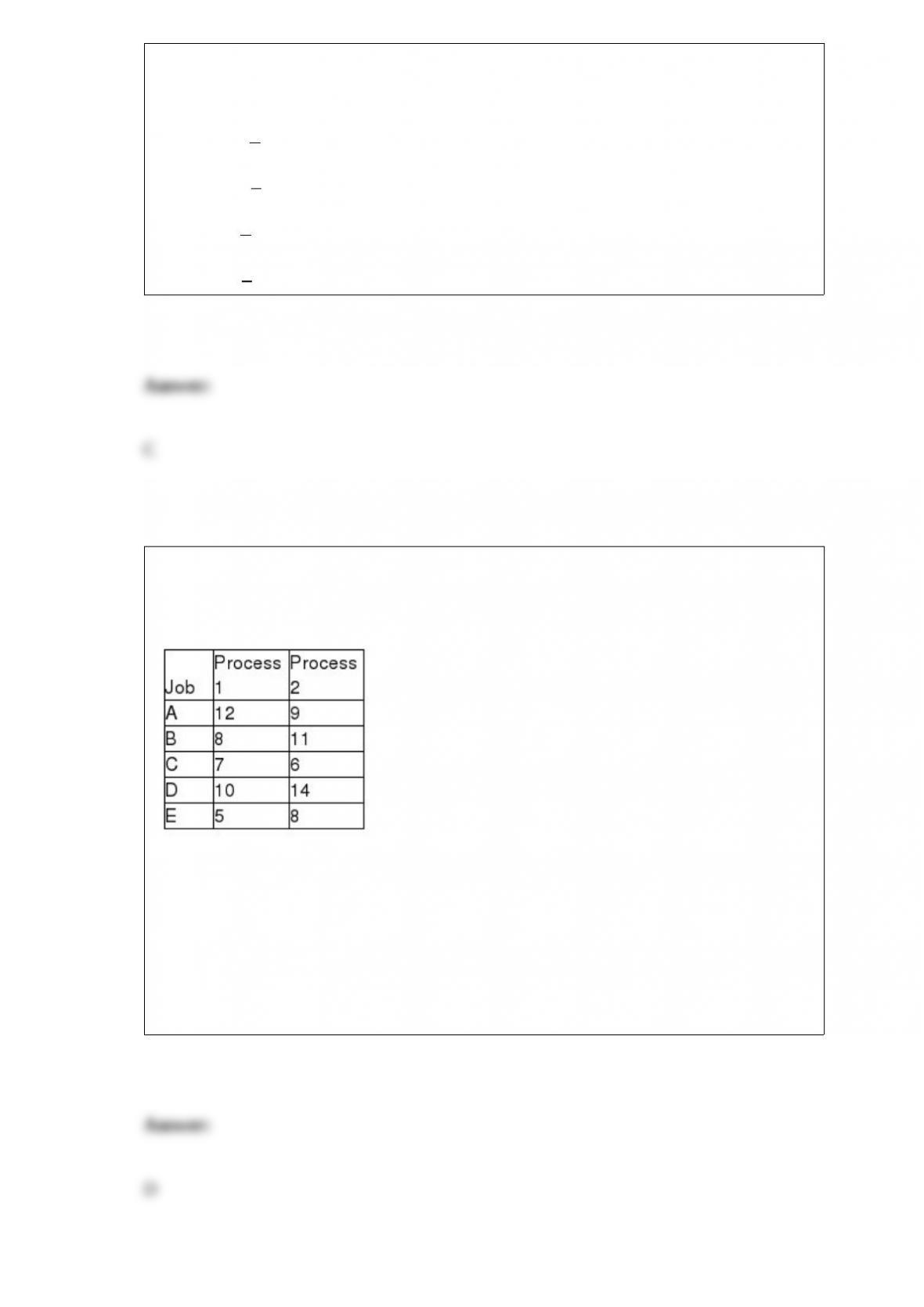
produced generates $25.00 in profit for the company. The capacity constraint for labor
is
a. 12A + 8B > 1000.
b. 12A + 8B < 1000.
c. 4A + 3B < 1000.
d. 4A + 3B > 1000.
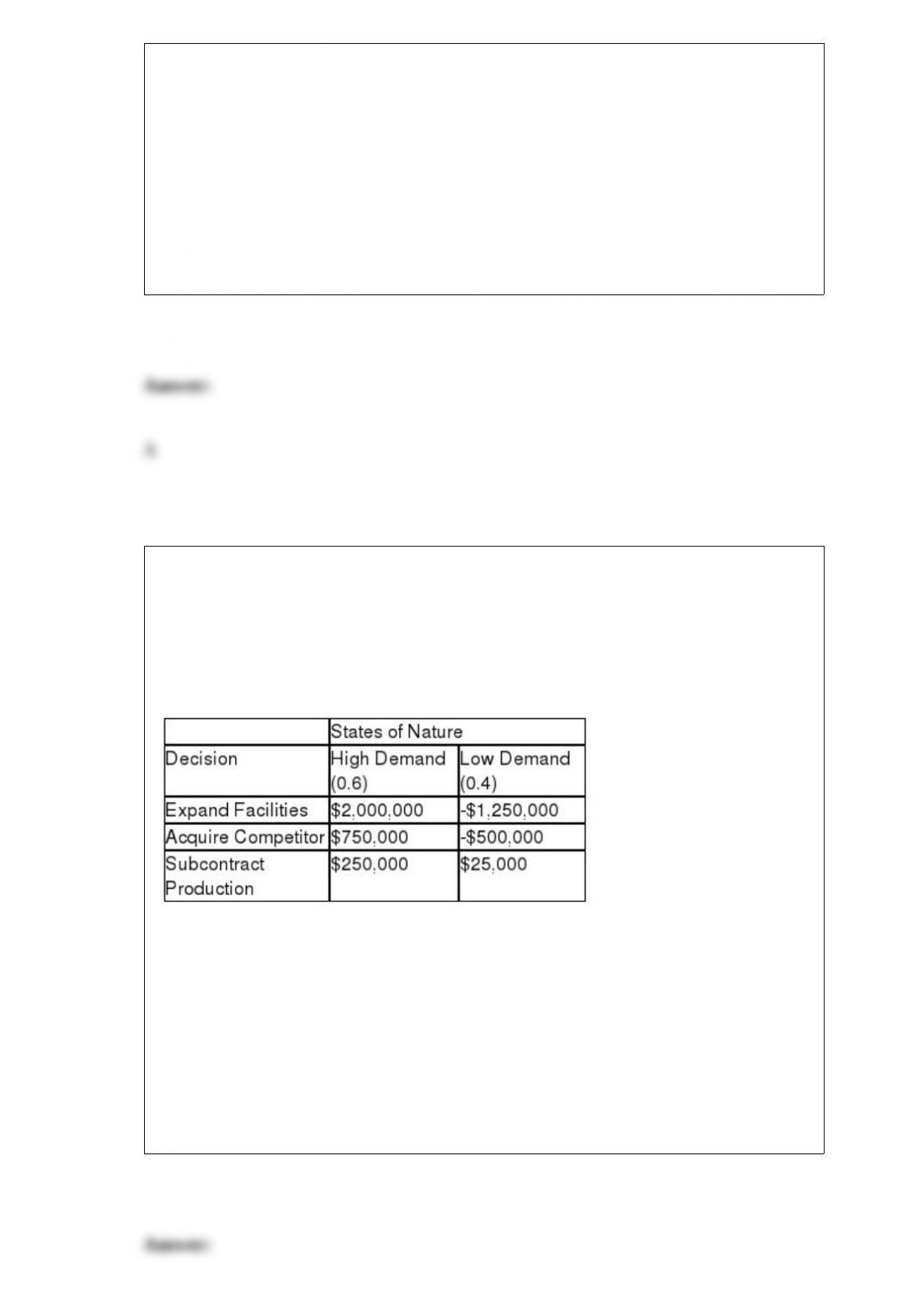
The following set of jobs must be processed serially through a two-step system. The
times at each process are in hours. If Johnson’s Rule is used to sequence the jobs then
Job A would complete processing on operation 2 at
a. hour 21.
b. hour 35.
c. hour 38.
d. hour 47.
In capacity planning, the feasibility of the sales and operations production plan is
verified by a
a. resource requirements plan.
b. rough-cut capacity plan.
c. capacity requirements plan.
d. master production schedule.
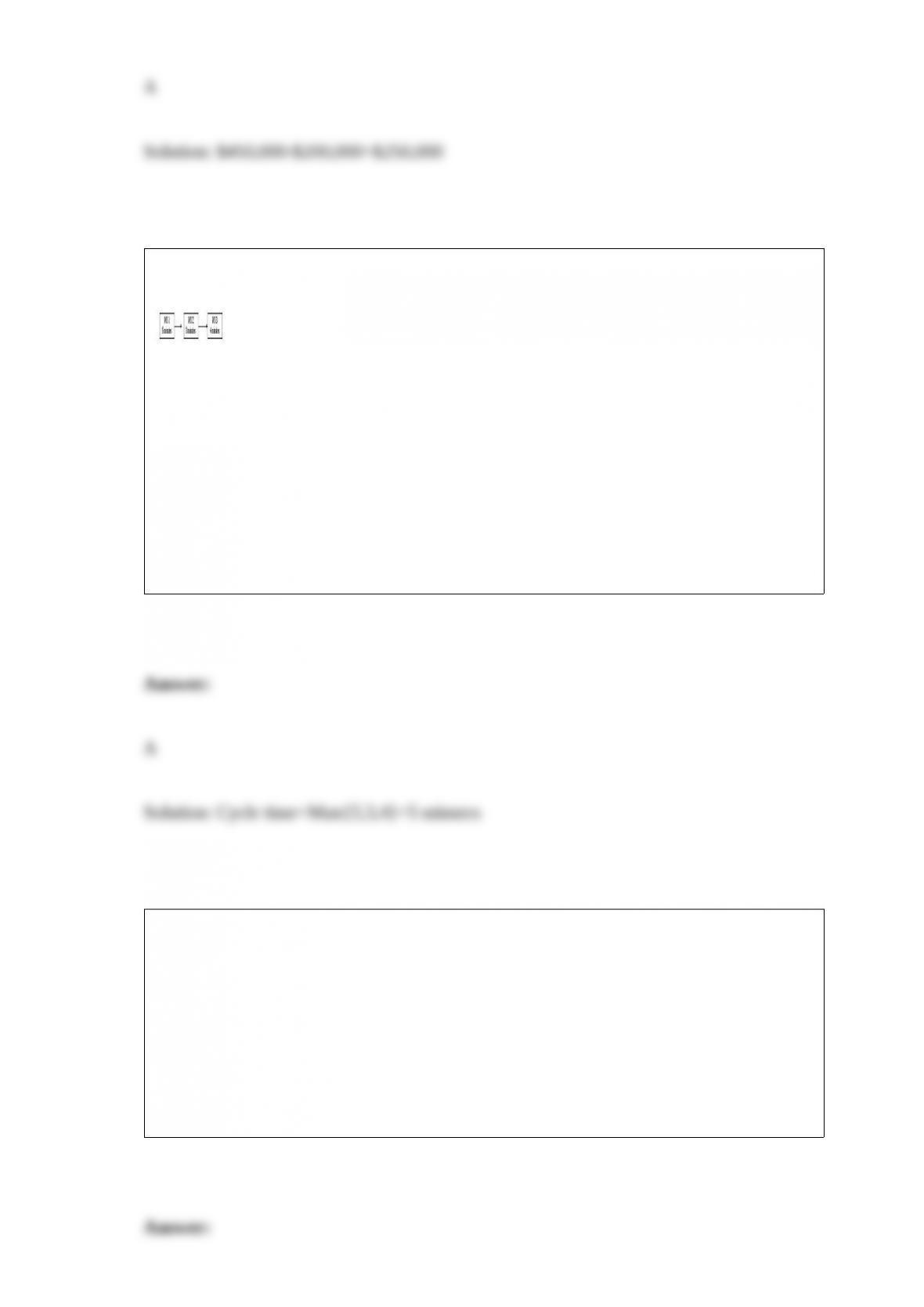
Kallie Inc., a small parts manufacturer, has just engineered a new product for the
automotive industry. In order to produce the part the company can expand existing
facilities, acquire a competitor, or subcontract production. The company believes the
product will either experience high market demand or low market demand, with
probabilities of 0.6 and 0.4, respectively. The following payoff table describes the
company’s decision situation.
The expected value for the acquire competitor decision is
a. $250,000.
b. $160,000.
c. $700,000.
d. $1,200,000.
An assembly line consists of three workstations (WS) with each station’s activity time
as shown.
The cycle time for this line is
a. 5 minutes.
b. 3 minutes.
c. 4 minutes.
d. 12 minutes.
A trend among service companies, in particular, is the use of
a. temporary and part-time employees.
b. telecommuting.
c. flexible work schedules.
d. teamwork.
The sum of the weights in a weighted moving average forecast must
a. equal the number of periods being averaged.
b. equal 1.00.
c. be less than 1.00.
d. be greater than 1.00.
Dividing a job into a series of small tasks, each performed by a different worker, is
known as
a. craft production
b. scientific management
c. division of labor
d. interchangeable parts
A company produces a product which is designed to weigh 10 oz., with a tolerance of +
0.5 oz. The process produces products with an average weight of 9.95 oz. and a
standard deviation of 0.10 oz. The process capability index for this process is

a. 1.50
b. -1.50
c. 1.83
d. -1.83
What is the discount order quantity using a purchase price of $120?
a. 100
b. 115.47
c. 200
d. 500
The ____________ function helps strategy evolve by creating new ways of delivering a
firm’s competitive priorities.
a. finance
b. marketing
c. operations
d. None of the answer choices is correct.
The two critical decisions concerning capacity include
a. When to increase and how much to increase.
b. When to increase and where to locate.
c. How much to increase and where to locate.
d. None of these answer choices is correct.
Which of the following is not an assumption of the EOQ model?
a. demand is known and constant
b. no shortages allowed
c. lead time is determined by quantity ordered
d. order quantity is received all at once
The ________________ method of linear programming can be used to assign workers
to different jobs.
a. transportation
b. differentiation
c. assignment
d. genetic
Which of the following is not a basic element of lean production?
a. flexible resources
b. pull system
c. repetitive production
d. small lot production