1) The maximal-flow model might be of use to an engineer looking for spare capacity
in an oil pipeline system.
2) The variance of the project completion time is equal to the sum of the variances of all
the activities.
3) In a zero-sum game, what one player gains is lost by the other.
4) (n + 1) = nP
5) Game theory is not very useful during Union negotiations.
6) The variance of a binomial distribution is expressed as np/(1 – p), where n equals the
number of trials and p equals the probability of success of any individual trial.
7) Upon retirement, Mr. Klaws started to make two types of children’s wooden toys in
his shop. Wuns yield a variable profit of $8 each, and Toos have a contribution margin
of $9 each. Even though his electric saw overheats, he can make 7 Wuns or 14 Toos
each day. Since he doesn’t have equipment for drying the lacquer finish he puts on the
toys, the drying operation limits him to 16 Wuns or 8 Toos per day. The final tableau for
Mr. Klaws’ problem would be:
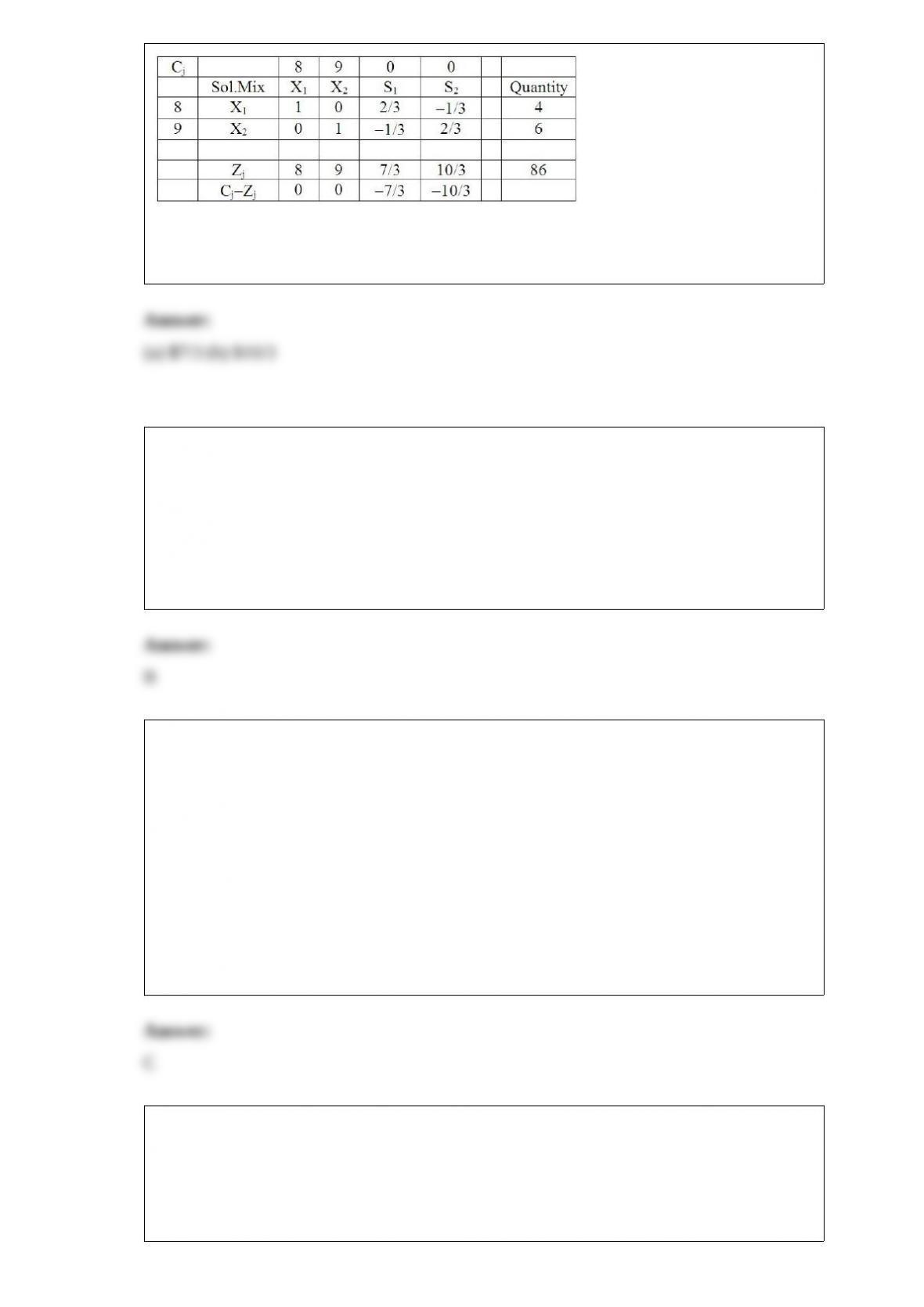
(a) What would the value be of an additional unit of constraint #1?
(b) What would the value be of an additional unit of constraint #2?
8) Which of the following techniques involves the use of optimization methods to
provide new and better ways to operate based on specific business objectives?
A) descriptive analytics
B) prescriptive analytics
C) predictive analytics
D) quantitative analysis
E) qualitative analysis
9) Tony B. is attempting to start a landscaping business. He estimates that to
break-even, he will need about 150 customers. He believes that he will lose
approximately $500 per customer for each customer fewer than the 150. At the moment,
he believes there is an 80% probability that he will be able to secure between 130 and
170 customers, and that there is a 50/50 chance that demand will be greater than 160
customers. What is the mean or expected number of sales?
A) 130
B) 150
C) 160
D) 170
E) None of the above
10) Properties of the normal distribution include
A) a continuous bell-shaped distribution.
B) a discrete probability distribution.
C) the number of trials is known and is either 1, 2, 3, 4, 5, etc.
D) the random variable can assume only a finite or limited set of values.
E) use in queuing.
11) Which of the following is not true of artificial variables?
A) They have no meaning in a physical sense-nothing more than a computational tool.
B) In all linear programs, they appear in the objective function with a very low cost
($M).
C) They are usually used with >= constraints.
D) They are usually used with = constraints.
E) None of the above
12) There is a 30% chance that any current client of company A will switch to company
B this year. There is a 40% chance that any client of company B will switch to company
A this year. If these probabilities are stable over the years, and if company A has 500
clients and company B has 300 clients,
(a) how many clients will each company have next year?
(b) how many clients will each company have in two years?
13) Consider the following linear programming problem:
Which of the following points (X,Y) is not a feasible corner point?
A) (0,60)
B) (105,0)
C) (120,0)
D) (100,10)
E) None of the above
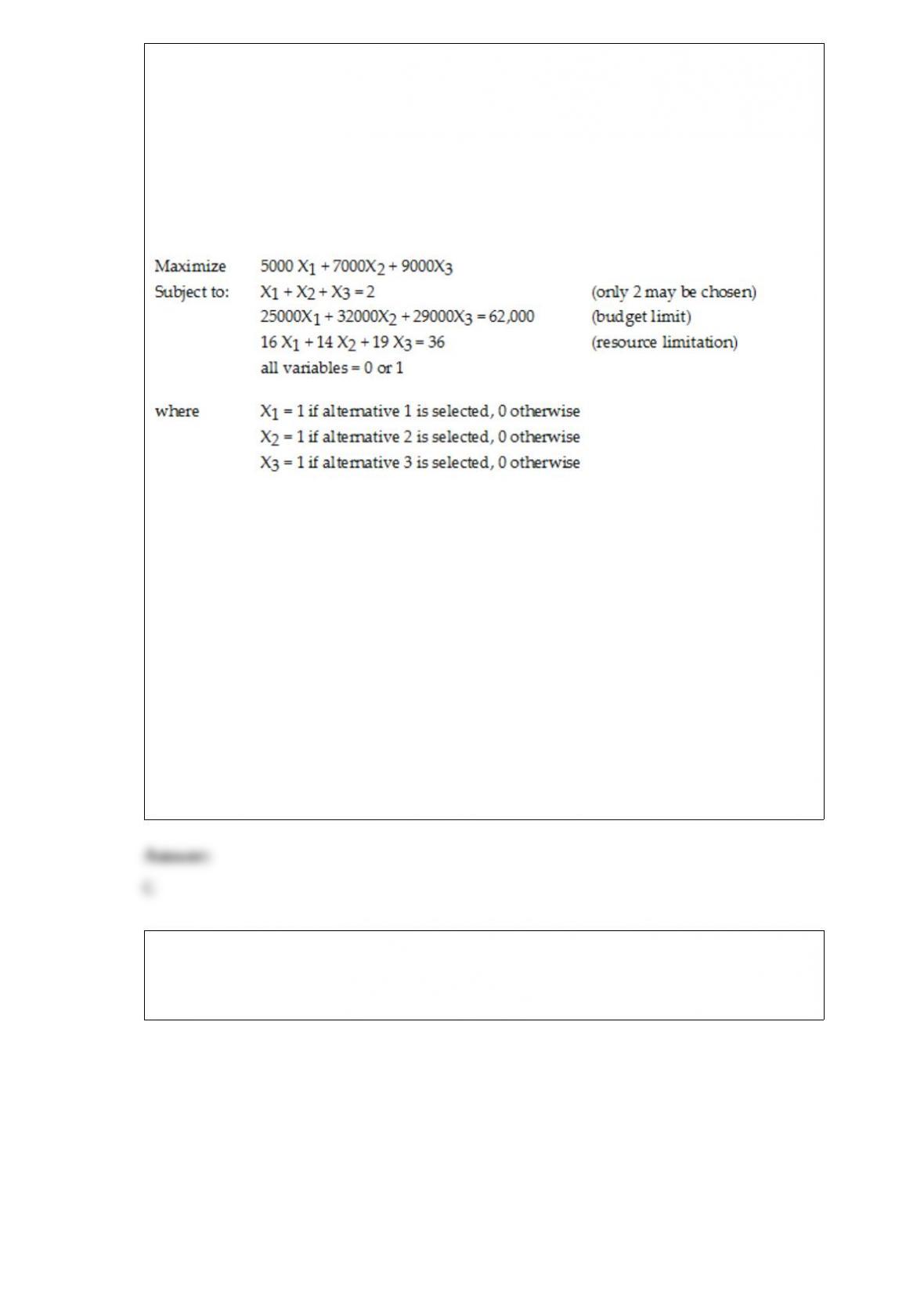
14) Table 10-1
A company has decided to use 0-1 integer programming to help make some investment
decisions. There are three possible investment alternatives from which to choose, but if
it is decided that a particular alternative is to be selected, the entire cost of that
alternative will be incurred (i.e., it is impossible to build one-half of a factory). The
integer programming model is as follows:
The optimal solution is X1 = 0, X2 = 1, X3 = 1
According to Table 10-1, which presents an integer programming problem, the optimal
solution is to select only two of the alternatives. Suppose you wished to add a constraint
that stipulated that alternative 2 could only be selected if alternative 1 is also selected
(i.e., if alternative 1 is not selected, you may not select alternative 2; however, you may
select #1 and not select #2). How would this constraint be written?
A) X1 = X2
B) X1 =< X2
C) X1 >= X2
D) X1 + X2 = 2
E) None of the above
15) A small software development project has four major activities. The times are
estimated and provided in the table below.
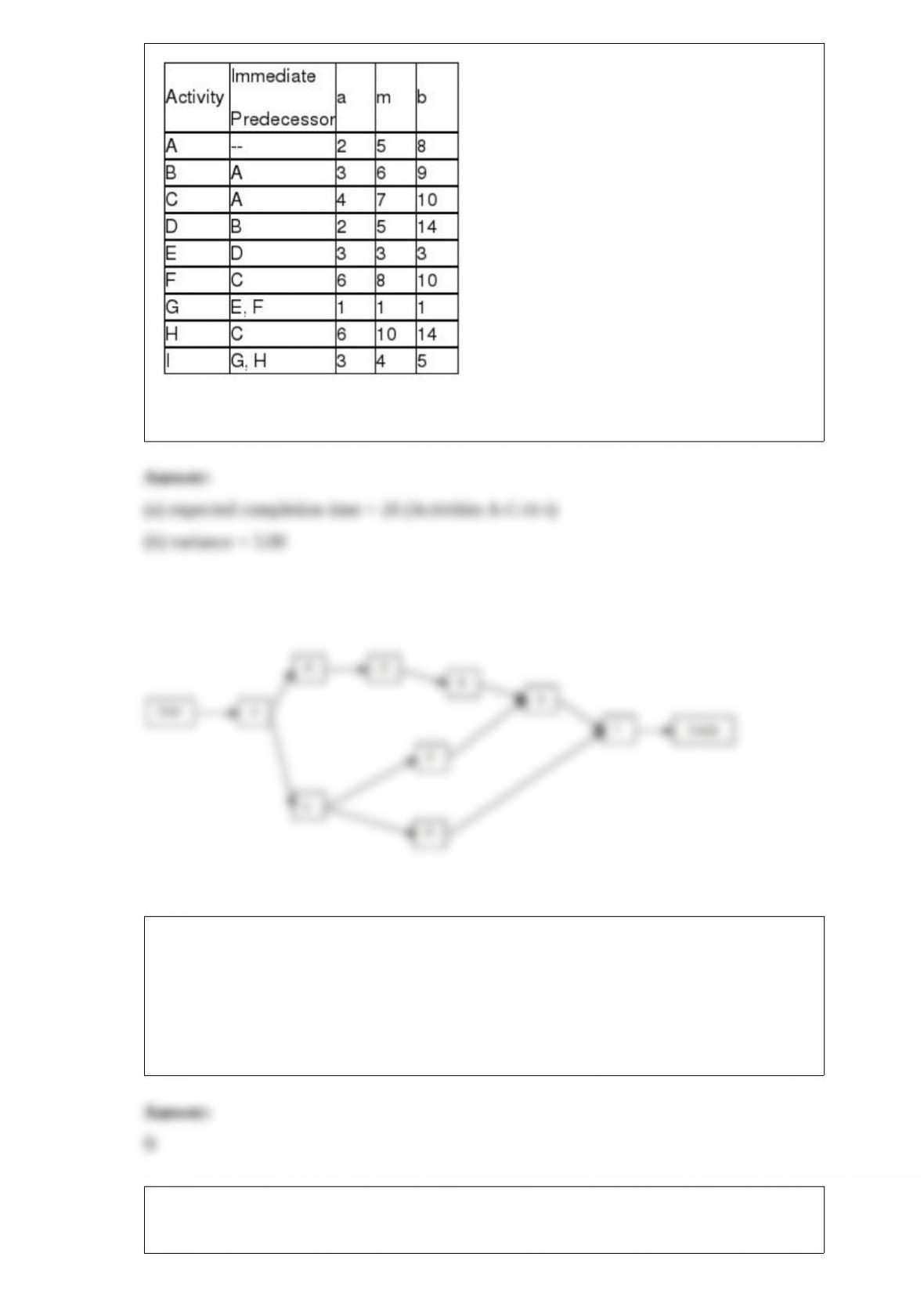
(a) What is the expected completion time for this project?
(b) What variance would be used in finding probabilities of finishing by a certain time?
16) If fixed costs were to double unexpectedly, the break-even point would be
A) unaffected.
B) doubled.
C) halved.
D) increased by a factor of four.
E) None of the above
17) Table 13-1
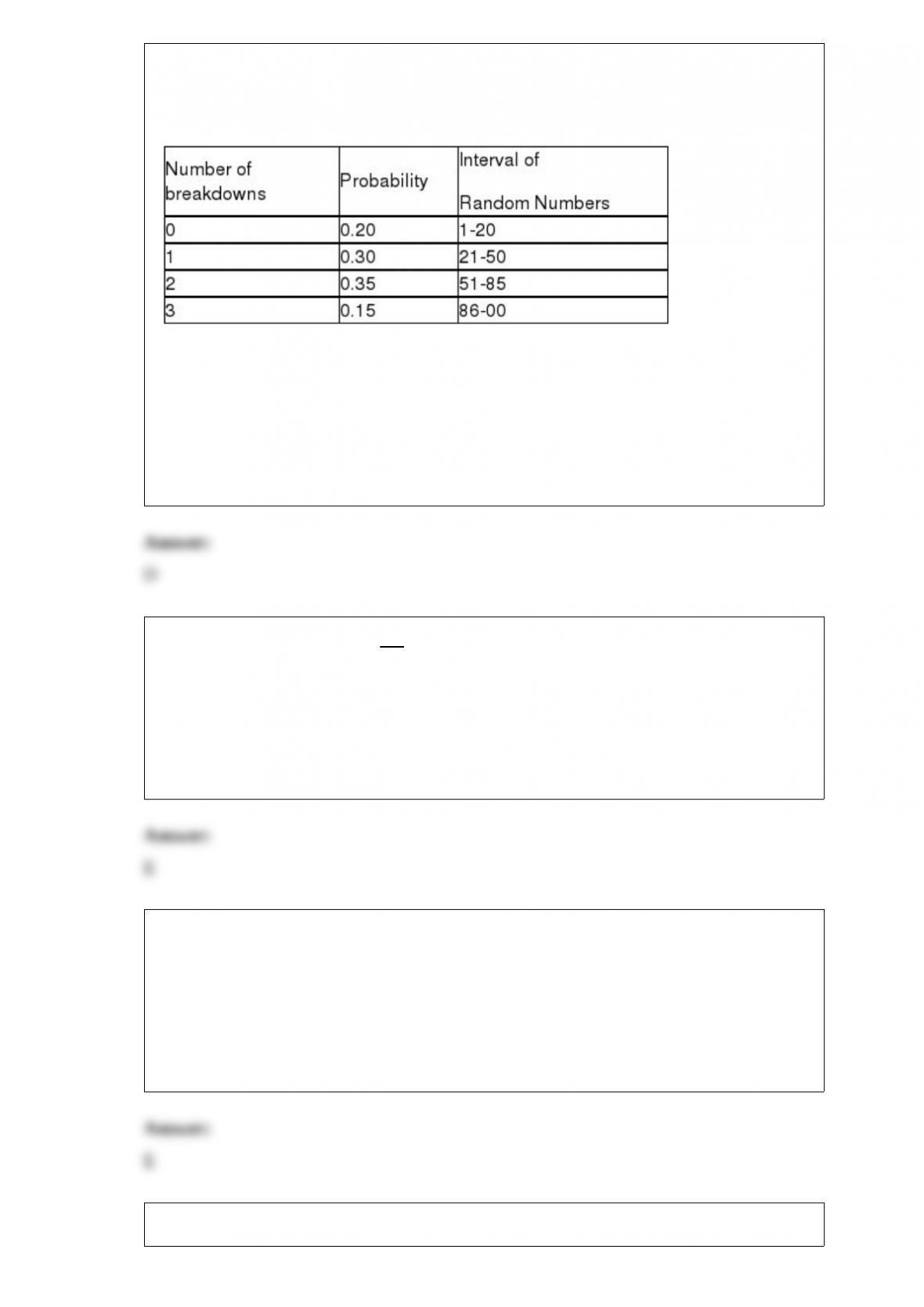
The table below represents the probability distribution for machine breakdowns in a day
of operation.
According to Table 13-1, if a random number of 00 is drawn, what would the simulated
number of breakdowns be?
A) 0
B) 1
C) 2
D) 3
E) Not enough information provided
18) Which of the following is not one of the steps considered in the “Six Steps in
Decision Making”?
A) Clearly define the problem at hand.
B) List the possible alternatives.
C) Apply the model and make your decision.
D) List the payoff or profit of each combination of alternatives and outcomes.
E) Evaluate the success of the decision.
19) What type of problems use LP to decide how much of each product to make, given
a series of resource restrictions?
A) resource mix
B) resource restriction
C) product restriction
D) resource allocation
E) product mix
20) A plant manager considers the operational cost per hour of five machine
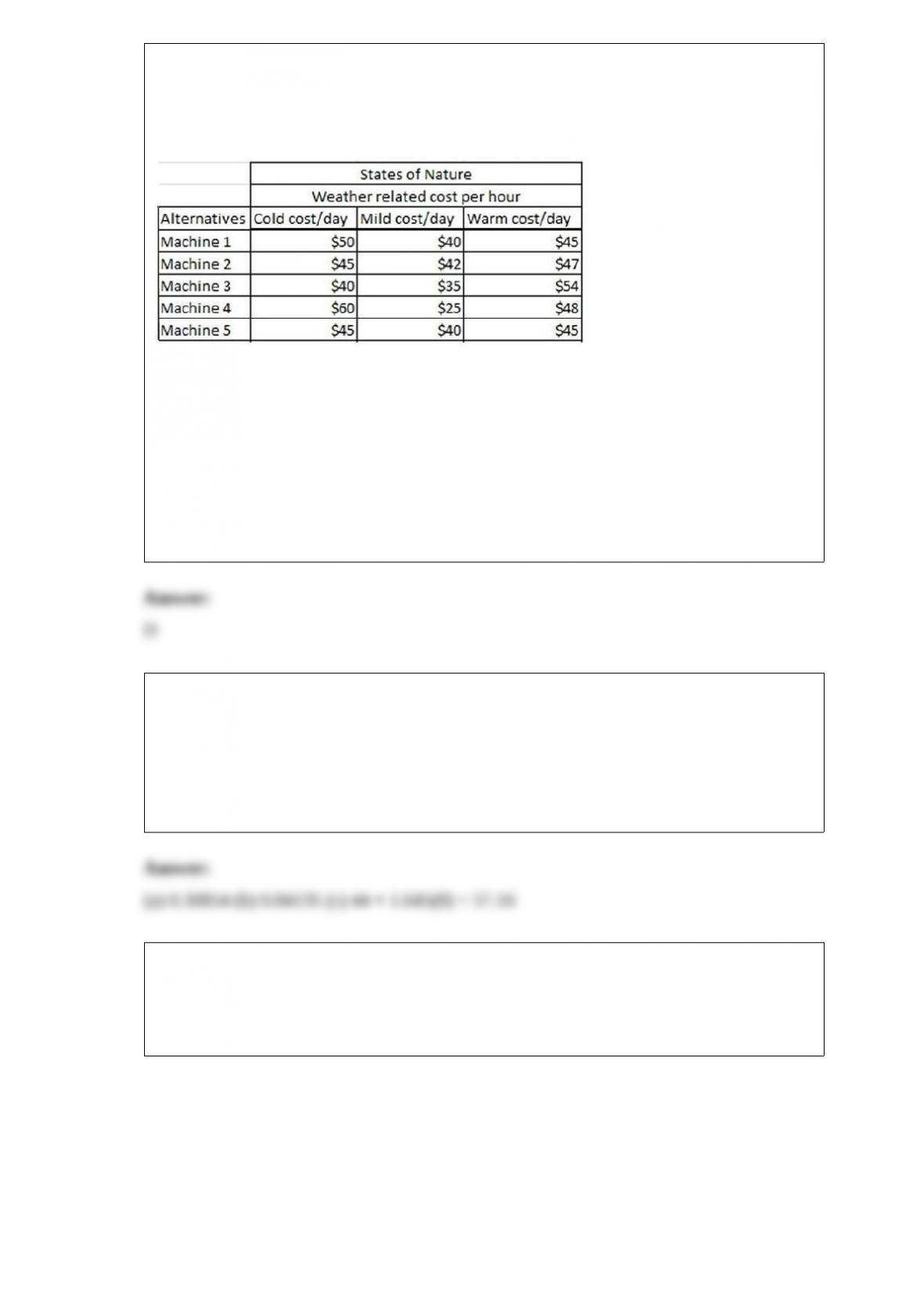
alternatives. The cost per hour is sensitive to three potential weather conditions: cold,
mild, and warm. The following table represents the operations cost per hour for each
alternative-state of nature combination:
Assume that for a randomly selected day, there is a 30% probability of cold weather,
50% probability of mild weather, and 20% probability of warm weather. What
alternative is best using EMV?
A) Machine 1
B) Machine 2
C) Machine 3
D) Machine 4
E) Machine 5
21) The time required to complete a project is known to be normally distributed with a
mean of 44 weeks and a standard deviation of 8 weeks.
(a) What is the probability that the project is finished in 40 weeks or fewer?
(b) What is the probability that the project is finished in 52 weeks or fewer?
(c) There is a 95 percent chance that the project will be finished in fewer than how
many weeks?
22) Development of a new deluxe version of a particular software product is being
considered. The activities necessary for the completion of this are listed in the table
below (Time in weeks).
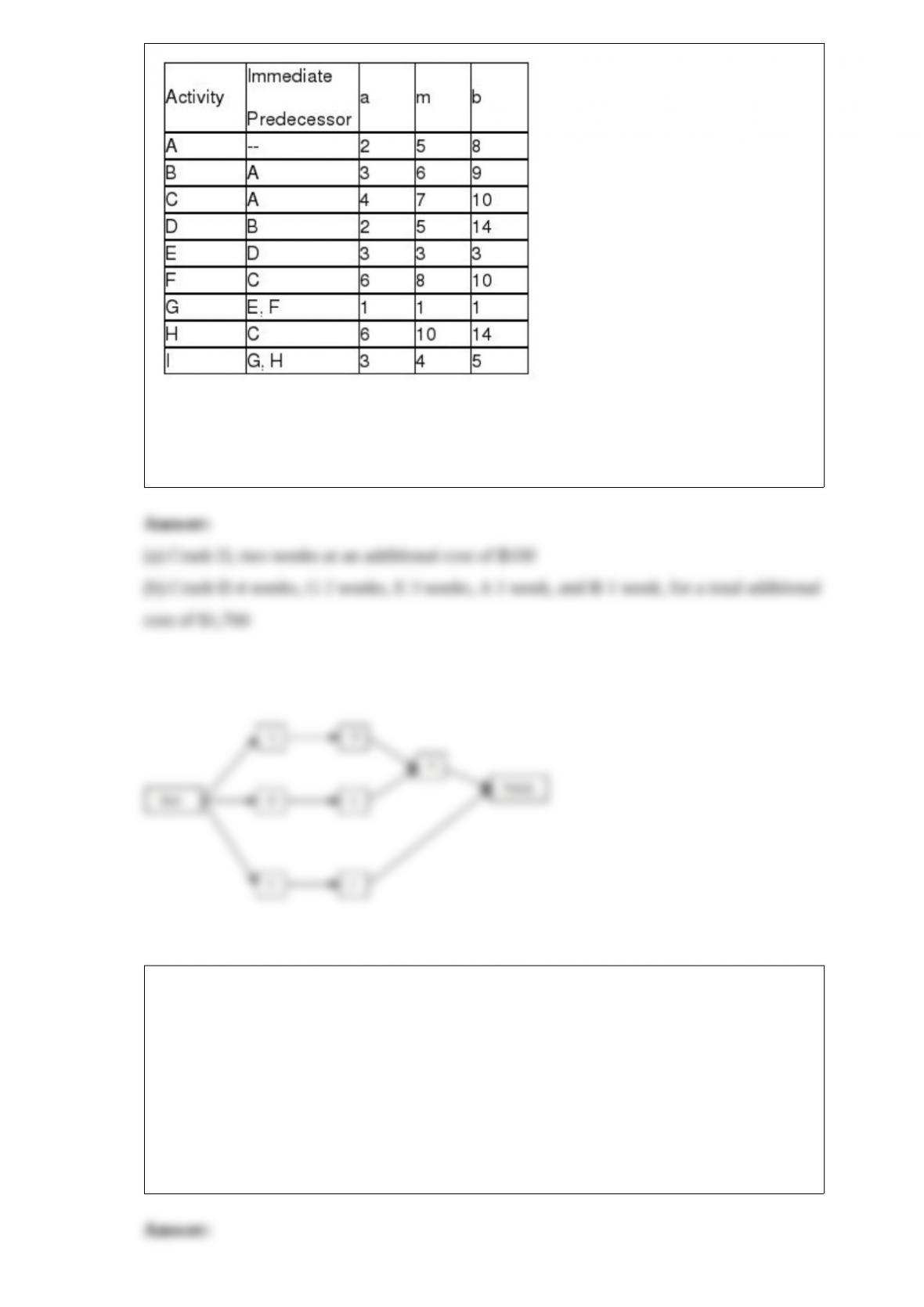
(a) If you wish to reduce the time required to complete this project by two weeks, which
activity(ies) should be crashed, and how much will this increase the total cost?
(b) What would be the added cost if you wanted to complete the project in the minimum
time possible?
23) When appropriate, the optimal solution to a maximization linear programming
problem can be found by graphing the feasible region and
A) finding the profit at every corner point of the feasible region to see which one gives
the highest value.
B) moving the isoprofit lines towards the origin in a parallel fashion until the last point
in the feasible region is encountered.
C) locating the point that is highest on the graph.
D) None of the above
E) All of the above
24) A market research survey is available for $10,000. Using a decision tree analysis, it
is found that the expected monetary value with no survey is $62,000. If the expected
value of sample information is -$7,000, what is the expected monetary value with the
survey?
A) $45,000
B) $62,000
C) -$17,000
D) $55,000
E) None of the above
25) What is meant by a single-channel queuing system?
26) Describe a two-person zero sum game.
27) Natural variation of a production process that follows a normal distribution is
characterized by two parameters: ________ and ________.
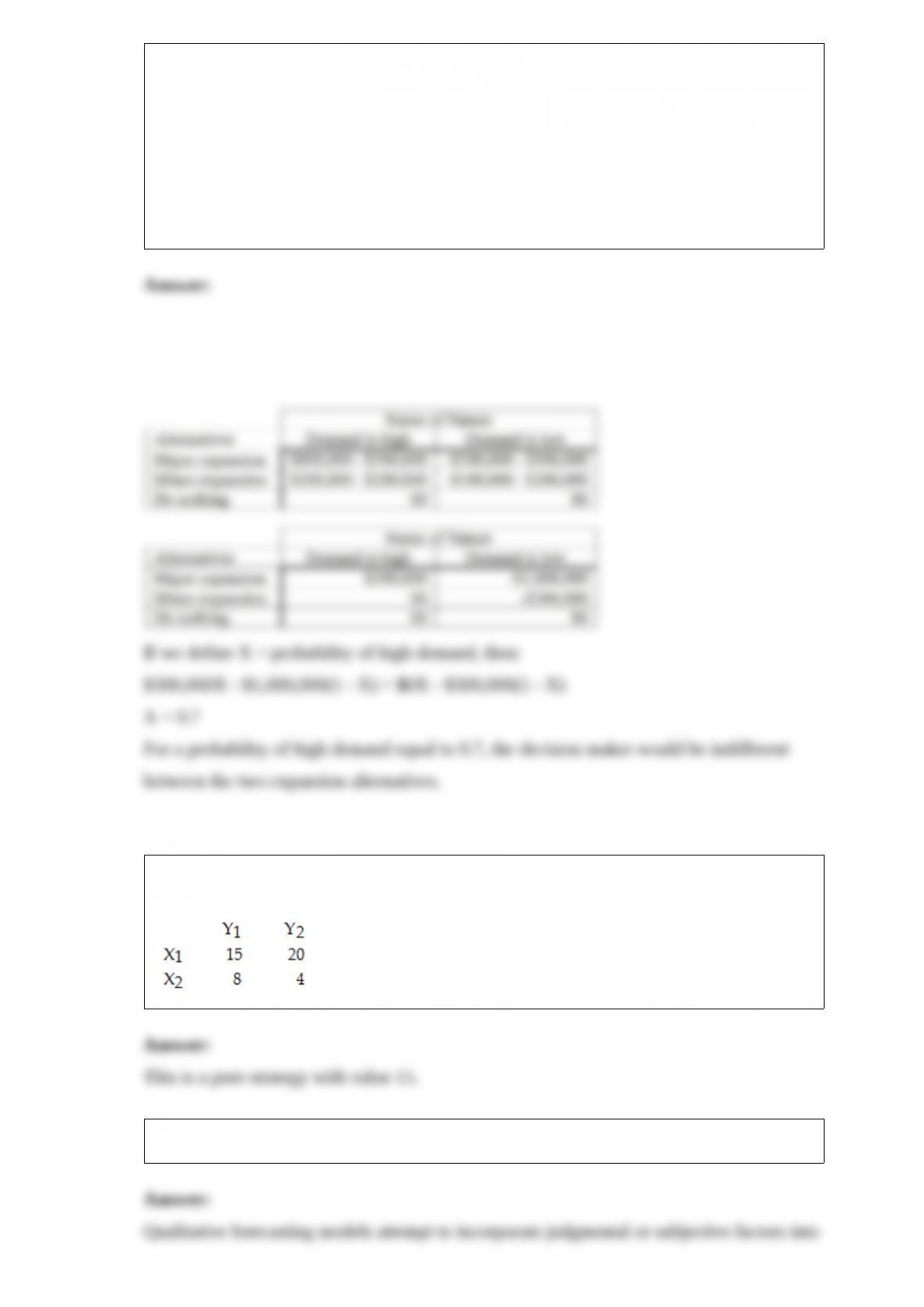
28) Evaluate the determinant below.
29) A company is considering expansion of its current facility to meet increasing
demand. A major expansion would cost $500,000, while a minor expansion would cost
$200,000. If demand is high in the future, the major expansion would result in an
additional profit of $800,000, but if demand is low, then there would be a loss of
$500,000. If demand is high, the minor expansion will result in an increase in profits of
$200,000, but if demand is low, then there is a loss of $100,000. The company has the
option of not expanding. For what probability of a high demand will the company be
indifferent between the two expansion alternatives?
30) What is the value of the following two-person game?
31) In general terms, describe what qualitative forecasting models are.
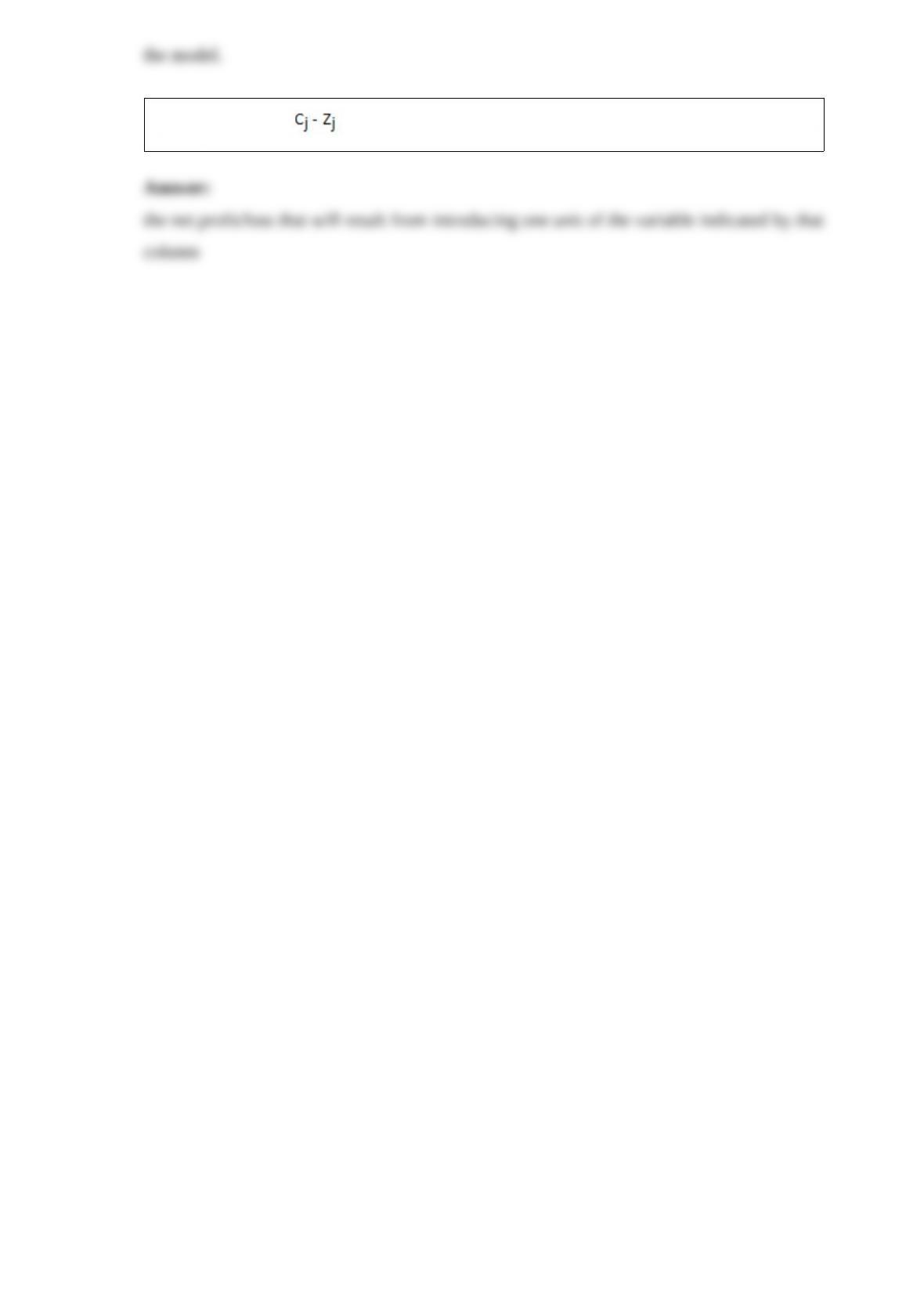
32) What does the row represent in a simplex tableau?