
For a given cycle time in line balancing, assembly-line efficiency can be increased by
_____.
a. speeding the assembly line
b. slowing the assembly line
c. decreasing the number of workstations
d. increasing the number of workstations
Answer:
Which level of the facility location hierarchy is most closely related to factors such as
managers’ preferences, services and taxes, available transportation systems, banking
services, and environmental impacts?
a. Global (National) location
b. Regional location
c. Community location
d. Local site selection
Answer:
_____is the fraction of time a workstation or individual is busy over the long run.

a. Utilization
b. Cycle time
c. Throughput
d. Turnaround time
Answer:
Capacity requirements are computed by multiplying the number of units scheduled for
production at a work center by:
a. the setup time and then subtracting the unit resource requirements.
b. the setup time and then adding the unit resource requirements.
c. the unit resource requirements and then adding in the setup time.
d. the unit resource requirements and then subtracting the setup time.
Answer:
The Academic Company mixes and bottles a high-energy beverage in various container
types and sizes for college students. The aggregate forecast for the next four quarters (1
year) in thousands of gallons is as follows:
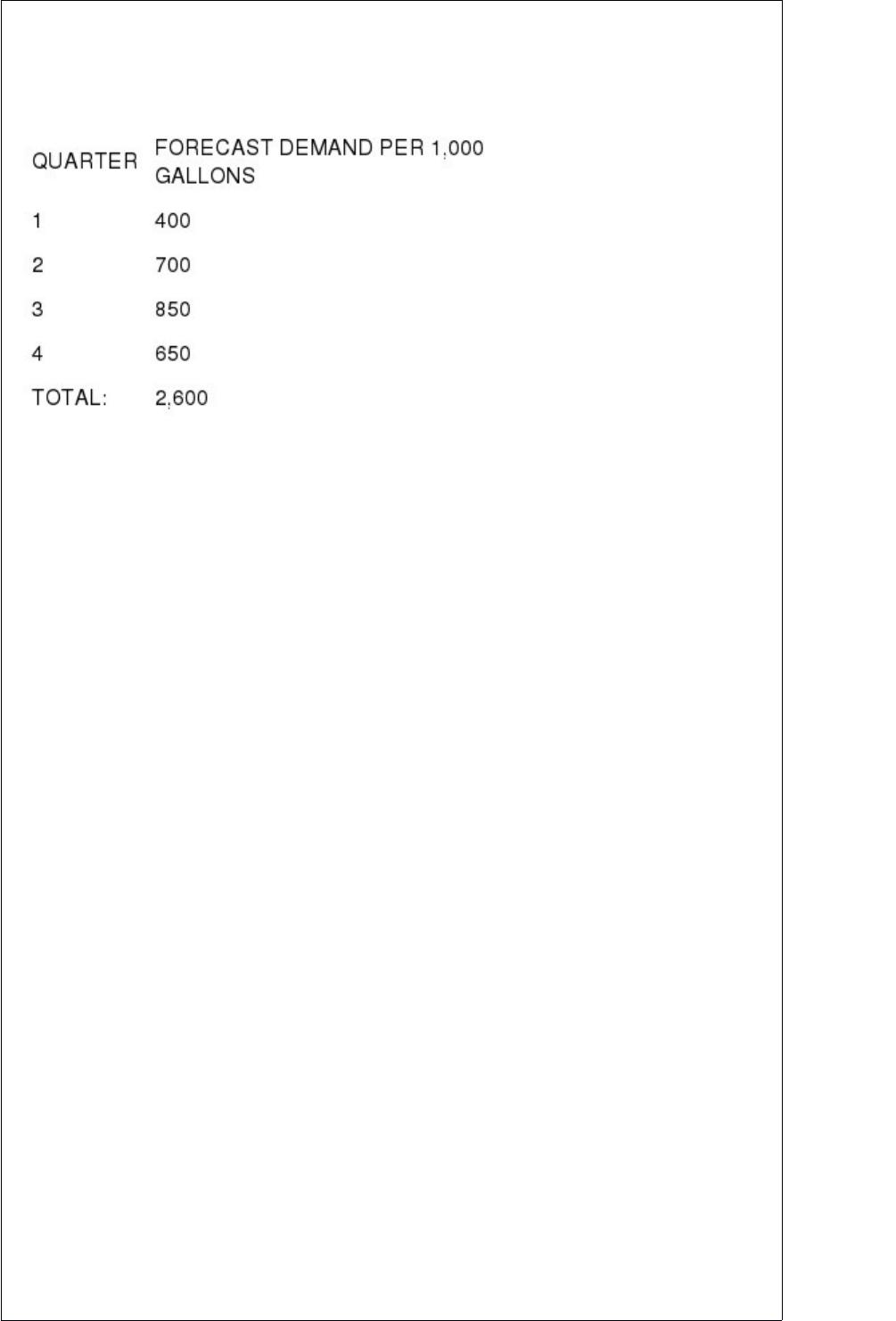
Table 1
Academic’s management makes the following assumptions:
Each employee works 550 standard hours of regular time each quarter.
On average, it takes 27 hours to produce and package 1 unit (1,000 gallons).
Regular-time labor costs $6.00/hour; overtime labor costs $9.00/hour.
Inventory-holding cost is approximately $4.50/unit (1,000 gallons) per quarter based
upon the ending inventory per quarter.
Because of extremely hot weather, there is no beginning inventory available to start
Quarter 1.
Management wants a constant work force (no hiring or firing).
Managers have also decided to always round up the number of employees needed to
the next whole integer, i.e., 37.2 yields 38 employees.
______________________________________________________________________
________
Using the information given in Table 1, determine how many employees would be
needed to meet the peak demand in Quarter
a. 32
b. 21
c. 50
d. 42
Answer:
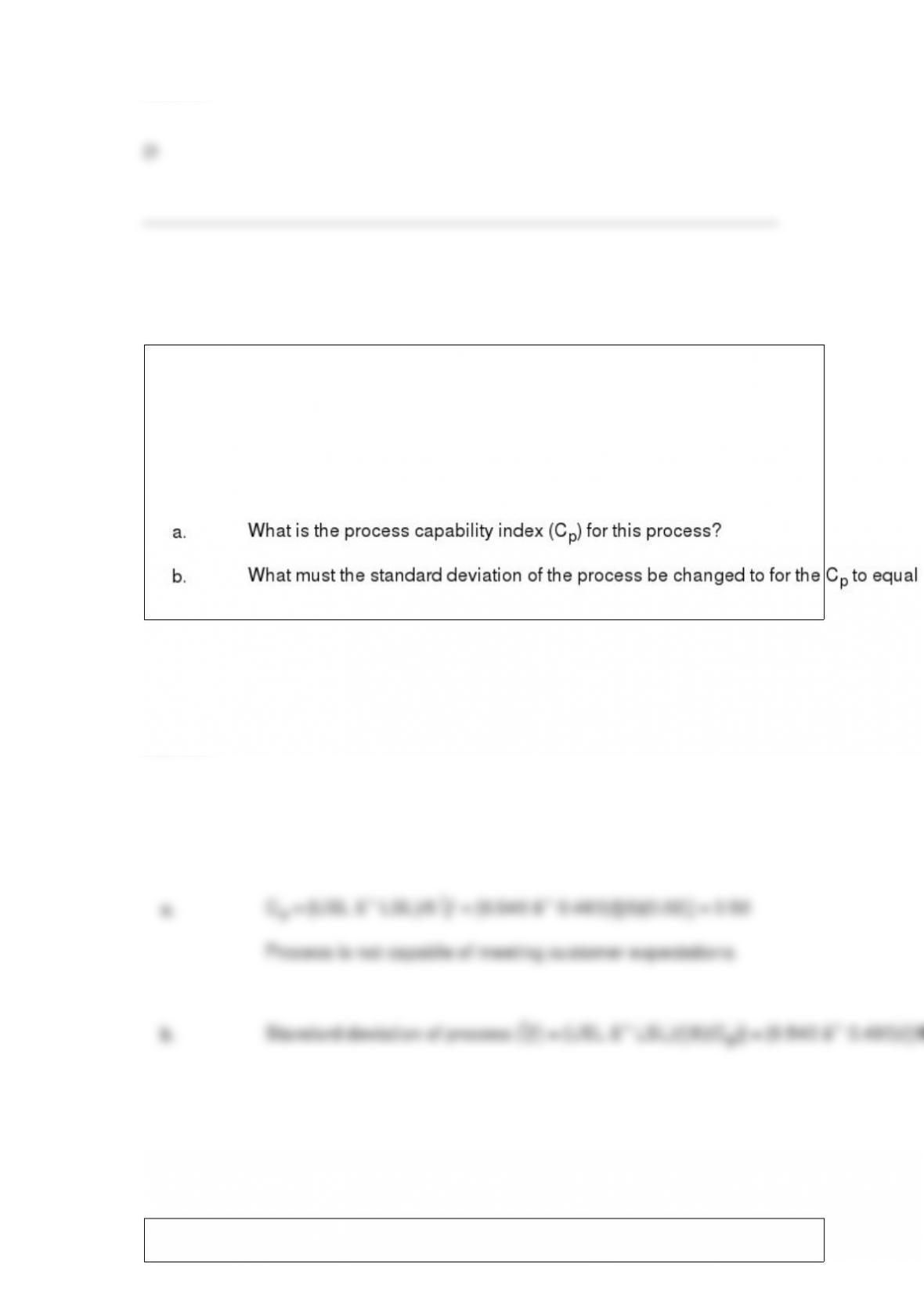
A steel company is interested in determining if a particular process in its mini-mill is
capable of meeting customer expectations. The thickness of steel has an upper limit of
0.540 mm and a lower limit of 0.480 mm. The process has a standard deviation of 0.02
mm.
Answer:
A company manufactures computer parts. They have received an order for 100 custom
disc drives. It is estimated that the first drive will take 20 hours of shop time and an 80
percent learning curve is expected. The labor rate is $15.00, and the pricing policy is to
charge 3 times the labor cost.
a. How many hours will the 100th disc drive take?
b. How many hours will the entire order take?
c. What is the price of the entire order?
d. What is the price per unit?
Answer:
A company has two alternatives for meeting a customer requirement for 9,000 units of a
specialty molding. If done in-house, fixed cost would be $350,000, with variable cost at
$30 per unit. If outsourced, the cost is $80 per unit. Determine the break-even point and
determine if they should make the item in-house or outsource it.
a. break-even point = 7,000 units; outsource it
b. break-even point = 7,000 units; make it in-house
c. break-even point = 11,667 units; outsource it
d. break-even point = 11,667 units; make it in-house
Answer:
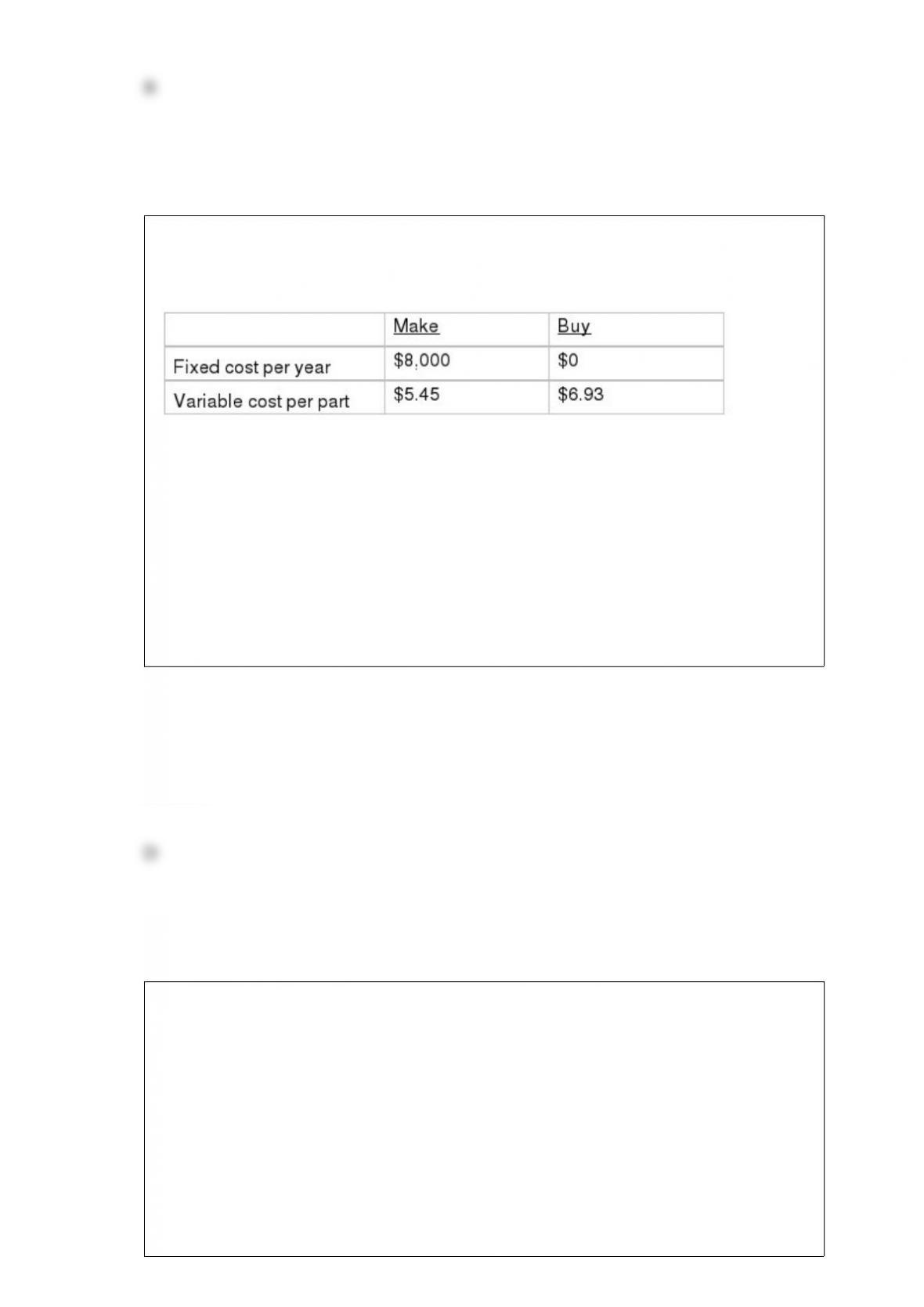
A manufacturing company needs to know whether to make in-house or buy a roller gear
assembly for its production of a new fax machine. The company expects to produce
9,000 units per year. The following estimates have been made:
The annual cost to buy the roller gear assembly is _____.
a. more than $30,000 but less than or equal to $40,000
b. more than $40,000 but less than or equal to $50,000
c. more than $50,000 but less than or equal to $60,000
d. more than $60,000
Answer:
Which statement is TRUE regarding the Community Medical Association (CMA) case
study in Chapter 17 that we discussed in class?
a. The case describes how the 5Ss were used by CMA’s 50 databases.
b. Total savings was over $50 million from implementing an integrated operating
system with a common database compared to the previous system.
c. Doctor total changeover and setup (i.e., system relog) time per patient increased after
the new integrated operating system was implemented.
d. The quality of medical diagnosis and decisions (i.e., clinical quality) improved with
the new system.
Answer:
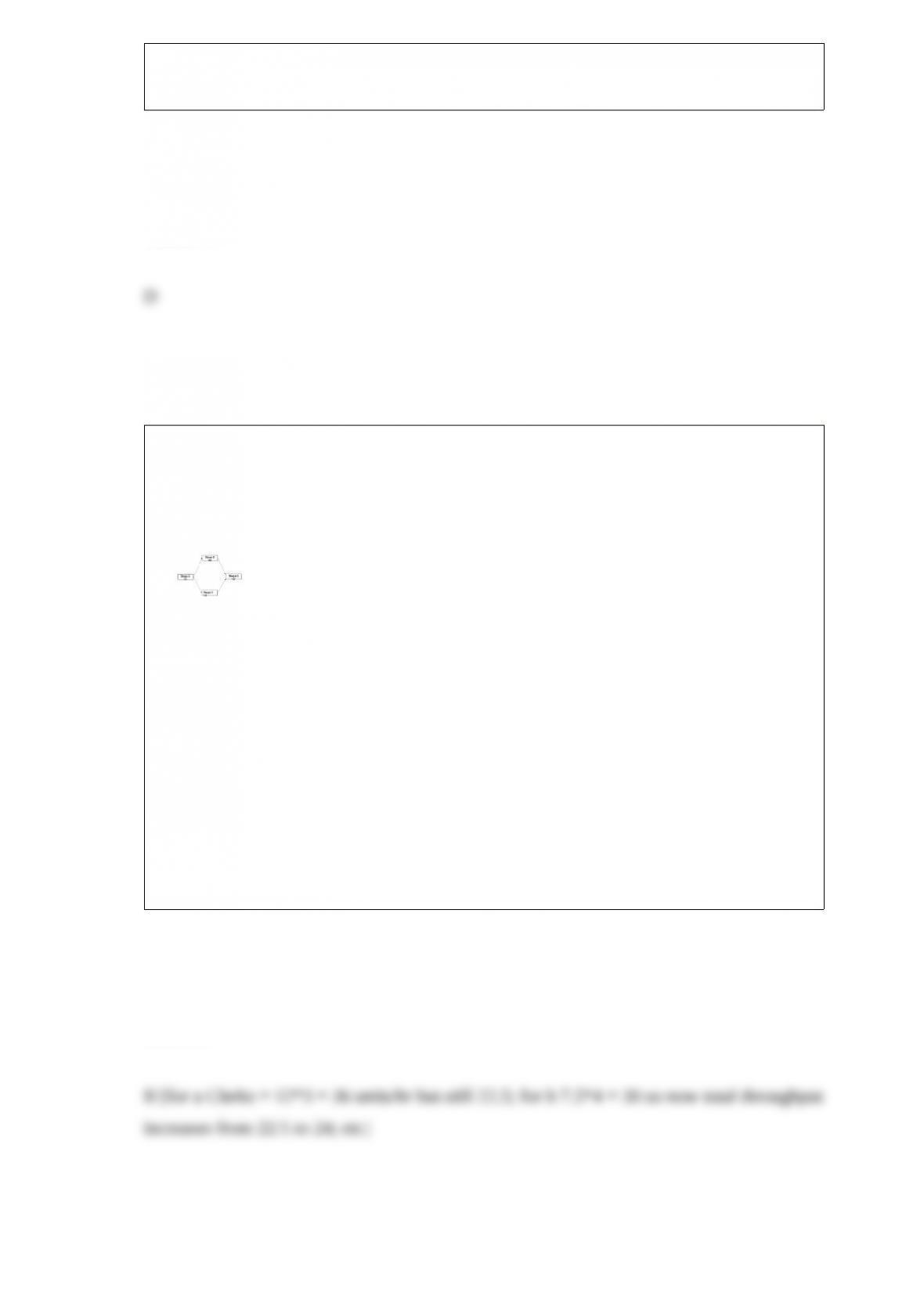
Perform a capacity analysis of the process given below. The numbers in parenthesis (#)
are the time in minutes to complete one unit of work. Demand on the process averages
20 units per hour and each unit must be worked on by all four stages. Administrative
clerk(s) do Stage A work. The assistant manager(s) do Stages C and D work and are
cross-trained to do both jobs. The coding specialist(s) do Stage B work.
Given the base case information and resource levels in question #21, which process
improvement option given below is best to maximize (increase) process (throughput)
capacity? (Each option is independent of any other option; that is, consider each option
below as the base case plus the one option.)
a. Add one clerk to help do the work at Stage A.
b. Add one assistant manager to help do the work at Stages C and D.
c. Transfer one coder from coding to an assistant manager job.
d. Speed up the service time for coders (Stage B) from 6 minutes/unit to 5 minutes/unit.
Answer:

Which of the following statements in the perspective of a value chain is TRUE?
a. Pre- and postproduction services complete the ownership cycle for a good or service.
b. Offshoring is the process of having suppliers provide goods and services that were
previously provided internally.
c. Value chain integration includes improving external processes for the client, and not
the internal processes.
d. A value chain is a narrower concept than a supply chain that focuses more on the
physical movement of goods, not services.
Answer:
Triage by nurses in an emergency room would be an example of:
a. scheduling.
b. sequencing.
c. appointments.
d. work shifts.
Answer:
Automobile factories and hospital laboratory work are examples of:

a. projects.
b. job shop processes.
c. flow shop processes.
d. continuous flow processes.
Answer:
Which of the following statements is TRUE of social sustainability?
a. It includes customization and financial management.
b. It includes ethics and governance.
c. It includes sustainable product design.
d. It includes energy optimization.
Answer:
The table below includes processing times and due dates for five jobs.
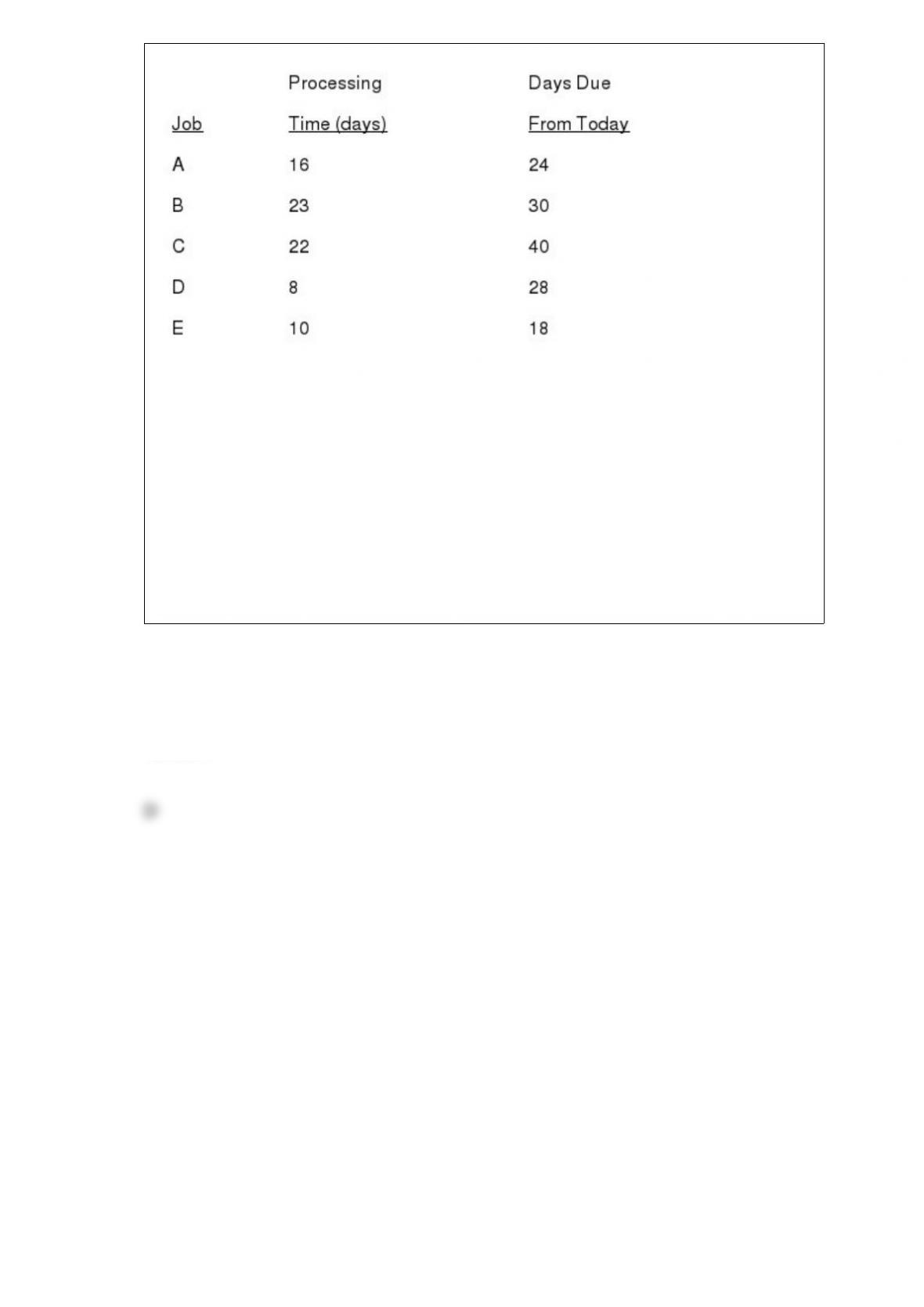
Using the shortest processing time (SPT) rule, the average flow time for the five jobs is
_____.
a. less than or equal to 10 days
b. more than 10 but less than or equal to 20 days
c. more than 20 but less than or equal to 30 days
d. more than 30 but less than or equal to 40 days
Answer:
General Electric (GE) would best be described as what type of company?
a. Business to business (B2B)
b. Business to customer (B2C)
c. Customer to customer (C2C)
d. Government to customer (G2C)
Answer:
Which of the following is NOT a current challenge in operations management (OM)?
a. Globalization
b. Technology
c. Quality

d. Mass production
Answer:
Which lot sizing rule is best when inventory carrying costs are high and setup/order
costs are low?
a. Lot-for-lot (LFL)
b. Fixed-order quantity (FOQ)
c. Periodic-order quantity (POQ)
d. Gross requirements (GR)
Answer:
Which of the following is generally TRUE of the transportation problem of linear
programming?
a. A specified quantity of goods is needed at each demand location.
b. The objective is to maximize profit.
c. The shipping cost from each source to each destination is the same.
d. An exponential loading/unloading distribution is assumed.
Answer:
Which one of the following skills contributes to project success?
a. Lack of data accuracy and integrity
b. Clear communication channels
c. Ill-defined project objectives
d. Inability to resolve conflicts
Answer:
Service management skills include all of the following EXCEPT _____.
a. accounting and finance
b. knowledge and technical expertise about operations
c. marketing and cross-selling skills
d. human interaction skills
Answer:
Discuss the differences between lean production and Six Sigma.
Answer:
Which of the following statements is TRUE of the activities not on the critical path?
a. These activities usually cannot be delayed.
b. These activities have less slack than activities on the critical path.
c. These activities can become part of the critical path if delayed long enough.
d. These activities have uncertain times.
Answer:
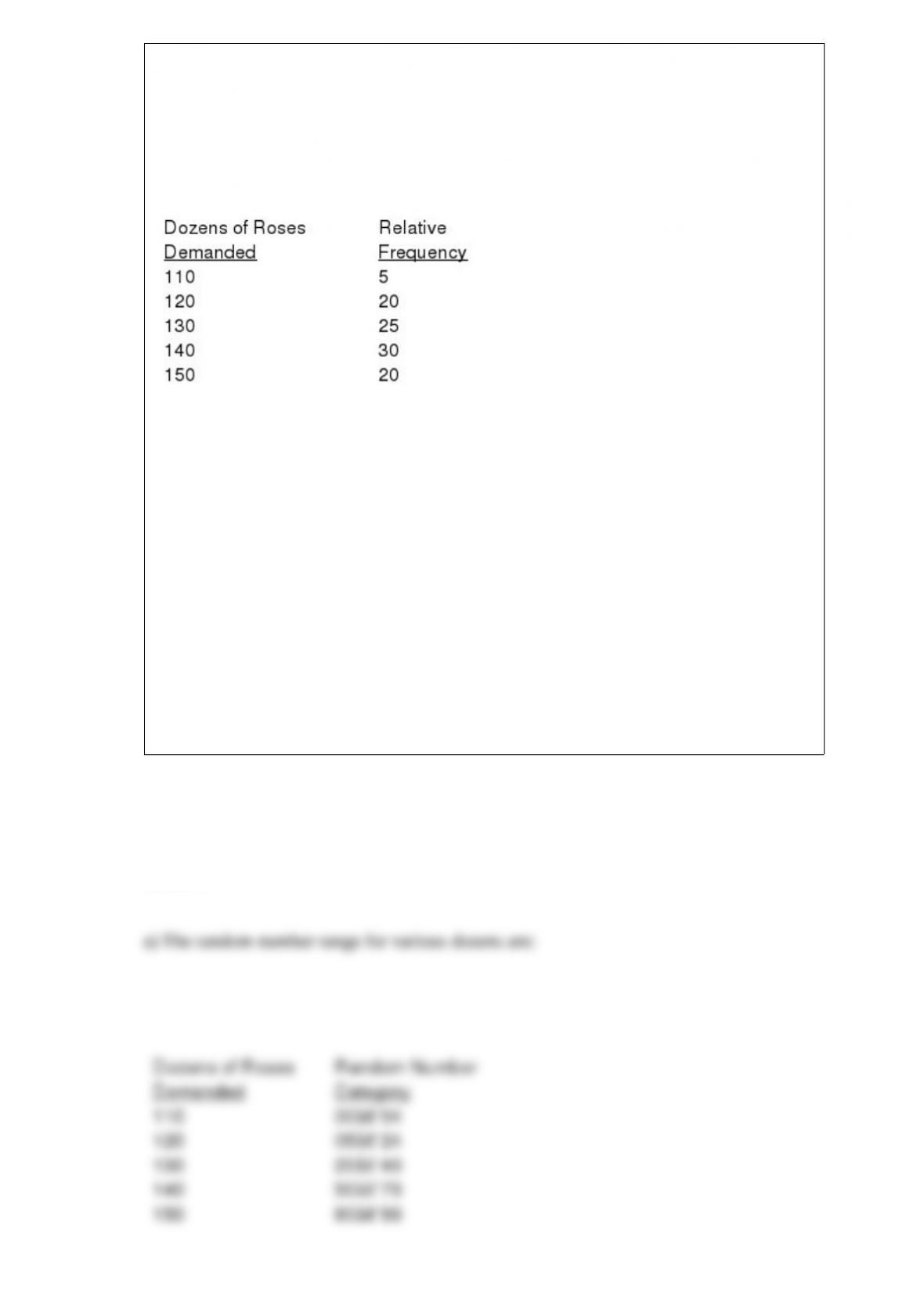
The Rose Warehouse buys roses each week from Panama. A toll-free long distance call
is made on Saturday night, and early Monday morning roses arrive at the airport in a
box refrigerated with dry ice. The roses cost $8 a dozen and are sold on a
cash-and-carry basis for $28 a dozen. Roses left over at the end of the week are put in a
trash collector in an alley behind the store. Past sales (rounded to the nearest ten dozen)
are as follows:
The owner of the Rose Warehouse wants to compare two ordering rules for ordering
roses: (1) order last week’s demand plus 10 dozen extra (as safety stock), (2) order 130
dozen every week. He wants to run an eight-week simulation to compare the average
weekly profit for the two rules. Last week’s demand was for 110 dozen. He generated
the following random numbers for weeks 1-8, respectively: 63, 13, 67, 50, 71, 25, 44,
and 00.
a. What is the random number range corresponding to 130 dozen roses demanded?
b. Using ordering rule 1, what is the profit for week 3?
c. Using ordering rule 2, what is the profit for week 6?
d. What is the average profit over all eight weeks for ordering rule 1?
Answer:
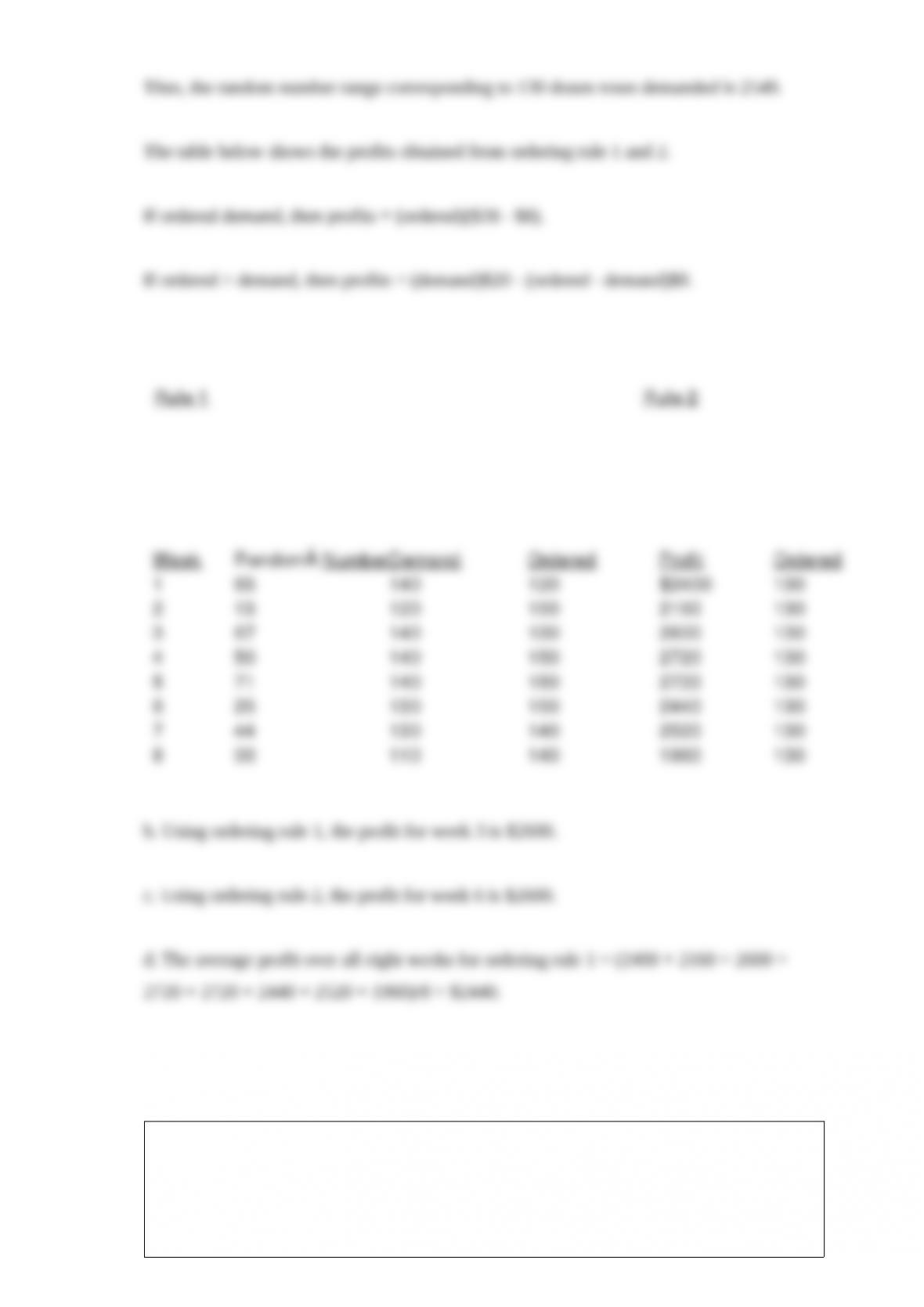
The expected variance of Activity A is _____.
a. less than or equal to 0.5 days
b. greater than 0.5 but less than or equal to 1.0 day

c. greater than 1.0 but less than or equal to 1.5 days
d. greater than 1.5 days
Answer:
If Activity C directly precedes both D and E on a project network, and C can be crashed
three (3) times using linear programming, then:
a. crash time affects only C.
b. crash time affects only C and D.
c. crash time affects only C and E.
d. crash time affects both D and E.
Answer:
The lower and upper specification limits for a component are 4.20 and 30 ounces,
respectively. The process standard deviation is .02, and the process average is 4.24
ounces. Which one of the following statements is TRUE?
a. The Cp index indicates the process is centered.
b. The Cp index indicates the process is not centered.

c. The Cpk index indicates the process is centered.
d. The Cpk index indicates the process is not centered.
Answer:
Which of the following costs is NOT considered a variable cost?
a. Labor cost
b. Transportation cost
c. Administrative cost
d. Material cost
Answer:
Rose is in charge of the advertising program for Proctor & Gamble’s new laundry
detergent. She has defined the advertising program as a project with the following
characteristics. The goal is to complete the project on time and within budget, or she
may not have this job next yearthe pressure is on!
Draw the project network in the space below if you want. BLANK SPACES
The earliest completion time for this project is:
a. 11 weeks.
b. 12 weeks.
c. 13 weeks.
d. 14 weeks.
Answer:
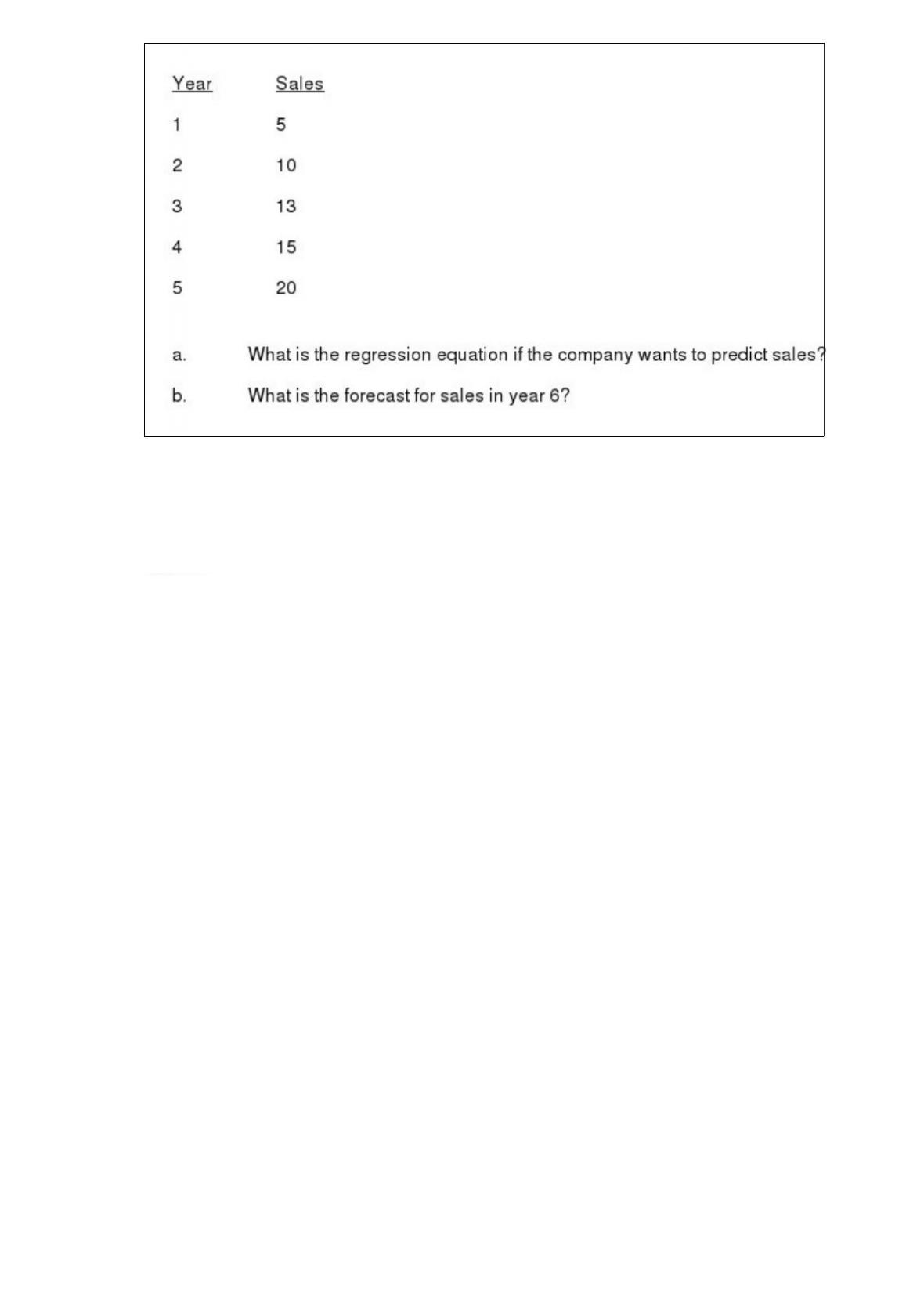
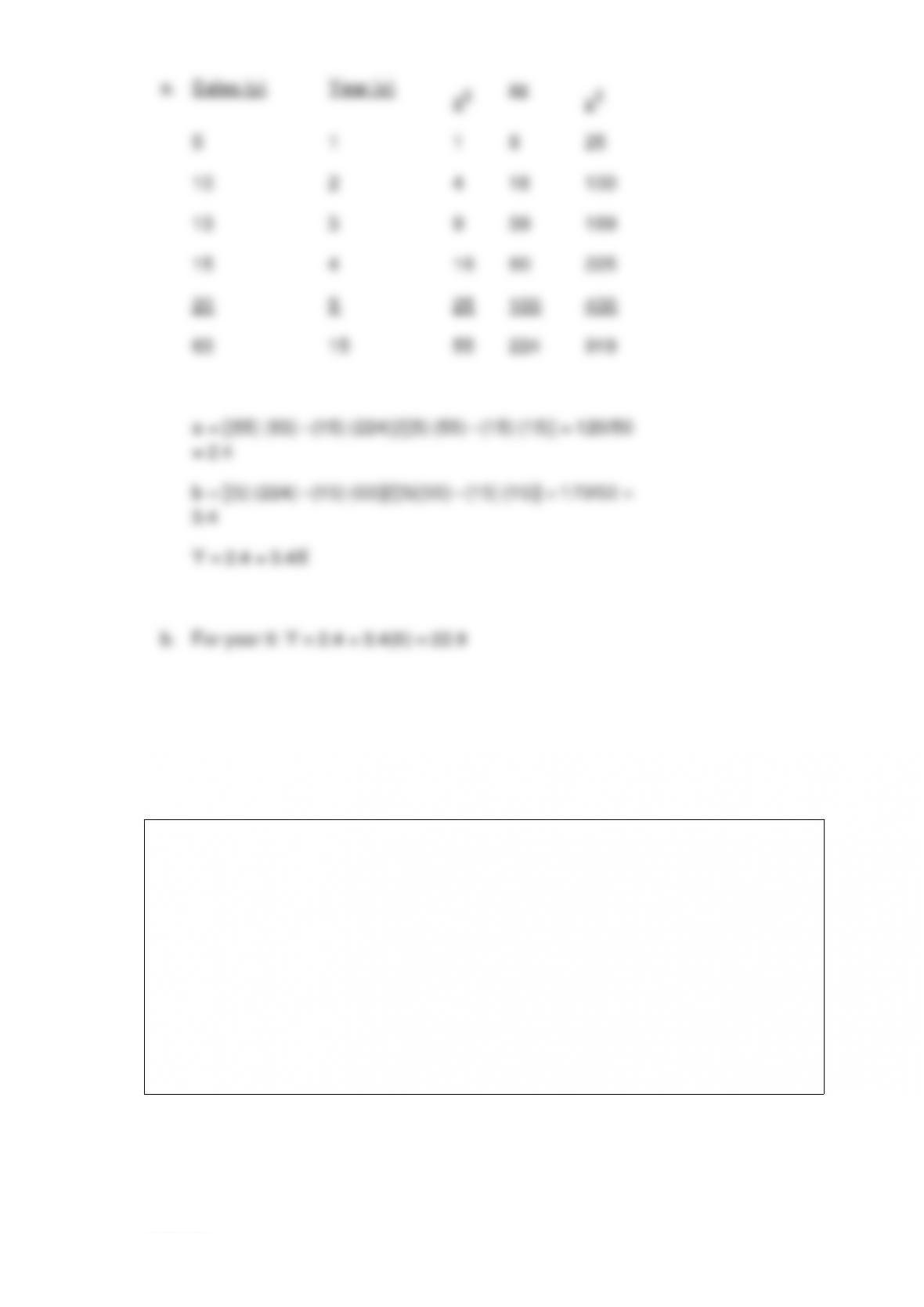
A Taiwan electronics company exports personal computers (PCs) to the U.S. Their PC
sales (in thousands) over the past five years are given below.
Answer:
A doctor’s office charges no-show patients $30 if they do not cancel their appointment
24 hours ahead of the appointment because:
a. insurance will pay the no-show fee anyway.
b. the appointment time and associated revenue is perishable, and the doctor may lose
revenue.
c. the doctor’s office does a poor job of forecasting demand.
d. the no-show price of $30 can be added to medical fees for reimbursement.
Answer:
A major difference between mean square error (MSE) and mean absolute deviation
(MAD) is that MAD is influenced much more by large forecast errors than by small
errors.
Answer:
While cultural differences are important in managing operations in different countries,
they have little impact in designing the overall value chain.
Answer:
Discuss two advantages and three disadvantages of simulation models.
Answer:
What are the major activities in designing a goods-producing or service-providing
process?
Answer:
The volume of demand in product layout is low, while it is high in process layout.
Answer:
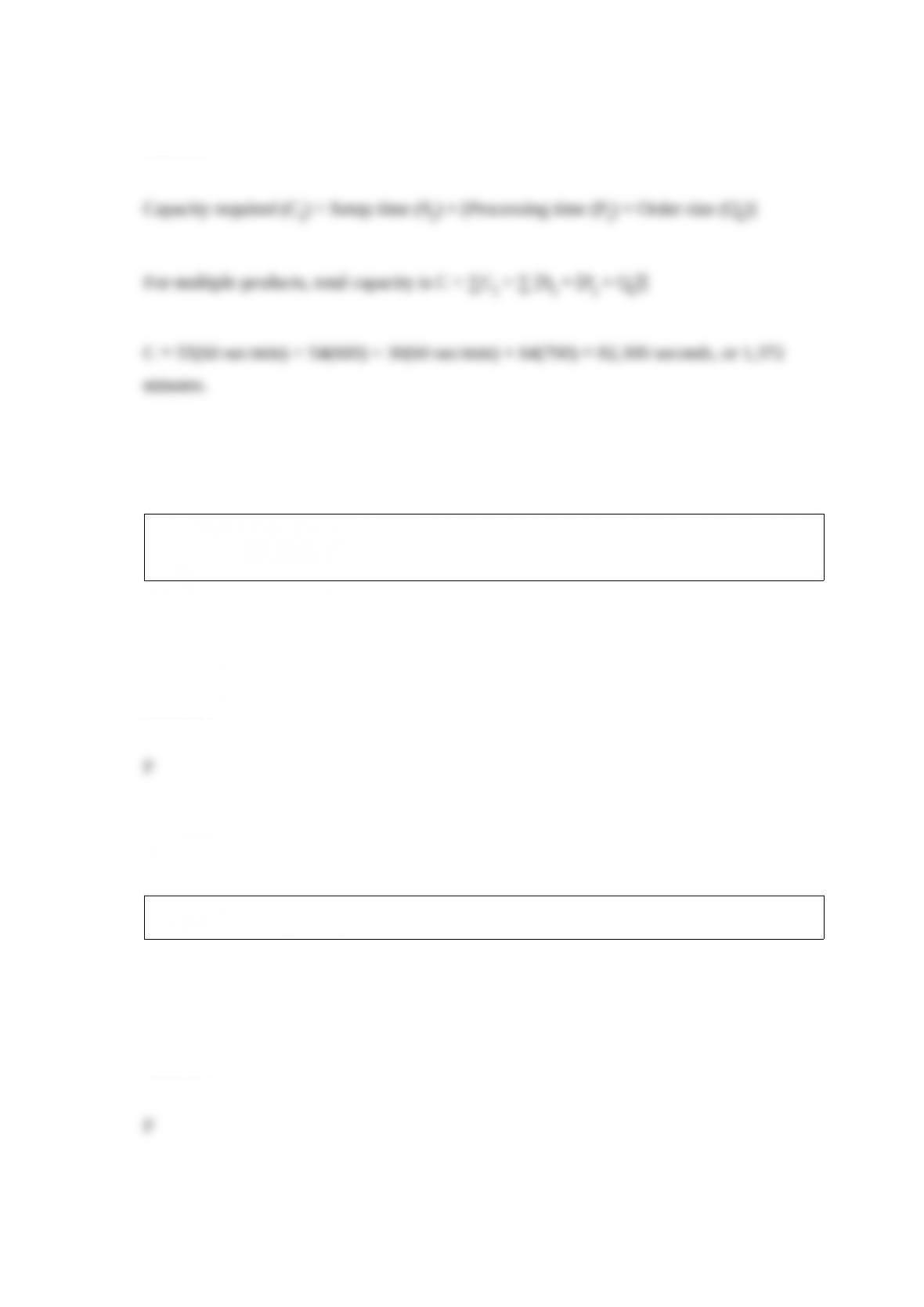
A machine in a job shop is used for only two parts, A and B. The time per setup (in
minutes), processing time (in seconds), and order size (in units) is given below. Using
the information, determine the total capacity required for this machine in minutes.
Answer:
An organization that outsources still retains ownership of an outsourced process or
function.
Answer:
Walmart uses a push supply chain.
Answer:
Reliability is the ability to perform a service dependably and accurately.
Answer:
A manufacturer of paint has two factories located in France and Spain and due to
economic conditions must close one of them. The factory productivity data is as
follows:
Answer:
Provide examples of business practices that support the three dimensions of
sustainability (environmental, social, and economic).
Answer:
A critical part has a manufacturing specification of 0.315 cm ± 010. If this measurement
is larger than 0.325 or smaller than 305, the product fails at a cost of $130. Determine
the Taguchi loss function.
Answer:
Differentiate between a flow-blocking delay and lack-of-work delay. How can each be
reduced?
Answer:
Service-positioning matrix is a model that describes the alignment of process choice
with the characteristics of the manufactured good.
Answer:
A process map and a value stream map are two terms for the same thing.
Answer:
Integrated operating systems (IOSs) include various hard and soft technologies.
Answer:
One approach to increasing value is to maintain perceived benefits while increasing
price or cost.
Answer: